

Desertcart purchases this item on your behalf and handles shipping, customs, and support to Seychelles.
⚡ Power your projects with precision and durability — don’t get left behind!
The Deegoo-FPV MG995 Metal Gear Digital Servo 4-Pack offers 13kg-cm torque at 6V with a full 180° rotation range. Featuring robust metal gears and ball bearings, these servos deliver high-speed, shock-resistant performance ideal for RC vehicles, robots, and mechanical arms. Trusted by over 1,100 users with a 4.5-star rating, this pack combines power, precision, and durability for professional-grade control.
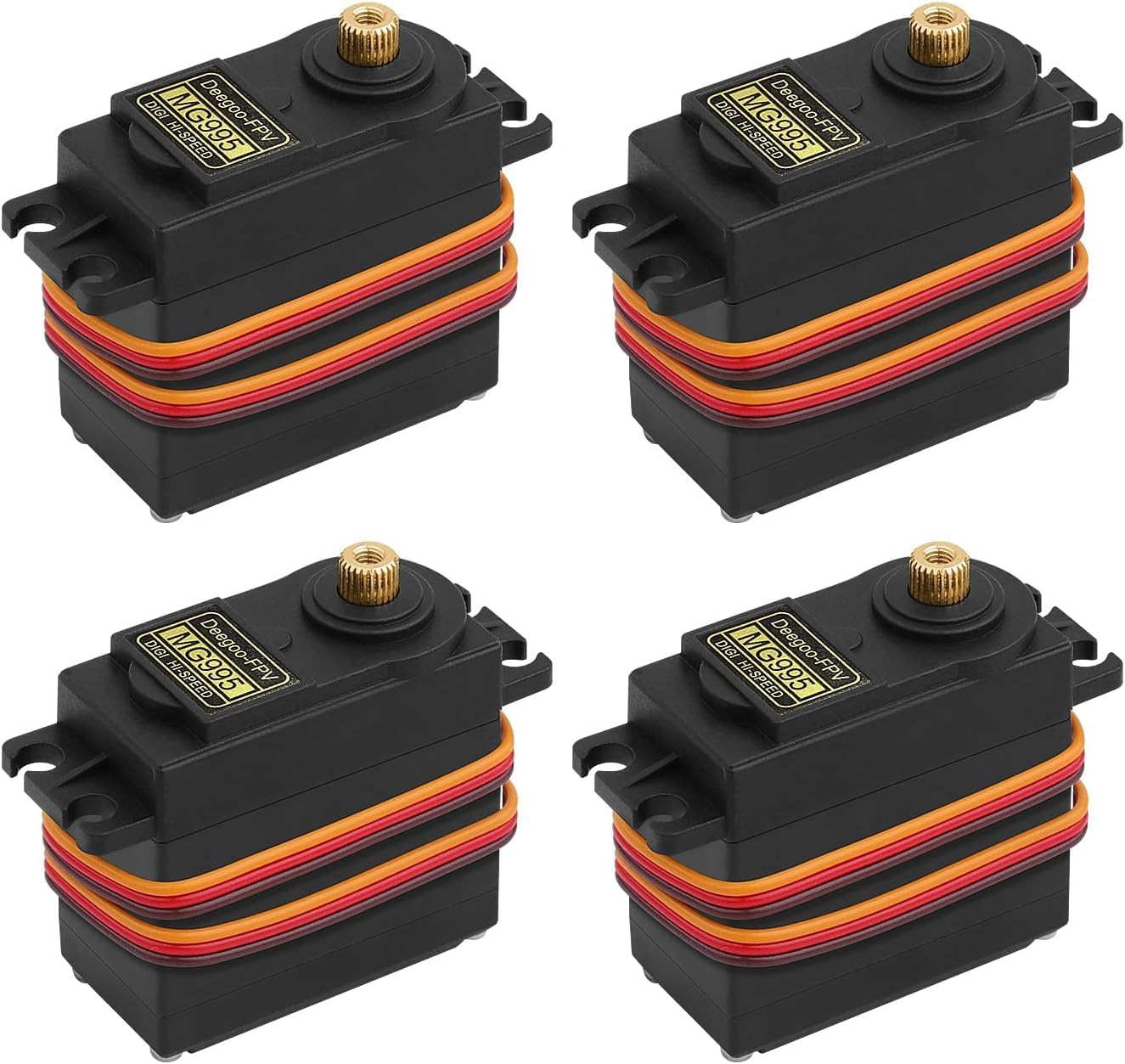


| Asin | B07NQJ1VZ2 |
| Best Sellers Rank | #28,678 in Toys & Games (See Top 100 in Toys & Games) #15 in RC Servos |
| Brand Name | Deegoo-FPV |
| Customer Reviews | 4.5 4.5 out of 5 stars (1,114) 4.5 out of 5 stars |
| Included Components | MG995 Servo |
| Item Dimensions W X H | 0.78"W x 1.69"H |
| Item Weight | 0.27 kg |
| Manufacturer | Deegoo-FPV |
| Material Type | Metal |
| Model | 4Pcs MG995 Metal Gear Servo |
| Model Name | MG995 |
| Number Of Items | 1 |
| Part Number | 4Pcs MG995 Metal Gear Servo |
| Voltage | 6 volts, 7.2 volts |
User
Did not disappoint me.
They were perfect for the project I was working on!
User
Works great for ground rovers
They worked great for my ground based rover, replaced a parallax servo that was burning out (my fault from overloading).
User
good value!
great for sailing rc boats
User
3 out of 4
Only 3 of the 4 work. Still a pretty decent deal for the price. Fortunately I only needed 3:)
User
Use a quality power supply
I got these servos to use for a small electronics project (completing a 100 jump challenge in Mario RPG, haha). It was a fun motivation to gain a little experience working with electronics hardware.My first attempt used a little 5 volt 2 amp power supply I had laying around, and wired directly to a Raspberry pi 3b. But it turned out this was not nearly good enough, as the servo would move erratically or not at all. I upgraded to a much stronger variable voltage desktop power supply and put a proper servo controller between the Pi and the servo, and then it worked great. There are wiring diagrams on adafruit and tips on reddit. The best way to learn is to try!
User
Rc part
Excelente producto
User
Perfect
Very good.will buy again.
User
Poor quality build ***UPDATED***
I never even powered the servos on. while installing the horn on them I noticed a lot of "wiggle" to the horn. This is usually caused by improper fitment of the horn it's self. I tested with the horns it came with as well several others. I got the screw tightened up as much as I could get it to go without stripping anything. and the wiggle did not change at all.Upon using a magnifying glass to look at the spline shaft and horn while I wiggled it I found that the horn was not moving on the shaft but instead the entire shaft is moving.I pulled the 4 screws on the bottom and lifted the lid off and as advertised all metal gears, not much in the way of lubrication inside the thing. I put my finger on the spline shaft and it is wiggling. I remove the spline shaft and gear and low and behold what do I find.. a nylon bearing/bushing on the bottom side of the gear. The bearing/bushing on the top of the shaft is metal and is pressed into the top of the servo.This is not a good thing. There should have been a pressed in metal bearing/bushing on the bottom as well. I pulled the metal bearing/bushing out of the top and slid it down the spline shaft and this thing has got a MASSIVE amount of play in it. No wonder the spline shaft moves about. I can move the metal bearing/bushing fo it sits crooked on the shaft my about 1.5mm. That 1.5mm of play translates into 6 mm of movement by time you get to the end of the horn. That's 1/4" of wobble in the horn.Now when the entire spline shaft is wiggling that much that means the meshing of the gear on the shaft is not going to be ideal and will cause failure extremely early in use. probably right after the return period has elapsed.I purchased 8 of these things and all but one has this kind of play in it. I will be returning all 8 of them.The meager use of grease inside this thing means planned failure. There is maybe 2 drops worth if it could be applied from an eye dropper.***UPDATE***OK so I did a little bit of a modification to them. In my specific use case I am using a round metal servo horn that has 4 threaded holes for attaching something to the servo. I found that using a small piece of 1" x 1" x 1/8" aluminum L channel stopped the wiggle. I drilled a hole in the L channel so I could put it over the top of the servo so that the "L" would go down the side of the servo. This keeps the aluminum from rotating when moving the servo. The hole has to be large enough so the servo horn could fit into it.Doing this actually solved 2 problems, the first was the lateral wiggle of the spline, the second was servo drift when no power is supplied. To solve the drift issue the hole drilled in the L channel needs to be a really snug fit with the servo horn. This provides enough friction so that when powered off it doesn't move easily.I also want to provide a useful tidbit of information for people using these with micro controllers. I had a need to know where the starting point is when powered on, if the servo is not in a position where you need it to be if you send it a signal to go to where you need it to be it's going to move there as fast as possible. That movement might be too fast, it was in my case.If you open up the bottom cover you will see the 3 leads soldered down to a circuit board inside. If you look at the board so the orientation of it is so that the leads exit the case away from you just above where they are attached right at the edge of the circuit board you will see 3 solder points. If you solder down to the middle one you can use the voltage reading to calculate where the servo's position is.I do not know if this voltage is going to be different depending on what the supplied voltage to the servo is. it might be so be careful and test before connecting it to a micro controller. In my use case I am powering the servo with 5 volts and I am using an ESP32 which has a maximum input voltage of 3.6 volts on the GPIO pins. The voltage I would be reading surpassed the 3.6 volts so I had to use 2 resistors to make a voltage divider to trim it down so it would be lower than the 3.6 volts.The voltage reading can be temper mental It is best to take 20 samples with 0.5 millisecond delay between each sample, drop the 5 highest and the 5 lowest readings and average the remaining 10.I have not looked at deviation due to temperature yet. I will be doing that at some point.
User
Excellent motor at the price
Motor rotates as expected from 0 to 180 degrees. Power efficient, it even works with 5V supply from Arduino, but for long term would be better to use separate supply.
User
ONLY 1 METAL GEAR
After only a few minutes of use, I noticed that the servo would completely stop spinning, even when I could hear the motor running. After opening up the housing I noticed that the one of the gears was completly stripped, but also that only 1 of the 3 gears was actually metal. Tldr, dont buy these servos if you need any semblance of quality
User
MG 955 metal gear servo’s
Great replacement for plastic gear servo’s
User
Plastic gears, only 1 gear metal rest all plastic
Wrong description, plastic gears and not working, all four which I received
User
Bo bon po chere
Bo bon po chere
Trustpilot
2 months ago
3 weeks ago