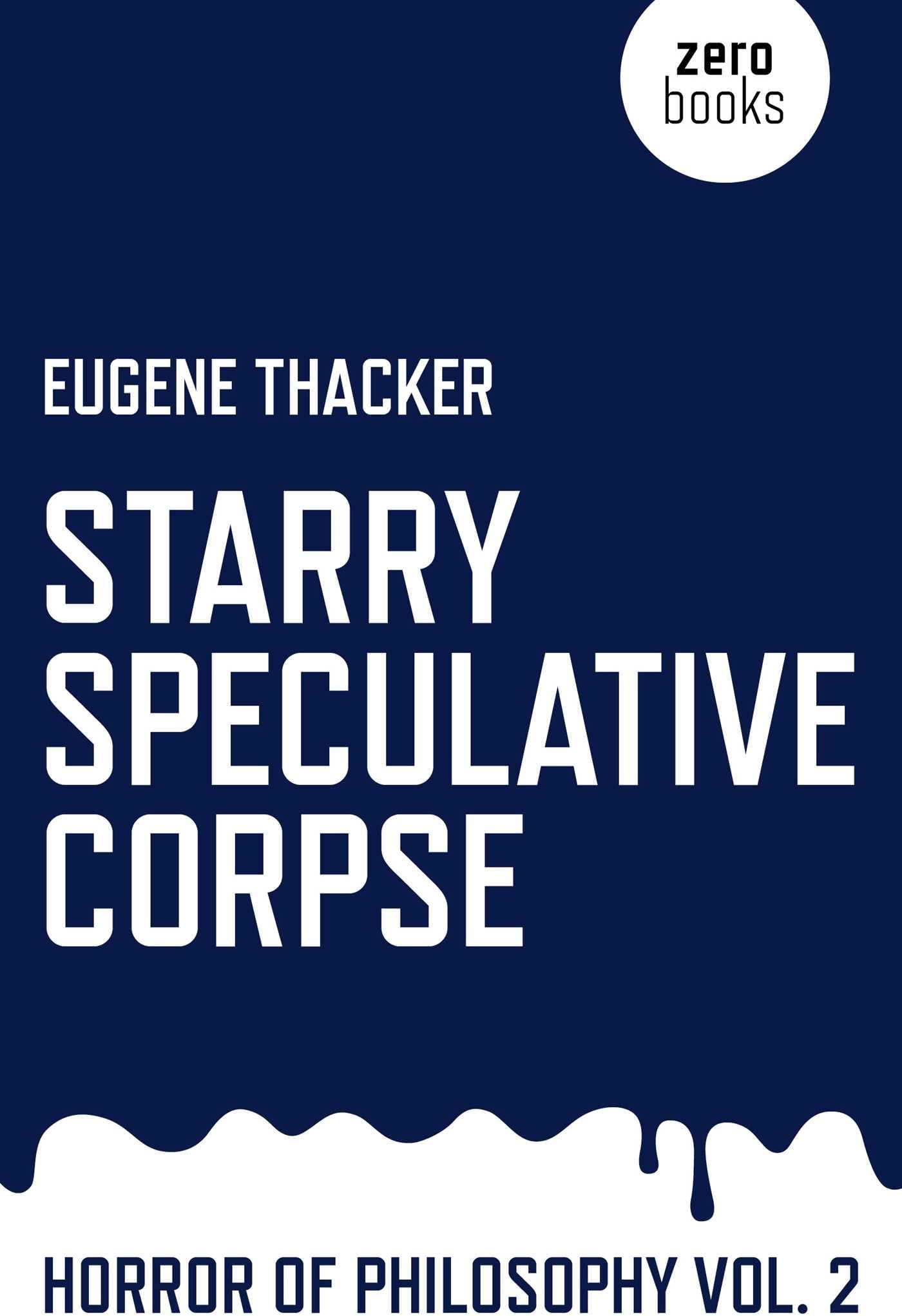

Starry Speculative Corpse: Horror of Philosophy (Vol 2) [Thacker, Eugene] on desertcart.com. *FREE* shipping on qualifying offers. Starry Speculative Corpse: Horror of Philosophy (Vol 2) Review: The Darker Side of Philosophy - A study in nihilism and pessimism that is supremely interesting. If you like deep introspective study and want to know more about the darker side of philosophy as it relates to literature, the books in this series are perfect for you. Review: "Dust of this Planet" was great, this is better! - Thacker continues to elaborate on his mystic nihilism. This second book of the trilogy leans less on the horror genre metaphor. I find it more focused and clear than the first book.


| Best Sellers Rank | #1,298,504 in Books ( See Top 100 in Books ) #396 in Gothic & Romantic Literary Criticism (Books) #554 in Philosophy Criticism (Books) #2,862 in Philosophy Movements (Books) |
| Book 2 of 3 | Horror of Philosophy |
| Customer Reviews | 4.6 4.6 out of 5 stars (124) |
| Dimensions | 5.57 x 0.6 x 8.48 inches |
| ISBN-10 | 1782798919 |
| ISBN-13 | 978-1782798910 |
| Item Weight | 2.31 pounds |
| Language | English |
| Print length | 201 pages |
| Publication date | April 24, 2015 |
| Publisher | Zer0 Books |
B**N
The Darker Side of Philosophy
A study in nihilism and pessimism that is supremely interesting. If you like deep introspective study and want to know more about the darker side of philosophy as it relates to literature, the books in this series are perfect for you.
V**R
"Dust of this Planet" was great, this is better!
Thacker continues to elaborate on his mystic nihilism. This second book of the trilogy leans less on the horror genre metaphor. I find it more focused and clear than the first book.
A**R
Slower reading than the first, but understandable
A really interesting look at philosophers such as Nietzsche, Kant, and Schopenhauer. This book focuses much more on philosophy itself than the first volume of the trilogy, "In the Dust of Planet". As a result it's a bit slower reading, but even if you don't have much background in philosophy at all it is still approachable.
S**L
yes!
fun and intelligent
S**R
A Guide to the Darkness
Moving away from the cultural and aesthetic themes that detailed the first volume of his ‘Horror of Philosophy’ series, Starry Speculative Corpse finds Eugene Thacker casting his dark and idiosyncratic gaze over the realm of philosophy proper. No longer witches, demons and back metal occupy the pages here, but instead arcane treatises on Being and becoming, existence and nothingness, negation and nihilism. Those who enjoyed Thacker’s free flowing and engaging style need not worry however - in his hands, even the most mystifying of texts offer themselves up to his easy explication, serving as touchstones that propel the book into the deep, dark abysses of thought that Thacker so plainly enjoys. Divided up into three central chapters - on darkness, nothingness and negation, respectively - Thacker’s ‘heretical’ project is to ‘read works of philosophy as works of horror’, finding in the cracks and crevices of philosophy the resources by which to think the impossible thought of a world-without-us, a thought of abnegation that undoes itself in its very thinking. Spanning the gap from the first century darkness mysticism of Dionysius the Areopagite to the modern day speculative nihilism of Ray Brassier, Thacker treats philosophy not on its own terms, but in a light that aims to expose the futility that dwells at its heart. A futility that for Thacker, far from making philosophy a discipline to dismiss, instead makes it all the more interesting. Indeed, what Thacker finds in philosophy are the resources for a new kind of mysticism, one hinted at in his first volume but only properly pursued here: an a-theological mysticism that aims at the limit of the human, or rather what he terms the ‘un-human’ - that towards which we can only grasp at but never behold. In pursuit of this mysticism, it’s to negative theology that Thacker turns, the doctrine according to which God, transcending any human power of description or discernment, can only be spoken of in terms of what He is not. Reconfiguring the 'negative logic' at work this tradition, Thacker discards the God and instead displaces the 'unthinkable thought' from the realm of divinity to the World-Without-Us. Starry Speculative Corpse abounds with just such guerilla-style interventions into philosophy, with Thacker sweeping in, pulling out just what he needs, and leaving the remaining philosophical carrion to the birds. Thacker’s reflections on the 'Kyoto school' of Japanese philosophy are a similar case in point. Combining aspects of Buddhist philosophy with the phenomenological writings of Martin Heidegger, the school's adherents expounded a philosophical approach that proceeded not from ‘Being’ - as the tendency of most classical Western philosophy - but from ‘Nothingness’ or rather, 'sunyata’ (‘emptiness’). I’ll leave it to the prospective reader to follow the twists and turns of logic that follow from such a philosophical starting point, but suffice to say that like his treatment of the theologians, Thacker wrings out some equally compelling conclusions from a similarly neglected strain of philosophy. Throw all this in together with a set of mediations on Schopenhauer and pessimism, and Starry Speculative Corpse certainly delivers on the promise of its name. Like the previous volume, I wouldn’t look to this book for a set of tightly argued theses or lines of sustained argument, but if you’re keen to have your thoughts taken down paths little-traveled by virtue of their darkness, Thacker is a guide you’d want by your side.
A**A
Not as engaging as the first volume but still very ...
Not as engaging as the first volume but still very interesting if you're into philosophy and the pop-culture elements of darkness and horror.
F**N
Waste of time
I shelled out the dough, mistakenly. Pure masturbation, with not the slightest poetry. Waste your time with it, if you like. A writer with nothing to say writing about nothing.
C**N
The second volume of Thacker's Horror of Philosophy is not as good as the first, In The Dust of This Planet. The primary reason seems to be because the book doesn't know what it is. It's not rigorous enough to be metaphysics, it's not enough fun to be literature, and there doesn't appear to be any central argument that Thacker's making. Calling this "a brief history of meontology and pessimism" might've made a more coherent project. As it is we get bits and pieces of interestingly dark philosophy. (As an aside, I have to say that I strongly disagree with Thacker's reading of the post-Kantians, in particular the way he lumps them all together. If his readings of philosophers I don't know are as shallow, then this work has serious problems)
I**E
OlvÃdate de este libro si buscas un libro de texto o un catálogo de pensamiento filosófico del terror. No, este no es un libro de mera consulta. No, Eugene Thacker no pretendÃa escribir un macutazo. Este libro es un paseo por distintos autores que han tratado el horror en la filosofÃa. El mundo-sin-nosotros, el terror de lo inefable y desconocido, la solemnidad de la fÃsica allende las constricciones fÃsicas y psÃquicas del ser humano tienen cabida en esta obra amena y sin embargo concienzuda. En su seno contiene no sólo la filosofÃa tradicional, sino también expresiones artÃsticas y hechos de la cultura popular que, inopinadamente, cobran coherencia llevados de la mano de Thacker.
Trustpilot
1 month ago
1 month ago