
Desertcart purchases this item on your behalf and handles shipping, customs, and support to Seychelles.
Unlock the Mind's Eye! 🌈
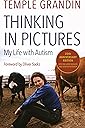
Thinking in Pictures, Expanded Edition offers a profound glimpse into the life of Temple Grandin, an autistic individual who has transformed her experiences into a powerful narrative. This illustrated paperback not only shares her journey but also serves as an essential resource for understanding autism through a unique lens.

| Best Sellers Rank | #23,744 in Books ( See Top 100 in Books ) #15 in Disability Biographies #16 in Children & Adolescent's Autism Spectrum #516 in Memoirs (Books) |
| Customer Reviews | 4.6 out of 5 stars 1,848 Reviews |
J**D
Autobiography About Autism and Animals
Temple Grandin grew up with Asperger's Syndrome before it was understood by anyone but a handful of researchers. She has turned her insights and special interest in animal science into a successful career designing livestock handling systems. She claims that the image-based thinking of the autism spectrum is similar to the language-free thought processes of animals. This insight leads to interesting conclusions about communication. The book weaves together accounts of Grandin's life and the development of knowledge about autism. Its eleven chapters are organized by autism topics and cover visual thinking, diagnosis, sensory problems, emotion, developing talents, treatments, relationships, connecting with animals, animal thinking, autism and genius, and religion. Temple Grandin provides a clear, readable account of scientific findings supplemented by experiences from her life. This expanded version includes updated information about autism spectrum causes, diagnosis, and treatment that have become available since the book was originally published in 1996. The author is candid about her life's hard-won lessons. She also shares the things which bring her the greatest satisfaction and what these insights may mean for others. A sample: - Her innovative design of a "squeeze machine" to restrain cattle is based on how calming she found gentle pressure as a child. - Temple visualized large transitions in her life as stepping through a doorway--and often found an actual doorway to step through and reduce the stress of change. - One way to get a feel for visual, associational thinking is to play with the Google search engine for images. - Autistic fixations are not always a problem; some people are able to channel them into successful careers. - Early in her career, Temple often made business contacts on the phone so she didn't have to interpret and respond to complex social signals. She believes that phone and internet contact can be useful in more gradual development of social skills. Grandin's blend of research reporting and personal reflection works well. Her book covers the basics of autism, grounded in the author's life. It is both a contrast and a complement to another excellent book, Tony Attwood's The Complete Guide to Asperger's Syndrome , which offers a drier and more exhaustive presentation of the same subject. Both are highly recommended for anyone on the autism spectrum or who wants both breadth and depth in their understanding of it.
A**D
That I did not have to wait long for it, because my foot is in pain!
I saw the author on TED Talk in one of my classes for the University and I work with children that have autsim and it so happen since I started that classes, I found out also that my granson was misdiagnoes and he has autism. I was so pleased by her wisdom and input concerning education in the school concerning this. And what she has accomplished. I gave it to me I brought one and gave it to my Superintendent of the county. I bought one for my great-grandson. I spread it to the young lady who works at a store, I just shared it with a director who works with children who have Autism. I let everyone that I need to share it with too! And they are so happy to hear about her book. If I had the money! I would buy a lot and give it away! But I just when you a medical issue that I have to spend money for that. But I am doing my part by telling those I come in contact with about the author's book. Because there are parents, some teachers, and children who feel they have nothing to offer! I never believed that she is living proof! As far as some teachers yes they loved the children, but during the years, I sometimes saw, that some felt that is far as they going go! And I never believed that!
A**R
I think in pictures, too.
This is a very interesting book, an eye opener for me. As I was reading it, I reflected back on my own life, and realized that I am very much like Temple. I am an older woman as well. In my time, instead of being labeled as autistic, I was labeled gifted. In first grade though I did not know how to talk and relate with others and my parents were asked to move me to a school for mute children. At home I talked though and my mother tried to help me learn to relate to others. It took a while, as I related far more to plants and animals than people and still do. Also, I am always the first to notice things which can be good if it's danger. On a test in high school that measured ability to visualize for spacial relations, I scored 99.99% for all women and above 98% of all men. Verbal processing was always a chore, however, and social cues were and continue to be learned by hard experience and in some cases remain a mystery in many cases. A class that teaches social norms would be good for kids now since they are not obvious to us picture thinkers. Thank goodness Temple's mother and my own mother found ways to help us flourish. We all have special gifts and weaknesses. The key is to realize your strengths and find work in that direction, plus find ways to help your weaknesses. I would also recommend another of her books, "The Austistic Brain". At the end, it discussed strengths and what types of jobs might be good for each. This is similar to my high school career test. I would definitely recommend this book. Temple's observations helped cattle be processed more humanely. I admit I was a bit squeamish about that part but hearing that she cared about them and found ways to make their time in processing better softened this topic.
S**Y
Temple Grandin
In his introduction, Oliver Sacks calls this a“fascinating book because it provides a bridge between our world and hers, and allows us a glimpse into a quite other sort of mind”. That “quite other sort of mind” is that of an unusual child who grew up to be the first autistic woman in the world to earn a Phd. She is a Doctor of Animal Science. The connection between her autism and her bond with animals led her to invent equipment designed for the humane killing of livestock. It is used in more than one third of all cattle slaughters in the US today. Dr. Grandin is a staunch advocate of autism research as well as animal rights. Her amazing story demonstrates how a disability can become an advantage and honed into a brilliant career advancing the welfare of animals and humans alike.
R**M
Insightful and inspiring
I have read the original version as well as the updated, expanded version (multiple times) and have not only found the insight into autism fascinating and educational, but I came to appreciate the strength of will Temple Grandin has displayed throughout her life. This applies not only in her journey as an individual on the autistic spectrum, but also as a woman doing work that at one time was considered to be suitable only for men. She truly broke through the glass ceiling, moved steadily ahead in her field, and made a national as well as international name for herself as an animal advocate and role model. I admire the "voice" of this amazing woman as she describes her way of thinking and reasoning, opening a world of experience that those of us without her condition can learn from, admire, and appreciate. She freely embraces her "differentness", but with a wistfulness that is touching when she likens herself to Data, the android of Star Trek fame, who so longed to experience "humanness". I also enjoy the writing of the neurologist Oliver Sacks, who writes the forward to this updated and expanded version of her book, and who spent much time with her over the years, even including her in his book An Anthropologist on Mars--the title, in fact, came from a statement she made. This book made me think.....and I love books that stretch my mind. I liked being reminded that because a person doesn't think in the same manner that I do, I can't feel that they are deficient or that my thinking is somehow "better". Temple's story emphasizes that each person is unique and that with effort, what some would consider weaknesses can be turned into strengths.
J**E
A must-have if you're dealing with the autism of a loved one...
This book was recommended to me by a friend (Mom of an autistic child) when I asked her for a book that would explain clearly what autism really is, but without the "How-I-cured-my-son-from-autism drama" so often found in books on that subject... My son is autistic and that book really made it all easier to accept and understand. Sure, not every autistic person is gonna be as successful and fullfiled as Temple grandin, (just as not every autistic child is an Einstein in the making !) but seing where Temple started (she was pretty severely handicaped by her autism) and where she is now (leading a life even "normal people" could envy) gives you hope that everything is possible if you work for it and believe in yourself (and in your child)! Temple Grandin writes things just as she feels them. No "novel-lingo", just plain facts, feelings and thoughts. Her approach of the cattle world and animal intelligence is amazing, and the source of info about autism (from the insider point of view) is priceless, especially because she goes right to the point. Having her input about relationships, religion and faith is really interesting, as is the whole chapter about Einstein... All together this book is easy to read and understand, entertaining and inspiring... So if someone asked me "what is the first book to read on the subject ?" I would recommend this one too... I think it is a must-have if someone around you is autistic or PDD, it can help family members too (like grandparents) understand your child better...
J**V
A remarkable achievement
I am making a special point of writing this while I am still reading it because I am concerned that it will be too easily dismissed by potential readers. I almost did not buy Thnking In Pictures because of what I now see is an unfortunate choice of cover art. I now understand that the cover is to sell the HBO movie starring Claire Danes, more than it is to convey anything about the book's content. That aside, this is a serious work by a serious and gifted scientist and thinker, who happens to be autistic. For anyone who is interested in autism both objectively as well as from a first person perspective, this is more than an introduction, but a penetrating work. This is a book by someone who is different from most both for her cognitive challenges, but also for her intelligence. It is an account of the author's constant efforts at integrating the various aspects of her entire experience-- personal, social, and professional. What comes across here is a remarkable whole as Dr.Grandin describes her mental efforts to control her perceptions and responses, how she tries to understand and use them, and also how her perceptions and her efforts bring her into closer proximity to others, both animals and humans. This is more philosophy and cognitive psychology than it is a memoir. And, for that, a picture of a smiling actress, however talented, cannot convey the full importance. The Meaning of Life: A Child's Book of Existential Psychology
C**Y
This book has already changed my life
You know when you read something and you become agitated because somebody says something to which you can relate strongly and you neither ever had defined or quite understood about yourself before? The kind of agitation where you say to yourself, "Yes!" so often you have to write notes in the margins (or in the kindle version draw highlights and add many annotations)? The kind of book that is so personally emotional and enlightening but agitation-inducing that you decide you can't read it before bedtime? That was this book, for me. Social behavior and language have always been fascinating to me, but always from a technical and somewhat foreign perspective. In my mind I see entire systems, cause-and-effect flows, concepts, theories; yet the "pictures" can be dang right nearly impossible to put into coherent words, at times. I "get" animals and frankly relate to many of them faster and more easily than to other humans. That my dog was my best friend was more of an understatement than I'd even conceived until she died, such had been our bond and ability to communicate. Meanwhile, I still struggle to interact with other people, to understand boundaries and the elaborate customs and assumptions taken for granted by neurotypical individuals. I'd been waffling over whether I should pursue therapy and an Asperger diagnosis, whether it was accurate or I was being a hypochondriac, until I read THIS book. I have no doubt anymore. I know now that I am not a failed intellectual, merely an obstinate genius unwilling to conform. That's what people told me all my life and although it didn't feel accurate, I internalized the derision. I know, now, that I'm not as screwed up as I thought. And with the research I have continued, I can now see how various traits considered components on the autism scale run in my family, sometimes residing only a couple or few in an individual, sometimes so many of these traits that the person is socially incapacitated. I feel I'm on the road to liberation. Would that I were not in my forties, already, when discovering these things. I highly recommend this book to anybody that knows someone that appears to be socially inept or seems to fail to live up to their intellectual potential, and especially to anybody that feels they are that person.
P**G
Excelente
la autora narra en primera persona el mundo de un autista. Es muy interesante conocer su visión de lo que la rodea, sus limitaciones y potencialidades. Y por sobre todo, su gran valor humano. Un libro para recomendar.
A**K
Fascinating read
Temple Grandin is a high-functioning autistic (i.e., she has Asperger Syndrome). This book is her explanation of what it's like to live as an autistic, and how that life has given her insights into other autistics, "normal" people and other animals. The book is part biography, part therapy, but mostly a scientific voyage of thought and discovery. If it weren't for Temple's deep grounding in science, this would almost be a philosophical book. Temple covers a wide range of topics, ranging from the symptoms, development, causes, and treatment of autism, to the experiences of autistics, to the lessons that autism provides us about human thought in general. The essence of Temple's experience is that she thinks in pictures. Not words, or emotions. It's like her brain is a vast collection of youtube clips or google images that she can search and access without necessarily accessing their emotional or verbal content. Temple had a very difficult time coming to grasp with this different way of thinking in that it made if very challenging to fit in with the people around her who didn't think in those ways. In particular, Temple highlights how the sensory experience of autistics is quite different. This literally means that they perceive the world differently, making any interactions inherently challenging. Where this has helped Temple is in understanding animal behavior, as she has gone on to design numerous livestock handling and processing facilities that maximize efficiency while minimizing animal suffering. This book even discusses Temple's moral and religious beliefs regarding the universe, herself, as well as the fate of the millions of animals that go through the facilities she has designed. Overall, it's a fascinating book that will not only appeal to anyone connected to autism, but to anyone who wants a view at how the human mind works, and how it can work differently. With respect to the expanding edition, Temple has updates at the end of each chapter that are primarily devoted to new research on a particular topic (e.g., dating & autism, or pharmacological treatments for autism). Compared to the recent HBO special on Temple, this book is less of a biography (although there's lots of personal anecdotes) and far more of a thoughtful, scientific look at autism. One should note that Temple's Ph.D. is not in autism, but her keen mind and deep personal experiences supply tons of fascinating ideas, anecdotes, and recommendations. A great read- particularly for someone who's strength isn't writing!
C**K
Ein wundervoller Einblicke in das Leben von Temple Grandin und (mögliche) autistische Erfahrungen
Ein wundervolles Buch, das tiefe Einblicke in das Leben von Temple Grandin bietet und wie sie die Wahrnehmung von Autismus geprägt und verändert hat. Daneben außerdem ein ermutigendes Zeugnis, wie die Besonderheiten von Autist*innen auch Stärken sein können, wenn sie im richtigen Kontext zum Einsatz kommen.
E**M
Excellent and Thought-provoking!
I admire Temple Grandin's way of thinking - visual thinking, which draws my attention. Although she had a speech delay in her childhood, she can turn every word she heard into pictures, where I believe she can make the gist of the framework. Then she usually turns it into the whole picture. Dr. Grandin does it every day, which has made her an avid thinker and has reinforced her imagination skill. It seems so effective to me because I think she organizes many pictures in her brain to get her message across. Therefore, she understands animals quite well, because autistic people, esp. non-verbal ones and animals basically rely on visions instead of using words. She couldn't become what she is now if she were an NT person, I'd say. I wasn't quite sure if I talked about some scenes of Dr. Grandin's seminar on my review of The Way I See It, but I didn't expect she would make such articulate presentations. Many people with Asperger's/autism are likely to be so nervous in public; I must admit that's a stereotypical idea because she has made a lot of effort to socialize by meeting her mentor, her science teacher at high school. And that motivated her to study animal science and now she teaches that at Colorado State Univ. Also she has made a bunch of presentations on Asperger's/autism. After all this book made me think twice about developmental impairments - Even challenged people can have opportunities to succeed in life. They might be able to make the best use of their potentials NT people have never thought of!
S**A
Insight into autistic behaviours!
I really enjoyed this book by Temple Grandin and was amazed at the amount of insight she has into her own condition. This has obviously been an ongoing learning curve for her. Her courage and perseverance in an often alien and disturbing world is truly inspirational. More than that, the book excited me, as it gave me insight into my own adult son's autistic behaviours, and how the world appears to him. It explained so much that I hadn't really understood before and enabled me to modify my own expectations or way of thinking about how he reacts to certain things. I had already seen a movie about Grandin's life. This book went into a lot more depth about autism and was well worth the read.
Trustpilot
2 months ago
3 days ago