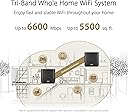
🚀 Elevate your home network to pro-level speed and security — don’t get left buffering!
The ASUS ZenWiFi AX6600 Tri-Band Mesh WiFi 6 System delivers ultra-fast 6600Mbps speeds and expansive coverage up to 2750 sq.ft, ideal for 4+ rooms. Featuring next-gen WiFi 6 tech with OFDMA and MU-MIMO, it supports multiple devices simultaneously with stable connections. Easy 3-step setup via the ASUS Router app, lifetime Trend Micro security, and AiMesh compatibility make it a flexible, secure, and future-proof solution for smart homes and busy professionals.


| ASIN | B088JYB8V4 |
| Antenna Location | Business, Home |
| Antenna Type | Internal |
| Best Sellers Rank | #10,976 in Computers & Accessories ( See Top 100 in Computers & Accessories ) #190 in Whole Home & Mesh Wi-Fi Systems |
| Brand | ASUS |
| Built-In Media | Power adapter, Quick start guide, RJ-45 cable, Warranty card, ZenWiFi AX 1PK Charcoal |
| Color | Black |
| Compatible Devices | Gaming Console, Personal Computer, Smart Television, Smartphone, Tablet |
| Connectivity Protocol | wi-fi |
| Connectivity Range | 2750 square_feet |
| Connectivity Technology | Ethernet, USB, Wi-Fi |
| Control Method | App, Touch |
| Controller Type | vera |
| Coverage | 5500 square feet |
| Customer Reviews | 4.3 out of 5 stars 543 Reviews |
| Data Transfer Rate | 6600 megabits_per_second |
| Frequency | 5 GHz |
| Frequency Band Class | Tri-Band |
| Item Dimensions L x W x H | 6.3"L x 2.95"W x 6.36"H |
| Item Type Name | ASUS ZenWiFi AX Tri-band Mesh WiFi 6 router (XT8 Charcoal), 6.6Gbps, WiFi, 3 SSIDs, life-time free network security and parental controls, 2.5G port |
| Item Weight | 1.6 pounds |
| LAN Port Bandwidth | 2.5 Gigabit |
| Manufacturer | ASUS |
| Maximum Upstream Data Transfer Rate | 3300 megabits_per_second |
| Mfr Part Number | ZenWiFi AX 1PK Charcoal |
| Model Name | ZenWiFi AX 1PK Charcoal |
| Model Number | ZenWiFi AX 1PK Charcoal |
| Number of Antennas | 6 |
| Number of Items | 1 |
| Number of Packs | 1 |
| Number of Ports | 4 |
| Operating System | Apple iOS, Linux, Mac OS, Microsoft Windows |
| Other Special Features of the Product | Alexa Compatible, Internet Security |
| RAM Memory Installed | 512 MB |
| Router Network Type | Tri-band |
| Security Protocol | WPA2-Enterprise, WPA2-PSK, WPS |
| Special Feature | Alexa Compatible, Internet Security |
| UPC | 192876470510 |
| Unit Count | 1 Count |
| Voltage | 110 volts_of_alternating_current |
| Warranty Description | 3 years warranty ARR |
| Wi-Fi Generation | Wi-Fi 6 |
| Wireless Communication Standard | 802.11ax |
| Wireless Compability | 802.11ax |
S**Y
Not Perfect, but As Close As It Gets.
Got this to replace a 5 year old d-link wifi5 (wireless ac) triband 3600 router with an awful Netgear extender (never found a single Netgear networking item that works after 20+ years of giving them chances, so even if you don't go with Asus, do NOT go with Netgear. They truly make some of the worst wireless solutions out there). The D-link router was great (and on its own had a noticeably better range than one of these), but I needed a better whole-house solution, so I went with this. Overall, I am happy with it. It provides solid speeds throughout the areas it covers, remains stable without requiring frequent reboots (the Netgear extender required reboots every few days, so this is a huge plus), has a really nice interface in the android app to easily control everything you would need to control, and supports a very robust smart home network (I have 40+ devices connected, so the older wireless ac router + extender would start dropping devices over 20 or so then crash and require reboots, another huge plus to this upgrade). The only things I have to complain about are two things that are specifically advertised as perks of a mesh network, and this device in particular, that don't really come through, even with latest firmware updates: 1. Devices in a mesh network are supposed to seamlessly move from node to node. I always hated having to manually switch my phone from the router to the extender and back as I moved through the house. Unfortunately, that has not changed. This network does NOT move my phone from one node to another automatically. I get "no internet" errors (even though it shows a strong wifi connection tray icon, yet the app shows an awful signal strength but still doesn't switch to a closer node), and have to disable and re-enable wifi on the phone to get it to switch nodes (the asus app has a reconnect option, but this just causes it to reconnect to the same crappy signal node). My phone is a fully wifi6 compatible galaxy s10+, so I am inclined to think it is the network, and not the phone, but I cannot say for sure without other test devices. 2. The advertised coverage of 5000 sq feet for 2 units is laugable. Its a lie. I know companies use wordage like "up to" or "under ideal conditions" but it is still a flat out lie unless maybe you are using this outside in an open field, and not inside of your home. I had to get 3 units to cover 4300 sq feet and still have a spot at the edge of the house where I lose signal. I live in the woods with no neighbors or interference whatsoever in a regular modern wood construction home, so I should be getting close to maximum advertised coverage, but it doesn't even come close. I do have 3 floors, so maybe that's it. I needed one unit per floor centrally located to cover almost the whole house and a little bit of the yard outside. The bright side is that you can add however many nodes you need to expand your coverage, but I just don't like such horribly overexaggerated numbers to get you to buy the product then sink more money into expanding it. It is, however, excellent for anything that is within range, and worth the cost of expansion, so that is what you will likely find yourself doing instead of returning it if your coverage is underwhelming. I just get irked by inaccurate or misleading advertising is all, and I know many others do as well, which is why I am making a note of it here. So in the end, I DO fully recommend this system, as it performs extremely well in most ways, and honestly the competition probably has even more small issues (its just the nature of ALL wireless tech). I get my full 300 mbps internet speed, and far higher internal network speeds that are often only limited by the speeds of my hard drives (well, except the m2 nvme, but I do have 2 of the nodes and 2 media/file storing/sharing PCs hardwired to allow full speeds to the wireless devices accessing them). It is excellent for a smart home full of echo devices (or your ecosystem of choice), smart switches, smart outlets, multiple phones, desktops, laptops, smart bulbs, etc. Again, 40+ devices without a hiccup and never having to reboot with full speeds everywhere is about as good as it gets with wireless tech even if there are those couple of small gripes above. Also worth noting is that all of my Asus products have lasted forever in the sense that I only ever have to retire them for new tech. I have never had a single asus product fail in 20+ years of building computers and playing with tech (which is more than I can say about some other companies - looking at you Netgear, Seagate, Western Digital, Epson, Lexmark, HTC, and Optima) so that is also a huge selling point for me as a loyal Asus customer year after year. December 2023 UPDATE - This mesh system is still going strong. I am now up to 120 devices on the network without a hitch and my newer upgraded Verizon gigabit internet that has been solid (Verizon plugs right into this from the box in the basement without a need for one of their routers for internet-only service). I still have issues with my phone properly jumping from node to node causing me to miss WiFi calls sometimes, but other than that, it remains excellent. I have only had to reboot the main router twice in the past 2 years to restore functionality to a couple of dropped devices that couldn't re-negotiate a connection to the network. This is by far the single most stable wireless network I have ever experienced since WiFi began oh so many years ago and I highly recommend it to anyone looking for a headache-free wireless networking solution.
E**E
Great Product Extremely Happy…Cumbersome To Install But Worth it!
This is a great product, but cumbersome to instal if you are installing more than four. My story: 1. I was upgrading from a 7 node Apple AirPort Extreme system. (The AirPorts were “Shampoo Simple” to install, lather, rinse, repeat) 2. I was paying for 1G but only getting 250 Mb at the base node (wireless sustained) 3. Based on the coverage of the ASUS nodes it sounded like I could away with two nodes, but likely needed three. Numerous YouTube reviews supported that conclusion. 4. Still skeptical, I ordered two of the two packs. 5. I installed two and nope, not enough coverage. The installation of the two pack was easy peasy. 6. I installed the other two pack, it was too was “shampoo simple” to install 7. The coverage from the four node network was better but I still had blind spots at the extremes of the house. 8. I ordered another two pack thinking I’d likely need only one of them. This is where the nightmare started. 9. The third two pack would not add itself to the network no matter what I tried. I searched the web, read Reddit, visited Asus’s website, Facebook, PCMag, YouTube….ugh! Attempt one, two, three, lost count. To heck with this I’m sending it all back. (Things I read and viewed said the node limit was 5, then 7, and finally 9. IIRC Asus’s website said 7.) 10. I’d already tried making a system using the two culprits as a small network just so I could update their firmware. They still wouldn’t allow themselves to be added to the 4 node. 11. I finally decided to try the nuclear option, I made the culprits the main/lead and then added the other 4 nodes to it and it worked. I’m getting 400 to 560 wireless at each node! Saw an instantaneous reading of 770 once and 600ish several times. No “shadow” areas anymore. The network tools ASUS supplies is top notch. The tools in the app is all most will want to tackle, but the web tools will give you god like control over aspects of your system you didn’t know existed. In short, it’s worth it. I’m still going through the optimization protocols and can report it’s getting better and better with each iteration. Extremely stable. The tools allow me to keep my IP honest. I have a FingBox, but I no longer need it, given the tools Asus provides. In my experience, if you are trying to determine how many you need: A. Determine where you plan to place a node and simply make 15 paces in each direction, that’s the edge of your coverage. B. Try to overlap the edges by at least 10%. C. Walls and floor levels diminish coverage. (Even doors. I saw different readings with the door opened versus closed. That’s why overlap is important.) D. Think of the WiFi signal as you would sound. If you were playing music in a room some distance away. Can you hear it? Can you hear the beat? Can you make out the lyrics? Is it just inaudible noise?
T**D
For Me, Best Router Ever
I wanted to replace my old Linksys ( WRT1900AC ) with a faster ( AX ) router. So I bought the Linksys MR9600 and it performed so poorly ( hard to set up and very weak signals ) that I gave up on Linksys. Then bought the Asus XT8. Couldn't be happier. Easy to install the router and set up using the web browser interface. And it gave stronger signals housewide than any of my previous routers. Also very easy to add additional AiMesh routers as nodes. But. I had bought the combo XT8, with three routers. What to do? Turned out I didn't need the AiMesh system for improved signal strength, but I discovered a feature that I absolutely love. Namely, you can set up a Aimesh system with multiple routers and then use either wireless or wired connections for computers at the router and/or at any node. In this way I was able to have a wireless network with some of my computers connected via ethernet cable in various rooms without the nodes being connected with cables. The throughput is FAST. And when hard-wired with the proper CAT6 or better cable, it is faster than my computer's AC network adapter. Please note that this system has three channels, 1 at 2.4 GHz and 2 at 5 GHz. You can set up separate networks or a smart network ( or both, using guest networks ( with or without passwords )). But when you use AiMesh to connect the router to nodes, it uses the second 5 GHz channel for backhauling. If you are using a "smart" network and log on from a wireless computer, the "system" will determine the channel and ( if using AiMesh ) the node. With separate networks you can force a given connection to either 2.4 o5 5 GHz. You can also block internet access by device. For example I have several NAS drives connected to the router that I don't want to have internet access. Lots of other features I have not explored. Five stars. Even with several couple of quirks ( minor flaws ). First is that while you can add a USB drive to any router or node, the firmware will only allow you to configure and dismount a USB drive connected to the router, not one connected to a node. If the drive is connected to a node, you have to power off the node before safely removing the USB drive. The USB drive works fine connected to a node, with these limitations. I can live with that. Second, the router sometimes forgets the names of computers connected to the network. Doesn't have any operational impact. Just keep track of the IP addresses and enter the name of the computer yourself, or wait until the "mystery" device is powered on again or the system reboots ? Or don't worry about it. Bottom line is ... I like it so much I am going to buy a fourth XT8 as a third node to place upstairs for my daughter when she visits. Not for the improved signal strength ( which is significant ), but so she can plug in her computer and get faster data transfers.
K**L
Easy set up, but Printer Config Issue with MACs
The Mesh System works Great for hardline or wifi internet access in my home. It was easy to set up. The GUI router interface gives me a lot if control over how I want interact with my internet service including internet security. The only problem that I am having with it is that I am a MAC product user, and I have an older printer which is in perfect condition that will only interact with the wifi with a WPA 2 configuration versus WPA 3 (a higher security config). There is a feature where I can activate that is suppose to use either configuration, but doesn’t seem to work with my printer. So, I decided to hardline my printer to one of my nodes which requires to activate the USB 3.0 on the back of the node, but it seems that ASUS doesn’t have drivers to support MAC computers to activate that feature. Hence, the USB 3.0 is useless to MAC users without any drivers to activate it. So, be aware that if you have a MAC and you have a printer that can only use WPA2…be prepared to dumb down your wifi security to accommodate. And… for hooking up your printer to the network via hardline…that doesn’t work. Otherwise, if you only have one computer, hardline the printer straight to your computer. That’ll be the work around for one computer.
I**M
Asus should be the Market Leader in Mesh WiFi Systems.
Pros: - Works seamlessly with existing Asus routers supporting AiMesh - Excellent performance and coverage with WiFi 6 technology - Tri-band functionality for enhanced network capacity - Simple setup and integration with Asus's AiMesh system Cons: - None mentioned Summary: The ASUS ZenWiFi AX6600 Tri-Band Mesh WiFi 6 System proves to be a high-performing solution, offering excellent performance and coverage with WiFi 6 technology. Its compatibility with most normal Asus routers that support AiMesh allows for easy integration and expansion of the mesh network. One of the standout advantages of this mesh WiFi system is its seamless compatibility with existing Asus routers supporting AiMesh. This feature enables users to expand their network by adding the ZenWiFi AX6600 system, creating a unified and robust mesh network. The compatibility with a wide range of Asus routers adds flexibility and convenience for users who already own Asus networking equipment. The WiFi 6 technology utilized in this system ensures high-speed and efficient connectivity, delivering enhanced performance for modern devices that support WiFi 6. The tri-band functionality further enhances network capacity and reduces congestion, allowing for smooth and reliable internet connectivity throughout the coverage area. Setting up and integrating the ZenWiFi AX6600 system is made easy thanks to Asus's AiMesh system. The user-friendly interface and intuitive setup process simplify the configuration and ensure a hassle-free experience during installation. In summary, the ASUS ZenWiFi AX6600 Tri-Band Mesh WiFi 6 System offers excellent performance and coverage. Its compatibility with existing Asus routers supporting AiMesh allows for seamless integration and expansion of the mesh network. With WiFi 6 technology and tri-band functionality, this system delivers fast and reliable internet connectivity. Overall, it is a recommended choice for users seeking a high-performing mesh WiFi solution. TL;DR: The ASUS ZenWiFi AX6600 Tri-Band Mesh WiFi 6 System provides excellent performance and coverage with WiFi 6 technology. It seamlessly integrates with existing Asus routers supporting AiMesh, allowing for easy expansion of the mesh network. With its tri-band functionality and user-friendly setup through Asus's AiMesh system, this WiFi system delivers fast and reliable connectivity. It is a recommended choice for those in need of a high-performing mesh WiFi solution.
T**S
Buggy, unreliable and prone to failure - Apple users steer clear!
I've used a number of ASUS networking products over the years and have generally had good experiences, but these XT8s have a been a miserable disappointment. I initially bought 3 access points to cover our new home (5500 sqft, 3 floors) and was disappointed to discover I need a 4th to get good coverage, but OK. Very quickly, I started running into issues. Apple devices in particular were a *nightmare* - I spent weeks going down rabbit holes trying to get them working well (mind you, I had been using all these devices on a plume mesh network for years without issue). Several firmware updates, arcane setting changes and factory resets later, i finally got everything stably connected, but flakiness continued. Devices randomly dropping connection despite good signal strength, streaming movies becoming pixelated or pausing to buffer because the throughput wasn't good (mind you, I have a 1GBps internet connection and repeated tests showed me I consistently had at least 700mbs up/down from the router to the internet. At that speed, you should be able to stream 20-30 4k movies *simultaneously*, and we never had more than 1 going). Then, less than 3 months after purchase, my primary router died (completely bricked, wouldn't even turn on). Well, joy of joys, there's no way to simply assign a new AP to be in control, so I had to factory reset all XT8s and reset up my network. I sent the AP back to ASUS and they were pretty good about taking care of it and sending a new one (though it took two weeks). After that, things were ok-ish. Still random movie buffering and occasional odd glitches, but infrequent enough that it was tolerable, though very disappointing given that I dropped $800 on all this hardware. Two months later, the AP in my office died. Just randomly stopped accepting wireless connections. Factory reset, and reattached to the network. Worked again for about 24 hours before doing the same thing. So I finally gave up and switched to Ubiquiti. Installation was a snap, and 1 router + 1 access point *bathe* my house in wifi. Everything works perfectly now, and the UI is just light years nicer than ASUS's. I'm never going back.
G**G
Finally, A Router System That Works
I have a large "L-shaped" ranch home and the "L" was added on, meaning that the wall separating the "L" from the rest of the home has aluminum-backed foil insulation in it. That serves to block the WiFi signal from that area of the house and that's where our family room is with our main TV. The cable internet service enters the house at the opposite end in my basement office. We've been plagued by drop outs and buffering in our WiFi signal, even though the speed was acceptable. After looking at the options and deciding that a mesh system would be the best solution, I settled on the ASUS XT8 mesh system as offering the best solution for my needs. I also felt that two units wouldn't suffice. I wanted to place the main unit in the basement office, with a node in the center of the original house on the main floor and a second node in the family room. At this time, these are terribly difficult to find in stock. I was able to get one unit from Amazon and a pair finally because available direct from ASUS. The installation was a breeze using the ASUS app on my iPhone. Does it work? It's amazing. I have Spectrum 100 Mb speed service. Using a VPN, I still get close to 100 Mb in the bedroom directly above the office. In the rest of the house my speed is around 60-70 Mb and the speed in the family room is over 30 Mb. This is at least three times faster than any system I've had in the past. Buffering hasn't totally disappeared, but it only happens rarely now (I think some of this may be the transmitting system, not my system). While I have ethernet cables available between these three units, I haven't connected them yet. Not sure how much they could improve this system. There was no reason to contact tech support as the system booted up quickly using the app.
J**K
Not a Magic Bullet, Great for Some Spaces/Not For Others
Not for older homes with lots of walls or heavy plaster construction. Bought the 3-node setup to replace my TP-Link router, since it looks like they might get banned in the US. Currently the single TP Link sits in my office at the back of the house. Built in San Francisco in 1930, the walls are 2" thick plaster and lath. However, the ZenWiFi had good reviews for coverage so I bought it. I started the setup in my office. Hint: set up your network FIRST, connect all the mesh nodes, and THEN do the firmware updates. I updated the main router first, and then had to reset it because the nodes weren't on the same firmware version. Once I had everything updated and the mesh established, I moved 1 node upstairs into my wife's office. As it was directly above my office (and the main router) the signal was "Great". I then plugged in the 2nd node out in my living room. I broke out a tape measure. It was 38' feet from the main router. However, the backhaul never got better than 71dbm signal strength. Not really acceptable. The nail in the coffin was when it started to created audio interference with my home theater system. I'm using price shielded audio cables and speaker wire. But couldn't get it to a position where it wasn't an issue. So, return initiated. Here's the twist: I have a friend who needs to replace the Orbi mesh system that died on her (after only 2 years, and only 90 day support from Netgear). She has a very open-plan flat in San Francisco, close to the same age as our house. I suggested since my system was already configured and updated, that before I return it I bring it by her place, we plug it in and try it out to see if it would work in her environment. So, we did. And because her place is much more open, it worked great. (I still returned mine, but she's ordering the same setup I had) So, while Mesh may be the answer depending on your living space and the constraints imposed by the construction, you might also be able to do something like a $100 Netgear Powerline Ethernet solution that uses your home's electrical wiring to send Ethernet to another room, and the receiver there can broadcast a WiFi signal to the basement/garage, etc. I'll keep my apparently super-powerful TP Link router for now. If and when the US bans it, I'll have to look for another solution.
B**.
Simple set up - very effective
Needed to expand my WiFi network across three floors in my house and into my backyard. I had two Zen Wifi Routers and added this additional one. Installation was very easy. The WiFi signal is quite good. And the Asus app is actually pretty good.
C**G
Nest setup to RT-AX88U
Works great in nest setup with my RT-AX88U. The bad connection in the far bedroom is resolved.
R**K
Muy caro - no lo recomiendo
Tengo un Asus 1200 y salió bastante bueno, después de revisar algunas reseñas y debido que necesitaba un nuevo router, me decidí a comprar este, las características son tan cuál se describen aquí, el problema es el alcance del router que indica hasta 2700 pies, una vez instalado es muy difícil que mantenga la conexión constante conectado a 5G en un segundo piso, por tanto la publicidad es falsa, de verdad no vale la pena, mejor buscar otras opciones, estoy pensando regresarlo. Actualización 3 meses después: falla mucho, los equipos vía WiFi como Sonos se desconectan constantemente, se cerró la events a de devolución, muy caro, los Routers de ASUS no son lo que eran antes, nada recomendado
F**N
Recommended.
Really reliable. Having had these products for a few years now, I would recommend connecting them with a good Ethernet cable, rather than using WiFi (it significantly improves the strength of the WiFi signal).
K**N
Stable work horse .. I have three of these at home... no more blind spot.
good solid router ..
Trustpilot
2 months ago
5 days ago