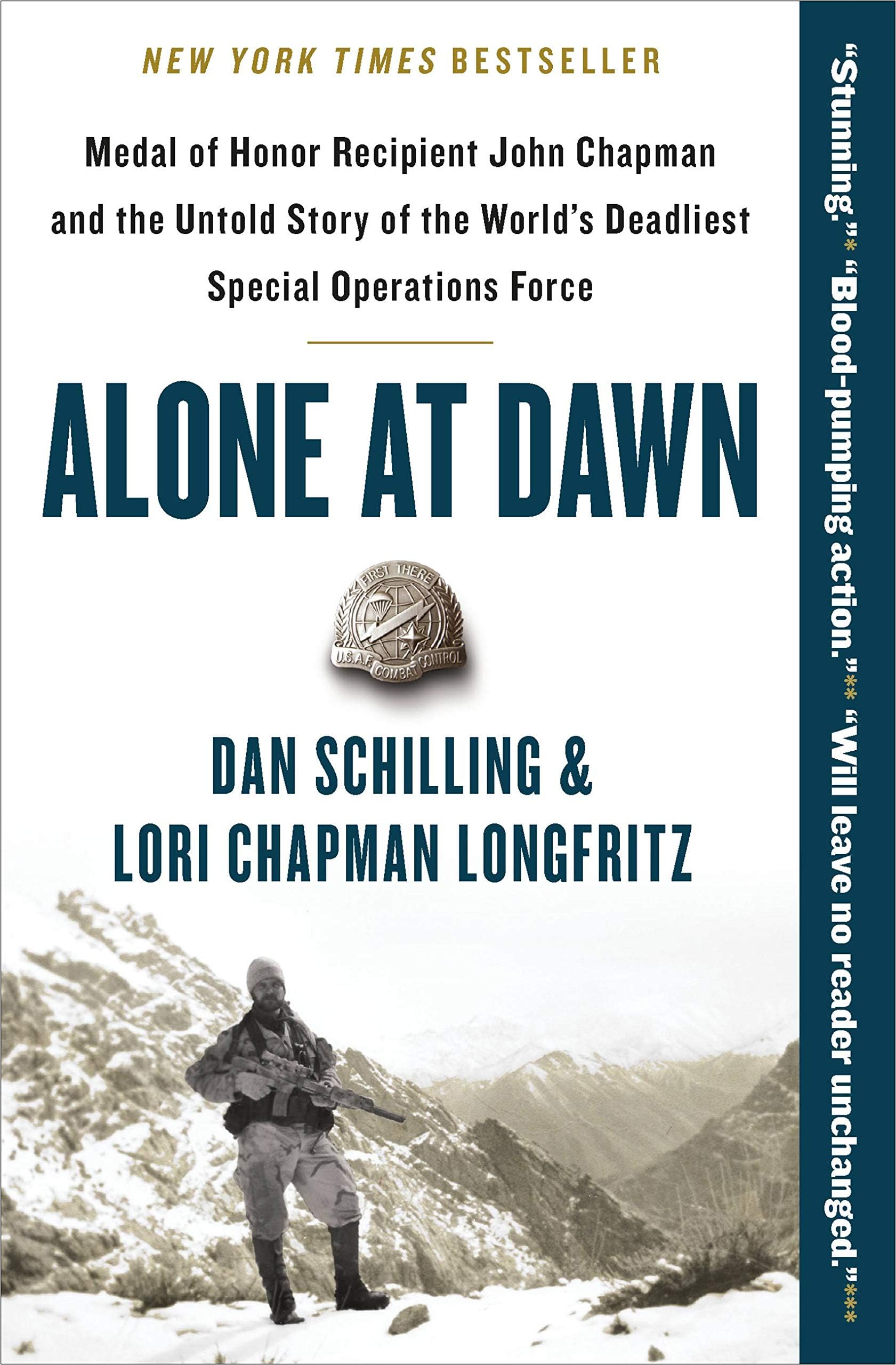
Alone at Dawn
Product ID: 211293697
Buy anything from 5,000+ international stores. One checkout price. No surprise fees. Join 2M+ shoppers on Desertcart.
Desertcart purchases this item on your behalf and handles shipping, customs, and support to Seychelles.
The New York Times bestselling true account of John Chapman, Medal of Honor recipient and Special Ops Combat Controller, and his heroic one-man stand during the Afghan War, as he sacrificed his life to save the lives of twenty-three comrades-in-arms. In the predawn hours of March 4, 2002, just below the 10,469-foot peak of a mountain in eastern Afghanistan, a fierce battle raged. Outnumbered by Al Qaeda fighters, Air Force Combat Controller John Chapman and a handful of Navy SEALs struggled to take the summit in a desperate bid to find a lost teammate. Chapman, leading the charge, was gravely wounded in the initial assault. Believing he was dead, his SEAL leader ordered a retreat. Chapman regained consciousness alone, with the enemy closing in on three sides. John Chapman's subsequent display of incredible valor -- first saving the lives of his SEAL teammates and then, knowing he was mortally wounded, single-handedly engaging two dozen hardened fighters to save the lives of an incoming rescue squad -- posthumously earned him the Medal of Honor. Chapman is the first airman in nearly fifty years to be given the distinction reserved for America's greatest heroes. Alone at Dawn is also a behind-the-scenes look at the Air Force Combat Controllers: the world's deadliest and most versatile special operations force, whose members must not only exceed the qualifications of Navy SEAL and Army Delta Force teams but also act with sharp decisiveness and deft precision -- even in the face of life-threatening danger. Drawing from firsthand accounts, classified documents, dramatic video footage, and extensive interviews with leaders and survivors of the operation, Alone at Dawn is the story of an extraordinary man's brave last stand and the brotherhood that forged him. Review: Eye opening account of events and soldiers we haven’t heard enough about - This was a very compelling read about some of the earliest events in the Afghan war. It traces the development of Air Force Combat Controllers over the decades, as well as the lives and upbringings of some of the key players in the events that lead up to a very bad day on Takur Ghar, a massive 10,000+ foot peak in the Afghan mountains. Overall there are a number of storylines to follow as well as much of the military jargon that necessarily finds its way into such a book. I’m terribly thankful to the authors for all their detailed and dedicated effort to “get this right”. They did. For those who simply wish to whine about the fact it was too complicated to follow I’d only add that you can read a book more than once, or for that matter you can take detailed notes as you read it (digitally or on paper). Short of that, perhaps try growing a brain. What some of the special ops forces have endured since 9/11 is simply beyond the pale. For someone to complain about the pain of actually having to “think” while reading about it is disheartening. It has been my painful experience to have to listen to the pain of so many friends who have had loved ones serving in these roles, for now these many years, and to understand the pain of what it has done to these wonderful warriors. John Chapman left a tremendous legacy of dedication and love and it really shined through at the end of the book. It was sad to learn of some of the military game playing that some of his supporters encountered (I’m sure that’s an understatement) in getting his valor recognized. Unfortunately military institutions from top to bottom have pretty much unfailingly produced some of the best and some of the worst in human behavior. Thins always go wrong in war. Some face up to it, some don’t. A theme does run through this book that is unfortunately not very favorable to some of the Navy Seals involved (and in fact team Six). But given the proclivity for this thing to happen in pretty much all wars, it rings true that some of the players made big mistakes and later tried to cover them up. In reading about military history, and especially US Military history I have found that as enough time passes certain valiant actors eventually get their due. But usually it’s only after significant classified information becomes de-classified. You will find much of that here with some seriously dedicated Air Force Sr. personnel. It reminds me of another GREAT example of the same behavior that was the experience of John Waldren from Torpedo Squadron 8 at the battle of Midway during WWII. He lost his life but his actions & those of his fellow aviators changed world history in mere minutes. Read Richard Mrazek’s wonderful tome on this episode for a gleaming example of military facts being covered up to protect the guilty. Sadly this wonderful story is tarnished by some of the same, but the authors have done their work and provided a compelling and worthwhile read. Personally I think the world of all of our incredibly brave US military people. They “write out a blank check” for an amount up to and including their lives, and sign on the line to serve. You will NOT be disappointed with this story about some very incredible US citizens going above and beyond the call of duty so that we can sleep at night. Special thanks to Dan Schilling & “Chappy’s” Sister Lori for putting in all this effort so that some truth can begin breath again for those who have fallen. Review: Excellent book - Well written. Explains the events at Takur Ghar without respect to anyone's hurt feelings. It shows the responsibility rests not with the seals on the ground, but to those Air Force and Navy commanders at HQ who were trying to promote their personal careers. It also reveals the humanity of the men on the teams.
| Best Sellers Rank | #21,396 in Books ( See Top 100 in Books ) #2 in Afghan War Biographies #2 in Afghan War Military History #3 in Intelligence & Espionage History |
| Customer Reviews | 4.7 out of 5 stars 5,387 Reviews |
J**M
Eye opening account of events and soldiers we haven’t heard enough about
This was a very compelling read about some of the earliest events in the Afghan war. It traces the development of Air Force Combat Controllers over the decades, as well as the lives and upbringings of some of the key players in the events that lead up to a very bad day on Takur Ghar, a massive 10,000+ foot peak in the Afghan mountains. Overall there are a number of storylines to follow as well as much of the military jargon that necessarily finds its way into such a book. I’m terribly thankful to the authors for all their detailed and dedicated effort to “get this right”. They did. For those who simply wish to whine about the fact it was too complicated to follow I’d only add that you can read a book more than once, or for that matter you can take detailed notes as you read it (digitally or on paper). Short of that, perhaps try growing a brain. What some of the special ops forces have endured since 9/11 is simply beyond the pale. For someone to complain about the pain of actually having to “think” while reading about it is disheartening. It has been my painful experience to have to listen to the pain of so many friends who have had loved ones serving in these roles, for now these many years, and to understand the pain of what it has done to these wonderful warriors. John Chapman left a tremendous legacy of dedication and love and it really shined through at the end of the book. It was sad to learn of some of the military game playing that some of his supporters encountered (I’m sure that’s an understatement) in getting his valor recognized. Unfortunately military institutions from top to bottom have pretty much unfailingly produced some of the best and some of the worst in human behavior. Thins always go wrong in war. Some face up to it, some don’t. A theme does run through this book that is unfortunately not very favorable to some of the Navy Seals involved (and in fact team Six). But given the proclivity for this thing to happen in pretty much all wars, it rings true that some of the players made big mistakes and later tried to cover them up. In reading about military history, and especially US Military history I have found that as enough time passes certain valiant actors eventually get their due. But usually it’s only after significant classified information becomes de-classified. You will find much of that here with some seriously dedicated Air Force Sr. personnel. It reminds me of another GREAT example of the same behavior that was the experience of John Waldren from Torpedo Squadron 8 at the battle of Midway during WWII. He lost his life but his actions & those of his fellow aviators changed world history in mere minutes. Read Richard Mrazek’s wonderful tome on this episode for a gleaming example of military facts being covered up to protect the guilty. Sadly this wonderful story is tarnished by some of the same, but the authors have done their work and provided a compelling and worthwhile read. Personally I think the world of all of our incredibly brave US military people. They “write out a blank check” for an amount up to and including their lives, and sign on the line to serve. You will NOT be disappointed with this story about some very incredible US citizens going above and beyond the call of duty so that we can sleep at night. Special thanks to Dan Schilling & “Chappy’s” Sister Lori for putting in all this effort so that some truth can begin breath again for those who have fallen.
P**E
Excellent book
Well written. Explains the events at Takur Ghar without respect to anyone's hurt feelings. It shows the responsibility rests not with the seals on the ground, but to those Air Force and Navy commanders at HQ who were trying to promote their personal careers. It also reveals the humanity of the men on the teams.
S**E
A STORY THAT HAD TO BE TOLD
Great book about the incredible heroism of Air Force Combat Controller, JOHN CHAPMAN. Brings to light the unique value and courage of Air Force Combat Controllers. As a former Marine, we looked down on the Air Force as an elitist branch of the military which never got their boots dirty. This book changed all of that. This is a story which had to be told about a man who was attached to a SEAL team to rescue a comrade on a maintain peak in Afghanistan. He charged and neutralized an enemy bunker which enabled the SEALs to retreat with their wounded. He was shot twice in the abdomen and left for dead. He managed to fend off attacks on his position while alone. Despite his wounds, he emerged from his bunker exposing himself to enemy fire and neutralized a number of Al Qaeda fighters in an attempt to save the crew of a rescue helicopter. Taking more rounds to the legs, CHAPMAN kept fighting until taking a fatal round to the chest. The book is highly critical of the SEALs for taking control of an operation without being fully prepared. The Navy contested CHAPMAN's Medal of Honor because they didn't want to admit that they left CHAPMAN for dead. This is why it took 15 years for the medal to be presented to CHAPMAN's widow.
B**M
Fascinating, sad and infuriating
Who knew that Air Force Combat Controllers are not only just as qualified to operate alongside the elite Army and Navy special operations units such as Delta Force and SEAL Team Six, but more technically trained and sophisticated in managing the battlefield under fire? This book is about the history of Air Force special operations, Operation Anaconda in Afghanistan, and a combat controller who died and ultimately won the Congressional Medal of Honor. It’s a compelling read as well as infuriating when one comes to learn that the hubris of SEAL Team Six ultimately caused the disaster on a mountain that became known as Robert’s Ridge.
A**S
Good book that describes a grim reality of modern military leadership failures
I highly recommend the book. Its a little bit of a tough read, especially if you've never served because of the terminology, the acronyms, the equipment used and described. Almost like a lot of short stories building to the point of THIS assault. So the descriptions are necessary and therefore the read is necessarily difficult at times. It takes 200 pages are the the telling of the job and experiences of other CCTs and the beginning of the war in Afghanistan. But in the process of telling the story, they expose why it is that the US can't seem to win wars, none of which have to do with the skill, training, dedication or equipment of the men and women filling the boots on the ground. The problem lies in the following: 1. The American people believe that we can fight a limited war with minimal enemy casualties. That we should fight a "moral war" where nothing bad ever happens. As a result, troops second, third and fourth guess themselves as Leavenworth is never far from their minds. If you've never served, don't say you support the troops. You don't. You'll throw them under the bus in an instant. 2. Politicians care more about what the American people think than whether or not service members come home or if wars are won or lost. To them, your children who choose to serve are nothing but cannon fodder. If it were not so, battlefield commanders would be given the autonomy to fight and not have to wait until they are in imminent danger to defend their own lives. While our enemies are prosecuting wars, OUR troops often have to wait until their lives are literally on the line to engage when they could neutralize the threat before it becomes imminent. No politician who endorses "rules of engagement" support the troops. 3. General officers far removed from combat consistently make poor decisions that cost American lives because they think they know better than the battlefield commanders seeing the action in real time. Imagine if Alexander the Great had tried to lead battles while sitting in his Lay-Z-Boy in Macedonia, guessing at what his generals in Persia were facing and disallowing his generals to adjust to battlefield dynamics. It would have been a slaughter. That's precisely what our troops face in every battle. The generals who made the decisions that got these men killed bypassed the man who had the intel on the battlefield precisely because they thought they knew better than the man who knew what was happening and who told them that they were wrong in their decision making. But they were generals, so their hubris cost many men their lives. When it was clear that they messed up, they tried their best to throw the lowest ranking enlisted man under the bus to cover their mistake. So...what happened to these general officers? George Bush promoted one to Lieutenant General, then to Ambassador and Chief of Counter Terrorism. Talk about promoting your incompetent. We hear the press talk about war crimes. The worst of the crimes is what the politicians (and most general officers are just that) hamstringing our soldiers, sailors, airmen and marines and making them tie an arm behind their back to fight an enemy who wants the whole of the USA destroyed. The men and women that they don't get killed, they turn the leftists and their hit squad of "reporters" on to assassinate their character. We either need to get into the business of war and embrace it, or get out of it entirely. Trying to take a delicate balance between the two is an untenable position. And our young men and women are paying the ultimate price for it.
D**S
An important story, well written
First, this is an important story that needed to be told. The motto for USSOCOM is "The Quiet Professionals." They work at the edge of foreign policy, where journalists don't venture, so what they do often goes unreported. And while it seems to me that so many books have been written lately, usually by SEALs, to turn the motto into a bit of irony, this story is different. Chapman is the first Combat Controller to receive the Medal of Honor. Yet most Americans have never heard Combat Control, Air Force Special Tactics or AFSOC. This book provides the means to highlight not only Chapman's heroic actions but also the history and work of a truly quiet community. Second, the book is well written. A great story poorly written is a story that goes unnoticed. Thankfully, I found this book to be incredibly well written and engaging. If you’re not familiar with the battle, it may help to read Not A Good Day to Die beforehand, but I thought this was an easy read. I was pulled into the story and I found it difficult to put down, which says a lot because we all know those books are really hard to find. I also thought it was smart how the author wove Chapman's story into the history of CCT because otherwise I believe the book would've come across as unfocused. Yes, as some of the more critical reviews have pointed out, the author tells us time and again how much heavier the CCTs ruck sacks are, which almost comes across as some kind of underlying insecurity of CCT vs SF and SEALs, however there’s no denying the outsized impact CCTs have on the battlefield. In all, the writing does the story justice. After reading it, I've purchased additional copies to give to friends and family. The only other book I've done that for was With The Old Breed. That alone should tell you how highly I regard this book.
D**I
They should make a movie of this story
Amazon's AI steered me to this (Based on your purchases these are some books your might like). I never heard of the Air Force CCT or the red beret people of the Spec Ops community. This was an education for me. All I knew about combat air support for ground operations was based on the Vietnam template - - that is FAC, pilots in light aircraft in the Vietnam era. CCT operators are enlisted Air Force air traffic controllers embedded with Special Operations unit. This book is helpful in bringing you up to speed on their training (can you swim underwater for 25 meters harassed by instructors?) and equipment load (training is much longer now and I hope advanced technology has reduced the combat load). You don't really get a sense of the battle that earned Chapman the MOH itself until the end of the book - about 200 plus pages later. The authors are not happy with the SEALS who were dropped off with Chapman at Roberts Ridge. Don't bash SEAL team 6 based on this book - - decisions that are second-guessed later are made in every battle since homo sapiens decided to fight each other. Anyway, I think Hollywood or Netflix should make a film about this story. It certainly is a better "feel good" story than "Lone Survivor." I gave it five stars because of how the Air Force went through the difficult process of upgrading Chapman's initial decoration to the MOH, thanks to the Air Force civilian Secretary (SECAF) at the time. As well as description of the funeral, MOH ceremony with Trump, and the later Air Force memorial. That, to me, is the real battle, i.e., how to pay full honor to our deserving military heroes.
T**E
awesome read
Great story and good read , good presentation of what a Combat Controller is and what he does. I didn’t know these people existed until I read this book . The bravery of Chappie is unbelievable, everyone will enjoy this book
G**S
Modern Day Hero Story
Finally the heroic accomplishments of solders fighting in Afghanistan is being published. This is a great book that goes into great detail to tell the factual story, using forensic pathology, eyewitness accounts from both sides of the battle, and various communications and imagery to piece together how this heroic FAC performed and rightfully earned the MOH, losing his life in so doing. It’s worth the read.
H**R
Drama, unglaublicher Mut und Sterben in den Bergen Afghanistans
Dieses Buch ist eine herausragende und unglaublich spannend zu lesende Rekonstruktion und Analyse der Rolle von Combat Controllern im Allgemeinen und der heroischen Rolle von John Chapman während eines Einsatzes im März 2002 auf dem Gipfel des Takur Ghar im Rahmen der Operation Anaconda. Das Buch basiert auf intensiver und umfangreicher Recherche und Analyse von zahllosen Originaldokumenten, Videoaufnahmen von Aufklärungsdrohnen sowie den Aussagen von Zeitzeugen und Kameraden und dadurch entsteht ein unglaublich realistisches und intensives Bild von den dramatischen Ereignissen in den Bergen Afghanistans. Der Autor erklärt im Laufe des Buches zunächst, welche Rollen Combat Controllern auf dem Schlachtfeld zukommen und zeigt dies anhand zeitgeschichlter Fallbeispiele wie Vietnam, Grenada, Panama oder dem Golfkrieg von 1991 auf. Anhand der Lebensgeschichte von John Chapman erfährt man zudem, wie umfangreich, intensiv und knüppelhart die Ausbildung dazu ist und das diese Soldaten zur absoluten Elite gehören und beim US-Militär auf einer Stufe mit Delta, SEALS und den Pararescue Jumpern stehen. Anhand von zwei konkreten Fallbeispielen zu Beginn des Afghanistan-Einsatzes (Einnahme von Kabul und Schlacht von Tora Bora) zeigt Dan Schillung auch, welch unglaubliches Zerstörungspotential ein einzelner Combat Controller für den Feind haben kann. Hauptgegenstand des Buches ist aber die Operation Anaconda im Shahi-Kot-Tal im Winter 2002. Die Rekonstruktion und Analyse umfasst dabei die Planung und Zielsetzung der Operation, die Infiltration der einzelnen Trupps von Spezialeinheiten sowie den Ablauf der Kampfhandlungen im gesamten Tal und natürlich auch die Ereignisse auf dem Gipfel des Takur Ghar. Ebenso wird thematsiert, was und wer aus amerikanischer Sicht für das Debakel am Tkaur Ghar und den Tod von 7 Elitesoldaten verantwortlich war und welche Schlüsselrolle John Chapman bei den dramatischen Kämpfen gespielt hat, für die ihm posthum die Medal of Honor verliehen wurde. Dieses Buch befasst sich zu keiner Zeit mit den politischen Fragen nach Zielsetzung und Sinn und Unsinn des Afghanistan-Einsatzes, sondern legt den Fokus rein auf die militärische Perspektive der Ereignisse und die spezielle Rolle, die den Combat Controllern darin zukam. Jeder, der sich dafür interessiert, wird in diesem Buch voll und ganz auf seine Kosten kommen und in der Tat ist es sehr spannend und auch faszinierend zu lesen, mit welchem Mut und Kameradschaft die Soldaten dort gekämpft haben. Von meiner Seite klare Empfehlung und 5 Sterne.
K**様
最近の戦争
最近の戦争がどんなかんじか知るきっかけになる。 海外レビューにも書かれていることなんだけど、軍事用の頭字語がめちゃくちゃ多いCCTとかHLZとかAFOとかいろいろあってわかりずらいのがよくない。
S**N
Just incredible!!
So we’ve probably all see the video footage on YouTube, but after reading this and then re-watching, it puts things into a completely different light. I knew these combat controllers existed, but I never in a million years realised the scope of what they do and what they have to attain to get there. As with all books of this nature, a good chunk of the start is building up, giving an insight into the roll of CCT and the people involved, but it’s worth it because when you get to the operation itself you have such an investment in the guys going into the thick of it. All of those guys were hero’s, but when you read about what John actually did, and try and understand what must have been going through his mind at the time, it is truly mind blowing. I can honestly say I have never had chills and a lump in my throat from reading a book before. Chapter 21 will leave you in utter disbelief and chalet 24 will have you welling up, guaranteed. You absolute have to read this book!!
G**A
Arrivato nei tempi previsti
Tutto ok
Trustpilot
5 days ago
2 weeks ago