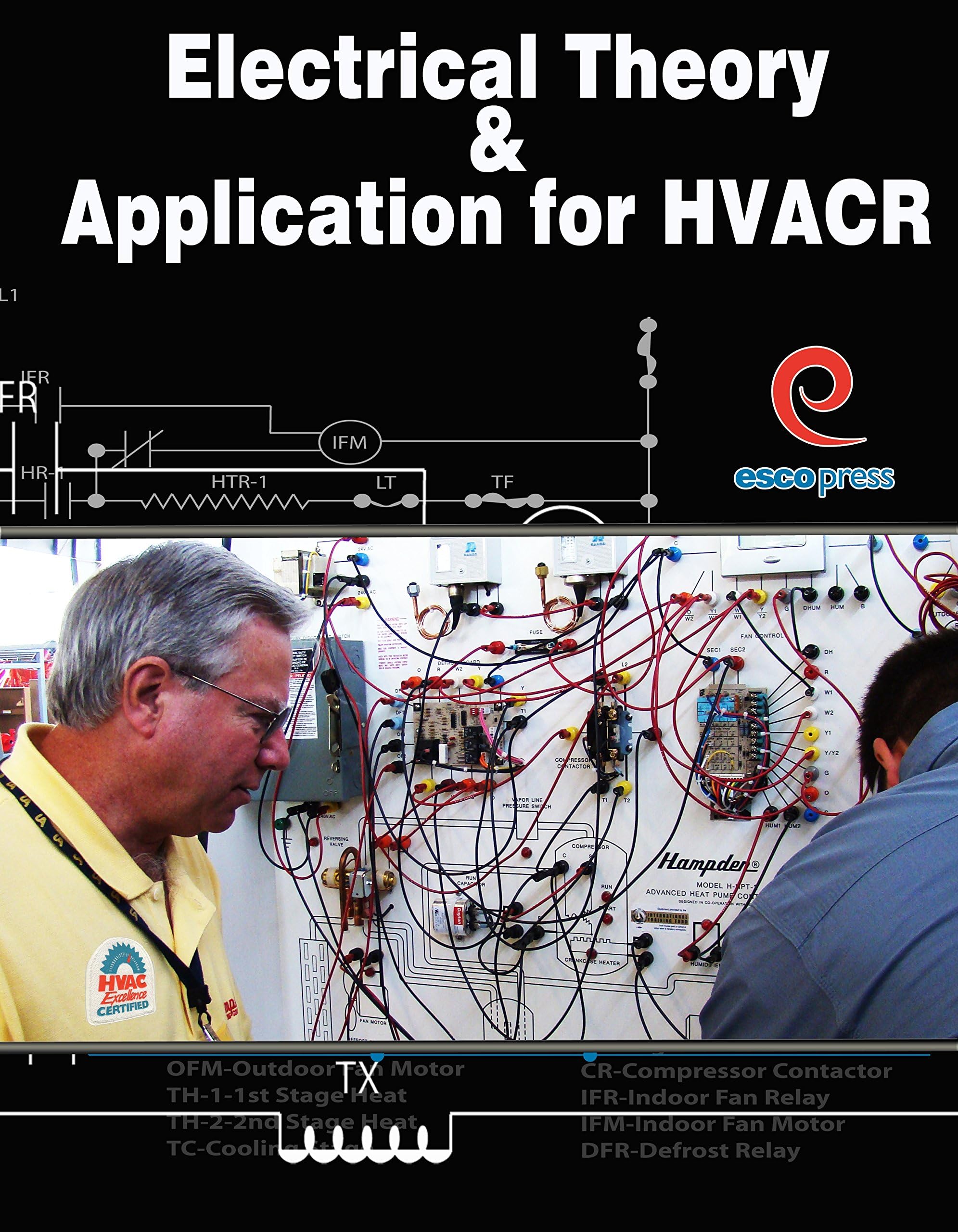
Electrical Theory & Application for HVACR
Desertcart purchases this item on your behalf and handles shipping, customs, and support to Seychelles.
Description
With the majority of HVACR service calls being electrical in nature, it is important for technicians to have a solid understanding of electrical fundamentals allowing them to develop a systematic and methodical procedure for troubleshooting. The Electrical Theory and Application for HVACR manual provides students and practicing technicians with the information and knowledge necessary to accurately diagnose and solve electrical system faults. This manual is full of color illustrations and includes student worksheets. The spiral binding will allow students to tear out worksheets for grading by the instructor. Main topics include: safety and hazard awareness, electrical fundamentals, circuits and components, motors, wiring diagrams, automated control systems, and troubleshooting. This manual replaces Troubleshooting and Servicing HVACR Electrical Systems. Review: A good reference book - A fun read Review: Great book - Great book and quality product submitted
Specifications
| Best Sellers Rank | #198,304 in Books ( See Top 100 in Books ) #304 in Electrical & Electronics (Books) |
| Customer Reviews | 4.4 out of 5 stars 159 Reviews |
Reviews
O**O
A good reference book
A fun read
J**S
Great book
Great book and quality product submitted
E**D
Quality
helpful book
M**L
and this book was mostly useful for filling in those gaps and weak spots to ...
We were required to buy this book for my class to study for HVAC Excellence's work ready certification exam. The publishers of that exam, ESCO, also put out this book. Having previously taken an electrical course at the same school, I had a general knowledge of electrical theory, ohm's law, some wiring, meter usage, and various components going in. Though the HVAC field uses different elements, and this book was mostly useful for filling in those gaps and weak spots to help me pass with an 89% three months into the program. Overpreparing isn't always a bad thing, so I also read external material for more understanding, such as Unit 17 on motors and Unit 20 on troubleshooting in "Refrigeration and Air Conditioning Technology" (7th edition); Chapter 6 on schematics in "Electricity for Refrigeration, Heating and Air Conditioning" (9th edition); and various chapters in "Electricity and Controls for HVAC-R" (6th edition). Though the majority of the HVAC Excellence exam questions were from this book. Compared to the Heat Pumps exam I also took and passed, the Electrical Theory exam had less tricky questions and answers. Though this book, at about 143 pages, had a share more to retain in comparison ("Heat Pumps: Operation, Installation, Service" also by ESCO Press had about 120 pages and only about half of that was actual reading material when you take away practice questions and lab sheets). "Electrical Theory and Application for HVACR" covers an introduction on safety and hazard awareness, definitions, along with 6 chapters (theory, circuits/components, motors, wiring diagrams, automated controls, and troubleshooting) with different subtexts within. Out of maybe 20 something odd classmates that went up at once to take the HVAC Excellence exam, only about 6 of us have passed. Ohm's Law, schematics and troubleshooting seemed to be weak areas, even after reading this book for others that didn't quite make it. Though, to be fair, the book does lay out how these function, and I found it takes practice for understanding to sink in rather than just reading straight through these chapters, or going for memorization only. Chapter 6 on troubleshooting had a very helpful approach in how to read voltage with your meter on a diagram (figuring out which side is L1 and which is L2 across your component to get a reading; or whether it's L1 and L1 you're reading, which will give you 0 despite there possibly being actual voltage there). The third chapter on motors, being one of the longer sections, is somewhat intimidating reading through it for the first time. I found it was organized with individual paragraphs and it wasn't overly complicated--that wasn't the issue--it was just a share to remember, especially if you've only had so much hands-on experience with them. I think a more helpful approach would be to focus a little more on the various differences and comparisons between motors and their components. Some more pictures or illustrations wouldn't hurt either. For instance, after reading this chapter and other material such as Unit 17 of "Refrigeration and Air Conditioning Technology" I started to notice some weren't all that much different from each other. They just had different functions or components shuffled around, such as one using a start capacitor for extra torque, and another that doesn't but is similar in function after starting. Some disconnecting the start winding after starting a certain way, while another might not. One relay using normally open contacts and current, while another has normally closed contacts and uses voltage. The patterns are there, it's just a matter of condensing them to a smaller scale. A share of my classmates had issues with Ohm's Law and series/parallel circuits from lack of practice. The book has some practice questions and lays out a simple approach to understanding them, though I noticed memorizing all 12 formulas of Ohm's Law might be an issue when it comes to being asked a random problem like, 'What is resistance if you only have volts and watts?' The book gives two helpful pie charts (P over I x E, along with E over I x R) for when using series and parallel circuits. Though there are 6 other formulas that are more challenging to remember, especially when you're under pressure and have a share of other material to keep in your head. The missing two I found through a Youtube video (P over I2 x R, and E2 over P x R). I memorized these 4 formulas without having to remember all twelve and was able to pass that section of the exam without trouble. The other step I think they could have included, especially if you don't have an electrical background, is a simpler way or chart to understand the different meanings of what E, I, R and P are on the wheel. I noticed classmates were confused at their various names when showing how to do practice problems. Such as "E" being the same as V, EMF, volts, voltage, potential difference, or electromotive force. Or "I" being the same as A, amps, current, or intensity. Overall, this was a mostly solid study guide for the HVAC Excellence exam, and I feel a good introduction to various aspects of electricity in the HVACR trade. It's a share of material to remember and may look intimidating at first, though I found just taking on one sentence, one paragraph, and then one chapter at a time was the best approach. We had some classmates that didn't study (thinking they'd play the odds with it being a multiple choice exam), some that psyched themselves out after reading, or put it off and only talked about doing it, but never doing so. I think with practice, notes in your own words, study groups where you talk/debate about it outloud, looking up photos to get a clear visual, and hands on experience will help greatly along with this book.
C**F
He was very happy with the product and expedient delivery
Purchased product for my grandson, currently in trade school for refrigeration,heating & AC. He was very happy with the product and expedient delivery.
M**T
Great
So helpful
A**R
Right book for class and came on time.
It is the correct book for the class.
M**O
Nice
Super
Common Questions
Trustpilot