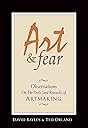
Art & Fear: Observations On the Perils (and Rewards) of Artmaking
Product ID: 286328
⭐4.6/5 from 3,335 reviews
📚Classic artmaking wisdom
🔥Top #1 in Arts & Humanities Teaching
Desertcart purchases this item on your behalf and handles shipping, customs, and support to Seychelles.
🎨 Unlock your creative courage with the underground classic every artist swears by!
Art & Fear is a critically acclaimed, bestselling book by David Bayles and Ted Orland that explores the real challenges artists face in making art. Celebrated for its honest, no-nonsense approach, it ranks #1 in Arts & Humanities Teaching Materials and boasts a 4.6-star rating from over 3,300 readers. This used copy in good condition offers timeless insights from working artists, making it a must-have for anyone serious about embracing the creative process and overcoming artistic fears.
| Best Sellers Rank | #10,245 in Books ( See Top 100 in Books ) #2 in Arts & Humanities Teaching Materials #5 in Arts & Photography Study & Teaching #7 in Art Encyclopedias |
| Customer Reviews | 4.6 out of 5 stars 3,403 Reviews |
A**R
I got the premise to come up with my own consequence for my own artistic purpose!
"Art and Fear," can be taken as a premise and a hypothesis to whatever aims one wants to go with it, to conquer fear is mine alone, to overcome anxiety is mine too, knowing that I am not the only one is comforting enough, we share a common sense of this interplay of art and fear, this books goes on to present these observations with a much to do about why doing is so important yet common to artists, but does not present: "a how to way" as to overcome a common stumbling block to creativity that many artists face; unfortunately, one critic of this book says that it presents the why and not the how of doing art when faced with fear, in what is its worth, it is a what observation; but when a what observation is taken as a premise and we readers take it upon ourselves to make and take away from this book what we find applicable to us alone and personally, we have come up with our how to approach and overcome this stumbling to our creativity and procrastination until something of a pleasurable emotion or mood hits us is wrongly taught us in mythic proportions assumed to be true. I am saying this because this is me and not is represented in this book. It is a sequel to the premises set forth here to come. "Art and Fear," is a message that I wanted and needed to hear, because I had had fits of starting out painting and drawing at many times then quitting then wanting and coming back to it again...repeatedly asking myself: "why do it?" if it was such a frustrating activity for myself only, i.e. why cause such unneeded frustrations to failure? The answer I gleaned indirectly after reading this book was, it is a "thankless...job to..." for me personally to get under what is seemingly the surface of appearance into the deeper unseen stuff of reality. I am now with a purpose, because I am highly creative and love to express it, I do art with fear, but afterwards, I give it away as an expression of love for the presentation may not be perfect, it is anyhow, a better thing to give more personal and not something that can be purchased with a price from a store commercially so. It is thus a part of me produced incapsulating a moment of emotional wish fulfillment. The work is thus a proof of thoughtfulness and mindfulness. It is after many tries at entry that one finds a way into the creation of a piece of art. It goes beyond a proof that I exist, then it is a proof that what I thought of is not something subjective, that which only exists in the mind for one moment and then can disappeared, because I gave it a life to live on its own structure and form, it can live outside of me as an objective thing materialistically realistic. To give something a form and structure to the known that one fears is highly liberating and empowering to put a name to an unknown disease appeases the mind and gives it a sense of relief and release like a sneeze. Just to know that it is ordinary people who commonly faced fear daily and to be able to find a way to express it creatively, i.e. to find that one is an anger and to put such anger into a passionate form that is creatively is useful of one's pent up emotions instead of doing something destructive one can do something because it is a highly personal choice do something else that is more within one's interest and therapeutic too, constructive and thus leave the criticisms to others, I don't have control over what made you say what you did that hurts me nor what you did that I cannot comprehend, but I have some control over what I see and hear and that which can be expressed without words in a piece of art be it in any form whatsoever I have produced. I help shaped my destiny and thus am independent of what you have done to me says a lot about our own free will in response to tragedy. Personally, I am battling with Cancer, and Art done be it of any form not perfect is the perfect way to respond to my fate with my time limited to me. I do what I can do...which is to preserve a piece of me personally to people of whom I presented this gift of me to hopefully outlast me, it is not mean to be exhibited in any fashion. To those who know me, this presentation is what is meant to convey in its expression a part of me eternally from my innermost being to be cherished for I know that I may live longer than what is imposed on me. Therefore, when faced with fear and anger, what is one to do? One can do art that gives form and function as much as structure if not to tame the fears and inner self realization of terminal illness to give what is really who one is to people of the world in some objective way one's own sense of tragedy transformed into something inspirational to another person. Carry on, I say, with whatever vision that may never be fully realizable now, but to be comprehensive enough for otherrs to carry on with one's wishes. It is liken to ordinary people writing a will, it is then a message on the ocean of life. The above observation is not what is given as the purpose in this book for why people do what they can call art. But it is what I can add to this purpose among many of why people do what they did. I got the most out of this book when I took off where I had left off in the first place when I was highly creative in the past and now wished to revisited that inspirational time and to create something that was that good and great, but I came to a realization that I had bestilled a higher purpose in the application of this inner desire to do something that I had no training to do, but raw inner desire that many people share for art, forget geniuses, I am surly not one of these Mozarts. From one hand to another, I hoped to convey hope for anyone who says that this book does not show you how someone is going to overcome an artistic block and just to do it...simply is the stumbling block, I hoped that from the sole purpose of knowing another why one does it and if it is only a giving away thing, it needs not be perfection given away, one can do it to give something highly personal, such as here, a condition that one is going through in life that has not a name or a form apart from calling it fear that is overwhelming such as Cancer, to find in this activity a solace to grapple with it conceptually so to put a good grip on a reality and then turn it into something productive to say something positive about why one lived and continues to live is important enough to communicate to someone else why one is here in the first place, that one has value and these are the values that sustained my creativity for its own rewards is saying I am valued because I exist. The object may be an object of affection only to me in regards to it, it is cherished for its imperfections than its closeness to being perfect. It is simply an interplay of work with the pleasure of lovingly spending the time doing something that gives hope to anyone looking for any in their time of despair to overcome their challenges. Not to be discouraged, but to go ahead, from my hands and mind, and heart to yours, I encourage you to try something new, go ahead, no one needs to know and it is with this private playful practice that we become a professional, you and I know we have to start somewhere where there is at times only us on the innermost of our being have the seeded desire to begin an adventure into the unknown with fear are we procrastinating to begin shaping our future as to avoid painful emotional hurts from criticisms. I say to you, I have learned and this is not found in this book, I have no control over what you say nor do, but I have total control over my view and my work, be it artistic or something of such nature that has healed me of my hurts or fear of the unknown which may be called anxiety. I have solved my problem within me through art. If art can do this for me, just think of what it holds for you, try and if you don t succeed forget about saying I try...I'll try...,I'll try...until you finally realized with paradoxical conclusion, why not try it anyway now, because yesterday's tomorrow is today!
H**G
I read it again and again
I bought audiobook and listen to it three times and then I had to buy the physical copy so I can read it while I listen to the audiobook. I wanted to underline things in here it's very good book it really helps you especially if you're an artist who struggles with anxiety and doubt
A**R
Product was an easy read, full of nuggets of wisdom.
as a frustrated artist, I WAS pleasesd to find out I am not alone artist are moody and forever searching for validation. I FIND IT IS A JORNEY OF MANY.
S**W
Was bought for a Book Club
Bought for a book club. It was thought provoking for artists.
C**N
Poetry, Polemics and Aphorisms about Art
The fear to which the authors refer in the title is the fear that an individual may have that will lead him to quit being an artist. The authors believe that artists quit either when they believe their next effort will fail or when they lose the destination for their work. This is a book about the process of making art. This book is a road map, not a survival guide. The authors provide a list of the obstacles that the artist will encounter in making his art, but they do not provide methods for overcoming these obstacles. In fact they seem to say that the artist must expect these obstacles and if he or she wants to make art, keep plowing through them. The book is beautifully written with flowing, majestic language that brooks no questions about the authors' pronouncements about the difficulties the artist faces. As factors that interfere with the ordinary individual's ability to make art, the authors dismiss fear that you are pretending, or that you lack talent or that you must seek perfection. Ordinary people, they say, can learn to make art. Similarly they dismiss the artist's fear of others, whether because the others lack understanding, or acceptance, or approval of the artist's work. The pithy statements that fill the book can certainly provide a ready source of affirmations if that's the way one deals with fears. For example the authors say: "Vision, Uncertainty, and Knowledge of Materials are inevitabilities that all artists must acknowledge and learn from: vision is always ahead of execution, knowledge of materials is your contact with reality, and uncertainty is a virtue." And they say: "Unreal expectations are easy to come by....Unfortunately expectations based on illusion lead almost always to disillusionment." Although the book is brief there are many opportunities for deeper contemplation. For example the authors distinguish between craft and art. Consideration of this distinction may help the artist to realize whether he is really creating art or just doing the same old thing. And yet as the critic Mark Schorer noted, "technique is discovery". Squaring away the distinction is important to an artist. Who should read this book? Not the consumer of art. The authors make it clear that there is no relationship between looking at art and making art. Probably every aspiring artist. It might be that the list of difficulties could lead one to quit before starting. But foreknowledge of the difficulties of making art may help the would-be artist to take those difficulties in his or her stride. Certainly the practicing artist will benefit from reading the book, with its message not to despair when fear occurs, but to keep pushing on if one really wants to make art.
W**N
Relatable and inspiring: indispensable for the practicing artist
David Bayles and Ted Orland’s Art & Fear is an insightful and deeply resonant exploration of the challenges faced by artists during the creative process. Far from being a technical manual, this book delves into the emotional and psychological struggles that often accompany art-making, such as self-doubt, fear of failure, and the pressures of external validation. The authors’ conversational tone and relatable anecdotes make the book both approachable and inspiring. They acknowledge the fears and frustrations that all creators encounter, offering reassurance that these struggles are not only normal but integral to the artistic journey. Their insights are not limited to visual artists; writers, musicians, and other creatives will also find their observations universally applicable. One of the book’s most compelling aspects is its emphasis on perseverance. Bayles and Orland argue that the act of creating, even in the face of uncertainty or imperfection, is what ultimately defines an artist. They challenge readers to focus on the process rather than the end result, cultivating resilience and authenticity along the way. While some readers might wish for more concrete solutions to overcome creative blocks, the book’s value lies in its ability to validate and empower artists. Art & Fear is an essential companion for anyone seeking to navigate the complex, often daunting path of creative expression.
E**R
I have mixed feelings about this book
First of all let me say that I am glad I read this book, I just don't know if I would do it all over again. I got a few things out of this book. There were some cool quotes from artists and some old proverbs that really hit home with me. Probably the most profound quote in the book for me was "if you chase two rabbits, you catch neither". I'm really glad I heard that one. It's also nice to have someone remind you that art isn't supposed to be perfect, art is supposed to be human and we humans are not perfect. I'm also glad that I read some of the interesting discussions of art vs. craft and art vs. science. Their approach to explaining the differences was rather philosophical and not definitive, but it was interesting none the less since probably none of us are able to draw an exact line between those things. However, I also have to say that I found this book very annoying and patronizing. It's full of constant reassurances as if they're speaking to someone that's got tears streaming down their cheeks and saying "I'm not sure if I can go on being an artist, boo hoo... I don't know if I have what it takes". The books tone kind of comes off like "there, there, Rome wasn't built in a day... you know what Picasso would say about this... well Mozart always said to keep your chin up!". I also found it really annoying how the book is constantly pulling up some kind of story or lesson from a rotating selection of artists from random mediums. You'll be reading along and they'll throw in something like "Mozart used to cry for ten hours before he could even write a note" and "Ansel Adams was constantly on the verge of suicide because he felt insecure about his photography skills". Of course those aren't real quotes from the book, but they are examples of what I find annoying. I know they were writing a book about art in general and they have to throw in things about different art forms occaisionally, but it just seemed really patronizing. Like I said I'm glad I've read it, but I probably wouldn't have if I really knew what it was. This book is for people that are very afraid and very insecure. It will give you lots of reassurance and make you feel better about yourself. However, if you are not depressed and on the verge of quitting, then I think you may find this book to be very annoying.
S**K
This book is a classic - don't listen to the whiners.
Before posting a review, I always (1) read the negative reviews (1-2 stars) (2) read the book beginning to end - and then (2) re-read the negative reviews Even then.... I rarely post a review. This time, I felt compelled. Those who post negative reviews regarding this book are in a class by themselves (thankfully) which I do not encounter often in real life. Decades ago, I actually made a living as an artist - granted, I was living on a shoestring, but through exposure to the work I sold to individuals, my customers would appear. It was all word of mouth. Flash forward: you got to make a living as a single parent (with no other financial or emotional support) and then, to get your child through college. Creative activities are on the back shelf meanwhile. Successful child-rearing: Mission accomplished. Throughout life, I have struggled in many artistic disciplines to find "my passion." It has been late in life - but I *did* find it! I consider myself very fortunate because of that. This book was listed on the recommended reading list of one of my professors at a community college. Not too far into the book, my jaw dropped. This is not some "feel good about yourself" "keep on going" hippie tome. (I was a hippie once, so I feel some authority to speak from that perspective). This book really speaks to the deeper blocks and fears that pervade the thinking processes of not only artists, but anyone responding to their passion as a pathway to success. As soon as I finished the book, I started reading it again. And not because I depended on some sort of new-agey "you can do it," but because it really helps in a way that (unfortunately) cannot be articulated. BUT - you really need to know what you're aiming to actually *do* with your time. If your passion is real, this will speak to you. If it is not, ho-hum. (At least that's the only way I can respond to the negative reviews here.) Really glad I got this book. It helps me in so many ways to recognize my personal creative barriers and (this is going to sound really hokey and new-agey) allowed me to feel like what I experience in creating art is an experience that far more people know about than I had imagined. I'm glad a couple of guys were able to put it to paper.
L**S
Les artistes sont finalement tous les mêmes =)
Et ça fait du bien de savoir qu'on est pas seuls à se poser ce genre de questions, existentielles ou non. Un très bon livre qui fait du bien au moral, et qui peut aussi être très instructif. Pour tout ceux qui se posent beaucoup de question et qui se demande s'ils sont vraiment des artistes ou s'il sont fait pour ça. Comme on dit souvent : si vous avez déjà pensé à tout laisser tomber, rassurez vous ... vous êtes bien un artiste ! Ne lâchez rien ! :)
L**S
Deep knowledge for life, not just for making art
I read that this was a cult, underground book and got the impression it would somehow discuss alternative or abstract concepts. It turns out, on the contrary, to be a ‘wow’ concrete, down-to-earth piece of art about facing the difficulties every artist faces but few overcome. Worthwhile knowledge for life, not just for making art.
A**Z
Hermoso libro
No tuve la oportunidad de asistir a una escuela de artes para educarme. Lo hice gracias a maestros particulares y autodidactica. Todo lo que hubiera querido escuchar de algún maestro o escuela de artes que no se te dice , está en este libro. Muchismas gracias
R**A
EXCELLENT BOOK, VERY HAPPY!
EXCELLENT BOOK
S**N
Six stars
This is the first art book I have read that can only be classed as a great comfort. Creating any kind of art full or part time is hard on so many levels that only artists ( like the authors themselves ) know how draining and frustrating it can be. Opening this book up to the first page I felt a sense of relief that I was not the only one out there with these secret unarticulatable thoughts. This pocket size guide is basically a map of sorts to the very difficult life that being an artist is. With this map come very funny, intelligent, observant and warming advice and insights aimed at showing you yourself through the eyes of others. These authors clearly care about other artists as their very clear compressed observations are straight to the point and very filling food for thought. Because art just gets harder after leaving art college/school ( 98 percent quit eventually they say ) it is great to know why this is. Having less or no fellow artists to relate to or confide in after leaving school is a large part of it so having a book like this is a warming comfort and a joy to read. It is like having two very helpful and caring tutors you can turn to when you want to throw in the towel...unlike many real tutors who just make you want to plain quit. This book is a keeper and not very expensive. I recommend this to all artist / musicians / writers etc of all mediums. You won't let it go if you buy it. If you like sensible helpful advice you can relate to that is well above average quality this book is for you.
Trustpilot
2 months ago
3 weeks ago