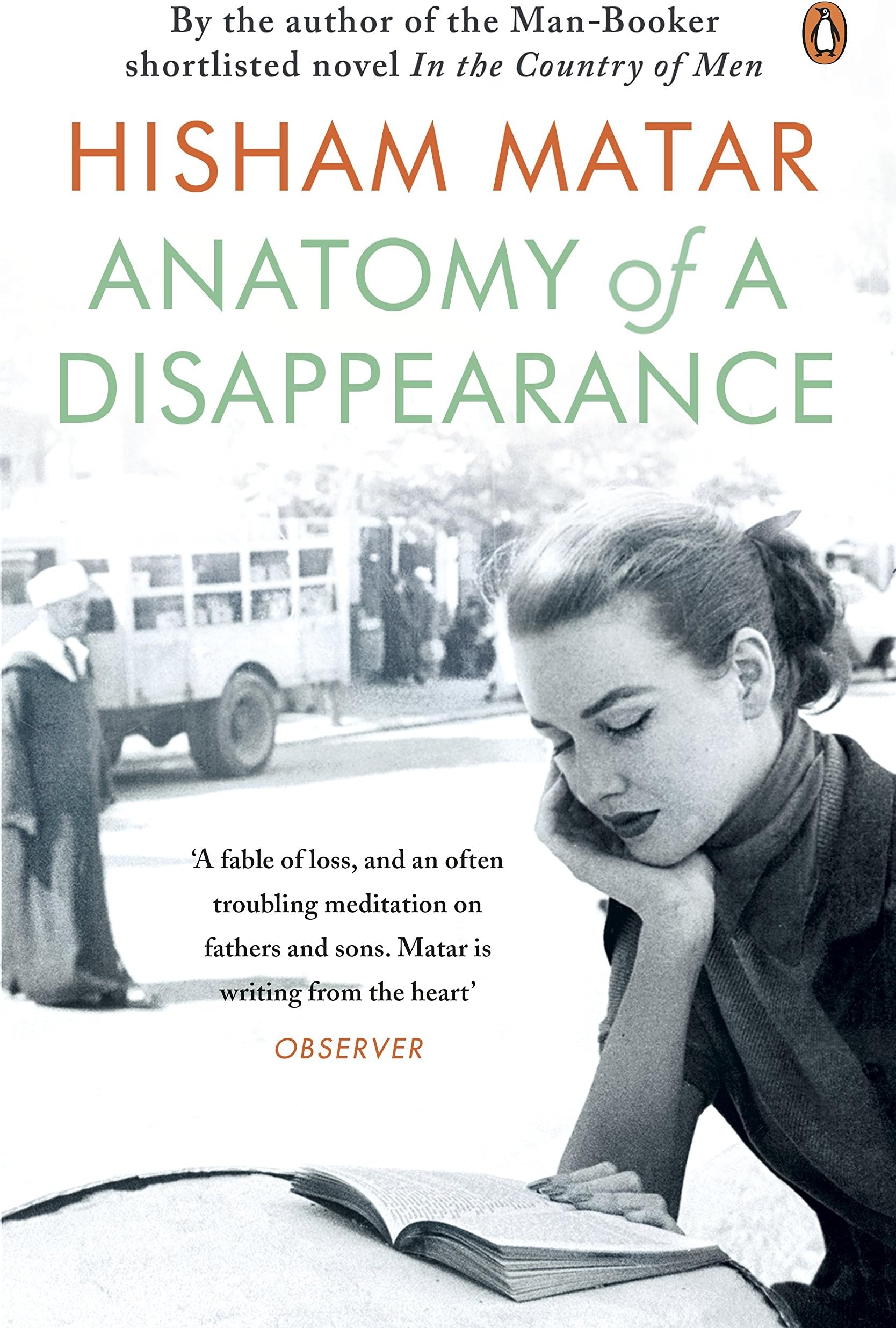
Anatomy of a Disappearance
Product ID: 352634283
🏆#885 Mysteries rank - critically acclaimed
📚Penguin Books Ltd - trusted publisher
⚖️181 grams - lightweight, portable read
Desertcart purchases this item on your behalf and handles shipping, customs, and support to Seychelles.
📖 Unlock the secrets of passion and disappearance—don’t miss the story everyone’s whispering about!
Anatomy of a Disappearance is a compelling novel by Hisham Matar, published by Penguin Books Ltd. Weighing just 181 grams, this critically acclaimed book blends mystery, political intrigue, and emotional depth, ranking highly in the Mysteries and Thrillers categories. With a 4.4-star average from 51 reviews, it offers a poignant exploration of love, loss, and identity set against the backdrop of Cairo’s turbulent history.
| Best Sellers Rank | #47,720 in Books ( See Top 100 in Books ) #885 in Mysteries #1,165 in Action & Adventure Fiction #1,242 in Thrillers & Suspense |
| Customer Reviews | 4.4 out of 5 stars 51 Reviews |
C**4
Evocative tale of infatuation, loss and coming of age
A beautifully written and evocative tale of a young man who becomes infatuated with his young stepmother. Events take a darker turn when his father, a Minister in a former regime in Cairo, disappears, presumed to be kidnapped, echoing the circumstances of the author's own father's kidnapping and enforced disappearance by the Libyan regime in the 1980s (as told in the author's excellent book,"The Return"). Such a tale of infatuation could be trite in the hands of another writer, but Matar captures the nuances, the anxieties and ambiguities of such passions brilliantly, somewhat like Orhan Pamuk in "The Museum of Innocence". The novel is also about loss - the loss of the narrator's father, naturally, but also the loss of innocence, the loss of having a voice to express yourself (literally in one character's case) and the loss of identity caused by having to live a life in exile. A truly excellent book and a joy to read.
C**.
Disappearing Romance
I bought the book on the strength of the narrative and the author's earlier work. Whilst I thought that the cover did it a disservice, the writing and storyline were compelling.
M**E
"Eighteen months after my parents employed Naima, our king was dragged to the courtyard of the palace and shot in the head."
Libyan author Hisham Matar draws on his own life to provide insights into this story of a son's yearning for the father he loved but who vanished when he was fourteen. In real life, Matar's father Jaballa, once a member of the Libyan delegation to the United Nations and, after Muammar Gaddafi's coup, a political dissident, went into exile in Egypt in 1979, when his son was nine. He was kidnapped in 1990, when his son was twenty and has never been seen again. This fraught background provides the structure of Matar's novel, which takes place in an unnamed country (perhaps Iraq, since the King of Libya died at age 94, in exile). Nuri el-Alfi is a young boy whose mother dies when he is nine while the family is in exile in Egypt. He and his father, a dissident and former minister of the government under the king, become, simply, "two flat-sharing bachelors kept together by circumstance or obligation." When Nuri is fourteen and in boarding school in England, his father and his father's much younger, new wife Mona meet Nuri in Switzerland, and it is on this vacation that his father is abducted. The Swiss police have no leads. All this information about Nuri is given in the first five pages of the novel, and as the author continues Nuri's first person story from that moment up to age twenty-four, the bare bones outline of his life at the time of the kidnapping gradually broadens and gets filled in, and his life as an exile, without family or country, takes shape. Through flashbacks and reminiscences, the reader learns about Nuri's younger life and his father's role as a dissident in exile, but there is a curious detachment in the story-telling. Scenes throughout the novel are abbreviated - almost lacking in description, and the reader must supply his/her own images. Nuri's teenage "crush" on his stepmother, who is twenty-six when he is fourteen, is full of passion, but his angst is "told about," instead of being "recreated" to make scenes come alive. Nuri's boarding school does not encourage the show feelings, and his personal life outside of school also has no outlet for them. His father's friends from the past have not provided him with emotional guidance, and, without a close family, Nuri has no one with whom he can share anything. Even when he reaches college age, he tells us that "I kept a small radius of friends, mostly from university, with whom I shared what I imagined some siblings share: a warm alliance that still assured the necessary distance...They did not know much about me except that I came from Egypt - a fact in itself untrue." It is only when he observes a man who has fallen into the water trying desperately to hang on until he can be rescued - a symbolic scene - that Nuri, at age twenty-four, starts to become "human." The novel's most successful scenes follow that, providing the kind of feeling that is missing in the earlier sections, perhaps showing a belated coming-of-age. The novel is cleanly written and straightforward, but I longed to see Nuri acting like a real boy and showing a need for closeness - with someone, anyone - and especially with the reader. His stiff upper lip, in the face of the dramatic events of his life, gives the novel an almost journalistic air, and I felt excluded from his life when I wanted to share it. Mary Whipple
N**S
A Loss Of A Sort
We've survived the tenth anniversary of 9/11. The media reports no shocking new acts of terror. We've waved flags, declared both the victims of the attack and those victimized by their response to the catastrophe heros. We've stood by while those who lost so much in the wake of 9/11 shed tears. We've survived this public ritual, coming away feeling, well, better, I suppose, in some sort of communal way. The victims of 9/11 are lucky that way. Their loss is marked. We stopped the world for a brief time to give them the solace of our joint recognition of their sorrow. All do not share their good fortune. I was reminded of this reading a new book by Hisham Matar, Anatomy of a Disappearance, the story of a 14-year-old boy whose father was present in a shared world of hopes and dreams, and then, in an instant, was forever absence. There was no ceremony for this disappearance. Just silent sorrow expected to be borne without a lot of fuss and ado. "The telephone continued to ring incessantly," Matar writes. The boy's father was kidnapped you see, swept away from the bed he shared with a woman by abductors suspected of targeting him because he was an outspoken critic of the third-world tyrant who ruled his country. "Then after a few days it grew quiet. Relatives and neighbors who might have filled the chairs in the hall if Father had died were silent in the face of his disappearance.... A great emptiness began to fill the place of my father. It became unbearable to hear his name." That is what silent, unshared, unrecognized, uncelebrated grief looks like: It is a scar borne quietly, a scream no one hears, a rite of passage unaccompanied by the comforting ritual of a funeral. But the disappeared are every bit as dead to those who remain as those who die a physical death. Matar is a graceful writer. His first novel, In the Country of Men, was critically acclaimed. His prose are elegant, the characters drawn with simple strokes. He draws freely from his own sense of loss, a sense provoked by the disappearance of his own father, a critic of Moammar Qadaffi who was present one day, and gone the next. Yet for all that, his latest work has an almost clinical feel to it. Yes, the protagonist lost a father, but he never loses his place in the world. He lives in a privileged bubble, with servants waiting faithfully for him in his expatriate Egypt. When his father remarries after the death of the protagonist's mother, the teenager is whisked off to an elite English boarding school. He learns that his father has provided for him in his will, leaving a generous sum with instructions that the boy is not to work until at least age 24. To earn full use of the legacy, he must complete a Ph.D., but not in business or political science, where book learning is inferior to experience. He returns to Cairo, a newly minted Ph.D., to an apartment kept for 11 years by servants loyal to his family. He moves in to the apartment. The dresser drawers are filled with his father's belongings. The closet in the master bedroom contain his father's suits. There is still hope, horribly agonizing hope, that his father will reappear. It is a hope the son cannot relinquish. This is a beautifully written story, but it is not really a story about the complete loss of moorings in the world. A less fortunate child would lose a parent and then go on to lose his place in the world. A father can disappear, and the result can be desolation, the loss of connection to a community, of all that the narrator in Matar's new novel takes for granted. Matar writes of a civilized sort of loss. It almost seems a contradiction in terms. Father is missing, but his artifacts remain. This is a polite sort of loss, the absence of a provider, but the maintenance of all the provider left behind. Some losses are complete and therefore savage. A man can disappear without a trace. He can leave nothing behind but questions, no generous will, no means of providing for those he once loved. Those left behind have nothing. The loss of a provider leaves no home to which to return, no servants to care for the bereaved, no loved one to stand in and provide shelter. Such losses are not even accompanied by the sense of closure a public ceremony provides. These are the silent sorts of loss felt by many year-in and year-out. These losses go unrecognized, but remain real. The ceremonial recognition of the losses associated with 9/11 felt much like Matar's novel to me: a stylized and almost self-indulgent sort of grief. Those who have experienced the disappearance of a parent, together with the loss of the social world the parent provided, were more alone on 9/11 than on most other days. The celebrants got the lubricant of a stranger's tears, far more than many receive in response to loss. The private silences of the solitary abandoned are much like the "great emptiness" of which Matar tried to write. Lest you think this is mere theorizing, let me relay simply this: my father disappeared when I was eight. In his wake, we lost all. There was nothing to remember him by. Even my mother lost her way, and I was sent to live with relatives. No ceremony marked the day I was sent to live with folks I had rarely seen before. I read Matar's work with a hunger for recognition that went unmet. The read was as unsatisfying as were the ceremonies devoted to 9/11. Some losses define a person, even when they are so idiosyncratic as to escape the notice of the larger world. It was not a lack of patriotism that turned me sour on 9/11; it was something akin to envy that those who lost that day received so much in return.
P**O
An unusual and disturbing novel
This is the second novel by Hisham Matar that I have read and it is just as unusual as and slightly more disturbing than the first, for many of the same reasons such as terse writing style and narrative fragmentation. In contrast to his first novel, 'Anatomy of a Disappearance' is spare and pared down in style and content. In Egypt, Nuri, a teenage boy, falls in love with Mona, the woman his father will marry. Consumed with longing, Nuri wants to get his father out of the way so he can take his place in Mona's heart. But when his father disappears, Nuri regrets what he wished for. Alone, he and Mona search desperately for the man they both love, only for Nuri to discover a silence he cannot break and unimaginable secrets his father never wanted him to know.
Trustpilot
3 weeks ago
1 month ago