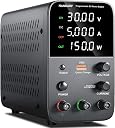
⚡ Power Precision Meets Portability — Never Miss a Beat in Your Lab!
The NANKADF WPS305H is a compact, high-precision DC power supply delivering up to 30V and 5A with 4-digit LED accuracy. Featuring advanced safety protections and an 18W USB fast charging port, it’s designed for professionals and enthusiasts who demand reliable, portable, and versatile power solutions for electronics testing and development.


| ASIN | B09C8MT4KM |
| Batteries Required? | No |
| Batteries included? | No |
| Best Sellers Rank | 818 in Business, Industry & Science ( See Top 100 in Business, Industry & Science ) 1 in Industrial Power Supply |
| Colour | Black |
| Customer Reviews | 4.5 4.5 out of 5 stars (2,135) |
| Date First Available | 30 Aug. 2021 |
| Item Package Quantity | 1 |
| Item Weight | 1.46 kg |
| Item model number | WPS305H |
| Manufacturer | NANKADF |
| Material | PE_(Polyethylene), PLA_(Polylactic_Acid), PS_(Polystyrene) |
| Maximum power | 150 Watts |
| Part number | WPS-10H |
| Product Dimensions | 19 x 8.99 x 14.99 cm; 1.46 kg |
| Size | 7.48*3.54*5.9 |
| Specification met | UL |
| Style | 30V/5A(150W) |
| Wattage | 150 watts |
A**N
Brilliant bit of kit
So glad I finally bought a bench supply. And checked on videos online to see which one is best at this price range. It does so much more than the cheapest ones. If you set the current limit, and it is reached it tells you it is in current limit mode and then the voltage drains down. You can also set it to shut off with Over Current Protection, where an alarm will sound and it will cut power. I found the leads more than adequate with the alligator clips and spade terminals, which I prefer to the banana clips. Readout is nice and clear with a fairly good update rate so you can see changes happen quickly. You can even adjust the baud rate in the options to make it quicker and lower the screen brightness. USB port also came in handy, although you cannot read the current draw for this, and the manual doesn't mention what it's limit is. I powered an Arduino and charged a phone off it, so it was fit for purpose. Adjusting everything is easy with pushing the knobs to change which digit you want to adjust to do fine or rough adjustment from 1 / 0.1 / 0.01 etc. It would be nice if it remembered which digit you were last on though, as it keeps defaulting to fine adjustment and takes a bit of remembering to push it first before turning it. Only thing is the beeps are a bit annoying, which wasn't a problem at first, because the manual lets you turn it off by going into settings if you hold down the output button for 5 seconds. However, it doesn't remember what you set each time you turn it off so have to do it all again every time. This is silly because it remembers all your other settings, even when you unplug. I might just open it up and cover the buzzer with a piece of tape to make it less noisy.
M**E
Fantastic DC Power Supply – Compact, Precise, and Feature-Packed!
Fantastic DC Power Supply – Compact, Precise, and Feature-Packed! I recently purchased this adjustable DC power supply, and it’s quickly become one of the most valuable tools on my workbench. Whether I’m working on electronics projects or need a reliable power source for testing, this little unit delivers on all fronts. Accuracy and Performance: The 4-digit display is one of the standout features of this power supply. It provides precise voltage and current readings, making it ideal for projects that require fine-tuned adjustments. I tested its accuracy with a multimeter, and the readings were spot-on, even at lower voltage and current levels. The 0-30V and 0-5A range is perfect for a variety of applications, from powering small components to more demanding devices. Build Quality: Despite its compact size, this power supply feels solid and well-constructed. The metal casing gives it a premium feel, and the design is sleek and modern. It’s lightweight yet sturdy, making it portable enough to move between workspaces without compromising durability. Ease of Use: The encoder knob is a game-changer. Adjusting voltage and current is smooth and precise, with no lag or jitter. The ability to toggle the output on and off is a great safety feature, especially when working on sensitive electronics. The intuitive layout of the controls and display makes it easy to use, even for beginners. USB Fast Charging: The inclusion of a USB fast-charging interface is a fantastic bonus. It’s a thoughtful addition that allows me to charge my phone or power USB devices without needing a separate charger. This feature alone makes it more versatile than other power supplies I’ve used in the past. Features I Appreciate: High Precision: The 4-digit display ensures you get detailed readings, which is essential for precision work. Output On/Off: Being able to control when the power is delivered adds an extra layer of safety. Compact Design: It doesn’t take up much space but still delivers the performance of larger units. Quiet Operation: It runs quietly, even under load, which is a big plus when working for extended periods. Pros: Highly accurate voltage and current adjustment Compact and lightweight design USB fast-charging port for added convenience Intuitive encoder knob for precise control Reliable and quiet operation Great value for the price Cons: The backlight on the display is quite bright, which might be a bit distracting in low-light environments (a dimming option would be a nice addition). The fan can kick in at higher loads, but it’s not overly noisy. Supplied Cables are not brilliant. I'll swap them out for multistrand, silicone wires. Conclusion: This DC power supply has been a fantastic purchase. It’s precise, versatile, and packed with features that make it ideal for hobbyists and professionals alike. The compact size and USB charging port are icing on the cake. If you’re looking for a reliable and accurate power supply for your lab bench or electronics projects, I can’t recommend this one highly enough!
C**Z
Nicely built and finished, seems to work well.
I bought this (the 10A version) after reading both positive and negative reviews, noting the reviewer who pointed out that many reviews were for free product so I'll say up-front that I did NOT get this for free, nor did I get any incentive to review it, favorably or otherwise. Addressing the criticisms I've seen first, in descending order of importance from my own perspective: (1) Noise: [updated] One reviewer said that the output had noise on it; I checked (off-load) with a 'scope and yes, it does. Fast switching transients, most of it is under 200mV peak-peak in amplitude, with a max of perhaps 400mV peak-peak, at different frequencies. This is quite a bit for low voltage o/p. Switching noise hardly a big surprise on a switching power supply, but because it's very fast transients, it is quite hard to get rid of. As you turn up the output voltage, the spikes don't increase in amplitude but do become more frequent. The manual quotes max ripple (current) of 0.5% and "voltage stability" of 0.5%. The fundamental output voltage seems absolutely rock steady, to be fair, but the noise is relatively fast impulse type noise; while the pattern of successive spikes is some syncopating mix of switching frequencies, in the region of tens of kilohertz, each spike is sharp-edged which means overall it's an episodic pattern of, in effect, very high frequency components. On my 'scope I see a rapidly diminishing "ringing" at about 450KHz, halving in energy every cycle and negligible after about 5 cycles, for each spike, so the 200mV spike lasts about half a microsecond according to my (slowish) 'scope but is probably in reality much shorter, and the ringing is probably on the connection wires. I initially thought that typical decoupling and other load capacitance would soak this up, but the sharp pulse edges instead get everywhere. Linking the -Ve output terminal to the centre ground terminal seems to help. I opened it up to take a look - there are no ferrites in the output wires, nor did I see any chokes near where the output wires leave the main board. I've docked a star because while I like the way it looks and works, I'm going to have to make some modifications to try to reduce the switching noise. (2) Mains cable being loose. I thought the reviewer who said this must have had a dodgy cable. Then I plugged the one supplied in and thought maybe they had a point, but then I realized it wasn't fully home. When plugged in, it feels like it's gone all the way in and is loose. It has another 5mm or so to go - push it firmly past this stiffness and it snugs into place and is nice and firm, at least on my one. (3) Control convenience: A YouTuber bought one of these and complained that when the output is switched on, adjusting the voltage also sets the current display into "entry" mode so it shows the preset current rather than the metered current. It goes back to "live" readings after a couple of seconds hands-off. (To make this clear - you adjust voltage and current with the output switched off and the voltage is what it will output, and the current is the current limit you set. Once the output is turned on, the current and voltage displays go "live", so if the load is drawing less than the preset current, that is displayed, if the load is trying to draw more than the preset current, the current will be close to the preset and the voltage will have dropped to keep current below the preset. If you're within the limit, though, the YouTuber reasoned that the thing should continue to show live voltage and current when adjusted with the output on. That way you can manually adjust voltage to achieve a desired current. For me, this is not a use case I care about - if I want to monitor the current in real time while adjusting the voltage I can just use another current meter, but mostly I'm only interested in setting a current limit that will prevent short-circuit damage. Another control feature is that while the device remembers the presets when you turn the unit off and on or unplug it, by default it always starts in output-off mode. This, to some, is an inconvenience because it means you can't leave it unattended as the sole power of something that you want to be on all the time, because a slight blip in the mains supply will cause it to reset and turn its output off. To me, though, for a bench PSU this is the way I want it to work, especially if there are people around who might have fiddled with the voltage etc while you weren't looking. At work, we have a bench PSU that comes on with the output in whatever state it was when switched off, and a couple of boards have been blown up by people turning it on connected, after someone else has left it set to a high voltage and output on. For me, then, this one works the way I'd want it to. HOWEVER, this feature can be altered via "system settings" - see below. The only other "user interface" thing I think might be of concern to some is the bleep on startup. I actually, unusually for me, looked at the manual to see if this could be switched off, and found somewhat to my surprise that yes it can, there are a number of "system settings" you can get to by a long press (5 seconds) on the output switch. System settings are as follows: 1. Machine ID (see comms) 2. Output state on power-up (so it can come on in "on" or "off" state) 3. Screen brightness 4. Buzzer mute (yay!) 5. Comms baud rate 6. Comms little- or big-endian. The comms features are for an option serial module that allows remote control - again, bit of a surprise, this. Personally, I'm totally happy with the defaults, except perhaps the bleep (though it's not that obtrusive). Features, observations, summary: As others have said, the output voltage seems accurate, certainly by the standards of regular hobby- or professional-grade meters and the like. Someone with lab-standard high-resolution calibrated meters might find something to complain about, but I would consider it "good enough" for any normal purpose. The number of decimal places for the current display might be a bit specious, I daresay it's not actually accurate to a milliamp, but it's not something I care enough about to check. The way it operates seems exactly as I'd like. Sure, they could have done more with bypass capacitors and ferrites and things to get rid of the leftover fast switching noise, but any load you're likely to connect will likely have its own supply caps or not care, or you can take steps to deal with it. The output is WAY more clean and stable than many a typical "wall wart". Neither of the output rails is tied internally to the centre ground connection (which I assume is tied to mains/supply ground). I.e. the output is floating. It's worth noting that the output becomes somewhat smoother if you ground the -Ve side. The output posts are screw clamp types but quite thin and lacking the sideways hole for wires that many of these types of posts have. The external part of the post is only about a 5mm diameter despite having a 4mm hole down the middle to take banana plugs. If that bothers you enormously then I daresay they can be replaced with better posts. (They mount with what look like 4mm screws with nuts on the back and should be easy to change.) The supplied croc-clip cable for the load side is OK but thin, cheap-n-cheerful, I doubt mine will see any use. The unit is light, but not as "tiny" as some reviews suggest - it's not big, though. The dimensions are given in the description. If you stacked six standard DVD boxes together and stood them on their long edge they would be more or less the same size as this unit. I have not tested the over-current protection, nor indeed its ability to supply the rated current. Mine allows output voltage to be set to 31v and current to 10.2A (I bought the 10A version, which at time of writing was about £14 more than the 5A one). The build quality seems really good, and it's noticeably fuller-featured than I was expecting, what with the system setting options and the optional serial comms remote control module (OK, I have no idea how you could get one but I'm willing to bet it'd be easy to hack a DIY one after a bit of a poke around inside. The facility to remote-control up to 32 of these from a single serial interface must be handy for someone!) [update] I have now had a quick look inside to see if extra suppression could be installed, and it's as neatly made as shown in the photos. The earth connection from mains inlet through to the ground post on the front is reasonably convincing, taking in various fairly generous ground planes on the main board via a couple of metal mounting brackets which appear to be meant to also ground the metal case. However, the powder coating on the inside of the case meant the case on mine was not in fact earthed. I scraped the coating off around where one of the brackets sits so that the case on mine is now earthed. When I dismantle it again to try to improve noise suppression, I'll also scrape the case around the other earthed bracket, replace the terminal posts with better ones and probably uprate the output and ground hook-up wires. This review is way longer than I originally intended but overall, I'm pretty impressed with this thing.
D**A
The power supply has an excellent adjustability because it has a rotary encoder, combined with choice of setting which decimal you want to change, although i usually leave it at setting on the tenths. It's also very intuitive and looks nice.
J**O
La fuente de Alimentación se nos entrega en una. caja muy bien envasada y con cables para poder ser usada.. Tras sacarla vemos que esta está fabricada en metal, y dispone de un venitilador para ayudar a disipar el calor que se pueda producir en el interior. Yo seleccione la de mayor capacidad de amperaje (30v-10Amp), ya que así dispongo de mas potencia en todo el rango de voltaje ya sí te aconsejo que hagas lo mismo, ya que la máxima potencia la entrega con la máxima tensión. Con ella puedes seleccionar el voltaje que deseas y limitar la corriente para evitar daños si no estás muy seguro del consumo del equipo que vas a probar o alimentar. Esta es una de las cosas más importantes de una fuente de alimentación de laboratorio, tanto "Pro" como esta de uso Amateur o de entrada. Otra de las cosas que me gusta es que muestre en el display a parte de la tensión y corriente, la potencia que se está entregando en todo momento, así te evitas el hacer cálculos, aunque eso es algo menos necesario, pero un plu, al menoss para mi. Como no, como buena fuente de alimentación de laboratorio dispone de protección frente a cortocircuitos, y he de decir que actúa inmediatamente, probado juntando positivo y negativo con intención para ver el tiempo de respuesta y es inmediato como he dicho. Amen de las salidas positivo, negativo y tierra para conectar las bananas, dispone de una salida USB-A para poder tomar corriente de ella y alimentar equipos que lo hagan desde este conector y así poder probarlos o si lo prefieres poner tu movil para cargarlo, eso ya es cuestión tuya. Dispone de un ventilador para evácualas el calor, pero en todo el tiempo que la he usado, bastantes horas, este no se me ha encendido en ninguna ocasión. Y si, funciona, porque lo probé usando la fuente a plena carga y tardo unos 5 minutos en saltar por la temperatura, pero con un uso normal, esta fuente con su disipador pasivo va mas que sobrada a la vez de silenciosa, obviamente. Estoy muy contento con ella y por lo tanto no me queda mas remedio que recomendárosla si o si tanto si eres Pro (usarla como secundaria) y principal si eres Amateur, o comienzas en el mundo de la electrónica y sobre todo una buena relación Calidad/Precio. 💯recomendada. Espero que esta reseña te haya sido útil 👍.
J**K
Perfettamente rispondente alle caratteristiche descritte. Preciso ed affidabile per il lavoro da laboratorio. Grande display luminoso e di facile lettura. Controlli molto precisi. Ottimo rapporto prezzo/prestazioni. Ricevuto puntualmente con imballo di protezione. Assolutamente consigliato.
N**E
Une alimentation qui fait le job. Facile et ergonomique.
S**A
Verilen parayı hakediyor.
Trustpilot
2 weeks ago
3 weeks ago