Buy anything from 5,000+ international stores. One checkout price. No surprise fees. Join 2M+ shoppers on Desertcart.
Desertcart purchases this item on your behalf and handles shipping, customs, and support to Seychelles.
🚀 Elevate your home WiFi game — never settle for slow or spotty again!
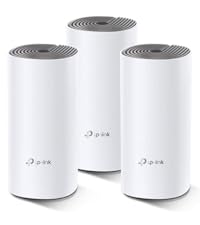
The TP-Link Deco M5 Mesh WiFi System delivers robust, seamless coverage up to 5,500 sq.ft, supporting over 100 devices with dual-band speeds up to 1300 Mbps. Featuring adaptive routing technology, a free lifetime security suite, and easy app-based setup, this 3-pack mesh system replaces traditional routers and extenders to eliminate dead zones and ensure stable, secure connectivity throughout your home.


| ASIN | B06WVCB862 |
| Antenna Location | Home |
| Antenna Type | Internal |
| Best Sellers Rank | #522 in Computers & Accessories ( See Top 100 in Computers & Accessories ) #25 in Whole Home & Mesh Wi-Fi Systems |
| Brand | TP-Link |
| Built-In Media | 1x Ethernet Cable, 3x Deco Units, 3x Power Supplies |
| Color | 3 Pack |
| Compatible Devices | Android 4.4 or later iOS 9.0 or later |
| Connectivity Protocol | ethernet, wi-fi |
| Connectivity Technology | Ethernet |
| Control Method | App |
| Controller Type | amazon_alexa, vera |
| Coverage | 5500 square feet |
| Customer Reviews | 4.6 out of 5 stars 27,581 Reviews |
| Data Transfer Rate | 1300 Megabits Per Second |
| Frequency | 5 |
| Frequency Band Class | Dual-Band |
| Global Trade Identification Number | 00845973080839 |
| Is Modem Compatible | Yes |
| Item Dimensions L x W x H | 4.7"L x 4.7"W x 1.5"H |
| Item Type Name | Deco M5 Whole-Home Wi-Fi System |
| Item Weight | 600 Grams |
| LAN Port Bandwidth | 2.4,5 GHz |
| Manufacturer | TP-Link |
| Maximum Upstream Data Transfer Rate | 1300 Megabits Per Second |
| Mfr Part Number | Deco M5 |
| Model Name | Deco M5(3-pack) |
| Model Number | Deco M5(3-pack) |
| Number of Antennas | 4 |
| Number of Ports | 6 |
| Operating System | RouterOS |
| Other Special Features of the Product | Access Point Mode |
| Security Protocol | WPA-PSK;WPA2-PSK |
| Smart Home Compatibility | Smart Home Compatible |
| Special Feature | Access Point Mode |
| UPC | 845973080839 |
| Unit Count | 3.0 Count |
| Voltage | 100240 Volts |
| Warranty Description | 2-Year Limited Warranty |
| Wireless Communication Standard | 802.11a/b/g/n/ac |
| Wireless Compability | 802.11a/b/g/n/ac |
D**N
Wow! Streaming problem solved and easy setup
I started my working career with my own typical Silicon Valley tech startup. This was in the early 80’s, just when the first PCs appeared and quite awhile before internet. I’ve gone through just about all techie equipment setup issues. Wow! Have we come a long way. My recent setup of the TP-Link Deco Whole House Mesh Router was by far the easiest in this guy’s tech experience. First: The Problem. I had a DSL modem/router/WiFi in my basement office. The WiFi was OK throughout the whole house for email etc; but my FireTV and Chromecast streaming dongles were intermittent. Two issues with them: 1. They were upstairs in a Den. 2. They were hanging off a Flat Panel with some radiated interference. Sooo, I decided to have some sort of additional WiFi generated in the Den. I could have just put another router upstairs, but, I’ve found that having new routers with the latest and greatest firmware perform better and save trouble in the long run. Solution: Researching new routers, I realized that the newer ‘Mesh Routers’ filled the bill. Excellent whole house coverage and the same SSID and PW for all devices.. Specifically I selected the TP-Link Deco Whole House mesh router because of other reviews and especially because it seemed to have a full set of setup features (allowing static IP - more on that later). It was priced slightly higher than less featured competitive products, but not a big deal. My Setup: The downstairs Modem/router/WiFi router is setup via the home network, 192.168.0.1 URL. Over years many home and guest devices use this router’s SSID and PW. My problems were only related to streaming devices therefore I decided to setup Deco with a new, streamer only, SSID and PW and keep the old WiFi running. I realize that this is under utilizing Deco and I could shut down or changed the WiFi downstairs and set Deco to the Home Network SSID and PW; but I’m OK with running two networks in case one goes down for some reason, or maybe I was just lazy. . Setting up the Deco was easy. The Android TP_Link Deco App ‘talks’ to the Deco router via Bluetooth so I didn’t have to go through ethernet or WiFi and could just use my android smart phone to setup Deco. All the other phones/tablets/printers still use the old SSID so no changes to devices other than the streaming ones.. My phone can use either network and is the only device setup to ‘talk’ to Deco. Results: m-labs speed test in Den Old, single point downstairs WiFi - Download 23.5 MBPS UpLoad 4.95 MBPS New, Deco mesh router - Download 34.5 MBPS upload 4.5 MBPS. After using FireTV to stream movies all of the old intermittent problems were gone! (It may be that not having competing ‘traffic’ on the streaming WiFi network may have been a factor). Anyway - PROBLEM SOLVED! The TP_Link setup App is very full featured. It has many advanced options: built in speed check, parental controls, blacklisting, and advanced networking mods. With regard to the later, I’ve found that our printer gets ‘lost’ periodically with dynamic IP and device changes. To circumvent this problem I’ve reserved a static IP address for my printers and cloud storage in the Home Network. The TP_Link Deco App has ‘Address Reservation’ that would support this same static IP setup if I decide to use Deco exclusively in the future. All in all, I’m very pleased with Deco and recommend it to anyone wanting to have reliable whole house WiFi coverage, and easy but full featured setup.
B**H
Great WiFi Signal in Chicago! Please read....
I read all the reviews before I bought, talked to a family friend who is an electrical engineer, talked with a friend who deals with computer systems for companies, and then just took a gamble! Installation was super simple. We just built a new house. With basement, it’s about 4,500 sq ft. Our modem is in the back corner of the house, in the basement. Even though we up’d our Xfinity signal to 1,000 Mbs, the signal in our house was pretty sad. Because of COVID, we have 2 kids virtual learning, me virtually teaching with 3 computers, and my wife doing secure law office work downstairs. We also have an extensive Ring camera system working around and through the house. On top of that, we have OneLink Safe & Sound devices on on all 3 floors! There’s a lot of stuff going on here. The first test I did I was standing a room away by the front door, which is around a corner from the unit. The signal speeds were off the charts! Then I went to the garage and driveway(pic1&2), amazing! I re-set up the ring camera out there to the TP mesh system and did a speed test through the Ring app. Much different numbers, but the signal was the highest it’s ever been without an extender in the garage (pic3)! Next, out of curiosity, I went to the sidewalk out front, check out the signal through TP app (pic4&5)! I then redid the camera on the side of the house by back porch (pic6&7). I took both Ring and TP readings - they differed, but that Ring test was the highest I had ever gotten! So, out of curiosity, I went into the backyard by the property line. See the numbers (pic8&9)! I then got on the ladder and redid the center camera. The Ring numbers were off the chart (pic10)! In our house the farthest point was my daughters bedroom. We called it the dead zone. Tonight’s reading seemed unreal, so I tested the speeds with Xfinity’s app. The 3rd numbers down was the speed test before I installed the mesh system. Look at the numbers now. I did it twice just to see if it was a fluke? She’s never had numbers that high, EVER (pic11)!! Lastly, I tested our master bedroom (pics 12&13), used both apps. Once again, amazing numbers! Placing the devices...I ignored the apps suggestions. I ran a hardwire from the back basement room up through a small hole in the first floor where the refrigerator has its water pipe coming up. I placed it on the wall to create a wide range of signal to be able to spread itself out (pic14). I then placed the second one on the 2nd floor in the middle of the hallway (the only outlets we have up there are near the floor (pic15). Signal works great! The 3rd one I placed in our unfinished basement. We do have some outlets higher up on the wall, so I placed it in the middle of the room (pic16&17) to get maximum WiFi coverage without anything blocking the signal. Now, it should also be noted, if you’re still reading this, that we live 10 minutes from the airport and planes fly over our house all the time. It messes with the signal of our WiFi, but not anymore! I swear this system covers every inch of our house with great speeds and extremely strong signal strength. The negative reviews that I read, I really don’t understand what happened in their houses. We used to have the Xfinity pods and they struggled at best and still gave us crappy numbers. This system is worth the money and does what it says! And no, I do not work for TP Link. Honestly, it’s a great system. Is it better than all the others out there? No clue, but it does work like they say it does. And, on mine, the update worked just fine. No issues. For the price and quality of product, I am feeling pretty lucky right now!
K**P
Easy Setup & Rock Solid Performance
Our older TP-Link router was very solid. But when it came time to replace it with another, the low-cost TP-Link routers in the same class were horrible. Impossible to setup without hours of TP-Link tech support & completely unreliable once setup. Our Spectrum service tech suggested Deco if we wanted a mesh system. Although we don't need a mesh system, I wanted to try the Deco router to see if it was any better... What a difference! The setup was a total breeze! I was blown away at how easy it was. And we've had very fast and solid connection nonstop out of the box. (We've been using this Deco router for 2 months now.) The nice thing is, because we don't need all 3 routers, they're identical. So if the one we're currently using does fail. there are 2 backups. I'd call that good value. 😉
S**7
Not World Changing But the Difference is Noticeable
Works great as a replacement for the rental router on my fios setup. Install was easy with simply writing the name of your network, where you routers are, and move on to the next one in the mesh. Downside, I highly recommend using MoCA to spread the signal around the house. The couple I have running strictly on others nearby are far weaker in speed so you would literally need a couple every 5-10ft or from one side of the wall to the other. Though by wiring a source either ethernet or from a MoCA adapter you get the max speed that transmission method can do which is a fair bit better. Speed is also a fair bit slower than the quantum router I had at the source they. The old one would basically go beyond my phone's top speeds while this one is closer to 250mbps right next to it. This is likely because my old router had split channels for 5GHz and 2.4GHz but this one simplifies them as one signal. Whether that's more convenient or more annoying is up to you. Either way you still get full speed from ethernet so since wireless devices rarely need more than 20mbps it shouldn't effect much. The controls in app are also great with built in virus protection, parental controls, the ability to isolate devices and block devices from connecting, you can set priority devices and how much bandwidth you allocate to each, you can set times devices disconnect from the network, and warns you when one goes down if they do, when a new device enters the network, and if a new firmware is available. The app really is perfect. Only things I would count against the app are in the setup. When setting up it gives you presets for the type of room but would be way more useful if it instead had the ability to directly name them or at the very least take a picture. You'll have to remember the order you installed them as unit 4 is in "bedroom 2" which one is that, guess you'll have to remember that one on your own. As a whole a fairly painless process dumbed down for anyone to the T. Literally took 5 minutes to setup the main router and then each satellite only took about a minute. To those who aren't tech savvy, it seems a good strategy, just note you will want to extend power with MoCA or ethernet lines that literally makes a huge difference. Signal now even makes it all the way to the back of our fence about 60ft back from the house and there are no longer dead spots though there are still weaker spots. Overall I'd recommend if you understand it isn't a magic solution. It definitely will benefit from some external source to extend it's power. Use ethernet if possible, MoCA is also a fast solution, and if latency is key such as gaming, use a powerline adapter (just note those aren't very fast so MoCA would still be better in most cases).
S**N
Excellent for Ethernet Backhaul setup
I originally purchased Eero Pro due to the abundance of positive reviews and stability. It was fast, covered entire house, and worked well from the get-go, but seeing that I was using Ethernet Backhaul and not WiFi backhaul, there was no need for the 3rd band feature. To save money, I decided to try out the TP Link Deco M5. Background: I have 1Gbps fiber internet speed. 4,800 sqft, 3 story home with cat 5e ethernet running throughout the house. All Deco M5 access points are connected via Ethernet [Cat5e] backhaul from an unmanaged 1Gbps TP Link Switch. I have over 30 devices that use either WiFi or Ethernet. Set Up: The set-up is easy through the Android app and took only about 15 minutes for initial setup. I first connected all the Deco units wirelessly then the first thing I did was update the firmware. After everything was green, only then did I connect all of them via Ethernet Backhaul [star configuration]. [one on each floor of the house] Everything connected like a charm via Ethernet but did have some connection issues at first that nearly prompted me to return it. 1. I could not for the life of me get the Ring Camera’s to connect. I spent hours adjusting TP Link settings [disable fast roaming, enable 2.4GHz only, adding ports, etc]. I connected the Eero Pro back and Ring worked perfectly fine. I nearly returned the TP Link Deco just for this. On the second day, I went ahead and factory restored the TP Link and Ring camera’s, reconnected it and FINALLY TP Link Mesh and Ring worked flawlessly [as a precaution, using the TP Link app, I did choose the Ring Camera’s NOT to roam to the other Access Points] 2. For whatever reason, the 2 access points were only giving me at most 100Mbps WiFi being 5 feet away (and yes, my device was connected to the closest Access Point). I had to reboot the the entire network and reboot my devices to finally get the full advertised WiFi speeds. 10 feet away I am getting 450Mbps Down\Up speeds via 5GHz WiFi Performance: I currently have fast roaming switching disabled, and even then my phone\laptop connects to the strongest point without interruption and super quick. I have no dead zones and no disconnects so far. At about 10 feet away [line of sight] I am getting solid 450Mbps – at about 15 feet away [in another room with walls] it drops to about 180-250 Mbps. The further out and more walls, it drops down. Guest network is also enabled and roams between access point without error (you’ll have issues if connected to a managed switch or DLink switch though – best be safe and either Daisy chain the Deco Access points or connect to a TP Link unamanged switch in a star configuration). I like that you can turn off 5GHz and\or 2.4 GHz on both the Main SSID and Guest SSID [Eero does not have this option]. Theoretically you can have one SSID hosting 5GHz and the other 2.4GHz for better device control; HOWEVER, I currently have both SSID combined with both frequencies enabled and have not had any issues with the devices. App: The app has enough features to make customized settings (such as Ports, VLAN, QoS, device priority, etc). I like how the Parental Controls is FREE and works well (unlike with Eero where you have to pay a monthly\yearly subscription). You also get 3 years free of network AntiVirus (Eero only gives you 30 days). You are able to view all devices connected, custom its name, and even choose whether or not you'd want that device to roam to other AP. Cons\Dislikes: 1. I did try out WiFi Backhaul instead of Ethernet Backhaul, and will say that it underperformed (highly likely due to it being a 2 band system) and is the reason why I’d recommend the Eero Pro per my results (I have not tested the M9, but i'd assume it would perform better due to the dedicated 3rd band) 2. It has web-based GUI, but it’s mainly a view only type of page. You cannot adjust settings. Overall – if you are doing Ethernet Backhaul – save your money and get the Deco M5! After a few hiccups during my initial setups I have not had a single problem. If you will be connecting via WiFi then get a 3 band system [Don’t get the M5]. I recommend the Eero Pro for a large home (although it wouldn’t hurt to try out the Deco M9)
G**O
Works at a distance of 90 feet!
We have an Airstream in the backyard used as a guest space, and our wifi signal was terrible. We have a combination AT&T gateway/router. The router signal strength has always been terrible even inside the house, and we have used a Netgear extender for years to get signal to the back of the house. I didn't want to spend $$$ and time running ethernet and setting up any kind of outdoor system, so decided to try a mesh network. I liked the look and price of the 3-pack Deco M5 system. I thought if I could increase the signal strength and use more than one extender, maybe I could get wifi out in the camper. The gateway comes in through a converted garage apartment, so there is an exterior wall separating the rest of the house. Setup was super easy via smart phone app, no hiccups whatsoever. I turned off the wifi feature on the gateway so the main Deco would act as the router, which is hooked up by ethernet cable to the gateway. I placed the second node where our old extender used to be in the main house, about 50 feet away from the router. The signal is 2 out of 3 bars (good) and STEADY. The extender was never steady. It is near a window with hopes of casting the signal to the third node, which I placed in the Airstream - but this one is 90 feet away! I placed the third node in the Airstream, and it has a signal of 2 out of 3 bars (good) and is also STEADY, source of signal being the second node. AMAZING! According to the app the download speeds match my internet service (100). We now have steady, uninterrupted wifi in the Airstream. Streaming is without any hiccups whatsoever. I am so impressed, considering the nodes are 50 and 90 feet apart. Some stuff I learned - there is definitely a "sweet spot" to place the nodes in order to get the strongest signal and correct signal source. When the second node is moved just a foot away, the signal drops to 1 bar. Placement is everything, so play around until you get the best signal. Our sweet spot in the Airstream is a ceiling mount under an overhead build-out. However, when my husband mounted it, he moved it about a foot south and (what he thought) was closer to the signal source (2nd node). It then picked up the signal for the main router Deco, which was only 1 bar and weaker, being further away. When moved back, it picked up the 2nd node signal with the stronger signal again and all is well. The app is fine for our purposes and simple home network. You can turn off the LEDs all the time or just at night. You can prioritize bandwidth - we set ours to streaming. We set up a guest network. You can use parental controls and antivirus. Our devices seamlessly jump from one node to the next, all on the same network. No hiccups, no failures. Recovers and resumes from power loss. Once you find the sweet spots for your nodes all is well, no problems. Just had to brag, and I still can't believe I'm getting steady, reliable wifi at 50 and 90 feet and didn't have to run cable all over the place or buy outdoor equipment. Winner!!!
G**C
Works as advertised. Ethernet Back haul works
I bought this for my parents house that had a basic 100 Mbps connection just installed. It was easy to set up (minus a couple snags. Remember to plug them in and sync them to the one by one. Then update the firmware. THEN move them to their final locations/daisy chain them/plug in switches/whatever) and visually looks attractive and unobtrusive enough to not at all be an eyesore; to the point my mother was impressed with how small and pretty they look. My initial impression is that this is a very worthwhile purchase. ----- For more particulars about our situation: The house is an old house, with a long rectangular L-shape structure. They recently built an addition and the materials they used, somehow effectively turned the room in to a wifi Faraday cage. Even with their old router directly on the other side of the wall, next to no signal would pass through. And on the opposite side of the house, every time anyone would use the microwave (located in the center of the house) it would completely kill the WiFi for those rooms. It was time for an update. After a bit of research, without having to blow $300+ it was between this (Deco M5), the Google WiFi, and the Orbi RBK23. The Google WiFi had double Nat issues when daisy chaining them that I didn't want to have to worry about in case they were using a combo modem/router from the cable company, which ruled that out (I ended up just buying them a pure modem myself, so moot point). The Orbi Rbk23 has a nice tri-band technology that apparently helps a lot with wireless speeds (because the 3rd band is dedicated to back haul) but the more expensive Orbi RBK50 reportedly connectivity issues that I was worried the RBK23 might inherit. At the end of the day, I was planing to physically connect them by running Ethernet cables through the attic so I didn't really need the RBK23's fancy triband back haul technology for a $70 premium ($180 vs $250 at time of purchase) After everything setup, so far everything functions ALMOST perfectly. The only minor gripes I have are that: 1.) This thing is almost *TOO* minimalist and pretty. There are no screw holes, you need to buy a separate mount if you want to stick it on a wall. It is also so lightweight that even weight of slightly dangling, connected Ethernet cables can actually put it off balance and make it tilt. 2.) This thing gets fairly warm. Warm enough that my mother commented on it. Warm enough that I reconsidered sticking them to the wall with double sided tape like I was initially planing. They're definitely light enough, but Heat + adhesives doesn't usually workout well. 3.) Older devices may have compatibility issues/authentication error issues with the mesh. So far both the HP inkjet printer and my Samsung Galaxy S6 consistently have similar issues where they initially connect, but after some period of time, they would drop signal and run in to an authentication error. This seems to be a firmware issue with the Galaxy S6 and 2.5ghz+5ghz mesh networks in general (regardless of brand as far as I can tell), supposedly there's a workaround that involves shutting off one of the bands (2.5g or 5g) on the router. Since this is also happening to the printer, I assume it's an older tech problem. 4.) The App interface is very simplistic, which may feel like a significant step down if you're used to more feature rich routers. 5.) The Monthly Report, is creepy. Disable it ASAP. 6.) If you use Ethernet backhaul, you cannot use the second Ethernet port on the satellite/secondary routers I.E. You CAN connect the main router to the modem, then connect the router to a switchboard (and even another switch to that switch as I'm doing), then plug the secondary routers (and whatever else) to the switch. You CANNOT try to connect the modem to the router, then the router to a switch, then the switch to the satellite/second routers, and then try to connect anything else to the secondary routers. Trying to do so will automatically change the routers to wireless back haul mode. Some stats for the tech nerds: Speed test results with my laptop: WIRELESS MODE (No Ethernet Backhaul) with no internet usage. Main router (directly connected): 112 Mbps Up. 12 Mbps Down. Main router, 5ghz @ 5ft :110 Mbps down. 12 Mbps up Main router, 5ghz @ 25 ft : 110 Mbps down. 12 Mbps up Secondary Router (60 feet away through 4 plaster walls) directly connected: ~70 to 110 Mbps* 12 mbps up Secondary Router 5ghz @ 5ft: ~70 to 110 Mbps down* 12 mbps up Secondary Router 5ghz @15 ft through 1 wall: ~60 to 110 Mbps down* 12 mbps up WIRELESS MODE (No Ethernet Backhaul) with two 1080p60 video streams going in same room Secondary Router (60 feet away through 4 plaster walls) directly connected: 70 to 110 Mbps* Secondary Router 5ghz @ 0 ft: 70 Mbps down* 11 mbps up Secondary Router 5ghz @ 5ft: 65 Mbps down* 10 mbps up Secondary Router 5ghz @15 ft through 1 wall: 50 Mbps down* 9 mbps up *Depending on conditions. Signal strength was erratic. At times it would preform at the maximum Mbps possible, but signal strength would randomly drop down to weak, causing the speeds to plummet to less than 1/2 to 1/4 normal speeds. Wired Mode*** (Ethernet backhaul-- Daisy chained: 1 Router connected to 2 switches connected to one another, then connected to the second router. one switch was 10/100/1000, one was 10/100. Will update when replaced.)*** with no internet usage: Main router Direct/5gz @5ft & @25ft: 110 Mbps 12 mbps up Secondary Router 5ghz &@0ft & @5ft & @15ft through wall: 85 Mbps 12 mbps up Wired Mode*** (Ethernet backhaul-- 10/100 switchboard in chain. Will update when replaced) with 2 1080p60 streams going in same room*** Secondary router 5ghz @ 0 ft 85 mbps 12 mbps up Secondary router 5ghz @ 5 ft 75 mbps 12 mbps up Secondary router 5ghz @ 15 ft through wall 70 mbps 11 mbps up ** Also of note: With Ethernet Backhaul, all speeds are significantly more consistent (I.E. My microwave and other miscellaneous interference problem is completely gone) *** I'm FAIRLY certain that the 10/100 Ethernet switch I have daisy chained and connected to the second router is bottle necking the speeds. The third router (My configuration currently looks like |Modem| --> |Main router| --> | Switch One 10/100/100 | --> |TV| + |PS3| + |VR| + |third router| + |Switch Two 10/100| --> |Secondary router|) seems to have speeds of about 110 Mbps, just like the main router. UPDATED: Got a 10/100/100 switch replacement: Main router reports: 115 Mbps Secondary router 5ghz @15 ft through wall, no internet usage: 115 Mbps Secondary Router 5ghz @15ft with two 1080p60 live streams going: 107 Mbps
A**.
Works impressively well
I write this review after having the Deco for about 4 hours. The physical installation was very straightforward since the AP walks you through what to do step by step. For me, this took about 1/2 hour. It would have been less but I had to learn that my phone needed to be connected to the new WIFI network (neither cellular data nor connection to your main WIFI network seem to work) in order to complete the installation. From here comes the tricky part. The Deco has a LOT of flexibility. Each wifi extender can be assigned the name of the room that it's in (useful for identifying what is connected to where). You'll also need to identify what type of device each connection is. Setting up the parental controls can take a little getting used to, but go very smoothly once you've learned how to navigate the AP. The 3 Deco units cover my 3000+ square foot house very well. Areas that were dead zones now have full and fast coverage. Suggestions: To the best of my knowledge, there is no way to change your Deco settings through the TP-Link.com website. All changes to access and parental controls must be done through the AP. Also, I wish that there was a way to set all new devices to a default profile. At present, any new device that's connected has no restrictions. I have a few tips for new/potential purchasers: 1) If you intend to use parental controls then be sure to change the password on your existing router prior to connecting the Deco units. Otherwise, your children can simply remain connected to the existing WIFI and entirely bypass whatever limitations you put in place. 2) Once you have created your new WIFI network through the Deco units, be sure to connect your cell phone to it. The TP-Link AP must be connected to your new Deco network to complete the installation. 3) Learn how to work your way around the TP-Link AP. Set up all of the profiles of the users in your household. Note that you might want to create a profile for your house itself so that printers, security cameras, TVs, etc can be isolated. You will need done this for the next step. 4) Connect each of the devices in your network ONE AT A TIME. This will save you from needing to go back and figure out which device is which. The software does try to identify each connection by name, but it is not always accurate. You'll need to know what's what to assign each device to the appropriate profile. So far this product appears to be doing exactly what I wanted it for. Recommended. [EDIT: It's now been about 6 months and this router still works fairly well. It was a timely purchase since it helped us manage kids being home during the quarantine. There have been some minor issues in that some devices get dropped from time to time. that appears to have been a Deco software issue that has since been resolved. my only issue is that the restrictions are all or nothing. You cannot block a website only for certain times of the day. you also cannot allow a user to have windows of time (eg. 9am to 12pm and 2 pm to 6pm) because the software only allows one block of time for each user. Overall, I'm still happy with this purchase.]
Trustpilot
2 months ago
4 days ago