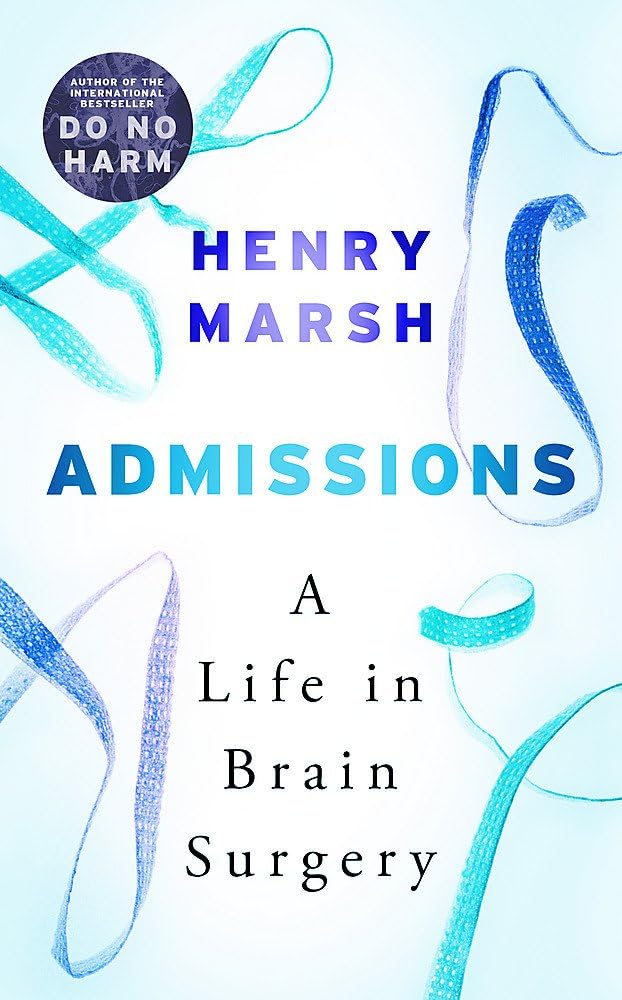
Admissions: A Life in Brain Surgery
Product ID: 48754974
Desertcart purchases this item on your behalf and handles shipping, customs, and support to Seychelles.
THE SUNDAY TIMES NO.1 BESTSELLER Henry Marsh has spent a lifetime operating on the surgical frontline. There have been exhilarating highs and devastating lows, but his love for the practice of neurosurgery has never wavered. Prompted by his retirement from his full-time job in the NHS, and through his continuing work in Nepal and Ukraine, Henry has been forced to reflect more deeply about what forty years spent handling the human brain has taught him. Moving between encounters with patients in his London hospital, to those he treats in the more extreme circumstances of his work abroad, Henry faces up to the burden of responsibility that can come with trying to reduce human suffering. Unearthing memories of his early days as a medical student, and the experiences that shaped him as a young surgeon, he explores the difficulties of a profession that deals in probabilities rather than certainties, and where the overwhelming urge to prolong life can come at a tragic cost for both patients and for those who love them. In this searing, provocative and deeply personal memoir, the bestselling author of Do No Harm finds new purpose in his own life as he approaches the end of his professional career, and a fresh understanding of what matters to us all in the end. Review: Thoughts at the career end of a renowned neurosurgeon. - Henry Marsh is a renowned neurosurgeon and author of the best-selling book ‘Do no Harm’, which related events from a lifetime working in the NHS. That book concentrated on the technical problems of brain surgery and was illustrated by many examples not only of spectacular successes, but also tragic failures, including some that were due to mistakes he freely admitted were due to him. Such frankness is still rare and continues in the present book. The book covers the period when, after a career spanning 40 years and very close to retirement age, he resigned his NHS post and spent more time on his charity work in Ukraine and Nepal, operating and teaching a new generation of young surgeons. He found the experiences very frustrating. Both countries are poor with underdeveloped health services, and patients rarely have access to appropriate aftercare. He is fully aware that he is sending patients home knowing that he has only “slowed their dying” rather than being able to resolve their problems. There are also vivid descriptions of the beauty of the mountainous Nepalese country contrasted with the squalor of the towns that a visitor finds hard to accept. He deplores the way the beauty of the Himalayas is being ruined by air pollution and rubbish, and the general state of public services. There was little in the earlier book about Marsh’s private life, except a few ‘flashbacks’ to when he was young and working in lowly positions in hospitals, although he did describe the fears he experienced when other members of own family became ill. In the current book a few more details are revealed: for example his chronic fear of swimming, the short spell he spent in a psychiatric hospital following suicidal thoughts as a young man, and his disastrous first failed marriage. Marsh’s criticisms about the way the NHS has developed with its layers of bureaucracy and lack of funds are if anything even more pronounced in this book, and his comments even more scathing. He hates the many private companies that provide outsourced services to the NHS that “prey off the NHS like hyenas off an elderly and disabled elephant – disabled by the lack of political will to keep it alive." On the other hand, he is also very critical of the American health system and is appalled by a visit to the Texas Medical Center, the largest hospital complex in the world, comprising 51 clinical institutions containing over 8000 beds. The vast amounts of money poured into the privatised healthcare system there means that hospitals copy luxury hotels. This appalls Marsh, particularly when he steps outside and sees “several dozen homeless people dossing out on the benches and sidewalks in one corner of the park” just on the edge of the hospital complex. Towards the end, he ponders how aging and his own health problems have affected him: for example, the inability to operate for long periods of time and the removal of a cancerous growth he experienced. He has developed a keen sense of his own mortality: “When my brain dies, ‘I’ will die. His trepidation and fears as he faces the prospect of encroaching old age and possible dementia is understandable when you realise that more than most people know the consequences of serious debility. His openness in discussing such things is again rare for a doctor. It is not surprising that Marsh is a supporter of euthanasia. “We are told we must not act like gods, but sometimes we must (indeed he admits he has done just that from time to time) if we believe that the doctor's role is to reduce suffering and not just to save life at any cost.” He reveals that his most precious possession is his suicide kit, which is understandably hidden in his home. He is concerned it may have passed its ‘best before’ date. After retirement Marsh bought a former lock-keeper’s cottage on the Thames near Oxford, derelict and vandalised, and refurbished it himself, returning to another of his passions, woodworking, and not just at the DIY level of most of us, but felling oak trees and producing great planks that he planed down by hand to make furniture and window frames. But even here he is self critical of his abilities as a carpenter. Marsh has produced a beautifully written, moving account of his life and work after retirement, as he looks back over a lifetime of intense activity now coming to an end. He comes across as a frustrated, not entirely happy man, never satisfied with what he has achieved, but with still a curiosity about the human brain and life in general. Despite what he says, it is hard to imagine him ‘going gently into the night’. Review: An interesting insight into the career of a surgeon and the approach of the end of life - This is an interesting further account of Henry Marsh's career. This book is more reflective than Do No Harm, as he comes to terms with advancing age and his eventual death. I enjoy his wry humour, his ability to criticize himself and his honesty about when things go wrong, or he gets them wrong. He comes across as a very human man, and not all surgeons manage that along with the ability to operate on people. Clearly he has agonized over some decisions and their outcomes. Well worth reading.
| Best Sellers Rank | 483,256 in Books ( See Top 100 in Books ) 52 in Surgery (Books) 2,499 in Medicine & Nursing |
| Customer Reviews | 4.3 out of 5 stars 3,788 Reviews |
B**N
Thoughts at the career end of a renowned neurosurgeon.
Henry Marsh is a renowned neurosurgeon and author of the best-selling book ‘Do no Harm’, which related events from a lifetime working in the NHS. That book concentrated on the technical problems of brain surgery and was illustrated by many examples not only of spectacular successes, but also tragic failures, including some that were due to mistakes he freely admitted were due to him. Such frankness is still rare and continues in the present book. The book covers the period when, after a career spanning 40 years and very close to retirement age, he resigned his NHS post and spent more time on his charity work in Ukraine and Nepal, operating and teaching a new generation of young surgeons. He found the experiences very frustrating. Both countries are poor with underdeveloped health services, and patients rarely have access to appropriate aftercare. He is fully aware that he is sending patients home knowing that he has only “slowed their dying” rather than being able to resolve their problems. There are also vivid descriptions of the beauty of the mountainous Nepalese country contrasted with the squalor of the towns that a visitor finds hard to accept. He deplores the way the beauty of the Himalayas is being ruined by air pollution and rubbish, and the general state of public services. There was little in the earlier book about Marsh’s private life, except a few ‘flashbacks’ to when he was young and working in lowly positions in hospitals, although he did describe the fears he experienced when other members of own family became ill. In the current book a few more details are revealed: for example his chronic fear of swimming, the short spell he spent in a psychiatric hospital following suicidal thoughts as a young man, and his disastrous first failed marriage. Marsh’s criticisms about the way the NHS has developed with its layers of bureaucracy and lack of funds are if anything even more pronounced in this book, and his comments even more scathing. He hates the many private companies that provide outsourced services to the NHS that “prey off the NHS like hyenas off an elderly and disabled elephant – disabled by the lack of political will to keep it alive." On the other hand, he is also very critical of the American health system and is appalled by a visit to the Texas Medical Center, the largest hospital complex in the world, comprising 51 clinical institutions containing over 8000 beds. The vast amounts of money poured into the privatised healthcare system there means that hospitals copy luxury hotels. This appalls Marsh, particularly when he steps outside and sees “several dozen homeless people dossing out on the benches and sidewalks in one corner of the park” just on the edge of the hospital complex. Towards the end, he ponders how aging and his own health problems have affected him: for example, the inability to operate for long periods of time and the removal of a cancerous growth he experienced. He has developed a keen sense of his own mortality: “When my brain dies, ‘I’ will die. His trepidation and fears as he faces the prospect of encroaching old age and possible dementia is understandable when you realise that more than most people know the consequences of serious debility. His openness in discussing such things is again rare for a doctor. It is not surprising that Marsh is a supporter of euthanasia. “We are told we must not act like gods, but sometimes we must (indeed he admits he has done just that from time to time) if we believe that the doctor's role is to reduce suffering and not just to save life at any cost.” He reveals that his most precious possession is his suicide kit, which is understandably hidden in his home. He is concerned it may have passed its ‘best before’ date. After retirement Marsh bought a former lock-keeper’s cottage on the Thames near Oxford, derelict and vandalised, and refurbished it himself, returning to another of his passions, woodworking, and not just at the DIY level of most of us, but felling oak trees and producing great planks that he planed down by hand to make furniture and window frames. But even here he is self critical of his abilities as a carpenter. Marsh has produced a beautifully written, moving account of his life and work after retirement, as he looks back over a lifetime of intense activity now coming to an end. He comes across as a frustrated, not entirely happy man, never satisfied with what he has achieved, but with still a curiosity about the human brain and life in general. Despite what he says, it is hard to imagine him ‘going gently into the night’.
M**S
An interesting insight into the career of a surgeon and the approach of the end of life
This is an interesting further account of Henry Marsh's career. This book is more reflective than Do No Harm, as he comes to terms with advancing age and his eventual death. I enjoy his wry humour, his ability to criticize himself and his honesty about when things go wrong, or he gets them wrong. He comes across as a very human man, and not all surgeons manage that along with the ability to operate on people. Clearly he has agonized over some decisions and their outcomes. Well worth reading.
B**.
Frank, brutally honest, yet totally captivating.
Writing as someone who has been operated on by Mr Marsh nearly 30 years ago, and to whom I am eternally grateful. If you were looking for a book full of happy endings of successful treatments and satisfied patients then don't read this book (although I am sure there will be hundreds/thousands of such cases). This is candidly and brutally honest about his own shortcomings, as well as of the healthcare systems he was part of. There are many regrets, failed relationships both personal and professional. The stories are all still very interesting, and full of lessons to be learned, even if sometimes that lesson is too late for some. Considering also what we know now about Mr Marsh's condition (spoiler alert - see his latest book), some of this book is remarkably prescient, even in the very first sentence talking about his "suicide kit", and ending with his thoughts on the balance of ongoing treatment versus being able to "ease the suffering" as it's euphemistically put. All that aside, it's still very engaging, interesting, and fascinating to hear the thoughts, warts and all, of a long and very distinguished career.
J**G
The meaning of life?
Truly wonderful book. And very different to his first which was an insightful and fascinating insight into medicine and neurosurgery from the perspective of an expert. Rather than “more of the same” this is very different. Didn’t grip me at first. But as I got into it started to appreciate it was more the story of a life, perspectives on medicine, the NHS, and how our lives and culture compares to this places as distant in miles and outlook as Nepal and Ukraine. At times gentle. At times rather deep. I found reading (and listening as the audio book narrated by the author was rather wonderful) to the views of a gentleman towards the latter end of his career and life reflecting not just on what he had learned professionally, but also personally, warm, comforting and genuinely thought provoking. “I wish I were a sea squirt, If life became a strain, I’d veg out on the nearest rock And reabsorb my brain” “75% of our lifetime medical costs will be incurred within the last 6 months of our life incurring expenses against the statisticians odds and inflicting a cost on society” “I am a neurosurgeon. I know that everything I am, everything I think and feel, consciously or unconsciously, is the electrochemical activity of my billions of brain cells, joined together with a near-infinite number of synapses (or however many of them are left as I get older). When my brain dies, ‘I’ will die. ‘I’ am a transient electrochemical dance, made of myriad bits of information; and information, as the physicists tell us, is physical. What those myriad pieces of information, disassembled, will recombine to form after my death, there is no way of knowing. I had once hoped it would be oak leaves and wood.”
B**A
A Disappointing Follow Up to Do No Harm
Having quite thoroughly enjoyed reading Henry Marsh's previous book, international best seller 'Do No Harm', I decided to purchase this book, and was eager to read of more tales of daring neurosurgery, and to enjoy his internal monologue over the moralities of defensive medicine, and his feelings when things would inevitably go wrong. A story which is continuously revisited throughout the book, is Henry Marsh's 'retirement project', where he attempts to restore a dilapidated overgrown old cottage with smashed windows and mounds of rubbish to its former glory. Much to his dismay, his progress is stymied through his own commitments, and that of vandals. The state of cottage seems somewhat analogous to the state of this book. In some chapters, you settle back into the familiar writing style present throughout 'Do No Harm'. I personally found these quite easy to read. In other chapters, Marsh cuts from one story based in a particular location and timescale (i.e. surgery in the UK 30 years ago) to another (i.e. talking to a px in the Ukraine or Nepal in the 2010s) without any warning, and it all feels very messy. It is these chapters which I feel make this book much more difficult to read than the predecessor, which is a tremendous shame. It is harder to keep track of what is happening, where it is happening, when it is happening, and who with. Although slightly self indulgent, I quite enjoyed learning a little of Henry Marsh's history, his relationship with his parents, wife and children. However I felt that diversions into such history interrupted the natural flow of the writing, and was an unwanted distraction. I feel that this is something which is prominent with the book as a whole. To a certain extent I blame the editors. This book would be significantly better had the various stories about Nepal, Ukraine, USA, UK etc been more logically ordered. I wanted to enjoy various segments of the book, but will admit to losing interest due to the structure of the chapters. Although this book is brilliant, I did not find that the narrative flowed naturally within and between the chapters, especially compared to Do No Harm.
W**N
full of interest and strongly recommended to others
Writing a second book was always going to be a challenge for Henry Marsh - in that his first book was gripping and would seem to have dealt with most aspects of his career as a neurosurgeon. This new book finds Marsh preparing for retirement and conducting his final NHS operations as well as renovating a lock-keeper's cottage near Oxford and reflecting on his life and to a degree those of his parents. He is working overseas in Ukraine (not happily now) and in Nepal (where there are interesting issues to explore about the role of neurosurgery in such an economy). Marsh is full of rage (which he expresses in a way that he regrets with a nurse during the aftercare of the patient who is he subject of his final UK operation) and outrage (against the NHS of today, bureaucratic targets and processes such as checklists), and also the healthcare systems of other countries. I found overall that this was slightly less gripping that Marsh's fist book. But it was still full of interest and I would strongly recommend it to others.
W**G
A brilliant bitter sweet memoir.
I was eager to read the follow up to his first book, Do No Harm, and was not disappointed. Admissions (a great title for a medic, chosen by his wife) is more reflective - about his family, his education and career. His passion for fine woodworking, coupled with his DIY skills (and errors) is cleverly weaved into his dedication to neurosurgery. In fact, great care is needed in both creating a masterpiece in wood and operating on the most challenging of organs, the brain. The difference, of course, is that a tiny mistake in brain surgery can have catastrophic consequences. What comes through so clearly is Henry Marsh's great humanity, generosity, and treating patients as vulnerable, worried people, and not as objects. He is frustrated - and angry - as doctors and surgeons have been relegated and subsumed within a managerial culture in the NHS, and he often despairs at his impotency in working and training surgeons in hospitals in Nepal and Ukraine given the lack of resources and experince (and not least his lack of understanding the languages). This is a very readable, bitter sweet account of his life and work, plenty of sad regrets, but many joyous high points. We all hope that when we need medical care we will be treated by such a professional as Henry Marsh, who is frank, honest and sympathetic - and an expert at doing the job. The NHS should pay a lot more attention to the frontline Henry Marshes of this world and less to the profit and loss obsessed paper-pushers.
L**)
Something A Neurosurgical Registrar Can Reflect On
This book is a beautiful book. It simply is beautiful. It encompasses an approach to reflective practice that is not formulaic but spontaneous and genuinely thoughtful. In just two books Mr. Marsh has redefined the neurosurgical memoir. His book Do No Harm represents a realistic portrayal of an NHS consultant neurosurgeon in a bustling place. Its unbridled honesty is something countless readers outside but more importantly inside medicine (and neurosurgery) have remarked on as being a triumph. You cannot help but detect a highly complex human being arriving into one of the most elusive specialties in medical practice through a personal evolutionary process that is anything but typical, e.g. dropping out of Oxford, moving far away from home, being a hospital porter then returning back. It contains a substance that makes books successful. This book Admissions had a lot to step to. But simply put in combination these two books blast away every single other book composed by neurosurgeons. Frank Vertosick Jr book When The Air Hits Your Brain possesses several powerful clinical cases that explains far more then neurosurgical practice, e.g. the deeply Christian couple expecting their first child and the harrowing experiences they had remains deeply embedded. Admissions communicates those personal changes that people spending so much time in surgery might reflect on towards older age. The under current to this book is that Mr. Marsh is a human being and thinks on the same concepts of death and suffering as everyone else does. But he communicates his personal thoughts and experiences in ways precious few have done. It is so well written that in conjunction to several other things in the book it is clear he is a polymath and someone so tortured to keep pushing himself. I have a neurosurgical registrar colleague that communicated several things about his feelings towards success and neurosurgery in the exact same ways expressed in this book. He too is a highly complex human being that even I as a friend and colleague do not fully understand. But this is typical for neurosurgeons, neurosurgical trainees and people seriously aspiring to be neurosurgeons: it is a specialty that attracts hyper curious, super bright, deeply introspective and thoroughly hard working individuals that and driven in ways precious few are (although Chris Hadfield might put us to shame with his work ethic). Why? Because your brain is the most complex entity in the known universe and it demands the utmost respect in terms of human cleverness, dedication and appreciation to even think to touch it. Mr. Marsh has in many ways tackled a topic that precious few talk about. That is the deep impact chasing neurosurgery, getting into neurosurgery, training in it and practising it for decades has on an individual: a profound introspection about who exactly you are. The complications in neurosurgery demand it at the very least (as do our patients). Read this book.
T**C
book looked old
book looked old, blackened at the edges of the cover and frayed at the edges of the spine.
L**T
Second book by Henry Marsh
Having enjoyed 'Do no harm' I was interested in reading his follow-up book which although not quite as compelling as the first book is very well worth reading.
M**I
interessante
Le riflessioni del grande chirurgo Henry Marsh a fine carriera. Ci sono gli aspetti personali: gli effetti del lavoro sulla vita familiare, le asperita del carattere, le illusioni e l'arroganza della gioventu, la tensione che lo ha sempre accompagnato. Ci sono di pari passo le rifessioni sui cambiamenti progressivi della professione del neurochirurgo in un sistema sanitario che cambia (in peggio) e che rischia di diventare sempre più simile a quello statunitense. L'intelligenza dell'autore rende il libro sempre interessante ma rispetto ad "admissions" sicuramente più malinconico e amaro
K**R
Excellent Book
My self having undergone neurosurgery, this books gives great insights from doctors perspective. Must read (if they can) for people like me. Take care
M**A
Livre excellent
Le livre est excellent
Trustpilot
3 days ago
1 month ago