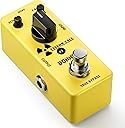
I am hijacking my wife's account to post this. Hopefully it helps. Over the past couple years, I have purchased every Nano and Mini Pedal that Donner has made. Some of them I have two of. Some I do not use at all. Only because I prefer specific ones over the others. For instance, I have the Verb Square, Echo Square, and Mod Square pedals, but prefer the Yellow Fall pedal for its simple operation. I also have all the Super Mini or Nano pedals, which are also great, but decided on the Mini Pedals for my set up, just because of how they can be configured so closely using Getaria cables. After many reconfigurations and finally watching a 1 hour YouTube video interview with Steve Vai about the principles of splitting a signal and playing in stereo, I set up a couple amps, and now have the option of playing in stereo using several Donner pedals that I feel produce the best signal path that I can control to create the voicings I am looking to emulate. For starters, I have a 1973 Peavey Studio Pro 40 that I use as my amp head that has been in the family my whole life, though I have only seriously learning to play guitar in the past few years. It was barely used until it was passed on to me, and probably not utilized the way I am using it now. I also have an Acoustic A20, an Acoustic G120 DSP, and configured an old set of Infinity speakers (two 1x12's) into a cabinet for testing the quality of the unbalanced line out on the Peavey. After two years of playing around with the pedal configurations and watching the Steve Vai interview, I have settled on this configuration as the optimum path for pushing the cleanest signal until I am ready to manipulate it: I run the clean signal from the GTR into the following Donner pedals listed in order powered by two DP-1 power supplies, and one DP-2 power supply, with the majority of the pedals mounted on a DB-3 Pedalboard for the main signal path: Donner Wah Cry (wah/volume), DT Deluxe Chromatic Tuner (tuner)*, Ultimate Comp (compression/sustain)**, Stylish Fuzz (fuzz/distortion), Extreme Driver (boost/overdrive/distortion), Pearl Tremor (phaser), Blues Drive (gain/overdrive), Boost Killer (gain), Morpher (distortion), Giant Metal (boost/distortion)***, and Viper (passive volume) pedals into Channel 1 (high gain) on the front of the amp. On the back of the Peavey Studio Pro 40 amp are jacks for an FX loop, an Unbalanced Line Out (ULO), and a footswitch controller. From the back, it comes out of the Send jack into the following Donner pedals: Noise Killer (noise gate/ suppressor)**, Jet Convolution (flanger), Harmonic Square (octave/pitch shifter), Tutti Love Chorus (chorus), ABY BOX (line switch) [pay attention here], Yellow Fall (delay), Golden Tremolo (tremolo), and finally into a Looper (loop station) which then goes into the Pwr In (Return) on the back of the amp to complete the effects loop. On the back of the Peavey, since it ALSO has the ULO jack, the signal coming out of the ULO can go to a mixer, recorder, another combo amp, or speaker cabinet. Using the ABY switch to split the signal before the Yellow Fall (delay effects), I can send a signal path to another amplifier and play in stereo (in this case, simultaneously using the Studio Pro 40 and the G120 with the slider switch set to ABY). If I use the ULO and utilize another speaker cabinet set-up, it enables me to use the Peavey as a monitor with a simultaneous split for a 3-channel Surround Sound Stereo effect. Using the ABY switch immediately after the Tutti Love Chorus, the signal path 'B' gets sent into Channel 1 of the Acoustic G120 DSP (high gain) on the front of the amplifier. The signal comes out the FX Loop on the backside (Send) into a MOOER GE-100 (configured to preset #64 'PreAmp Driver', or #65 'JC Amp'), and then into a second Donner Yellow Fall (which is the same delay pedal as on the 'A' signal side of the ABY BOX) with the echo, time and feedback settings compensated so the Acoustic G120 sound washes over the output of the Peavey Studio Pro 40 so that the delays in sync. For a regular set up (Dual Channel stereo), the Peavey is directly in front of me, with all the foot controls comfortably within reach, and most of them on the Donner pedal board. Any other amps or cabinets are about 10 - 15' away to the left and right facing out. This set up CAN BE VERY LOUD! The Viper (passive Volume/Expression) pedal is key to controlling the signal level and achieving the sound you want, based on your guitar, how hot the pickups are, the strings you use, etc. But it can also be soft, clean, warm, bright, rich, or spacey. With just one ABY switch at the end of the signal path, just before any time effects are applied, the signal is split into A and B, enabling me to play, A, B, or Both (Y). Playing 'Y' (A and B together), I can play in stereo (up to 160 watts), and with the 'B' signal passing through the MOOER GE-100, I can wither use its metronome feature, or select from a variety of preset drumbeat styles and adjust the tempo to play along with. It also has an MP3 input, to play along with your favorite songs or prerecorded tracks. It also has its own looper with over dub features, so between the MOOER GE-100 and the Donner Looper, I have 2 loopers available to play multiple riffs of up to 10 minutes at the same time. And if I really want to get crazy, the MOOER has 80 preselected voicings to use with its own integrated volume/wah pedal (as well as room for 80 more user programmed presets). This enables me to split the signal and have one guitar playing like there are two; either playing the same notes with two separate effects signals, or playing in unison with the same effects signal. Yesterday I added another ABY BOX Line Selector between the GTR and the Wah Cry to go into an Acoustic A20 amp (for acoustic and hollow body guitars) to use as a lower watt amplifier head and/or monitor plugged into Channel 2 on the Acoustic G120 DSP. Using the ABY Boxes and a Line 6 (2 button latching footswitch) to switch Channels on the G120, I can direct the signal to go from the Peavey into the G120 DSP (toggling between channels 1 & 2) or into the A20 and come out the FX loop and through the MOOER and any other effects (I can take the MOOER out and toss in an entirely separate set of Donner effects or cabinet simulator effects pedals -- Dynamic Wah, Sweet Juice, Incredible V, Green Land, Force 2, Black Devil, or MOOER M005 Brown Sound as well or in the ULO path for different cabinet simulations). [A side note here: I am exploring the possibility of adding a EarthQuaker Devices Swiss Things Pedal Board Reconciler for more control in place of the first ABY Box (between GTR and the Wah Cry) and letting it manage one of the signal paths to either the G120 DSP or a more aggressive cabinet setup like a 200w Marshall stack (400W total).] All the effects pedals (stomp boxes) are true bypass, so depending on whether I want to play some blues, pop, funk, rockabilly, country, rock, metal, or jazz -- it just depends on which guitar I pick up (acoustic, electric, hollow body, semi-hollow body), what effects I apply, and where I direct the signal. I have my sights set on a Marshall cabinet (or stack of two) to have a 200w (possibly 400w) option available and still use the Peavey as the amp head because it has the one thing the Acoustic G120DSP doesn't -- an Unbalanced Line Out to be able to play in stereo or with a smaller amp and integral FX loop as a monitor. With a double latching Peavey footswitch connected to the Studio Pro 40 (I cannot find a vintage Automix, so I have a Peavey multi-purpose 2 function footswitch), and a double latching Line 6 footswitch connected to the G120 to change between high gain or low gain input channels, though they create a pretty large footprint with all the pedals and footswitches, I have total control as I play. It is important to note that the placement of the PolyTune 3 serves as a kill/mute switch for everything but the drumbeat or metronome (there is a Rhythm switch on the MOOER GE-100 to turn this feature on and off). This set up can be pretty interesting, and is definitely a lot of fun! Though I have them all, I have spent significantly less on the Donner brand than any Boss, MXR, or other major brand to have all the effects available to recreate any voicing -- from a clean 50's vintage tube amp, to a heavily distorted or modulated brown sound -- I can dial it in through the Donner configuration, or choose a preset in the MOOER GE-100 and play along or improvise my own music. *Note 1: I will be replacing the Donner Chromatic Tuner with a PolyTune 3 for more immediate recognition of which string may be out of tune and higher tolerance. **Note 2: Depending on your amplifier's ability to apply more equalization to the signal pre amp and/or post amp, you may want to consider a 5-band Graphic EQ (filter) either between the Ultimate Comp and the Stylish Fuzz, or immediately after the Noise Killer. ***Note 3: Fuzz, gain, overdrive, boost, distortion are in increasing order of how many ohms they utilize and the dB they output in order to eliminate accumulation of line hiss that is common when high gain/distortion pedals are in series despite whether they are true bypass. Summary: GTR <cord > >ABY BOX 1 (line selector) [optional placement of EarthQuaker Swiss Things Pedal Board Reconciler (ABY/FX channel controller] > Path 'A' [Box 1] <cord> [Donner DP-3 Pedal Board] >Wah Cry (wah/volume) [may substitute with Auto Wah}, >PolyTune 3 (tuner), >Ultimate Comp (compression/sustain), >Graphic EQ (filter) [optional placement] >Stylish Fuzz (fuzz/distortion), >Extreme Driver (boost/overdrive/distortion), >Pearl Tremor (phaser), >Blues Drive (gain/overdrive), >Boost Killer (gain), >Morpher (distortion), >Giant Metal (boost/distortion), >Viper (passive volume/expression) <cord> into +Channel 1 (high gain) on the front of the amp (Peavey Studio Pro 40). >Path 'B' [Box 1] <cord> into +Channel 1 (high gain) on the front of the amp [Acoustic A20]. {Acoustic A20] +Direct Out into +Channel 2 (low gain) on the front of the amp [Acoustic G120 DSP]. [If your amp does not have an FX loop, then just connect the rest of the following pedals in series immediately after the Viper and then plug the entire signal chain into the high gain channel of your amp.] [Peavey Studio Pro 40] +FX Send >Noise Killer (noise gate/ suppressor), >Graphic EQ (filter) [optional placement] >Jet Convolution (flanger), >Harmonic Square (octave/pitch shifter), >Tutti Love Chorus (chorus), >ABY BOX 2 (line selector), >Path 'A' [Box 2] >Yellow Fall (delay), >Golden Tremolo (tremolo), >Looper (digital looper) <cord> into +FX Return (Peavey Studio Pro 40). +ULO (Peavey Studio Pro 40) <cord> >Marshall MG412BG and MG412AG cabinet stack +Peavey Two Button Multipurpose Footswitch {Activates or Defeats Saturation and Reverb functions} >Path 'B' [Box 2] <cord> into + Channel 1 (high gain) on the front of the amp (Acoustic G120 DSP). [Acoustic G120 DSP] +FX Send <cord> >MOOER GE-100, >Yellow Fall (delay) <cord> into +FX Return (Acoustic G120 DSP).