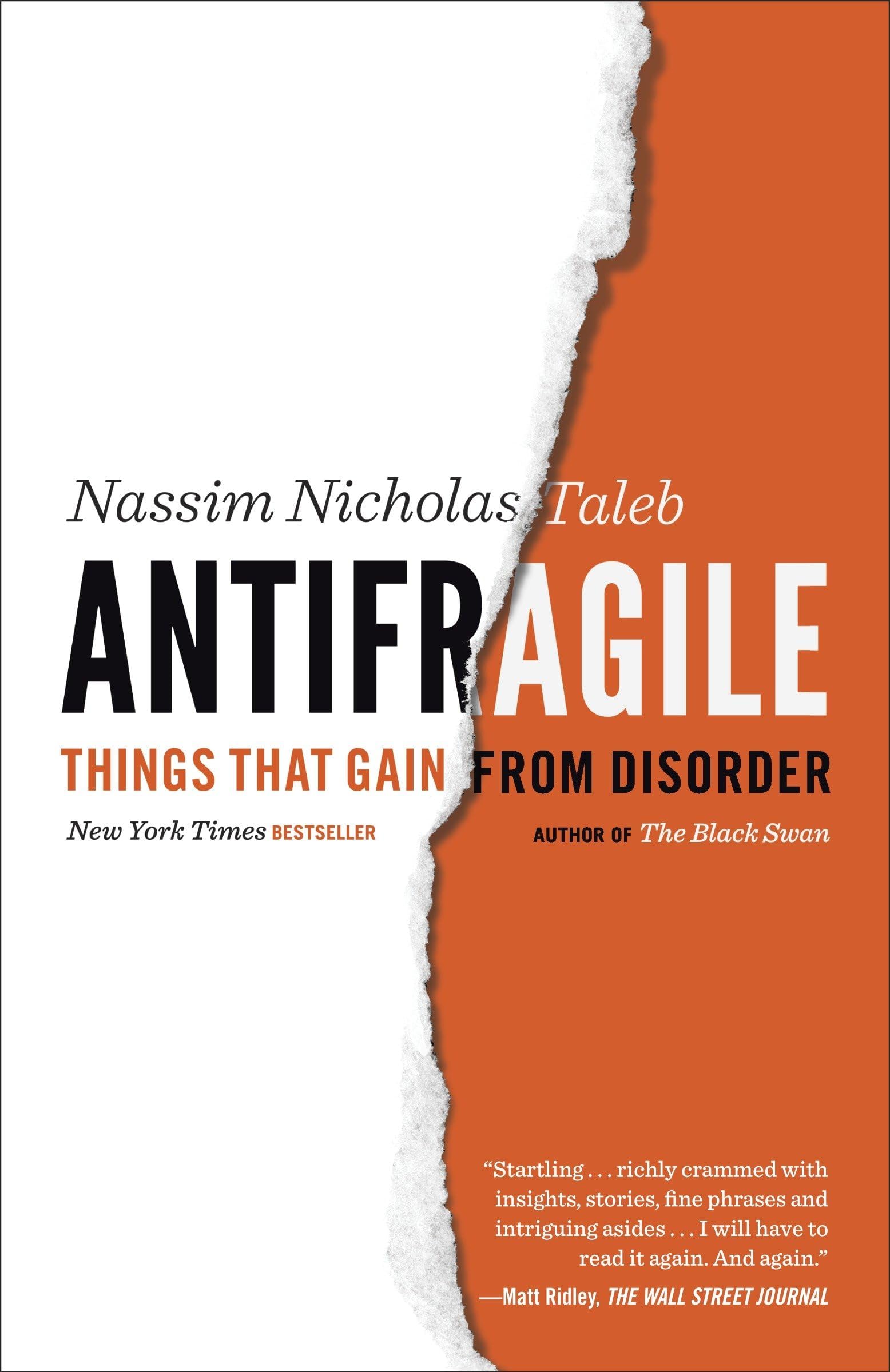
Antifragile: Things That Gain from Disorder: 3 (Incerto)
Product ID: 546559705
⚡Revolutionary antifragile concept
📈Thrives on volatility
📚Deep interdisciplinary insight
Desertcart purchases this item on your behalf and handles shipping, customs, and support to Seychelles.
⚡ Embrace chaos, thrive in disorder — be truly antifragile!
Antifragile by Nassim Nicholas Taleb is a groundbreaking book that redefines how we understand risk, uncertainty, and disorder. Part of the acclaimed Incerto series, it introduces the concept of antifragility—systems that grow stronger under stress and volatility. Combining philosophy, economics, history, and practical wisdom, Taleb offers a bold blueprint for thriving in an unpredictable world, challenging conventional thinking and empowering readers to harness chaos for success.


| Best Sellers Rank | 672,720 in Books ( See Top 100 in Books ) 8 in Finance & Stock Market History 13 in Business & Economic History 40 in Philosophy (Books) |
| Customer Reviews | 4.4 out of 5 stars 7,940 Reviews |
A**N
5 things Nassim Nicholas Taleb hates
The third book of Taleb's Incerto trilogy was published in November 2012 and is now available in paperback. His first two books, Fooled By Randomness and The Black Swan, sold so well that he was paid an advance of $4m for the final instalment. Antifragile is an interesting read both intellectually and personally. Taleb famously gives little away to journalists but in this book his personality shines out through his writing. So emotionally charged is the book, I thought it would be appropriate to review it by reference to the subjects contained that come in for the most vitriol from Taleb. 1. Bankers Readers familiar with Taleb's other writings will already know how he feels about bankers. Taleb's definition of antifragility (systems that get stronger under volatility, as opposed to fragile ones that break) stems from his work in banking. One criticism that is already gaining much ground elsewhere is the absence of "skin in the game" for traders gambling with their clients' money. But Taleb's dislike of bankers is not just an academic one. Personal insults abound, including a "suit" held to task for getting a porter to carry his bags to the gym. 2. Politicians Fragility is often seen at a relatively simple level, a glass being the obvious example, whereas antifragility is a property of complex systems - the human body, human populations or markets. Politicians come under fire on (at least!) two counts. First, they cause chaos by interfering with systems that they do not understand. In particular, interventions by politicians tend to favour eradication of error, which increases fragility and risk of collapse. Secondly, and more strongly, politicians frequently gain personal advantage at the cost of others by talking a good game that they do not practice in their own lives. 3. Economists I don't think I need to explain why Taleb hates economists or give examples from the book. Instead I just want to mention Taleb's rather touching fondness for Nobel-prize winning economist Joseph Stiglitz. Despite Taleb naming the Stiglitz syndrome (predicting the future inconsistently and only taking credit for the ones that turn out to be correct) after him, Stiglitz does not come in for the same strength of insults dished out to other "fragilistas" and I am amused by my impression Taleb secretly quite likes him. 4. Alternative Medicine Taleb has a disdain for all modern medicine, and a whole section of the book explains the wrongheadedness of risking a serious issue by using insufficiently tested medicine for a non-life-threatening condition. The terrible example of treating morning sickness with thalidomide makes this point well. But don't confuse Taleb's skepticism with a belief in alternative therapies - he "went postal" on receiving a letter of support from one such practitioner saying she understood how he felt. 5. Orange Juice Taleb's hatred for orange juice is an example of a wider disdain for the modern diet. He reveals his personal food rules, and very fascinating they are: no liquids that have not existed for at least one thousand years (i.e. wine, water and coffee only), no fruit not present in the ancient Mediterranean (no pineapples, pawpaws or other exotica) and observance of Greek Orthodox fasts for health rather than religious reasons. He considers oranges to be the equivalent of candy, as the modern variety have been intentionally bred for their sweetness. I found Antifragile to be thought provoking and very entertaining. It is full of contradictions and inconsistencies, but the sincere passion behind the main themes gives the book its charm. The most delicious irony is that according to Taleb's own criteria - a book is more likely to contain accurate useful ideas the longer it has been in existence - the reader made their first mistake in choosing to pick the book up.
T**S
One of the greatest books ever written
The popularity of Taleb's books and ideas is perhaps better captured on his Facebook page than Amazon, where he has thousands of likes and hundreds participate in discussions he stimulates. There are many people who, probably like myself, consider him one of the finest minds of the past 50 years. It is hard to capture quite what he does. I expect that if you read his book from one perspective, such as business or economics or politics or risk management that you will be interested by some parts of it and uninterested by others. But If like me you are truly interested in society, human nature and potential then this is a book full of profound insight and deductions. Sure, it is opinionated. He seems to be opinionated to his own detriment rather than to sell a book, as he has to deal with things like death threats and hate mail etc, and he has bulked up to be like a bodyguard to help with this. If you are a philosopher who suspects that there are some fundamental misconceptions within modern society, then Taleb is bound to stimulate you with his work. He doesn't just rely on personal experience and logic and opinion to create and illustrate his arguments, but a life-time's intelligent reading, and three years seclusion and study (approx). Taleb in a way trained himself in literature and art before moving onto statistics and then to pretty much every subject that exists. And this comes through. He gives a holistic interpretation of reality, human knowledge, society, maths etc. But this is backed up, in the appendix, by truly insightful qualified debunking of some economic theories such as the Ricardo-Smith comparative advantage thingy. Overall, Taleb comes through as a truly original thinker. His ideas are new philosophy, but he somehow manages to take a different direction to the postmodernists who in a way tackled similar subjects, drawing in contrast on historic wisdom as a theme. Things tend to survive for a reason. And he takes the rare point of view (which may never be repeated) of someone who has managed to work within and alongside academia, but has successfully preserved his skepticism of academic thought and knowledge. But perhaps more than anything, his book with its countless illustrative diversions will teach you so much about the history of good ideas and the makers of world culture.
M**N
The alternative to the impossible prediction of Black Swans.
In Fooled by Randomness and The Black Swan, Taleb predicted the financial crisis of 2008. But more than predicting that particular crisis he advanced the idea that Black Swans, which are large scale, unpredictable and irregular events of massive consequence, cannot be predicted and consequently forecasts and predictions by experts or anyone else are useless. This left me with a conundrum. Doesn't any activity in life whether it is marraige or business investment require a prediction? In Antifragile, Taleb addresses this issue. He proposes replacing prediction with classifying systems and things as Fragile, Robust of Antifragile. He argues that things can be fragile but the opposite of the fragile is not robust, which are simply things that would break with greater difficult than the fragile. It is the "antifragile" that benefit from shocks, and thrive and grow when exposed to volatility, randomness, disorder and stressors. The fundamental idea of the book is that by grasping the mechanisms of antifragility we can build a systematic and broad guide to non predictive decision making under uncertainty in business, politics, medicine and life in general. It is far easier to figure out if something is fragile rather than predict the occurrence of an event that may harm it. The key is the emphasis on designing antifragility into the system. You cannot say with any reliability that a certain remote event is more likely than another but you can state with a lot more confidence that an object or structure is more fragile than another should a certain event happen. He then goes on to argue that by removing stressors from the system or minimsing volatility, fragility is being built into the system. He draws the parallel with weight training which, by increasing stress, creates a stronger body; or immunisation that by injecting small doses of nasty substances into the body, immunity is generated. The problem with artificially suppressing volatility or minimising risk is not just that the system tends to become extremely fragile; it is also that , at the same time , it masks exhibition of visible risks. So silent risks accumulate under the surface. Stability promoted by political and economic policy makers, intended to inhibit fluctuations, tend to have the opposite effect - they result in more massive blowups. Two central elements of modernity are naive interventionism and the unconditional belief in the idea of scientific prediction. He maintains that anything where there is naive intervention will have iatrogenics (harm caused by the healer). He qualifies this by saying he is not against intervention, but he warns against naive intervention and the lack of awareness of the harm done by it. For example intervening to limit size (of companies, airports, sources of pollution) concentration and speed are beneficial in reducing Black Swan risks. Interventionism in the form of "look what I did for you" should be replaced by inaction. Taleb is allergic to theories which are not founded on practice and he is venomous about universities and the majority of academic life. He sees academic theory as reflecting the illusion that you know exactly where you are going and assuming today what your preferences will be tomorrow. Additionallly never ask people what they want to go, or where they they think they should go. Instead create options for yourself and for others. The important difference between theory and practice lies precisely in the detection of the sequence of events and retaining the sequence in memory. Life is lived forward but remembered backwards. The ability to switch a course of action is an option to change. Options are what allows you to benefit from the positive side of uncertainty without the corresponding serious harm from the negative side. I think you can see I found the key messages of the book stimulating. But the presentation is often dense and rambling. He displays his fascination with in classic Greek and Roman philosophies beyond my reach and luckily my kindle has a dictionary because frequently vocabulary unfamiliar to me is used! He repeats his points and there is a lack of structure but the advantage is he provides rich examples and illustrations. Not an easy book but well worth the effort.
M**M
A MUST read.
Not a super easy read. But, why should it be? Really. Life is far more complex than most folks would like to admit. Especially our politicians, bosses, leaders etc. A good focus on this book is very rewarding. There is a dreadful truth. Which is probably that most of the time we are kidding ourselves about the control and our resilience we really have. Whether it's over our society, environment, the weather, conflicts and confrontations, physical, political, romantic, etc, etc. Life. Having just come through the first wave of Covid 19. I found it was a perfect example of Taleb's concept. The topic presented in this work is 100% spot on. The response of the public governments and health providers was just as Taleb' anticipates. The progress of Covid 19 through the global community was influenced by all the randomness and unpredictability that Taleb identifies as being massively influential on our everyday lives, yet un-recognised and discounted by most of us. I'm not saying the book is some kind of prophecy. No, the book is a description of the way people cope with, try to cope with, or don't cope with reality and that which cannot be predicted. So, armed with Taleb's thoughts and observations of the way that humans do and don't cope with life, I feel that I now have something that I'm sure most of us want. Yet few of us have. An edge, over everyone else, which is simply, a better idea of how things happen and whats really going on. Also a little sadness that humans have a LONG way to go yet, before enough of us ''Get it'' . To make a worthwhile difference to our societies. Essential reading, if you would like to make the most of your life. Taleb, is not, by the way an un-educated scrawler of self help books. He has devoted a signifcant life time effort to producing three books this being the third, on the topic of 'randomness' and how we cope or don't cope with it. He is also clever enough to have made enough money and a reputation as a serious thinker, that he doesn't have to write books for a living nor have them edited by a publisher in order to attract an audience. If folks don't read his books it's their loss.
F**K
"Antifragile" could easily be considered his main book
If you like Nassim Nicholas Taleb's other books, in particular "The Black Swan" and "Fooled by Randomness" you will most definitely like `Antifragile' too. This book continues and builds on the themes from " The Black Swan: The Impact of the Highly Improbable " and " Fooled by Randomness: The Hidden Role of Chance in Life and in the Markets " with the same intelligence and crude sense of humor. Through insights, anecdotes and fascinating detours into the history of science and philosophy Taleb shows an intriguing and convincing way to look at systems, particularly how we quantify risk. Taleb explains that all things are fragile, robust, or anti-fragile. Things that are fragile are easily damaged by disorder, things that are robust hold up well in most situations and are not easily damaged, but things that are anti-fragile benefit from disorder and grow stronger from hard times. Despite being the most recent of his books, "Antifragile" could easily be considered the main book and the other two books mentioned above could be seen as supplements to this book. In other words, if you were to read only one of his books, read this one (and then you are inevitably going to read the other two anyway) The book has more than 500 pages and is not exactly an easy read. The book includes a long citation list for the curious reader as well as a full glossary of all the terms Taleb has introduced us to. When finishing "Antifragile" or any other book by Mr. Taleb, and moving on to another book I got the same feeling as when you speed down in order to drive off the highway to enter a city road. Everything suddenly feels really "slow". I know for sure I am going to re-read "Antifragile" several times over the following years. Highly recommended.
D**A
the ramblings of an inteligent man
this book is written with the attitude of what he likes to call f"$> you money. Clouded by his own ego this book rambles on in an 'I'm right and you're the wrong' kind of fashion. Yes, anti-fragile is an enlightening concept, pity about the rest of the noise. Reading this book is like weeding the garden and quite often difficult to distinguish the weeds from the flowers. Often simply wrong or contradictory to itself this book is a lazy effort with a lot of gems sprinkled in between. Definitely worth reading for those gems but careful, mind the weeds
S**N
Compelling read containing vital insights
I thoroughly enjoyed this book. I completely understand some of the other reviewer's frustrations, but once I got about halfway through I found it came together, made sense and became a compelling read. My interest in this topic goes back to a period of being close to some large public sector programmes that seemed to be chaotic: small events seemed to have dramatically bad consequences, causing the programme to go off the rails, or not, and it was impossible to predict which, though it was horribly obvious with hindsight. So I was really interested to read this account of events that are unpredictable and where the impact can be huge and asymmetric. Taleb's lesson is that those large programmes are fragile because the impact of change can be slightly good, or enormously destructive, but never enormously positive. A bad place to be as one programme can take out all a company's profits made over years - profits that may have already been distributed to shareholders, and if so, the company and its operating model exits the gene pool. Taleb's advice is obviously to be antifragile. However this is a very difficult thing to do. It means innovating conservatively, appearing to make many unconventional decisions, labelled poor, that turn out to be good ones only in the long run and with hindsight. Most Shareholders are not so happy with this approach. But it can work as I was intrigued to read in the FT yesterday (14 Jan 2013, Handelsbanken grows using retail blueprint). There's much, much more of interest in this book, indeed something to think about on every page. It's hard work in places as Taleb writes for his own enjoyment as much as our edification. In doing so he covers a huge range of topics from investment and innovation to health and ethics, not to mention autobiography, showing how personally and in society and business we can benefit from being antifragile and avoiding being fragile.
N**S
Great idea, book itself a little too long
Review courtesy of www.subtleillumination.com What’s the opposite of fragility? Most people say robustness, resilience, or strength. Most people, says Taleb, are wrong. Fragility is to be weakened by uncertainty or volatility, while resilience is to be unaffected by volatility. What we need is something strengthened by volatility and change – something antifragile. That, in a nutshell, is Antifragile. Like all the best ideas, it’s a simple idea with immediate, important, and interesting consequences. In particular, Taleb argues that the modern world, in its quest for efficiency and optimization, has ignored the effects of volatility. As a result, shocks (Black Swans) have catastrophic consequences. When one hits, however, we ask the wrong question. We demand to know why we failed to predict the housing bubble or disease outbreak, instead of asking ourselves why we built a system that is tremendously vulnerable to such shocks. Instead of eliminating centralization and vulnerability in our systems, like big corporations or big bureaucracies, however, we keep trying to predict the future, an endeavor doomed to failure. Shocks, as Taleb has argued in other books, are rare, and so attempting to predict them is impossible because they happen so rarely – we never have enough data points to draw conclusions. (For the economists reading, he believes in fat tails). Rather than trying to predict the future, we should build systems that can evolve and adapt to it. The idea is a fairly simple one, but not I think something most of us have thought about. Once you've got it, the rest of the book doesn't add much, which is always the danger of having one great idea. It can also sometimes be a bit technical for a general audience. The idea gets 5 starts, possibly 6: the book 4 for being too long.
S**H
This book changed my life
When I first read Jurgen Appelo's Management 3.0 I was already deeply impressed. Then Frédéric Laloux' "Reinventing Organizations" touched me even more. By a random pick from a "dotnet rocks" podcast about antifragile software architectures I detected this literature gem. This book is philosphical, yet practical for the day-to-day endeavours we encounter in our so-called modern world. It opens your eyes how things influence each other. That our world is not linear and non-predictable. And that it is good that way. Taleb demystifies the scharlatan sciences such as economics as taugh in universities today and detects the vulnerable point in our western societies. Yet this is not a book to complain about the atrocities of the world we're living in. Instead it makes courage. Courage to look at our world with different eyes. See what is a short gain, but probably non-lasting like a spark. Detect what is more lasting - or antifragile - since robustness is not the inverse of fragility. This book has impact on technology, society, sociology, almost every corner of our life. Still Taleb is not a radical: While pointing out how nature helps to cure itself and is the most persistent and antifragile institution ever he doesn't get into a mood of Darwinism or survival of the fittest. He just shows up where our limits are and what's the tradeoff of the lives we live today. Deeply impressing, a must-read. My world would be paler if I had missed this book.
F**U
Excellent
Excellent
J**C
Great insights & Climax towards the end although there were some unfair statements to Dr Stiglitz
Like his previous book, there are many extremely unique insights and with so many topics mashed into a single book; it is pretty normal to read the book two or three times (like I did with the Black Swan) in order to fully appreciate the depth of the author's knowledge and the wisdom of the ancients. However, like many reviewers, I too think the author should submit his essays for editing: there are parts that are dryer than usual. So to make it more readable and for the 2nd edition of the book, he should add more satirical jokes or funny thought experiments that lighten the mood (esp. for sub book IV?) The idea of iatrogenics (or harmful side effects from receiving treatments) is interesting (In Chinese Medicine, there's a saying,"medicine carries 30% of poison") Other key insights include Stoicism, skin in the game, and many useful heuristics. In fact, we could "platonize" his key insights into useful checklists! In sum, It's a great read epecially towards the end, and it's fun reading his rants against famous authors/scholars though there are places where I feel pity and a bit unfair to scholars like Mr Stiglitz who in March 2002 (on page 478) published a paper saying that Fannie Mae 's new risk based capital standard: "ON THE BASIS OF HISTORICAL EXPERIENCE, the risk to the government from a potential default on GSE debt is effectively zero" Is this statement really completely wrong? is the author not subjected to hindsight bias? At least 9 months later ,the author in chapter 19 wrote a journalist from NY Times came to him sometime in 2003 concerning about the Fannie Mae problems; Then he wrote "if he (Stiglitz) were a businessman, he would be wiped out and exited the gene pool" That sounds way too harsh and affirmative. I would say the author suffers from overconfidence (in the same way as Stiglitz for his 2002 paper) to assert such an outrageous statement. Does a businessman, if Dr Stiglitz were one, have no optionality to get rid of his exposure or simply sell his stakes when facts and conditions change? Is it fair to insinuate that Dr Stiglitz or all investors back in 2002 would be stupid enough, after conditions obviously had changed by say 2005, to stick with Fannie Mae until it was bailed out? I think you could only argue Dr Stiglitz was overconfident about his assessments but we never knew back then in March 2002 that Alan Greenspan would maintain interest rates at such a low level for so long, and the author only realised the problem sometime in 2003. Talab is correct that Dr Stiglitz didn't see himself potentially as being the Turkey, but everyone makes mistakes based on what information they have, and I presume if Dr Stiglitz were the businessman, he would be like Warren Buffett who mistakenly bought Gen Re and had to sell all those derivatives contracts to reduce exposure. So despite loving the author's work, I would advise him to be a bit more humble and shouldn't assume the "smartest of economist" to be the most stupid investor or businessman: buy and hold or not change course towards the end even when there were so many new evidences against his initial position like housing bubble and ninja loans etc. This is completely the opposite of the Turkey's confidence being maximum based on historical evidence of being fed daily, right before the chef cooks it. To conclude, it is slightly cheap to attack an economist who he too respects in order to become infamous with assumptions that are unlikely to be true. However his main point "Joseph Stiglitz problem" might be true: "Mental cherry-picking, leading to contributing to the cause of a crisis while being convinced of the opposite-and thinking he predicted it" (pg. 432) And with his super intelligence, the author probably knows his statement "exit the gene pool" being too harsh - the attacks are probably a ploy to gain controversy deliberately to promote his book !! (he actually explained that the more criticisms the author received, the greater the sales!!) So I am helping the author to sell his book!! Anyway, whether you agree or not, readers should be grateful for having such thought provoking wonderful book available ! the glossary, appendix and notes (about 50 pages) have some more interesting and technical discussions. Thank you very much for writing such amazing book! Looking forward to the expanded version of Anti fragility in the near future with more satirical jokes and funny thought experiments in between the dry parts!
A**E
Great book
it is very good book
A**Y
Antifragility to survive, thrive and develop in unpredictable environment
Antifragile: Things That Gain from Disorder by Nassim Nicholas Taleb is a thought-provoking and insightful book that challenges readers to rethink their assumptions about risk, uncertainty, and resilience. Taleb is a renowned thinker and writer, and his ideas have had a significant impact on fields as diverse as finance, economics, and philosophy. The concept of antifragility, as introduced by Nassim Nicholas Taleb in his book "Antifragile: Things That Gain from Disorder", describes systems or entities that not only withstand stress, shocks, and uncertainty, but actually thrive and improve as a result. Antifragility is the opposite of fragility, where a system or entity is vulnerable to damage or collapse under stress, shocks, and uncertainty. Antifragile systems are characterized by their ability to adapt and learn from mistakes, to use variability and randomness to their advantage, and to improve through exposure to stressors. These systems are not only resilient, but they actively seek out and benefit from disruption and disorder. Taleb argues that antifragility is an essential characteristic for survival and success in complex and unpredictable environments. He identifies a range of antifragile systems, from biological organisms that improve through exposure to stressors, to businesses that thrive in volatile markets, to cultures and social systems that evolve through trial and error. In practical terms, the concept of antifragility has important implications for individuals, organizations, and societies. It suggests that instead of trying to eliminate risk and uncertainty, we should focus on building systems that can adapt and benefit from them. This might mean embracing experimentation and failure, seeking out diverse perspectives and approaches, and building redundancy and flexibility into our systems. Overall, the concept of antifragility challenges us to think differently about how we approach risk, uncertainty, and change. It offers a new perspective on resilience and adaptability, and suggests that there are opportunities for growth and improvement even in the most challenging and unpredictable situations. Overall, the book is an eye opener to think about risk and how to adjust to unpredictable environment.
Trustpilot
1 month ago
2 weeks ago