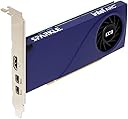
🚀 Elevate your desktop game with power-packed efficiency and sleek style!
The Sparkle Intel Arc A310 ECO is a compact, energy-efficient graphics card featuring 4GB of GDDR6 memory, a 50W TBP design, and advanced Intel XeSS and ray tracing technologies. Its low-profile, single-slot build with HDMI and Mini DisplayPort outputs makes it ideal for professional millennials seeking powerful visuals in space-conscious setups.


| ASIN | B0CSFJN835 |
| Antenna Location | Gaming |
| Best Sellers Rank | #36 in Computer Graphics Cards |
| Brand | Sparkle |
| Built-In Media | Graphics Card, Short Bracket |
| Compatible Devices | Desktop |
| Customer Reviews | 4.5 out of 5 stars 496 Reviews |
| Display Maximum Resolution | 1920x1080 |
| GPU Clock Speed | 1000 megahertz |
| Graphics Card Interface | PCI-Express x16 |
| Graphics Card Ram | 4 GB |
| Graphics Coprocessor | Intel Arc A310 |
| Graphics Description | Arc A310 |
| Graphics Processor Manufacturer | Intel |
| Graphics Ram Size | 4 GB |
| Graphics Ram Type | GDDR6 |
| Item Dimensions L x W | 6.14"L x 2.72"W |
| Item Weight | 202 g |
| Manufacturer | Sparkle |
| Memory Clock Speed | 15.5 GHz |
| Mfr Part Number | SA310C-4G |
| Model Name | SA310C-4G |
| Model Number | SA310C-4G |
| Number of Fans | 1 |
| Number of Items | 1 |
| Number of Packs | 1 |
| Unit Count | 1 Count |
| Video Output Interface | HDMI , Mini DisplayPort |
| Video Processor | Intel |
| Warranty Description | 3-year limited |
E**N
Great for specific tasks.
This is a great little GPU. Want a power efficient system that will still let you game a little bit? Extremely portable pc with a dedicated GPU? Server and you just need to see the screen sometimes? A bit overkill, but this will do it. Where this card really shines is for media servers or a dedicated streaming pc. My machine is both, and usd two of these for a time! You generally want low power use and low price, and the encoding capabilities of this little gpu are absolutely stellar. I have used it to game, I have used it to stream, and now I am building an incredibly small itx HTPC which I also intend to also use for some easy-to-run games to play with my family on or TV (stuff like golf with friends, the lego games, etc.) I have two of the a310 models, and there have been so many situations and builds which these have been very helpful with. Noise levels were a concern when reading the reviews of others, and they aren't as good as they could be, but honestly it is just not that bad IMO. I noticed it after opening the case up and trying to run some stress tests and heavier (for this gpu) games and what not. When I put the class panel back on my case, I completely forget about the noise. TLDR; This is not a gaming card, but it'll generally work on low settings in a pinch, and is great for trouble shooting and experimenting. This is a god tier little media server GPU though. Not the quietest when under heavy load, but could be worse.
T**E
Add AV1/QS/HEVC to Your Media Server/Workstation in SFF Cases.
I never tested this in game. Purchased the card explicitly to replace as 1050 Ti as a "Plex Media Accelerator" in a custom TrueNAS box. Features built-in HEVC, Quick Sync, and AV1 codec support. Sure, it's only got 4GB of VRAM, but if you're building a Plex/Enby/Jellyfin server or Adobe Premier Workstation without an iGPU, then this handily allows such a system to handle 4k streams and video transcodes with a minimum of stuttering. Comes with standard height and low-profile brackets for half-height standard mount cases. The card seemed solid and has been humming along for almost a year now, no hiccups. Being that it's in a server in a different room, I don't hear it when it's under load, but while testing I never heard the fans ramp with my workloads. Card was $100 when I first saw it, I paid $120 for an open-box model when the AI RAMpocalypse started. For the increase in my servers ability to handle concurrent streams and higher end content and because it passes through without any issues in TrueNAS, it was worth the cost to me. As a note, AM4 CPUs without iGPUs appear to support unbuffered ECC memory, dependant on motherboard & BIOS. A Ryzen 7 5800X AM4 with 64GB ECC could not handle a single 4K transcode without noticeable and frequent buffering, given a capable and validated network infrastructure + configuration. I tested with more or less a single use case + configuration, so take all this with a grain of salt.
2**W
Unbeatable for its size.
If you are considering this card for gaming, yes the A310 has a little bit of muscle but you could probably get more value out of a different card. What makes the A310 special, however, is that it can slot into even the tiniest of buiids and turn them into transcoding powerhouses! And, for the retro gamers out there, I can confirm that this little guy can be the centerpiece of a pretty strong Batocera build. For modern gamers, the 4GB VRAM buffer is going to tie one hand behind your back right off the bat; further, while Intel has been making good progress in GPU development, they mostly compete on value, not horsepower. Likewise, certain games/game engines don't play nice with Intel cards so it's best to search for benchmarks on the games you know you will be playing to avoid any surprises -- when it shines, it shines; when it flops it flops. I purchased the A310 to install in a Lenovo M920X Tiny for transcoding and light gaming. In this admittedly slim market segment, the A310 is, in my opinion, the best option. The alternatives are nVidia's RTX 3050 and AMD's RX 6400. Anything beneath those, such as the GTX 1030, wouldn't be all that better than sticking with an iGPU assuming the CPU is decently modern. So, of the major options, the 3050 sports more VRAM, but what's out of reach for 4GB is generally out of reach for 6GB as well since an 8GB buffer is minimum recommended spec for most new games. Further, nVidia's offering draws slightly too much power for Lenovo Tinys, with some variants simply failing to boot, while also not offering significantly more performance in transcoding. As for the RX 6400, it has the same 4GB buffer and fits in the power envelope, but AMD isn't as competitive in transcoding as they are gaming, so the A310 has a clear advantage if you need a card that can improve both your productivity and gaming experience. If you are interested in gaming only, I would advise comparing benchmarks on your favorite titles and deciding based on that. Which card is right for you will really depend on your specific needs -- if you could fit a larger card in your system, then there are more and better options out there from all three GPU chipmakers. If you're looking for pure gaming performance and don't want to crosscheck your most-played list with benchmark outlets, tread carefully. But, as someone who has tinkered with all three, here's my assessment: If you need a versatile card that operates within the tight power budget and even tighter dimensions of a mini PC, this is the clear No. 1 -- hopefully Intel can bring some of their second-gen gains into an updated card in this form factor because, honestly, this has been the first (and only) exciting release in this market segment for years.
B**E
Top tier transcoding for NAS/Jellyfin but one big/small issue
This little card is the king of transcoding in small form factor PC's. I set up a Truenas server for my daughter using an old Dell Optiplex 7010 SFF and at first tried an AMD WX4100 low profile card. That did work but performance left a lot to be desired. Then, I got this little gem and WOW, this this really shines. Very fast, very low power consumption and basically plug and play for Linux these days. You won't do better for this use case. If you have a full size case, I would strongly recommend the Asrock Arc A380 instead. It's a better card in every way. Now for the problem - the fan. Intel and Sparkle left a glaring problem with the fan on this card. Out of the box, you get a terrible droning fan and as a bonus, the firmware constantly ramps the fan uuuupp and downnnn. It's enough to make you lose your sanity. I updated the firmware, which helped. That can be done in Linux command line but on Truenas Scale, it's next to impossible due to how locked down it is. So, install it in a Windows PC or boot a Windows drive, install the Intel drivers and allow that to do it's update. That will also install the latest firmware onto the card. Then, you can go back to Linux. However, the fan STILL ramps up and down, just a little bit less. OMG, it's so annoying! My final fix was to run powertop on the server (install powertop, run powertop --auto-tune, systemctl enable --now powertop). That seems to have sent the card into a state of stability and the fan is basically steady now. It's still an annoying tone but at least it's just ONE annoying tone. If this issue was fixed, the card would be flawless for it's usecase.
J**N
Good card for encoding or some games on low settings
This GPU is great for video encoding. I use it in a low power gaming PC. Been happy with its performance under a realistic load. Very low power draw so could be in a ITX PC or HTPC. Could run basic titles like Fortnite on low settings at 60 fps. Needs resizable bar so thats a consideration to take into account if thinking of buying. Keeps good temps, easy to install-comes with attachment for full size or ITX pc cases and solid quality.
J**S
Tremendous video encoding speed
Bought this for AV1 video encoding. Wow is it a great value. It crunches through encoding at blistering pace, two at a time with no problems.
M**A
Perfect for Transcoding
Perfect for transcoding media files in my Plex server. Low profile, low power and effective.
M**K
But it don't wait works great as encoder
Needed video encoder and AI machine learning for my server . Found this gpu its very small fits perfectly in tiny case. Low power consumption. Very good value for money. Quality of bulid is grate but fan noise levels whining is very high . I ended up 3d mode third party fan and its amazing now
J**N
Weird.
It's fine, if you can get it working and the your PC is in the basement. The driver installer is a joke, results in the attached photo. The card makes an annoying whining ramp up and down constantly - NOT something you want to be sat beside all day. Other people report that updating the driver (and by side effect the firmware) on windows fixes the issue, but it does not. Intel has lost their mind, and if I don't return this card, the annoying sound will make me lose my mind too.
A**ー
爆上がり
最近いろんなPCパーツが爆上がりして性能と値段のバランスが難しかったですが、この値段でこのスペックなら満足です
N**P
Au top! compact, efficace 👌
Ça fait tellement longtemps qu'on ne trouve plus de petites cartes graphiques performantes. Celle-ci fait exception. 1 seul slot occupé, du câble mini-display port histoire d'aller en 2k / 4k en haute fréquence de rafraîchissement, de la modernité dans le décodeur vidéo hardware. La 3d qui passe avec les jeux (voyez la vidéo de R-Type en 2k) et le tout pour 50watt de consommation énergétique. Franchement bravo Intel! Super content de cet achat. ++++++ Attention aux réglages UEFI, si c'est demandé après l'installation du pilote, choisir "décodage au dessus de 4g" et "redimensionnement support bar" dans les paramètres UEFI afin de gagner en fludité d'affichage (voir copie écran des paramètres)
G**N
perfect small videocard.
Looking for a good low profile videocard and wanted actually an Intel card, so this one is obvious surely for the price! a lot better than those ancient 730 videocards you see around for a lot more money..
L**S
Low power, great for transcoding, needs a firmware update to fix fan surging issue.
I purchased this as a dedicated hardware transcoding GPU for a rack mount server, it requires no external power, fits in a 2U case, comes with both full size and low profile brackets, but swapping them requires a little creativity as the plastic shroud covers the upper screw. Installation is easy as no external power needs to be connected. Out of the box, the cards firmware contains a bug that causes the fan to constantly spin up for a few seconds, this is fixed by installing the Intel GPU drivers under Windows which also upgrades the firmware during install. After that, it runs quietly and fulfils that role perfectly and runs cool, the fan is barely noticeable, even at full chat. While it was in a windows environment, I ran 3D Mark, being a 4GB card it’s clearly going to struggle, so had to drop to the basic benchmarking test, 3D Mark predicted FPS results on 1080 High: Fortnight 180+ Battle Field V 55+ Apex Legends 110+ GTA V 145+, Red Dead Redemption 2 35+ Obviously those are just guide numbers, but for a basic card at 1080p, it looks like Arc has some decent performance potential. It handles transcoding multiple streams with ease, unlike NVIDIA, no artificial session limit on transcodes, the only concern is 4GB VRAM, but that is more than enough for over a dozen H264/H265 transcodes from 1080 down to whatever. If you need more, then choose a card with extra VRAM. Is it good value? That depends on your needs. For gaming at 1080, I would pay a little more and go Arc 570/580, at 1080 they are significantly more capable. If you just need to add a low power, quiet GPU for transcoding duties with AV1 support for the future, it’s the cheapest and arguably best option, also ideal if you stream and want to hardware encode in real time without hitting your main GPU’s resources.
Trustpilot
2 months ago
1 month ago