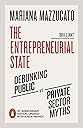
The Entrepreneurial State: 10th anniversary edition updated with a new preface
Desertcart purchases this item on your behalf and handles shipping, customs, and support to Seychelles.
Description
10TH ANNIVERSARY EDITION: UPDATED WITH A NEW PREFACE 'Superb ... At a time when government action of any kind is ideologically suspect, and entrepreneurship is unquestioningly lionized, the book's importance cannot be understated' Guardian According to conventional wisdom, innovation is best left to the dynamic entrepreneurs of the private sector, and government should get out of the way. But what if all this was wrong? What if, from Silicon Valley to medical breakthroughs, the public sector has been the boldest and most valuable risk-taker of all? 'A brilliant book' Martin Wolf, Financial Times 'One of the most incisive economic books in years' Jeff Madrick, New York Review of Books 'Mazzucato is right to argue that the state has played a central role in producing game-changing breakthroughs' Economist 'Read her book. It will challenge your thinking' Forbes

Specifications
| Asin | 0141986107 |
| Best Sellers Rank | 262 in Starting a Business |
| Dimensions | 12.8 x 1.7 x 19.7 cm |
| Edition | 1st |
| Isbn 10 | 9780141986104 |
| Isbn 13 | 978-0141986104 |
| Item Weight | 224 g |
| Language | English |
| Print Length | 304 pages |
| Publication Date | 22 Mar. 2018 |
| Publisher | Penguin |
Reviews
User
Important and Refreshing new approach
This is an important book.Mariana Mazzucato persuasively argues that the state has a key entrepreneurial role in technical development and innovation and development. She contends that the central role that the State has played in kick starting the IT and pharmaceutical sectors in the US and the green technologies in Germany and China and the auto industry in Japan has not been adequately recognized and cannot be contested.Conventional theory is that the State 's role is to establish and enforce the rules of the game, to keep a level playing field, to build public goods such as infrastructure, defence, and basic research and to devise mechanisms to mitigate negative externalities such as pollution. If the state intervenes beyond that it is accused of picking winners. It should be up to private industry to innovate.But Mazzucato believes that the history of technological change teaches us that choosing particular sectors by the State is absolutely crucial. She contends that in practice the State in the US, and especially in China and Japan, has invested heavily in going way beyond basic research in providing for the explosion of innovation in certain sectors. She examines post-war period two US government agencies. The Defence Advanced Projects Agency (DARPA) was created in 1957 for space research as a panic induced reaction to the Soviets successful launch of Sputnik. But DARPA also included money for "blue sky thinking" which contributed heavily to semiconductor and the internet development. Then through the Small Business Innovation Research Programme heavily funded the development of companies like Apple and Google. Similarly, the US National Institute of Health invested heavily in R and D in the pharmaceutical sectors and also provided the ecosystem of innovation including loans, grants and government contracts.But she identifies a major problem in the West that when the State does invest in basic research and development and creates an ecosystem of innovation in any selected sector, one of the unfortunate consequences of modern-day capitalism is that risks are socialized and rewards are privatized.One of the refreshing aspects of the book are the practical policy recommendations that emanate. For example, to address her perceived issue of socialized risk and private reward, any loans or grants to private companies from the state should be repayable in the event of success, or States should take equity stakes in companies they help.The argument that tax recompenses States in returning them reward for their investment is undermined by the footloose nature of the Apples, Google's and pharmaceutical companies that allows them to play off one country against another. Mariana does not have an answer to this and prefers direct recompense through loan repayment or equity shares.China and Japan have been much more systematic in "sector selection". Their form of capitalism provides for the state sharing the rewards.There is no doubt that the State's role in technological development is underrated and subject to prejudice. My problem with Mariana's forceful advocacy of the role of the state - her belief that the state's responsibility goes beyond planting seeds via R and D at public institutions and must support technologies until they can be mass produced - is highlighted by her account of the experience of solar and wind industries where China outcompeted the US, Japan and European rivals. Heavy investment by these governments was not rewarded by thriving industries.The clear and proven historical risk is that sectors are picked for political reasons or for fashionable reasons, like wind and solar, and taxpayers shoulder risk but do not share rewards.Mariana’s answer to this is the state should accept that risk but ensure that the existing system of socializing risk (i.e. born by the state) but privatizing rewards is overturned. It is the only way the innovation cycle will be sustainable over time both economically and politically.I would applaud such an action. But since the stock market crash in 2008 is there any evidence that the UK State can effectively retain access to reward having shouldered the burden of the risk incurred by RBS and others? If we can address this then I would wholeheartedly support Mariana’s argument.You can see I found the book immensely stimulating!
User
Public investment vs. private - which is greater for innovation/creativity technology and business?
Really enjoyed reading what is clearly a well researched bookIt calls into question the whole free market ideology that privatisation is good for nation states and the idea that it is private business that is at the forefront of innovation and creativityThe material/research identified by the author in actual fact reveals that is is public investment i.e. tax payer money that underlies the greatest innovations/creative leapsAs a whole - the book is easy to read (even for the layman), concepts and ideas are expressed clearly and objectively (I myself underook some research in order to find fault with this book - I found next nothing to contradict the material in this book)Overall, ver well written, easily explained and well presented bookI highly recommend it to lay people and those with an interest in socio-economic/socio-political thinking
User
Superb...
If we believe much of what passes for the political narrative of the last 40 years it would be easy to imagine that it is the state that stifles innovation, restricts enterprise and burdens citizens and businesses with unnecessary regulation, wasteful expenditure and life sapping tax policies. As with every argument, there may be some truth there, lurking in the intellectual undergrowth, but how much of it is a shaky justification for perpetuating the currently socially injurious power relations?What the Left and indeed the Centre Right in British politics has needed a core of ideas and beliefs (as well as credible historical examples /policy ideas)that can justify the idea that the role of the state in the politico eco-system is vital to the future growth and prosperity of the economy. This rigorously researched, tightly argued, accessible book is indeed a sturdy intellectual platform for those readers who feel that free markets are only part of the story in the way that the modern economy functions. Readers of a more Libertarian hue, will also have much to ponder here. Understanding the role of state and its promotion of enterprise and innovation will undoubtedly turn more than a few heads!Here are some of the core ideas:Industry – farming, consumer electronics, construction, aviation, banking to name but a few has always relied upon sought state intervention in one form or another: subsidy, protectionist policies, ‘bailing out’, tax breaks, incentives, regulatory frame works and so on. The corporate world likes government when it is acting in the interests of business but the tone changes when some degree of reciprocity or responsibility is required.Engineering firms, chemical producers, capital goods producers, defence contractors have regularly get to taste the honey of public largesse, sometimes just to keep capacity or expertise ( see shipyards) available. The drug industry of course has a major customer in the form of the NHS.Business needs government in times of recession to exercise its influence in the economy via expansionary fiscal and monetary policies. The only problem is of course, corporations are notoriously adept at managing their revenue flows to reduce their tax liabilities to negligible proportions whilst taking full advantage of all the opportunities that operating in an advanced economy such as the UK offers.Primary research is essentially a public good. Mazzucato suggests that companies such as Apple benefit from research undertaken elsewhere. The genius of Steve Jobs was to harness ideas (such as touchscreen technology) and incorporate them into a pleasing consumer products. This is product development rather than the sort of research that can lead to fundamental shifts in technology or scientific understanding such as provided by nuclear research or the development of the internet. Research has become increasingly from state sponsorship and the activities of universities, not corporations. The private sector takes advantage of such research without paying their due.The state fosters enterprise, it creates opportunities for business, it educates citizens, and it can create new markets (green power). The state can do so much more then be a market gatekeeper and corrector of market failures. In short, markets need government. What government has to do is gain expertise, be prepared to ‘fail’ sometimes and become more confident in the way that it can motivate markets to think more long term and be more socially responsible. Theresa May is already thinking along these lines her ideas on a UK industrial strategy.What I have described above is but a few of the ideas that Mariana Mazzucato outlines in this invigorating book. Read it and see what more of interest there is to glean.Highly recommended.
User
Brilliant book.
The author argued very well against the neoliberal ideology that believes that private companies and the market produce wealth and that governments' role should be as small as possible and step in only to sort out failures. She demonstrates that the major amount of investment in research and development comes from governments, not private companies, and they support this over the long term and through initial teething troubles that companies trying to build on it might have. Private companies are only interested in quick returns and only take up new research after governments have invested in all the ground work. They then add some new twists and reap all the benefits - like Google - and then often manage to avoid their fair share of taxes. It tends to be governments rather than private companies that chose new directions for research and development and follow through, but fail to recoup their investment from the companies that take this further and reap all the rewards. A way needs to be found to redress this balance and return the fruit of investments to the governments who did the necessary ground work. I totally agree.
User
Good, but it could have been better
The author of this book, Mariana Mazzucato, has an impressive CV and with a handful of books has managed to get into the general non-specialized public and readers. However, while her ideas and opinions on economic innovation and the correct balance between the public and private sectors are very profound, her prose fails to live up to the content. For this reason, even if this book is not very long (288 pages), the reader feels let down at about one third of its content. Then it becomes repetitive, as if the author was looking for quality through quantity. It seems perhaps that the book could have been much better if it would have been shorter.The very good ideas are there, yet we do not feel fully attracted to them.
User
V good read
This book was very accessible without watering down the argument at all, which is a very difficult thing to achieve. It is full of very interesting examples throughout, especially with often not talked about industries. It was a very hard book to put down.
User
An essential critique of the small state proposition
This should be essential reading for politicians of the left who need to find an appeal beyond grievance politics if they are to be elected. However it could have done with a wider range of examples and the continual hammering home of the point became tedious.
User
Economics - how things really are !
Excellent ! Part of the move to show the 'economics' of Friedrich Hayek, Milton Friedman and the discredited 'Laugher Curve' were just greed and redistribution of wealth to the 1% and 10% of the already rich at the expense of the 99%, 90% of everyone else, that have led to increased child poverty, reduced social mobility and poor infrastructure and public services we all need. Great one Mariana, keep it coming, we need more of this - now just turn it into a 3 word slogan !
User
Good read
I bought this book for a class and I thought it would be boring, I was pleasantly surprised that is not the case, is very engaging and critical about the topic.
User
これからのイノベーションをどうするのか?
このイノベーションに関係する著名な学者は,ナイトのリスク。シュンペーターの企業家精神、ケインズの自由放任の終焉である。事例としてアップルの成功、コンコルドの失敗、その中で、国家がいかに基礎研究に関わり、民間企業がそれを土台にしinnovationを発展させたが、そのリターンを国家に戻さず、低税の恩恵をほしいままにして役員の報酬としている実体を描く。高額所得者の1%が、他の99%の人々所得に比肩することは周知であるが、国家と民間企業の役割はどうあるべきか、詳細に検討されている。 残念ながらニッポンのinnovationをどうしていくか、という学者の本を見たこともなく、企業も目の覚めるような革新を超さず 、きっかけもない事が経済が次第にデフレに向かって進んでいき、次第に世界水準から取り残されていくこいとで、あろう。ただ第2章でアダム・シミスが政府は学校と自動車道路をつくれば良い、と書いているのは著者の間違いである。スミスの時代に自動車はまだ一般に普及していない。思い込みで書いたのであろう。
User
Political biased book, badly written
It almost felt the conclusions were predrawn, there is no presentation of research ( citations dominated by their own papers)There is cherry picking it examples, stories get dropped where the continuation of story doesn't suit the author.I agree that there is a scope for debating the role of government in research, but this book is a political manifesto and not a work of quality academia!
User
the real risk takers
Thoughtful, readable book that well and truly debunks the myth about private business and venture capitalists being the innovation and growth engine on our economies. So much of the heavy lifting for term innovation is left to the public sector because it is considered too risky by the. The rewards definitely should be shared by governments (on behalf of the people) so that there is a clear risk-reward relationship between public and private. Mazzucato is crystal clear in her arguments, and as her Apple shows deftly shows, so much of the propaganda we are fed, including by an unquestioning media is full of half truths. Well done
User
Libro indispensable para todo economista del siglo XXI
El libro está muy bien estructurado. La autora defiende el aspecto teórico de su teoría a través de ejemplos y todo queda muy claro. Te da una visión totalmente distinta sobre el rol que puede tomar el estado en la economía.La letra es un poco pequeña para mi gusto pero nada exagerado, se puede leer perfectamente.
Common Questions
Trustpilot