Buy anything from 5,000+ international stores. One checkout price. No surprise fees. Join 2M+ shoppers on Desertcart.
Desertcart purchases this item on your behalf and handles shipping, customs, and support to Seychelles.
🔍 Power Up Your Insights!
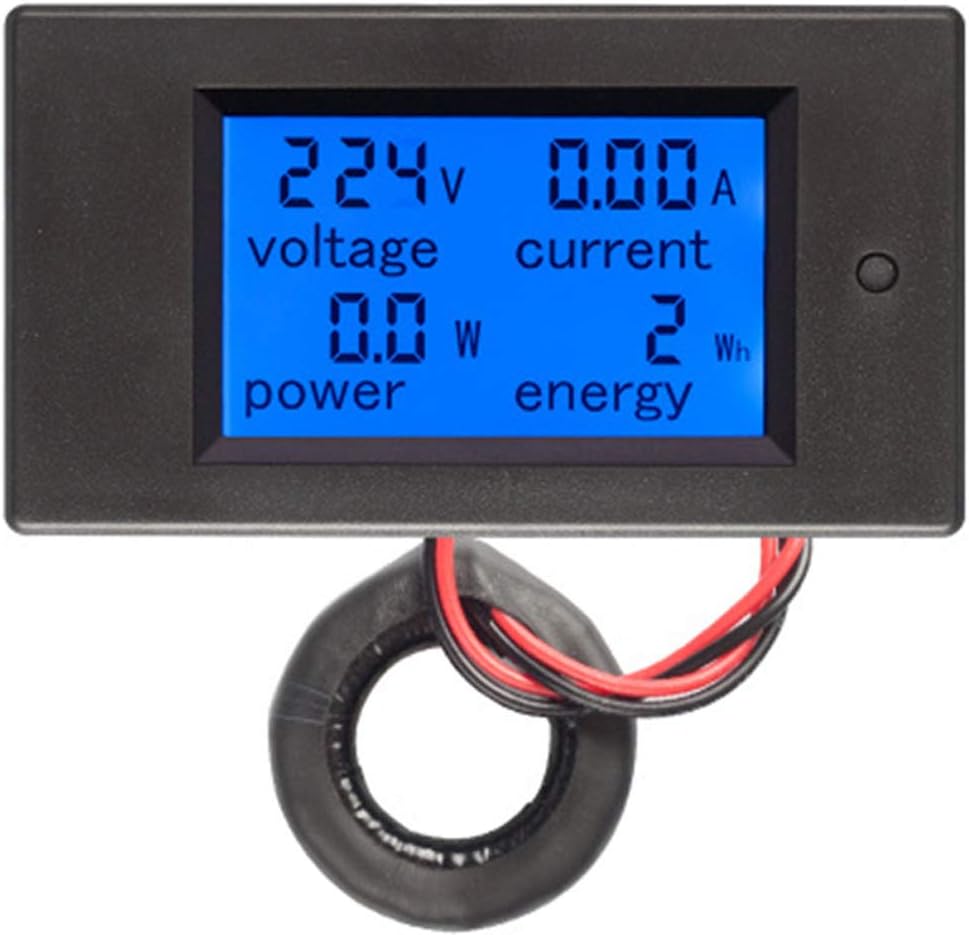
The HiLetgo Digital Multimeter PZEM-061 is a compact and efficient tool designed for precise measurement of active power, voltage, and current. With a voltage range of 80-260V AC and a current capacity of up to 100A, this multimeter features an easy-to-read LCD display and overload alarm for enhanced safety. Its user-friendly design allows for quick installation and data retention, making it an essential device for professionals seeking reliable energy monitoring.
| ASIN | B079JNY5VD |
| Best Sellers Rank | #47,875 in Tools & Home Improvement ( See Top 100 in Tools & Home Improvement ) #92 in Voltage Testers |
| Brand | HiLetgo |
| Brand Name | HiLetgo |
| Color | Black |
| Compatible Devices | Electrical devices with one-phase AC power |
| Customer Reviews | 4.6 out of 5 stars 603 Reviews |
| Item Weight | 370 Grams |
| Manufacturer | HiLetgo |
| Measurement Type | Ammeter, Multimeter, Voltmeter |
| Min. Operating Voltage | 80 Volts (AC) |
| Minimum Operating Voltage | 80 Volts (AC) |
| Model | PZEM-061 |
| Part Number | 3-01-1458 |
| Power Source | Corded Electric |
| Specification Met | Iec 61010-1, Ce |
| Style | AC 80-260V 100A |
| Style Name | AC 80-260V 100A |
A**Y
Very accurate than other DC inline watt meter
I purchased several dc inline meters, this one works more accurate than 60V/100-200A DC inline meter. Easy to use, built-in Shunt 20A is enough for Solar panel test. I haven't try to max it out but so far so good at low current. Based on seller spec is correct working voltage is 8-100V. I lower it down to 6V, the meter won't display. LED is bright enough and only pulling 0.10W. Please note this Shunt load on Positive + instead of most of watt meter using shunt on Negative- which is fine. It saves last energy state, when you turn it off/on blue led display is blinking to show last state energy. To clear it, while it blinking press and hold (very long) until you see CLR then release button and short press again to clear out last saved energy. Note: if you press not long enough it will bring you to alarm mode setting for Voltage and Amperage limiting. I make solar connectors and screw them in follow DC input (from your solar or DC power supply) and load to your electronic load device. Very straightforward. I suggest using 14AWG wires is best fit for screw terminal. Will buy more of this version than the other 60/100-200A DC inline meter is so inaccurate than this. Hope that helps
T**E
Perfect meter for the price, but instructions are not clear
Easy to install, but instructions are lacking. ButGoogle works great for instructions.
B**R
Very useful to monitor or test Solar devices.
Easy to set up. I noted that there was no reading when I first connected my solar cell as the input, but as soon as I connected the load (the battery), it took off and started counting the watts in, amps in, and accumulated watt-hours since reset...along with the voltage. Very handy little meter for solar testing under 20a, but note that the terminal connections are too small for my normal 10awg wires. I found a pair of SAE cords to use with 12 ga wires and they fit perfectly. After all, this built-in shunt is only rated for 20a. I just prefer to use 10awg for my permanent PV connections. Seems a fair price for such a useful meter.
B**N
within the stated accuracy, but could be better with a calibration pot.
It has 4 full digits for the voltage, and yes its within the 1% cal limit, but two digits from the resolution. wish they would have added a calibration pot. Current is spot on.
K**N
Precise, big screen, blue backlight
The item came fast and well packaged, and it's bigger that I thought it would be (which is good as most of it is a display). The input and output is clearly marked on the back of the unit, as well as in the manual. There is a single button which is used to turn the backlight (it's blue by the way) on and off, as well as to reset the unit (as it keeps the energy counter even if turned off). I have tested in with voltages from 5 to 20 V and with currents from 0 to about 2A. Both the voltmeter and the ampermeter are quite precise, compared to other measurement tools I have and trust: the voltage is within 0.05V, and the current is within 0.001A as far as I can see. Measurements change every second or so, which is less frequent than your average multimeter. The screen is well readable from left, right, and down sides, but less so from the up side that is usually the case with liquid crystal displays, so take that into accounting when you mount it. One other remark is, the description says the lowest voltage is 6.5V, which is true except the backlight only comes in from about 7V, so I would say if you're going to need a backlight, consider the lowest voltage at say 7.5V to be on the safe side. Now, the upper limits are 100V and 20A as per description and documentation, unfortunately I don't have equipment to push the device to its limits. Finally, I have tested the alarm function and it works fine. You can set the two voltage thresholds (upper and lower), and if the voltage is not within the range specifies, both display and backlight flashes rapidly. This might come handy if say you need to prevent your lithium battery from discharging too much (i.e. undervoltage). I am giving it five stars overall, but especially for its precision.
P**R
Good unit
Update 2025: I ordered a replacement for the 5yo internal-shunt one which I left in the sun for 30min and which started flashing back and forth between the regular status screen and some alarm about amps. The replacement works fine and once disconnected and opened up and then tested I find the old unit works correctly now too. No idea why. I’m using this with a 10a pwm sunsaver solar charger to make an offgrid battery charger for my various trucks/tractors/trolling batt/etc. The controller works with 0v batteries so it’s perfect for recovering dead ones that haven’t been that way for long. as a note the insides of the two are dramatically different with the newer one being much simpler. It’s running that charger now so we’ll see how it stands up over time. Original 2020: I needed the ones with external shunts but wasn’t paying attention when I ordered these so they are sitting unused. I’ve used the external shunt models several times mounted with and power monitoring my trolling motor battery, my offgrid work desk, etc. I had two complaints about these 2-3 years ago: 1) the backlight/settings button was recessed and required a little screwdriver or pen tip to click it, that’s been corrected and now the tip of button stands proud of the bezel. 2) The settings menu has the alarm setting as the first item and you have to keep holding and holding the button until the menu moves on to the thing I care about - resetting the watt-hour counter. I do that every evening and it’s annoying every time. I’ve scrambled those alarm settings more times than I can count. I complained about it then and it’s still that way now. It’s a pretty minor complaint. 3) They are unidirectional, they’ll only measure current flowing in one direction. For my trolling motor I installed a dual pole dual throw switch that reverses the polarity of the current lines. After a day on the water I note the power used, zero it, flip the switch and plug in the charger. Later I can see how many watt hours went back in.
R**R
Easy to read. Great for current time and for cumulative output. Perfect for my application.
Perfect for Solar panel output monitoring. Easy to install. Um. I got wires wrong first time. Didn't hurt it Though .
T**T
perfect dc power monitoring - FAILED
I bought this for monitoring the power usage of my RV refrigerator. I used double-sided tape to stick it to the back of the fridge. It measures voltage and current, shows power, which is simply the product of voltage and current, and energy delivered to the load, which is the Power integrated over time. It shows energy since last reset, but it doesn't keep track of when it was reset, so if you want to measure "kWh per day", then you have to make a note of when it was reset, then calculate the time period. I note that this device is a much better version of a similar one I had three years ago. The old one used a hall-effect sensor to measure current, which had poor accuracy, especially with low current. This one has a built-in shunt, taking up to 20 amps. It is accurate to 2 decimal places on current, Not bad! UPDATE, this failed after 1 year in service. I had it monitoring my RV refrigerator. One day, my fridge started to malfunction, flashing light, no cooling. I found that this device has failed with screen off, but the current still flows through it to the fridge. Current flows through the device's internal shunt, so if it is damaged, it will cause problems for the appliance. It only draws 4 Amps, way less than the 20A it could handle. I would NOT try to run 20A through this thing! Now I do NOT recommend this device. The current has to flow THROUGH it, and when it fails, it will cause other failures. I have contacted the merchant for help.
Trustpilot
4 days ago
2 weeks ago