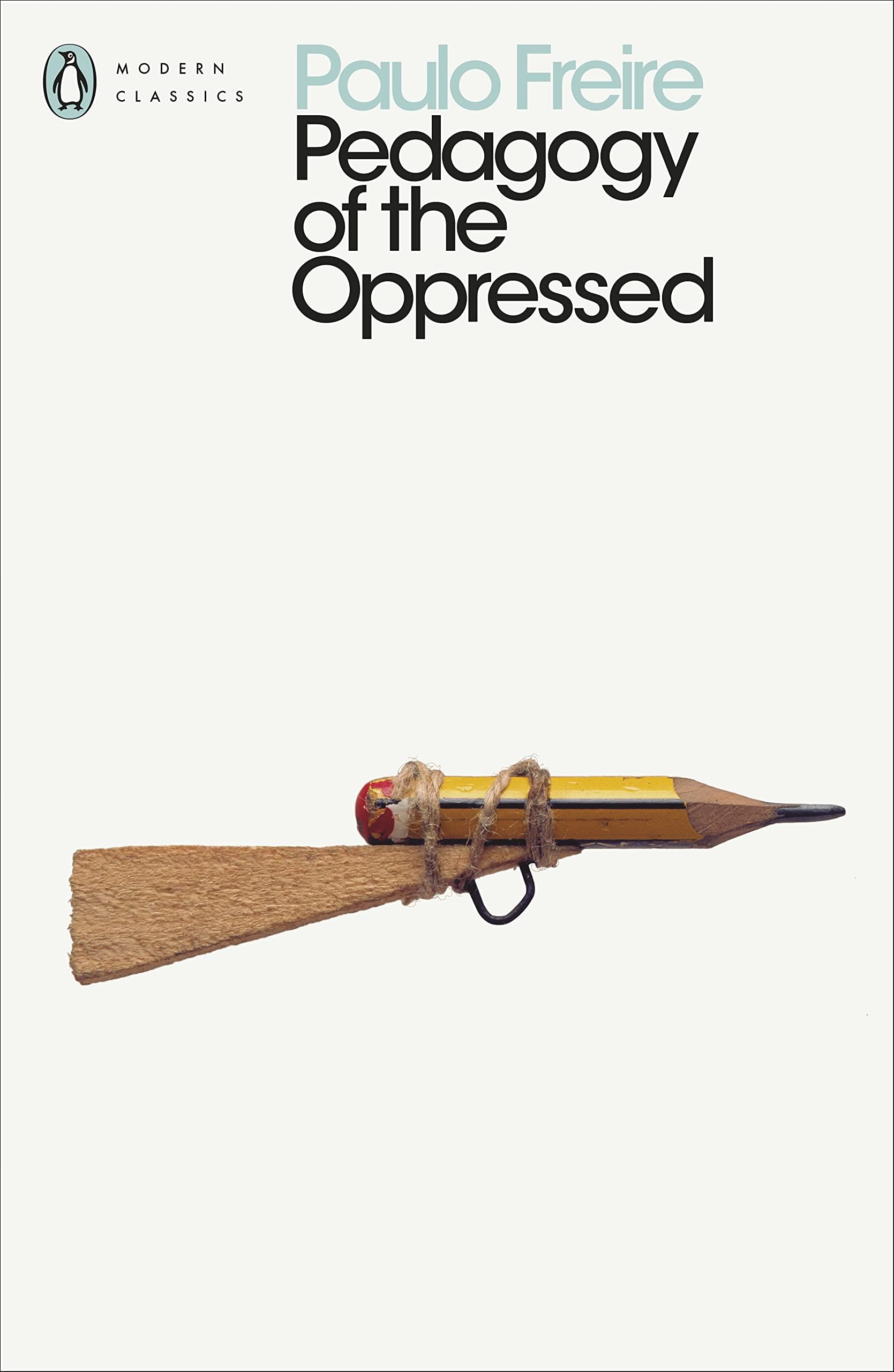

Pedagogy of the Oppressed
Product ID: 66696715
Desertcart purchases this item on your behalf and handles shipping, customs, and support to Seychelles.
This text argues that the ignorance and lethargy of the poor are the direct result of the whole economic, social and political domination. The book suggests that in some countries the oppressors use the system to maintain a "culture of silence". Through the right kind of education, the book suggests, avoiding authoritarian teacher-pupil models and based on the actual experiences of students and on continual shared investigation, every human being, no matter how impoverished or illiterate, can develop a new awareness of self, and the right to be heard. Review: Powerful book packed with insight and wisdom - One of my favourite books of all time. Be warned- the translation from portugese to English can make the text seem a little impenetrable at first. In fact, I've been using this book on various courses through the years, and would say it took many readings to grasp the timeless wisdom contained within. Freire understands deeply what it means to be oppressed, and manages to illustrate how many routes to freedom simply 'flip flop' the power of the oppressor onto the previously oppressed. That might not be too illuminating a review, but I ensure you grappling withthis book will leave you with a much more developed understading of power, love and the human condition. A must read for all and particularly relevant to professions where there's a vested interest in dismantling inequality. Review: Che`s handbook? - Paulo Freire was a Brazilian educator and philosopher whos experiences of the depression in the 1930s, left within him a calling to try and change society. He says that poverty and hunger severely affected his ability to learn at school and that “experience showed me once again the relationship between social class and knowledge”. I might describe this book as having a very high density to volume ratio. I agree with many of the other reviewers here, that this is not a text easily dealt with. I personally found some of it impenetrable. At one point I was wondering if the fact that it had been translated from Portuguese might have resulted in a certain `lost in translation` effect, but I suspect that I am making excuses! I was a little surprised that many of the references which Freire uses come from unpublished texts - they are annotated thus. Some of the words used require their own investigation - assuming you are not an aficionado of course. But, and it is a big BUT, the intention of this work is of the highest order and is quite awe inspiring. I was brought to tears on one occasion when contemplating my own personal feelings regarding my own consciousness of freedom. There is a great potential catharsis underlying this kind of investigation. Freire states his intention in the penultimate paragraph, `just as the oppressor, in order to oppress, needs a theory of oppressive action, so the oppressed, in order to become free, also need a theory of action.` I like to imagine Che Guevara as a champion of this theory. Today we see uprisings as never before all over the world. The Ukraine being the latest such case at the time of my writing. So the issues that this book is raising and the awareness that it attempts to promote are as urgent and relevant as ever!
| Best Sellers Rank | 285,926 in Books ( See Top 100 in Books ) |
| Customer Reviews | 4.6 out of 5 stars 260 Reviews |
O**R
Powerful book packed with insight and wisdom
One of my favourite books of all time. Be warned- the translation from portugese to English can make the text seem a little impenetrable at first. In fact, I've been using this book on various courses through the years, and would say it took many readings to grasp the timeless wisdom contained within. Freire understands deeply what it means to be oppressed, and manages to illustrate how many routes to freedom simply 'flip flop' the power of the oppressor onto the previously oppressed. That might not be too illuminating a review, but I ensure you grappling withthis book will leave you with a much more developed understading of power, love and the human condition. A must read for all and particularly relevant to professions where there's a vested interest in dismantling inequality.
H**L
Che`s handbook?
Paulo Freire was a Brazilian educator and philosopher whos experiences of the depression in the 1930s, left within him a calling to try and change society. He says that poverty and hunger severely affected his ability to learn at school and that “experience showed me once again the relationship between social class and knowledge”. I might describe this book as having a very high density to volume ratio. I agree with many of the other reviewers here, that this is not a text easily dealt with. I personally found some of it impenetrable. At one point I was wondering if the fact that it had been translated from Portuguese might have resulted in a certain `lost in translation` effect, but I suspect that I am making excuses! I was a little surprised that many of the references which Freire uses come from unpublished texts - they are annotated thus. Some of the words used require their own investigation - assuming you are not an aficionado of course. But, and it is a big BUT, the intention of this work is of the highest order and is quite awe inspiring. I was brought to tears on one occasion when contemplating my own personal feelings regarding my own consciousness of freedom. There is a great potential catharsis underlying this kind of investigation. Freire states his intention in the penultimate paragraph, `just as the oppressor, in order to oppress, needs a theory of oppressive action, so the oppressed, in order to become free, also need a theory of action.` I like to imagine Che Guevara as a champion of this theory. Today we see uprisings as never before all over the world. The Ukraine being the latest such case at the time of my writing. So the issues that this book is raising and the awareness that it attempts to promote are as urgent and relevant as ever!
K**D
though not always easy to read (perhaps because of its brevity)
A fascinating and challenging book, which, though not always easy to read (perhaps because of its brevity), nevertheless gives more than technical educational insights I approached this book from the angle of New Testament studies and found one or two very illuminating points in it.
S**N
A powerful read, both for its liberation inspiring content as well as its educational analysis and propositions.
This book was a very good read in terms of opening my eyes to the interrelated aspects of oppression, liberation, and education (pedagogical methods). The author as well as the translator use very eloquent words in expressing the meanings they wish to convey, and thus define new concepts for the mind of the reader to use them throughout the whole text repeatedly in a very effective manner. The author discusses the banking model of education in this book, and elaborates on this model's purpose of continuous oppression of the masses. He also offers a comprehensive analysis between dialogical and antidialogical approaches, and connects them very well (thought sometimes it was hard to comprehend from the first time) with the process of oppression. He simply puts education, liberation, and oppression together throughout the whole text in a way that ties them together as if it was the most obvious thing in the world (and it is to a certain extent, though I think that he got carried away). On a con note, the book is too idealistic, and it also promotes several well-known dictators (or controversial at best) as dialogical and freedom-fighting figures. Probably that wasn't clear for the author when he wrote this book, or probably he wanted to see the cup half full with these characters as they resembled the closest relation the model he discusses. On a pro note, the author elaborates (although not for long) on a modern approach towards a Socratic dialogue-like method in education and knowledge seeking, with the main aim of infusing the world with the people and reclaiming the people's ability to "name the world", leading them towards a higher critical consciousness which would eventually allow them to overthrow any form of oppression and create a prosperous critically thinking and acting (through reflection and action; "Praxis" as he defines it) society. A great read, and a very strong book for all the third world nations and their peoples. It hits the right spots and the right buttons and I would recommend it as one of the essential-reading books of any nation-uplifting efforts around the world (especially in the face of oppressive regimes).
B**)
The Curriculum
I purchased this book as part of my studies to gain full teaching accreditation. My assignment was on the Curriculum and my reading led to understand that Freire's works and theories on the Curriculum were paramount even in today's education. This book has been extremely useful in understanding how education for the poor, or the less privileged must be instigated by them and not by the ruling classes (as it were). This may seem somewhat are archaeic, but it is easy to see how the theories can be applied today, and the effect this needs to have on the Curriculum to enable inclusive education. Pedagogy of the Oppressed (Penguin Education) Highly recommended for those studying to gain their PGCE or PCET, or even for teachers who wish to improve their knowledge of education.
K**R
Interesting book.
Covers liberation theology, praxis, etc.
J**N
If you read one book in your life time, ...
If you read one book in your life time, make it this one! I found this book one of the most enlightening reads I have ever had. As you read through you can see not only the historical issues that inspired Freire to write this book but you will also recognise the subtle oppression of the 21st century.
E**R
Still Relevant
In social history the oppressed class has always had the same barriers, to perceive themselves as a group and then to create a change in their circumstances. Over time nothing changes except identity of the oppressed and the oppressor. This book is as relevant today as it was 40 years ago. It should be read by teachers, community workers, sociologists and all those interested in why the road to change is so slow.
か**ム
教育学専攻の人、必読
日本語訳が2バージョン出てますが、どちらも納得いかないと思う方は この英語版(原書はポルトガル語)を読むことをお勧めします。
D**L
The bottom line: Read this book and free your mind.
Few books deliver a message so powerful that it forever becomes embedded in the reader’s mind. Even fewer books transform the way you perceive, interact with, or respond to, reality. This book masterfully accomplishes both tasks and inspires you to spread the word to others. In short, the purpose of this book is summarized on the last page: “This work deals with a very obvious truth: just as the oppressor, in order to oppress, needs a theory of oppressive action, so the oppressed, in order to become free, also need a theory of action.” Freire goes on to elaborate by arguing that the disposition of the oppressed is a direct function of a system, designed and engineered on many different levels, to keep the oppressed in their current predicament as a means to fuel a perverse scheme that is predicated on a majority remaining ignorant of its methodology. The prescription to change this system must come from the oppressed and not the oppressors, as the author posits, through a dialogical process of education. This is based upon mutual investigation, a shared, exploratory means of discovery, and the abandonment of a system of education based on the “banking principal.” Freire strives for everyone to gain a new understanding of the world and reality so that all can take a step back to understand the dynamics at play; only then can one develop a new awareness that will equip them to break the cycle and achieve true liberation. The text proceeds as follows: It starts by defining the oppressor-oppressed relationship, characterized by dehumanizers who employ several mechanisms to subjugate the dehumanized. Next, the blueprint for a liberation plan is described with a particular emphasis on the educational system. The last chapter starts by providing a summary of what has been stated thus far, describes specific tactics used to oppress, and then details the liberation praxis. The strength of this book lies in its ability to dare the reader to challenge his or her own assumptions and perceptions about the world and view reality through a different lens. Although Freire describes liberation praxis primarily through education, the groundwork is already established for more far-reaching methodologies. Keep in mind that Freire does not seem to have an agenda based on one group in particular, but instead has a universal outlook for humanity in general. He repeatedly emphasizes a breaking free not so that one may overtake the other, but rather to permanently abolish the forces that established a class of people in bondage in the first place. For anyone who believes that as human beings we can do better, and that learning and knowledge should be a transformative process, this book should be in your library.
M**D
Eyes opening !! Good quality
For school
C**B
A book that inspires theory and action
“Pedagogy of the Oppressed” is one of the most important revolutionary books of the 20th Century. As such, it’s been banned by authoritarian governments everywhere, and has often had to be passed on surreptitiously, in photocopied form, from one radical to another. After the generals took over in Brazil in 1964 Freire was jailed for 70 days, then thrown out of the country, for engaging in what the authorities saw as a threat to their existence - the subversive education of the poor. Freire sums up his theory of education with a quotation from Mao Zedong: "Our cultural workers must serve the people with great enthusiasm and devotion, and they must link themselves with the masses, not divorce themselves from the masses. In order to do so, they must act in accordance with the needs and wishes of the masses. All work done for the masses must start from their needs and not from the desire of any individual, however well-intentioned. It often happens that objectively the masses need a certain change, but subjectively they are not yet conscious of the need, not yet willing or determined to make the change. In such cases, we should wait patiently. We should not make the change until, through our work, most of the masses have become conscious of the need and are willing and determined to carry it out. Otherwise we shall isolate ourselves from the masses.....There are two principles here: one is the actual needs of the masses rather than what we fancy they need, and the other is the wishes of the masses, who must make up their own minds instead of our making up their minds for them". (from the Selected Works of Mao Tse-Tung vol.3 "The United Front in Cultural Work". A big problem of the Left has always been communicating with ordinary people - i.e peasants and the working class; as opposed to intellectuals or middle class, privileged students like themselves. Mao understood this, as did his collaborator in the popularisation of dialectics, Ai Siqi (author of “Popular Philosophy”). He engaged in what's been called the biggest educational programme in human history - the literacy programme that took place in China at the instigation of the Communist Party after the revolution in 1949. He has been criticised for The Little Red Book but it helped spread literacy as nothing else ever has, except perhaps the Protestant Bible, and introduced the basic ideas of Marxism to millions of people in China and abroad. Freire made no secret of his debt to Marxism, especially Mao’s writing about dialectics in the essays "On Contradiction", "On Practice” and “On the Correct Handling of Contradictions Among the People’. It was these ideas that Freire introduced to small groups of peasants in “culture circles”, deliberately avoiding academic or political jargon; but through dialogue helping them analyse their situation in their own language. By identifying the causes of their oppression….by giving them names - a vocabulary -…. they came to understand that their situations were not permanent, that things could be done to change them. Instead of passivity and fatalism they emerged with confidence and hope. And what they learned, they passed on to others. As Freire says: “Critical consciousness is brought about not through intellectual effort alone, but through praxis - through the authentic union of action and reflection. Such reflective action cannot be denied to the people. If it were, the people would be no more than activist pawns in the hands of a leadership which reserved for itself the right of decision-making. The authentic Left cannot fail to stimulate the overcoming of the people’s false consciousness, on whatever level it exists, just as the Right is incapable of doing so. In order to maintain its power, the Right needs an elite to think for it, assisting it in accomplishing its projects. Revolutionary leadership needs the people in order to make the revolutionary project a reality, but the people in the process of becoming more and more critically conscious.” "Cultural Action for Freedom" (Penguin, 1972, p.78) “Pedagogy of the Oppressed” is not an easy read, but well worth it (especially if you use AI to explain some of the more difficult concepts (e.g. generative themes, limit-situations, limit-acts, thematic nuclei and conscientization).
A**G
Five Stars
My wife is happy! Me too! Thanks.
Trustpilot
3 weeks ago
2 weeks ago