

Desertcart purchases this item on your behalf and handles shipping, customs, and support to Seychelles.
🌙 Sleep smarter, not harder — track your nights like a pro!
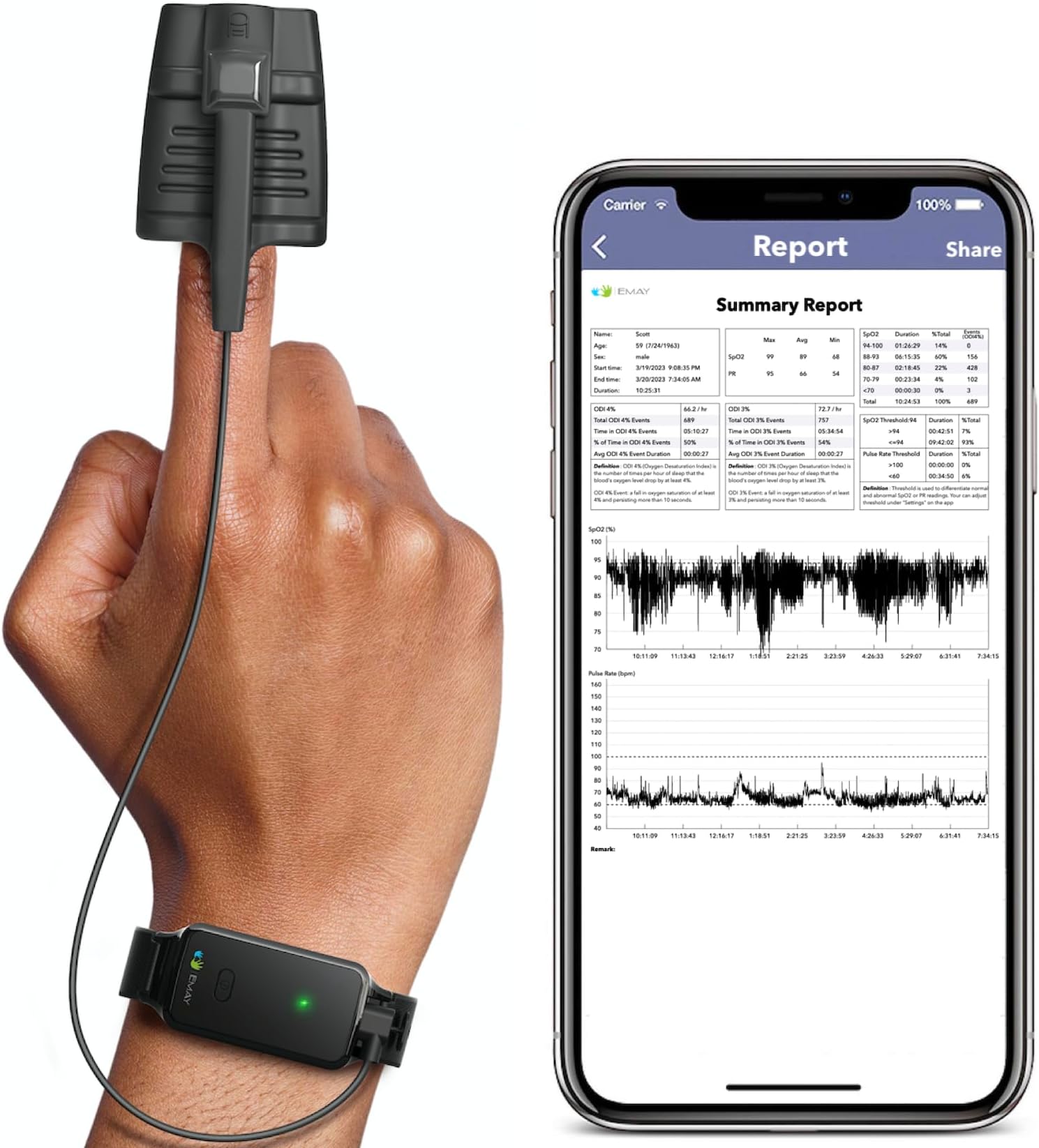
The EMAY SleepO2 Wrist Pulse Oximeter is a lightweight, rechargeable device designed for continuous overnight monitoring of blood oxygen saturation and pulse rate. With up to 12 hours of battery life, it records data independently and syncs seamlessly with the EMAY app for real-time viewing, detailed sleep reports, and easy sharing. Its ultra-soft finger probe and compact wrist unit ensure comfort, making it an essential tool for anyone serious about optimizing sleep health.


| ASIN | B0B2NNF32M |
| Battery Average Life | 12 hours |
| Battery Life | 12 hours |
| Best Sellers Rank | #39,120 in Health & Household ( See Top 100 in Health & Household ) #23 in Athletic & Aviation Pulse Oximeters |
| Brand | EMAY |
| Brand Name | EMAY |
| Color | Black |
| Compatible Devices | Smartphones ( iOS & Android ) |
| Customer Reviews | 4.3 out of 5 stars 574 Reviews |
| Item Weight | 20 g |
| Manufacturer | EMAY |
| Material | Silicone |
| Material Type | Silicone |
| Model Number | SleepO2 |
| Number of Items | 1 |
| Sensor Type | Oximeter |
| Size | Small |
| Software Update Supported to Date | unknown |
| Unit Count | 1 Count |
R**L
Amazing product - Highly recommend
I was recently assigned a bipap machine due to the fact that my blood ox has been dropping off during sleep. I purchased the Sleep02 to monitor my blood ox levels through the night to monitor progress. I'm also wearing it while doing chores. I am very pleased on how the device functions and interacts with the Emay phone app. The app is seamless to setup and use the reports are complete and amazing. Easy to download to a computer thru email or share. The manual provided is user friendly, complete and understandable. I'm 77 years old and I highly recommend this product
A**S
Easy to use. Great stats, reports, graphs and second by second monitoring info.
I am generally very happy with the EMAY SleepO2 Wrist Recording Pulse Oximeter. It works works well, easy to use and the associated app provides a wealth of information, stats, reports and graphs to assess your overnight or episodic SpO2 and heart rate. Very useful for correlating the recorded info with the more general stats that might be provided for sleep by activity watches. My only complaints are design feature issues. The recording and transmitting unit, that straps to your wrist like a small watch, is very small and light weight. But the battery life is also very short at only about 10 hours. I would have gladly accepted the wrist unit being twice as large to get two or three times greater battery life. The micro USB socket for plugging in the finger tip sensor sleeve doubles as the charging port. That means you have to detach the sensor every time your charge the unit, which, as mentioned, is every day you use the device due to the limited battery life. I would have preferred that they had a port for the sensor and a port for charging. Also that the ports used USB-C not micro USB. And lastly the strap for holding the recording unit on your wrist is a plastic snap band, more like what you would see for a hospital ID tag, not a wristwatch band. I would have preferred a proper standard width watchband, and a replaceable one. All that said the info from the device is excellent and very useful.
S**E
Very easy to use! Great product!
So far, I’m really happy with it. The ease of use makes it great! You just put it on your wrist and attach the sensor to your finger. Turn it on. It blinks green while taking the stats. (Re-charging the wrist piece only takes a couple hours). And you’ll see a red glow from the end of your finger sensor. I have very small fingers, but it seems snug enough and goes to work. I put it on my thumb first, thinking that I would need it on a bigger digit. But I think the readings might be more accurate on my left index finger. I had been using my Apple Watch along with the Pillow app to keep an eye on sleep issues. But when the year subscription came up for renewal, I wasn’t real sure I was getting enough info on the Pillow Blood O2 readings. I had dips down into the 80s which were worrisome. Pillow is a good app if you want just a sampling of things like snoring, REM, Blood O2, pulse, etc. But the dips in my Blood 02 deemed it necessary to go further. So I opted to buy this. One price and done. It continually reads the O2 and pulse rate. So easy to use, and then sync to my iPad. The stats are comprehensive. I am hoping to get a handle on it before I inquire on a Sleep Study, and this is the best method to do that. I’m hoping to avoid CPAP. I needed something uncomplicated so that I’ll use it every night. And this truly is very simple to use. The App that you sync the results to, couldn’t be easier. Connects via Bluetooth. No complicated buttons. Just off/on. I love it!
B**S
It does what it says it does
The device arrived well packed. The instructions are clear and well written. For context, I've been using the company's excellent finger pulse oximeter EMO-80 for seven months. It is a fine unit, and I expect the same tech is to be found in this device. I am only switching because, after trying many solutions, I have not found a reliable method to keep it on my finger during sleep! I've tried tape, tiny wedges etc., and finally a rubber band wrapped around it to increase grip. The rubber band generally kept the device on, but after a couple of hours, discomfort would wake me to change fingers. (As well, the EMO-80 is AAA battery powered, and two batteries are good for about two nights. Batteries are cheap these days but...) So finally, I'd had enough and ordered the SleepO2 Wrist Recording Pulse Oximeter. My only regret is that I didn't order it sooner! Another review mentioned annoyance, regarding the sensor and finger mount. Mentioned were discomfort, placement of the sensor, too much pressure on the finger tip, and that the blinking green light signaling the unit is operative (orange for charging) was too bright for the bedroom. First, about the light: I can't even see it, unless I raise the unit and look directly at it. I read the above-mentioned review before I bought the device, and was expecting something way different than what I got. I suppose different folks have different sensitivities to light, but this is about pinhead size, and isn't very bright. I've had no problems whatsoever with it. As well, the duckbill finger mount has been zero problem. I was surprised by how well it does work. Based on appearance, it might be a bit clumsy or awkward. I am an adult male, 6 feet tall, 180 pounds, so imagine my fingers in accordance. The finger easily slips right into the duckbill sensor mount. It isn't too tight or too loose, there's a comfortable pressure on my fingertip, and the sensor placement when using this oximeter seems fine. Basically, it just works. And whichever side you sleep, you won't need to make allowance. I've been surprised that it hasn't awakened me even once! I've become so accustomed that, on waking for a sip of water, I will check to see if it is still on my finger. The battery is charged by USB-3.0, so pretty quick. I haven't clocked charge time at various levels of discharge, but it isn't slow. And anyway, you've got a whole day before using it again! The box it comes in is a nice black cube and is fine for daytime storage. Connecting to the phone to download data is straightforward. Power up the Bluetooth on one device, then on the other. Occasionally, you might have to try syncing twice (It's Bluetooth, after all), but it will connect. With the data transferred to the phone, you can see multiple screens of graphs and information. There are many options for analysis, so if that's your thing, you can totally geek out. Printing the results is straightforward. Basically then, I have no complaints. Oh, wait! I did find the strap a little difficult to fasten, as it has a sort of peg that pops into a hole in the opposing strap. I've developed a technique and it's not so bad now. If you want to track your pulse and/or H02 levels, this is definitely the sweet spot in its price range, maybe even a in a higher one. Aside from the two niggling complaints – charging cable length and somewhat awkward strap fastening – I have no problems, only praise. I'm a fairly serious techie, and that's unusual. The oximeter does what it says it does, unobtrusively, and as far as I can tell, accurately. The readouts from both the finger pulse oximeter and the wrist oximeter are coherent, in that the levels and graphs are consistent. If you're wondering whether to go with the EMO-80 or the SleepO2 Wrist Recording Pulse Oximeter, I would say that if recording during sleep is your aim, definitely go with the wrist oximeter! I do not think you'll be disappointed.
F**E
Continuous monitoring of O2 works very well. Won't charge with some adaptors.
I bought this O2 monitor because I suspected that the wife's BiPAP machine wasn't providing adequate air to her at night. I found the Sleep02 device very easy to setup and use and it confirmed my suspicions. The only problems I had was that it wouldn't charge using my new One+ 2A charging block, but it charges fine with my old LG G2 1.8A charger. (Go figure!). Also, when you plug in the finger adapter make sure to push it in until it "clicks" or you won't get any readings. It has a "Remarks" link on the graph screen that lets you add Tag: and Remark: The Tag button presents 10 Select boxes for "on cpap", "on medication", "on oxygen", 'used oral appliance", had caffeine", "had alcohol", "had exercise", "slept on side", "slept on back" and "restless sleep". Most of those don't apply during sleep. I need "stopped breathing", "couldn't exhale", etc that I can tie to specific times on the graph, but the Tag/Remark is not tied to a time and you get only one for the entire session. It's worthless. Same with Remark. Only one. It's a little better because I can put time stamps in the textbox, but it's limited to 500 characters. Overall, I am very happy with the Sleep02.
S**T
Cannot disable Bluetooth at night, disrupting slow-wave and REM sleep
I continue to be disappointed that companies making these devices overlook the effect electromagnetic radiation has on sleep. Why would you wear a small device for 7-9 hours at night, often lying right near your head, depending on your sleep position, if it is emitting 1 to 10 mW/m² at a distance of about 1 foot to 1-2 inches (the specific measurements we took while wearing the watch). Multiple studies have shown that exposure to specifically this level of RF radiation has been linked to the suppression of melatonin, a hormone crucial for regulating sleep-wake cycles. Lower melatonin levels can disrupt the onset and quality of sleep, affecting both slow-wave (deep) sleep and REM sleep. I am a scientist and researcher who is not just stating an opinion here. I have looked into this subject very deeply, including multiple objective, controlled measurements using EEG and HRV tracking. RF radiation in the range stated above has even been shown to alter neural activity, potentially interfering with the brain's ability to transition between different sleep stages. This can lead to fragmented sleep and reduced time spent in slow-wave and REM. If you were to use this watch (and similar devices that do not offer an “airplane mode”), prolonged exposure to RF radiation may further induce cellular stress, which can affect the body's ability to repair and regenerate during sleep. This stress can disrupt the restorative functions of slow-wave sleep and the cognitive benefits of REM. Our group has been tracking a cohort of ~1,000 people for the past 10 years and we have seen significant cognitive decline, metabolic dysfunction, immune system weakness, and other generalized metabolic dysfunction in the group that has regular exposure to EMFs at night, including Bluetooth and WiFi. It should be no surprise that those that sleep with their cell phones turned on in close proximity to their sleeping area suffer the most derangement in these measures. Given the potential for even low-level RF radiation to disrupt sleep patterns and the significant health implications of chronic sleep disruptions, it is advisable to minimize exposure to EMF fields during sleep. While the Emay SleepO2 watch and other Bluetooth-emitting devices emit relatively low levels of EMF, the cumulative effects of nightly exposure should be concerning. Sadly, there are few consumer devices out there that are mindful of this problem. Oura ring and Garmin smartwatches, for example, do have airplane mode, but their accuracy and SpO2 measurement frequency are not at the level to be qualified for sleep apnea tracking. All in all, I had high hopes for this device and was disappointed once again by what should already be a well-handled problem in this particular industry.
J**S
Excellent Pulse Oximeter for Monitoring O2 levels & Heart Rate Overnight.
I was recently diagnosed with obstructive sleep apnea after taking a home sleep study test. The test showed that my O2 levels were dropping off during the night, & I wanted a pulse oximeter that would record what's happening overnight. I like the fact takes readings every second, and you can download the readings to the app without having the device connected to the phone all night. Setup was easy & straightforward. Overall, I'm very happy with this pulse oximeter.
J**L
Very clever, upscale design - very helpful!
This item works exactly as advertised. It's a great way to capture accurate sleep o2 data as you sleep - a particular concern for those struggling with sleep apnea. Both raw data as well as a nicely formatted summary report can be exported from the app (and shared with medical personnel, etc). User note: the battery charge is more than sufficient for a single night's recording; the battery may not last for a second night; I found it best to recharge it daily before use.
Trustpilot
1 month ago
5 days ago