Desertcart purchases this item on your behalf and handles shipping, customs, and support to Seychelles.
✨ Fix fast, shine forever with the ultimate UV resin kit! ⚡
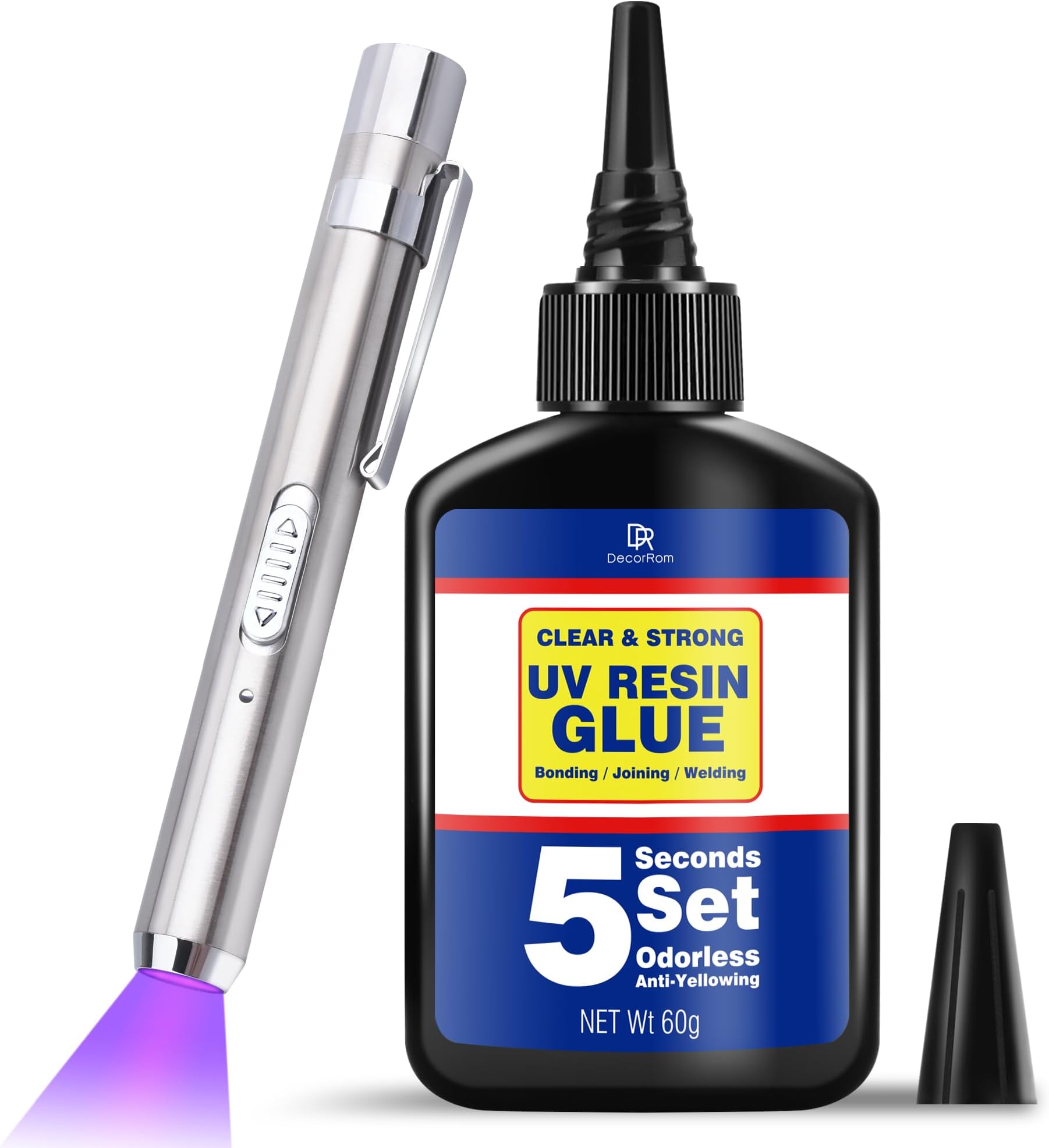
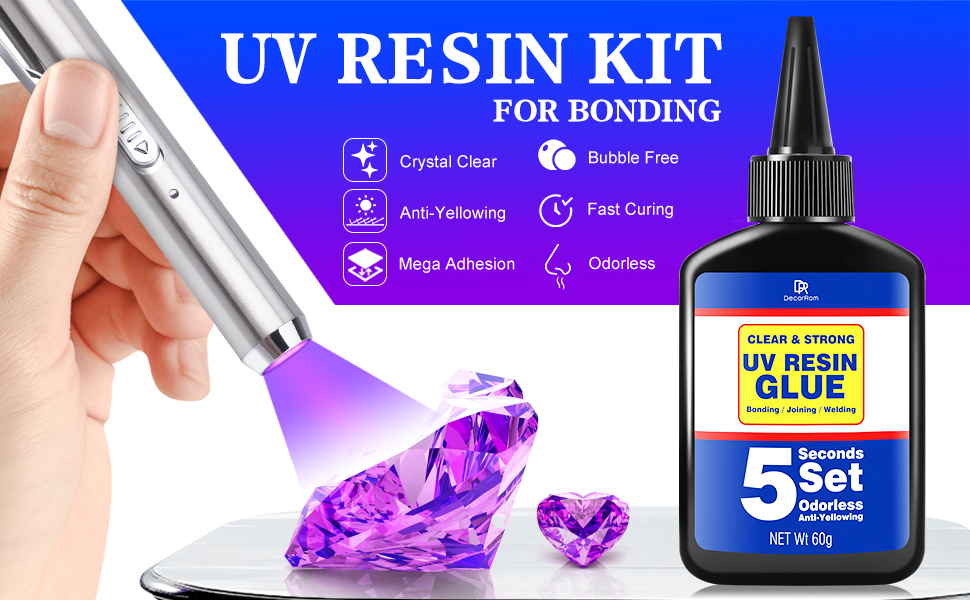
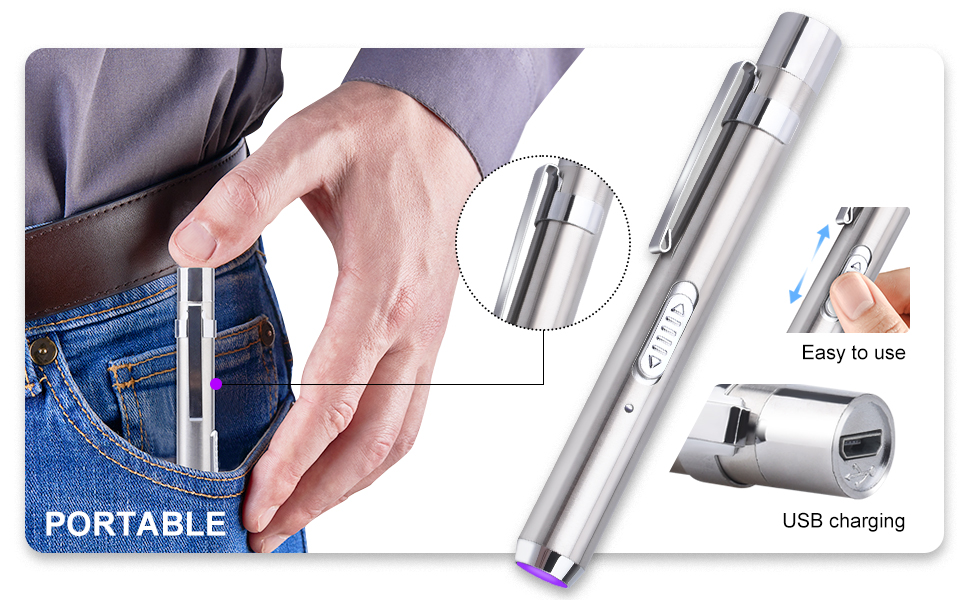
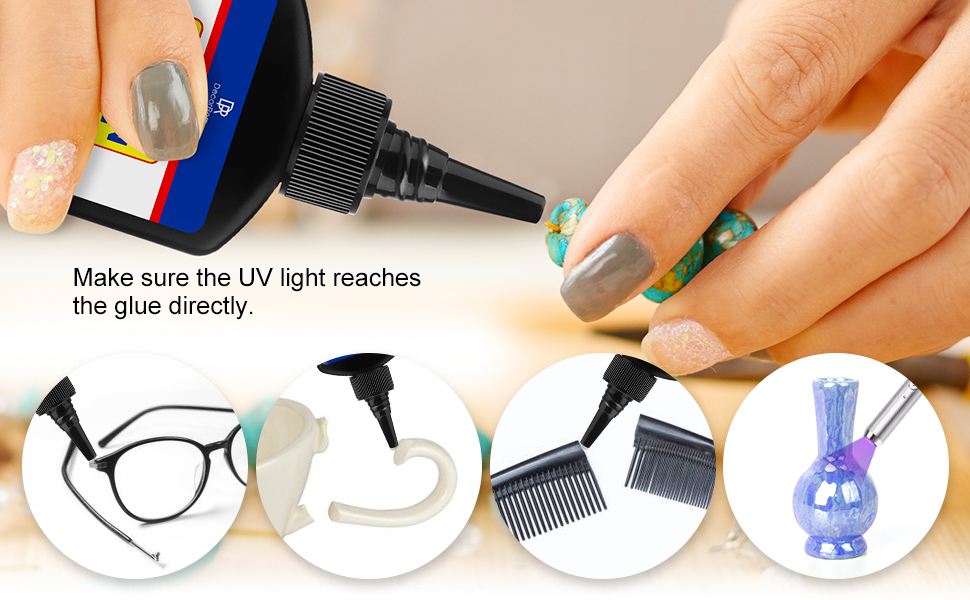
The DecorRom UV Resin Kit delivers ultra-fast curing with a 395nm rechargeable UV flashlight, bonding crystal-clear, waterproof, and heat-resistant resin in just 60 seconds. With 60g of high-clarity adhesive—50% more than typical kits—and a complete accessory set, it’s engineered for flawless repairs and creative projects on plastic, glass, metal, ceramic, and more. Perfect for professionals and DIY enthusiasts craving instant, durable, and invisible fixes.


| ASIN | B0DX1VWXFV |
| Best Sellers Rank | #3,163 in Industrial & Scientific ( See Top 100 in Industrial & Scientific ) #1 in UV-Curable Adhesives |
| Brand | DecorRom |
| Brand Name | DecorRom |
| Color | Transparent |
| Compatible Material | Plastic, Metal, Glass, Ceramic, Wood, Rubber, Acrylic, Ceramic, Porcelain, Fiberglass, Engineered Wood, Marble, Stone, Concrete, Granite, Carbon Fiber, Vinyl |
| Container Type | Bottle |
| Customer Reviews | 4.3 out of 5 stars 4,838 Reviews |
| Full Cure Time | 1 minutes |
| Included Components | Resin |
| Item Form | Liquid |
| Item Weight | 60 g |
| Manufacturer | DecorRom |
| Material | Resin |
| Material Type | Resin |
| Model | 241 |
| Other Special Features of the Product | Ultra-Fast Curing, High-Clear Adhesive, Rechargeable UV Flashlight, Multi-Surface Compatibility |
| Part Number | A0241 |
| Special Feature | Ultra-Fast Curing, High-Clear Adhesive, Rechargeable UV Flashlight, Multi-Surface Compatibility |
| Specific Uses For Product | Craft, Jewelry, Model, Repair |
| Unit Count | 2 Ounce |
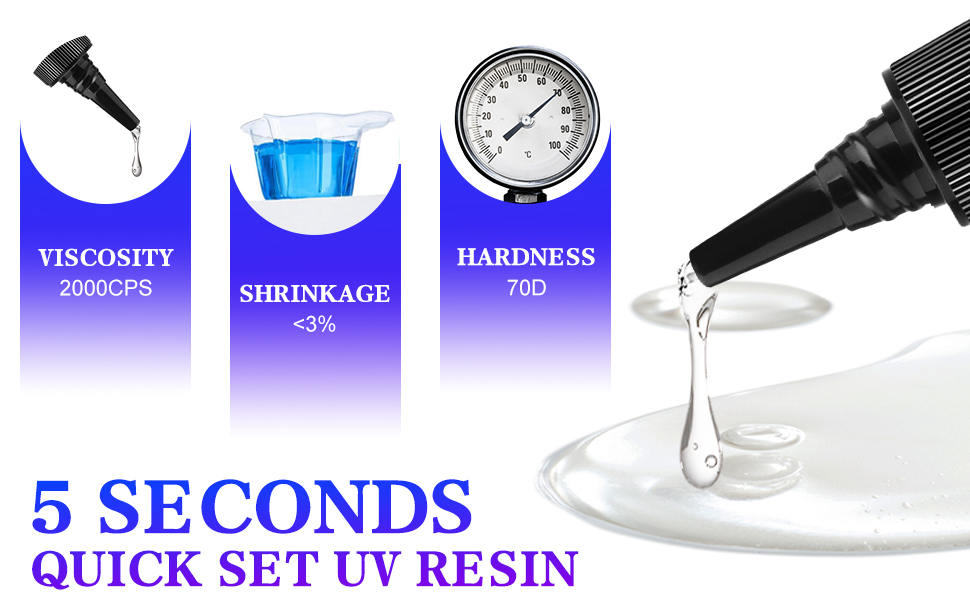
| Viscosity Level | Low |
| Volume | 59 ml |
| Water Resistance Level | Waterproof |
T**D
An essential tool for seamlessly repairing clear things.
I felt the need to write my own review of this UV resin to offset the (in my opinion unreasonable) negative reviews. I just bought my second bottle, as the one I've been using for over two years is finally starting to get low, and it's been so wonderful that I don't want to risk running out. Below, I'd like to address a few key points: 1. Usefulness. The photo I attached is of a small (8" tall), clear, light-up Christmas tree decoration, the top 1/2" of which had broken off and gotten lost. I was able to reconstruct it easily by dabbing on a bit of resin at a time and curing it mid-drip to make new branch-tips. You'd never know it had broken. That said, the resin doesn't stick super hard to most things other than itself, so making sure to sand surfaces prior to application--or even better, applying it in such a way that it can flow around part of what you're repairing in order to lock onto it mechanically--is very important. 2. Shelf life. As I said, I've been working with the same open bottle for two years now, and it works just as well as ever. The tree light in the photo was repaired last week, and the resin cured hard and clear like normal. 3. Yellowing. I have never, ever, had issues with yellowing or color distortion with this resin. In contrast, the "clear" UV resin I bought to use with my 3D printer yellows significantly with additional UV exposure, to the point of turning amber after several minutes of post-curing. The same amount of UV exposure makes no perceptible difference in the color of this resin (the one I'm reviewing). 4. Curing. Okay, I think I know why some people are having trouble here. I have a 405 nanometer UV lamp for post-curing 3D printed resin things, and I've found that this resin never cures fully with that light (the surface stays tacky and takes fingerprints). Luckily, I have a 395 nanometer UV flashlight intended for spotting pet urine, and it cures this resin fully and flawlessly. I would never have thought that the exact UV wavelength would make such a difference, but it seems it does. So if you're having trouble getting this resin to cure with a UV light, double check the wavelength. If it's 405nm, try 395nm instead, and see if that helps. (Edit: I found the flashlight's original packaging, and it claims it's "390-410nm", so maybe the broad spectrum makes a difference? Also, I noticed my resin wasn't fully curing with that flashlight anymore, and it turned out that I needed to change the batteries. Unfortunately, the light will continue emitting a purple glow long past the point where it's no longer strong enough to fully cure the resin, so it's something you have to stay cognizant of as you use it.) 5. Bottle size. Really?? Yes, the resin sometimes comes in a bottle of a slightly different size. Sometimes business have to order their containers from multiple different manufacturers depending on availability, and therefore the exact shape and size can vary. That doesn't mean they're trying to cheat you. Shake the wet cat food out of your skull. Did you get the volume of resin advertised? Then there's no problem. smh 6. Storing the container. The bottle is made of opaque black plastic that, as far as I can tell, lets in no light whatsoever. I'll occasionally shine a UV light directly at the bottle to cure any resin drips that have accumulated on the outside to make them easy to clean off, and I've never had it affect the inner contents in any perceptible way. So I guess what I'm saying is that I wouldn't worry about the bottle starting to harden prematurely from incidental light exposure. I'd worry more about extreme temperature fluctuations. Update: I finally ran out of my first bottle and opened the new one. First, I noticed that the bottle was slightly shorter and wider than the previous one, but seems to be of the same volume. The next thing I noticed was a strong herbal smell (not a chemical smell, oddly enough), like something you might whiff at a Traditional Chinese Medicine shop. I don't find it at all off-putting myself, but some might. Beyond that, I can't tell a functional difference between this resin and that of my previous order.
M**O
Works good for what I wanted! Regarding the negative reviews
The negatives I keep hearing about it remaining tacky I can attribute in part to people using low powered UV lamps or flashlights. I used a UV flashlight to test it and while it did cure it still felt a bit tacky. I left the flashlight on it for a good 5 mins and it felt less tacky but not tack free. I got a 36W UV lamp and put it in there for a total of 4 mins...the surface was crystal clear, beautifully smooth and completely tack free. I don't know if it made any difference but I also treated it like I would a two part resin where I put the bottle in a container of hot ( not scalding) tap water for about 20 mins to warm it up so it would flow more freely and any bubbles would rise out a little easier. . Winter here is pretty chilly so even if the ambient temperature feels OK it's best to make sure your resin is decently warm. Can't attest to the bottle size if it's in fact a full 120g since I have nothing to compare it to but so far I like this resin and just wish they sold bigger sizes. I will be buying again. I have had a decent amount of experience with two part resins. When I started learning about UV resins I wanted to try it in order to achieve some effects that was very difficult or not possible with regular two part 24 hour resins or even a quick cure will not achieve. The resin does have a smell but it is not overpowering. However, even so wear a respirator and gloves because many people who enjoyed this hobby had to quit because of developing allergies from repeated contact with the resin on their skin of breathing fumes. I don't use this for large projects, mostly to cover up certain objects like stickers or paper because since it can be dried so quickly there is little risk to it saturating the item and deforming it. I tested it on a vinyl sticker I was encapsulating in resin from an inkjet printer and did not coat it or seal it beforehand, the colors did not run or smear. I did leave the sticker to dry overnight in a warm place to make sure it was completely dry. Did some quick experiments of covering inkjet printed paper designed ( small ones ) and there was no running or smearing either. I would still prefer to seal it with Krylon UV Resistant Sealer or Modge Podge but this seems to work great if I need to get something done quickly. As far as appearance it is crystal clear with virtually no bubbles. Any that do show up can be fish out with a needle or popped with a lighter if they are close to the surface like regular resin. Even better is to leave it in a sealed contained ( for the fumes ) to let all the bubbles rise up to make it perfectly bubble free.
A**M
Good for heavy tables or projects if used correctly.
I’ve no conflict of interest and this review is solely to help public. I bought a glass table where the metal 'boss' had detached from the glass (the resin bond is very strong for vertical forces but can’t hold with horizontal sheer stress). Because it’s a heavy tempered glass slab on three wooden legs, the interface needs to be incredibly strong. After several failed attempts with other glues, this UV kit did the job. Tips for success: 1. Scrape off every bit of the old factory glue first, make sure both surfaces are very clean and use 100% alcohol and razor blade if needed (with extreme caution and special gloves to avoid cuts). 2. Use a liberal amount of resin (thick consistency somewhere between honey and water) in center to ensure no air bubbles, avoid too little or too much of it. 3. Hold it tight while using the UV light, drying time is decent and if you avoid bubbles then appearance would be great. It cured clear and is holding the full weight of the glass perfectly, nice appearance and good value for money. Saved me from throwing away a nice table! I can afford but avoid waste and carbon footprint if it can be avoided. I am a novice so some bubbles are there in photo attached. Finally, please do this on your own risk with protective glass, gloves and maybe mask as odor is high. Better to do this project in open air or open garage avoid direct sunlight till you cure it.
C**M
Cures hard, lightweight viscosity
Works well under UV viscosity is a little thinner than what I am used to. Not bad but for some applications it can drip
A**S
Very easy to use and cures hard as glass and I really can not recommend it enough
So I've tried several brands of UV cure resin, and by far this is my favorite. Even tho it's a little finicky to cure, if the UV light isn't strong enough it won't cure all the way and will be tacky to the touch (tho that can be remedied by just leaving it in the sun for a day), but the results are very worth it since the finish product has a nice solid feel similar to glass (which also means it can be sharp so be careful with sharp looking edges), not to mention it's extremely clear and shiny. Plus while it does have a strong smell, it smells like pine sap so it's not unpleasant unless you don't like the smell of pine. Another thing to keep in mind is that this stuff gives off significantly more heat than any other resin, UV or otherwise, when it's curing so be careful of when you put in it or put it on
S**W
Overall pleased. Minimal odor. Cure time not too long.
I've been mixing glow-in-the-dark powder pigments into this. The resin starts as a gel with the consistency of shampoo, then hardens to a somewhat tacky phase after a few minutes of exposure to my UV flashlight or other UV sources I have (a UV laser makes it harden in seconds, but only over a very small area at a time). Depending on the color of pigments you mix into it (and how well they absorb/block UV), it may take longer to harden. For full hardening, I set it under a UV florescent bulb for a few minutes, which works well and results in a hard surface. Sunlight works also. Warning: Even in a shaded area, the scattered UV light from the sky on a sunny day is sufficient to make this start to harden within a minute or so (so it would be starting to gel even as I am still trying to mix glow powder into it), so I do most of my work outside at night. Working under an incandescent (not florescent or LED) light works nicely, especially one with an "old-fashioned style" filament and yellow tinted glass. Smell is fairly minimal, but I seem to be a little bit allergic to this and other epoxies (it is common to develop allergies after using them for a long time), so I prefer to use it outside, or in the bathroom with the fan on. I have had good success with encasing this resin in clear polyvinyl shrink tubing (shrinking the tubing first and then hardening the resin inside afterwards). This provides a layer of replaceable slightly softer material around the resin which can protect it if necessary. Warning: Get eye protection (e.g. yellow glasses with 100% UV protection) if you are working with UV light sources! You only get one set of eyes!
L**H
epic fail
Sigh. I had such high hopes for this product. A one-step resin that cures in sunlight? A crafter's dream! However, in this instance reality did not meet expectations in any way. First of all, accessing the resin is problematic. For something like this, where time is of the essence and exposing the product to light starts the curing process, there should be a spout of some kind! There isn't even a flip-cap thing like on shampoo bottles; it's just a screw-on lid. Luckily I had some pipettes laying around, which I was able to use, but those aren't ideal either, since they're almost impossible to use without getting some bubbles. But for a one-step process, I could've lived with that. But the resin itself? Even worse. I tested this with a mold smaller than a quarter and maybe 1/4" deep, and after 30 minutes... it hadn't set at all. So I figured, okay, whatever, I'll just leave it in the sun for a while longer. I ended up leaving it in full sun for an entire day - at least 12 hours - and it's STILL tacky, with the same chemical smell as the uncured product. At this point I'm pretty sure I could throw my test pendant into a sun flare and it would come back just as sticky. What's worse, once I realized the stuff was never gonna cure, I had to un-mold it, which left a film of resin on the bottom of my mold that I have no way of removing. So I guess I'm down one mold, unless maybe I add a thin layer of resin, let it sit through a week of full, sunlit days, and hope the two batches cure together enough for me to pop them out in one chunk. There's probably a lesson about shortcuts in here somewhere, but I'm too grumpy right now to find it.
M**E
Some tips, considerations, and long term experience.
So I bought this resin nearly 4 years ago. I had used it a couple of times to do some glueing and casting small lenses for LEDs. The gluing strength was okay, but not amazing. Enough to get the job done in most cases though. However the clarity was great for the lenses. It does really have a good ability to work bubbles out passively (Letting it sit for a bit) or with a little tapping of the mold you have it in before curing. I was able to luckily find some of the test lenses I did when I first got it and I can honestly say that it has done great without yellowing. They are still crystal clear even after 4 years. However that has been inside and not exposed to sunlight. However this resin is not without issues. For one, the biggest thing is the bottle I got had claimed to be 'Non-Toxic...' There is literally not a single resin in existence that is Non-Toxic. And UV resins tend to be worse then regular resins. Some resins can be food safe and such only AFTER curing. But before they are extremely toxic still. And this resin is most definitely Toxic like all other resins are when uncured and most definitely even when cured as there is no certification otherwise. The uncured resin is so fumey that the smell burns my eyes and irratares my throat/nose if used in an enclosed area. And when curing the resin heats up releasing more of these fumes that are guaranteed to be bad to breath. So again that is not okay. The second thing is I had my bottle of resin for 4 years and after being in a temperature controlled environment and away from sunlight/UV the bottle became unusable. It was extremely weird becuase I went to use it the other day and it was still liquid. I put a drop on a cap and hit it with a uv light to make sure it was still able to cure which it did. Then I went to get a touch more and the bottle in that time (2 minutes) went from being liquid to completely gelled and useless. It was not exposed to the UV at all and it didn't heat up so it didn't end up accidentally curing. Some other reaction took place that must of happened triggered by the exposure to the air or perhaps the mechanical action of sqeezing the bottle. Long story short 4/5th of the bottle suddenly became worthless. So don't expect to keep this around for long term storage. I have traditional resins that are 13y old that still work fine. Sometimes they crystallize and you can use warm water to fix them. But warm water didn't help with this UV stuff (Hence why the bottle label is all messed up in the photos.) Again I suggest not expecting a long shelf life from this resin or you'll waste your money. Some considerations: -I found if you use too strong of a UV light the resin cures too quickly which results in Bubbles and/or cracking and clouding. It can also cause the resin to start smoking which again is probably extremely toxic to breath in. -The resin gets HOT when curing. Enough that it can smoke and burn you if you touch it. You want to cure it slowly if you can. In general the slower the better within reason. If using a high powered UV light you should start a far distance away and move it closer to finish the cure. Or hit it in short burst to allow the heat to dissapate. -Uv resin will only cure properly so deep as the UV can only go so far into the plastic. That means if you try and use this for thick cast it might only be solid on the outside. For me up to 5/8in (1.88cm) cured fine but I didn't test deeper. Additionally again if you are trying to cure it thicker then doing it slow is important to stop too much heat from building up. It will also take a longer exposure to the UV as it get weaker the more plastic it needs to pass through. -If you add too much coloring to the resin the Pigment or Dye can Inhibit or stop the ability of the UV to cure the resin. This stuff should always be a bit translucent when using it. Overall excluding the Gelling that happened after long term storage the resin did work great when I first got it. And cured pieces managed to not yellow after 4 years inside. But the nontoxic claim on the bottle I received was unsubstantiated and frankly untrue. It is a decent product if used quickly and with good ventilation. Hopefully this all was useful.
S**Y
Quick fix Quick cure
A great product to keep at home for many things that might need a fix with a clear resin. This resin cures fast with little odour and hardens solid and clear.. Any household should have this in the drawer with things like elastic bands and Elmer's glue and pins. Excellent product.
T**K
Works Well For What It Is
It does the job and does it quick. The resin has a slightly slick/sticky surface after curing with the light, but I found that polishing it with a paper towel got rid of it. For my purposes it worked well.
T**A
Produto
Não é muito bom
T**R
Works great
Works exactly as intended and exactly like the ones in the tiktok videos. I used this to make repairs on my cars valve cover. The flashlight is pretty cheap but to be expected at that price. I used my own higher quality flashlight. Be careful when using this in sunlight as the liquid at the top of the nozzle will begin to harden in sunlight
D**E
Good!
Its good stuff. Dries nice and easy. I recommend it.
Trustpilot
1 month ago
1 week ago