
DOWNLOAD THE APP


Customer Services
Copyright © 2025 Desertcart Holdings Limited
DOWNLOAD THE APP

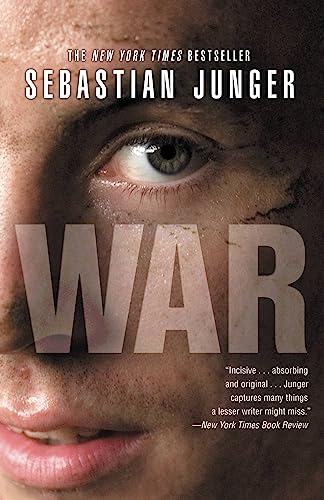

desertcart.com: WAR: 9780446556224: Junger, Sebastian: Books Review: "The Only One Listening was Satan" - Sebastian Junger, probably best known as the author of A Perfect Storm, spent months embedded with soldiers of the Second Platoon, Battle Company, 173rd Airborne, in the Korengal Valley, the most hostile area of Afghanistan. The result of this is War, an absorbing, if uneven account, of the men sent to intercept Taliban fighters as they move between Afghanistan and Pakistan. The mission is difficult and costly, fought in terrain that is unlike any other in Afghanistan, and is performed by young, highly trained men bonded by the ties of brotherhood, a word that is much more meaningful and important than you might imagine. War is not an examination of our involvement in Afghanistan, it is not a treatise on politics or strategy, nor is it a profile of the people of the Korengal Valley. There is no connection to anything else that may be occurring in Afghanistan or the world, the focus is solely on the front line soldiers of Second Platoon and the effects of combat on them. They are the heart and soul of the book. Through them, Junger examines the effects of intense firefights, living in very close quarters in extremely difficult conditions. As for the outpost that Second Platoon occupies, Junger writes, "It's a miraculous kind of antiparadise up here: heat and dust and tarantulas and flies and no women and no running water and no cooked food and nothing to do but kill and wait." This is a view of the war in Afghanistan that you cannot find anywhere else, it is unique and interesting. Junger divides his book into three sections; "Fear," "Killing," and "Love." Each section shows the boredom and terror, monotony and excitement, and the madness that have been a part of combat since the first time groups of men took up arms against one another. Junger's narrative shows the strengths and weakness of the men of Second Platoon, but he also explains the reasons for their behavior. He relies on an incredible but fascinating amount of research; military history, Army and university psychology studies, biology, and his first hand experiences. War is an accessible, enjoyable, heartbreaking, and overwhelming account of men facing an often invisible and driven opponent. Where War falters, it is with the men of Second Platoon. Junger provides thumbnail sketches of the members of the platoon and spends the most time with Sgt. Brendan O'Byrne, a soldier that "seemed to have a knack for putting words to the things that no one else really wanted to talk about." Other than O'Byrne, none of the other men are discussed much beyond certain anecdotes. While there are several intense firefights, Junger explains what he was feeling and seeing, however he does not include the images and thoughts of those doing the actual fighting. War could have been much improved by including more from the perspective of the soldier and less from the reporter. Further, Junger could have connected the reader much more emotionally with soldiers of Second Platoon. War has always been a part of our lives. It is easy to sit thousands of miles from the frontlines and believe that you know the men that do violence against an enemy. Junger has not written a book filled with cliche or Hollywood glory; it is about comradeship and brotherhood. Even though it isn't perfect, War is a book that brings the realities of combat home, allowing the reader to better understand the men that fight and die, and to understand war. Highly recommended., Disclosure: Obtained from: Library Payment: Borrowed Review: A War For Your Brain - Sebastian Junger was no neophyte to covering war when he climbed the steep slopes to join the men at FOP Restrepro in the remote hellish mountains of Afganistan. But the mental torment that develops after 5-6 fire fights a day, for weeks on end is something his mind could not prepare for. Junger does not preach - he takes no political stance or makes his personal views of war known other than as to how his own fear at times crept into his psyche. He describes in unique prose the fighting bases, the men, and the war there that appears to have no end unless you die. Above all he stresses the brotherhood - the strong bond that forms from being in combat and depending so much on the man next to you for your survival. He delves into some of the men's histories - some boys who signed up to prevent going to jail for minor infractions generated out of sheer boredom living in a small town. One Soldier's own father got drunk and shot him twice. I found that by watching the documentary "Restrepro" by Sebastian Junger and Tim Hetherington (photographer) I was better able to see the moonscape the soldiers were fighting to hold, as well as give the men a true identity - I could accurately know what these soldiers looked like. The documentary compliments the book so well and I was glad I could compare the two while reading the book. I will say that the descriptions in Junger's book stand alone and are written so well that the documentary is not necessary to enjoy the book. Junger captures a lot of the action, but also goes into what makes the boys tick. "House to House" by David Bellavia (fierce fighting in Fallujah 2004) and "The Good Soldiers" by David Finkel (the 2007 surge directed by GW Bush in iraq) are two of my favorite books on wars in the Middle East. Both authors cover the battle scenes with such a fine eye for detail and action, and touch briefly on the mindset of these soldiers. Junger covers more of the mind and the emotional side of war, and by book's end, those who never experienced war will have a better understanding of those who have. I highly recommend both the book and the documentary "Restrepro". Since the book's release, Tim Hetherington was killed covering the civil war in Libya (April 20 2011) Knowing that helps you appreciate more the dedication and serious threat these two men exposed themselves to in order to get their story. An excellent read that goes fast.
| Best Sellers Rank | #103,557 in Books ( See Top 100 in Books ) #13 in Afghan War Biographies #35 in Afghan War Military History #112 in American Military History |
| Customer Reviews | 4.7 4.7 out of 5 stars (2,813) |
| Dimensions | 5.25 x 0.88 x 8.13 inches |
| Edition | Reprint |
| ISBN-10 | 044655622X |
| ISBN-13 | 978-0446556224 |
| Item Weight | 2.31 pounds |
| Language | English |
| Print length | 320 pages |
| Publication date | May 17, 2011 |
| Publisher | Twelve |
G**D
"The Only One Listening was Satan"
Sebastian Junger, probably best known as the author of A Perfect Storm, spent months embedded with soldiers of the Second Platoon, Battle Company, 173rd Airborne, in the Korengal Valley, the most hostile area of Afghanistan. The result of this is War, an absorbing, if uneven account, of the men sent to intercept Taliban fighters as they move between Afghanistan and Pakistan. The mission is difficult and costly, fought in terrain that is unlike any other in Afghanistan, and is performed by young, highly trained men bonded by the ties of brotherhood, a word that is much more meaningful and important than you might imagine. War is not an examination of our involvement in Afghanistan, it is not a treatise on politics or strategy, nor is it a profile of the people of the Korengal Valley. There is no connection to anything else that may be occurring in Afghanistan or the world, the focus is solely on the front line soldiers of Second Platoon and the effects of combat on them. They are the heart and soul of the book. Through them, Junger examines the effects of intense firefights, living in very close quarters in extremely difficult conditions. As for the outpost that Second Platoon occupies, Junger writes, "It's a miraculous kind of antiparadise up here: heat and dust and tarantulas and flies and no women and no running water and no cooked food and nothing to do but kill and wait." This is a view of the war in Afghanistan that you cannot find anywhere else, it is unique and interesting. Junger divides his book into three sections; "Fear," "Killing," and "Love." Each section shows the boredom and terror, monotony and excitement, and the madness that have been a part of combat since the first time groups of men took up arms against one another. Junger's narrative shows the strengths and weakness of the men of Second Platoon, but he also explains the reasons for their behavior. He relies on an incredible but fascinating amount of research; military history, Army and university psychology studies, biology, and his first hand experiences. War is an accessible, enjoyable, heartbreaking, and overwhelming account of men facing an often invisible and driven opponent. Where War falters, it is with the men of Second Platoon. Junger provides thumbnail sketches of the members of the platoon and spends the most time with Sgt. Brendan O'Byrne, a soldier that "seemed to have a knack for putting words to the things that no one else really wanted to talk about." Other than O'Byrne, none of the other men are discussed much beyond certain anecdotes. While there are several intense firefights, Junger explains what he was feeling and seeing, however he does not include the images and thoughts of those doing the actual fighting. War could have been much improved by including more from the perspective of the soldier and less from the reporter. Further, Junger could have connected the reader much more emotionally with soldiers of Second Platoon. War has always been a part of our lives. It is easy to sit thousands of miles from the frontlines and believe that you know the men that do violence against an enemy. Junger has not written a book filled with cliche or Hollywood glory; it is about comradeship and brotherhood. Even though it isn't perfect, War is a book that brings the realities of combat home, allowing the reader to better understand the men that fight and die, and to understand war. Highly recommended., Disclosure: Obtained from: Library Payment: Borrowed
G**N
A War For Your Brain
Sebastian Junger was no neophyte to covering war when he climbed the steep slopes to join the men at FOP Restrepro in the remote hellish mountains of Afganistan. But the mental torment that develops after 5-6 fire fights a day, for weeks on end is something his mind could not prepare for. Junger does not preach - he takes no political stance or makes his personal views of war known other than as to how his own fear at times crept into his psyche. He describes in unique prose the fighting bases, the men, and the war there that appears to have no end unless you die. Above all he stresses the brotherhood - the strong bond that forms from being in combat and depending so much on the man next to you for your survival. He delves into some of the men's histories - some boys who signed up to prevent going to jail for minor infractions generated out of sheer boredom living in a small town. One Soldier's own father got drunk and shot him twice. I found that by watching the documentary "Restrepro" by Sebastian Junger and Tim Hetherington (photographer) I was better able to see the moonscape the soldiers were fighting to hold, as well as give the men a true identity - I could accurately know what these soldiers looked like. The documentary compliments the book so well and I was glad I could compare the two while reading the book. I will say that the descriptions in Junger's book stand alone and are written so well that the documentary is not necessary to enjoy the book. Junger captures a lot of the action, but also goes into what makes the boys tick. "House to House" by David Bellavia (fierce fighting in Fallujah 2004) and "The Good Soldiers" by David Finkel (the 2007 surge directed by GW Bush in iraq) are two of my favorite books on wars in the Middle East. Both authors cover the battle scenes with such a fine eye for detail and action, and touch briefly on the mindset of these soldiers. Junger covers more of the mind and the emotional side of war, and by book's end, those who never experienced war will have a better understanding of those who have. I highly recommend both the book and the documentary "Restrepro". Since the book's release, Tim Hetherington was killed covering the civil war in Libya (April 20 2011) Knowing that helps you appreciate more the dedication and serious threat these two men exposed themselves to in order to get their story. An excellent read that goes fast.
F**N
Ein Journalist schreibt über seinen monatelangen Aufenthalt bei des US-Truppen im Osten Afghanistans. Ein sehr detailierter und dadurch ungemein spannender Bericht, der von einem Krieg erzählt, der so weit von uns entfernt stattfindet und so schwer für den Leser, aber auch die Betroffenen zu verstehen ist. Es wird von Männern erzählt, die eine Karriere bei der Army der eines Kriminellen vorziehen oder die einfach nur aus Langeweile über ihren Job bei einer Fastfood-Kette zum Militär gingen. Der Autor versteht es, simpel über Hitze, Kälte, Ungeziefer, Schweiß, Rotz und Blut zu schreiben. Gerade das macht dieses Buch so packend. Heftige Kämpfe, die Opfer fordern wechseln mit nervenzerrendem Nichtstun ab. Schlaglichtartig kommen die Soldaten zu Wort, über ihr Vorleben und ihre Zukunftspläne. Leider schwingt über allem der Gedanke mit, dass einige ihre Heimat nicht wiedersehen werden. Gut fand ich, dass Junger auch Zusatzmaterial zur grundsätzlichen Psychologie des Krieges und der Krieger nutzt sowie auch die Gegenseite zu Wort kommen läßt. Nicht jeder Afghane im Kriegsgebiet ist ein Taliban und nicht jeder US-Marine ein John Rambo. Sehr interessant und das, was ich einen Pageturner nenne. Vlt sollte dieses Buch auch von Lehrern als Unterrichtsstoff in Erwägung gezogen werden, denn dieser Konflikt unterscheidet sich so sehr von Verdun und Stalingrad...und trotzdem eine Wiederholung...
G**C
Un libro degno di un Pulitzer. Junger descrive con uno stile avvincente la vita quotidiana di un piccolo reparto entrando nelle dinamiche psicolgiche e nei meccanismi umani del combattimento. Ricco di riferimenti e dettagli che lasciano trasparire oltre al lavoro sul campo un'attento studio di quanto osservato è scritto in uno stile asciutto ed avvincente, senza retorica ed celebrazionismo. Più che il lavoro di un giornalista pare quello di un ricercatore sul campo considerato il tempo trascorso a contatto con i soldati ed i disagi&rischi condivisi con loro . Da segnalare che a fianco a Junger c'era anche il noto fotografo Tim Hetherington ucciso in Libia che con il materiale raccolo con Junger ha prodotto il noto docufilm "Restrepo" vincitore del Sundance Film Festival.
S**E
"War" is about the 18 month placement Sebastian Junger got with Battle Company in the Korengal Valley in Afghanistan. Battle Company, 150 men, see 20% of the fighting in Afghanistan and Iraq. 150 men out of hundreds of thousands! This is because of the Korengal Valley, the most dangerous area in this region. The mountains border Pakistan and many of the Taliban fighters come across from Pakistan into Afghanistan. There are a number of things that strike you about the men in Battle Company. How they all come from disparate backgrounds for instance. One guy joins because he heard a radio advert while working in Subway, quit his job, and joined the army the next day. 6 months later here he is firing off machine gun rounds and calling down air strikes in a valley thousands of miles away! One man used to deal drugs in Reno, crossed some drug dealers, and joined the army to escape them. Another, perhaps the most interesting, O'Byrne, joined after being sent to reform school for taking the rap for his dad shooting him! The other thing that strikes you about them is their loyalty to one another. They really care about each other and look out for one another like nobody else, anywhere else. It's a close knit group that honours their dead and loyalty to their unit. Even when they're on leave, they race back to the front as they don't want to be responsible for not being there if one of them dies. When Doc Restrepo dies, their name the camp after him and fight the Taliban like animals, going out into the valley just to draw fire, then calling down Apaches to bomb the positions. The book is about the soldier's life in this valley and as such violence suffuses the book. From the numerous encounters with the enemy (often with Junger caught up in the middle), to the casualties they inflict and absorb, it is inescapable. One man grills cheesesteaks and then when he calls out that dinner's ready an RPG takes his arm off! One man is shot in his leg while asleep in his hammock - if he had been sleeping in his normal position the bullet would have gone in his head. When a new lieutenant joins the unit the men hold him down and beat him up. In any other part of the army this would be mutiny but here they do it to gauge his reaction - if he takes the punishment then they will listen and respect him; if he can't, he's failed the initiation. It's a brutal world these men live in and the stakes are high. Junger reports all of this with clarity and skill, knowing how to bring the reader into this barely recognisable world and making them understand how these men live day to day. It's fascinating, exciting, absorbing, and an utterly brilliant book, I can't recommend it higher.
D**K
Brilliant! One of the best books I've ever read on the experience of war, the the bond among soldiers.
M**L
I have served in Afghanistan and felt that the author truly captured the nature of the conflict and the often absurd methods employed by the coalition to deal with an enemy that knows nothing but war.
Trustpilot
2 weeks ago
1 month ago