We remain fully operational. Our teams are working around the clock to ensure your deliveries continue safely.

DOWNLOAD THE APP


Customer Services
Copyright © 2025 Desertcart Holdings Limited
DOWNLOAD THE APP
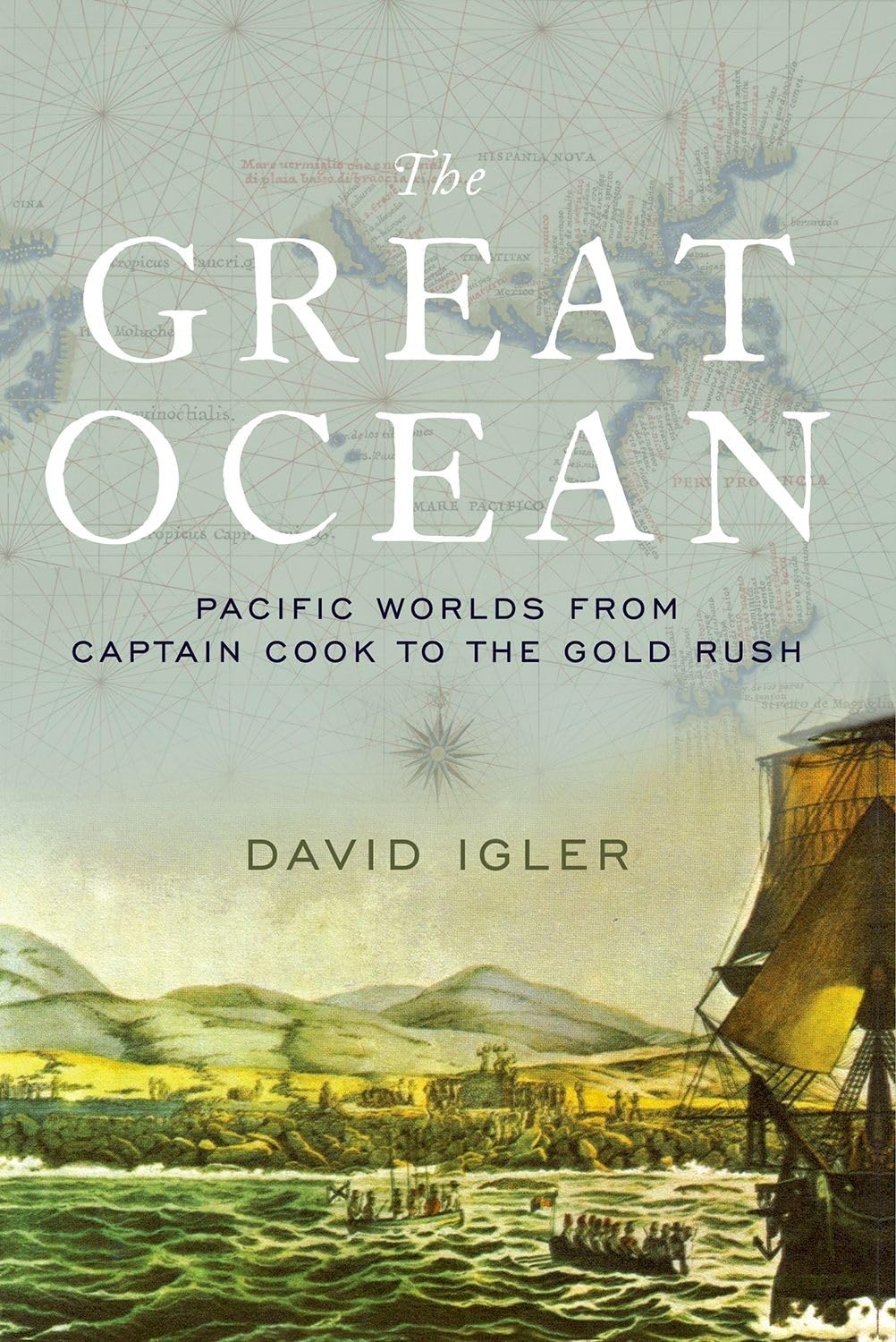
desertcart.com: The Great Ocean: Pacific Worlds from Captain Cook to the Gold Rush: 9780190498757: Igler, David: Books Review: Great introduction to the Pacific world. - This book is a great overview of the Pacific Ocean as a historical topic... A really great read ad very enjoyable! It will enlighten you to the uniqueness of Pacific history as well as its significance ! Review: Fantastic book! - Igler takes the reader on a fascinating journey, as he invites us to consider the ocean as the starting point for analyzing cultures and peoples. The land is on the periphery of a new way of seeing history and cultural development. The American West is actually the Pacific East in this construct! We meet fabulous characters - ruffians, explorers, and saints - as Igler explores a crucial time period in the development of the U.S. and Pacific worlds. The book is full of adventure and scholarship, and it took me to places and people I'd never even heard of! I'd recommend it heartily for the more thoughtful reader, and think it would make a great mini-series!
| Best Sellers Rank | #1,365,483 in Books ( See Top 100 in Books ) #177 in Oceania History #1,965 in Economic History (Books) #13,012 in U.S. State & Local History |
| Customer Reviews | 4.5 out of 5 stars 23 Reviews |
M**R
Great introduction to the Pacific world.
This book is a great overview of the Pacific Ocean as a historical topic... A really great read ad very enjoyable! It will enlighten you to the uniqueness of Pacific history as well as its significance !
S**W
Fantastic book!
Igler takes the reader on a fascinating journey, as he invites us to consider the ocean as the starting point for analyzing cultures and peoples. The land is on the periphery of a new way of seeing history and cultural development. The American West is actually the Pacific East in this construct! We meet fabulous characters - ruffians, explorers, and saints - as Igler explores a crucial time period in the development of the U.S. and Pacific worlds. The book is full of adventure and scholarship, and it took me to places and people I'd never even heard of! I'd recommend it heartily for the more thoughtful reader, and think it would make a great mini-series!
A**K
Good book on the history of the pacific
Got this book for a history of the pacific course I am taking. Lots of great info
A**S
Great purchase thank you
Great purchase thank you
L**T
Focused on the Pacific waters close to the Americas. A fine book full of fascinating stories.
This is one of the best books I have read about the Pacific. It is extremely well-written history, concentrating on the eastern Pacific, largely from Baja California to Russian Alaska, and focused on the span from Captain Cook's voyages to the starting days of the California gold rush. He emphasizes that the Pacific is a connector not a barrier, and looks at a number of voyages of several kinds of ships--merchants, whalers, explorers, and the US Ex Ex (the United States Exploration Expedition). One theme is how the eastern Pacific becomes the American West. He uses journals and travel accounts (some published well after the actual experiences) extensively, and interweaves a number of lives to form a mosaic of connections. Chapter 1 examines the "Sea of Commerce." This explores many aboriginal trade systems, as well as early trade venture to the Northwest coast, the Californias and Hawai'i, linked of course to Canton. Some of this is done through the story of William Shaler (1802-1804). The number of voyages seems to be known fairly well, and between 1786 and the Gold Rush, at least 953 ships from at least 20 states (not all were nations at the time, for example Hamburg)traded on the California coast. Chapter 2 examines "Disease, Sex and Indigenous Depopulation." This is the best account of a widespread and unpleasant phenomenon I have read. Much of the sex trade was forced prostitution, and partly through that sexually transmitted diseases became widespread, with baleful impact on native populations everywhere. He also discusses other diseases introduced such as tuberculosis and smallpox. This web of negatives is also part of the ocean of connections. Chapter 3 is about hostages and captives, with some interesting stories about several Russian captives of Northwest tribes. Taking hostages appears to have been routine, but arbitrary and often as a means to get native people to return something allegedly stolen or to return deserting sailors. This chapter has some grimness to it as well. Chapter 4 is on "The Great Hunt." This describes the Russian hunt for sea otters, and more general (later mostly American) hunts for whales. fur seals and other furs. They would be sold in China. Again there are many stories, including from the journals of the wife of an American whaler captain, Mary Brewster, a total of six years at sea. By 1850 there were some 700 American whalers in the Pacific, with Hawai'i as a main port of call. The chapter is particularly disconcerting on the massacre by whalers of grey whales in the Gulf of California (although the whales killed some sailors). Chapter 5 is "Naturalists and Natives," and has some fascinating stories of naturalists. In one, a German/Russian naturalist on a Russian ship became close friends of a Micronesian man, member of the crew, more or less. Igler notes that these scientists were in the service of nationalism, of patrons and of international science, but also had some baleful effects--such as publishing accounts that told where resources such as sandalwood could be found. Chapter 6 looks primarily at the US Ex Ex, and the experiences of an important American geologist. Overall, what Igler paints is a picture of exploitation, an excitement of exploration, and of reluctant accommodation on all sides. Crews tended to be complex and the mixing of people and cultures was extraordinary. It also establishes that American whalers, merchant ventures, explorers and missionaries (in Hawai'i from the 1820s) all but made the West coast officially American before the Gold Rush, even while British, Russians and Mexicans were active as well.
T**T
Highly readable and accessible
The Great Ocean neatly coordinates nuts-and-bolts historical scholarship from professional historian literature, first-person accounts from the men and women of diverse nations and cultures who witnessed the scenes depicted, contemporary literature (Moby Dick) and even mid-19th century geological sciences. While the geography is vast, the time period under consideration is not very great, which is matched by the rapid pace of the the changes in the Pacific and North American Pacific societies and mega-faunal ecology. These are linked to distant world historical events such as decay of the Spanish New World empire, Napoleanic wars, and US continental expansion in an engaging and readable style aimed at a broad audience.
K**E
More like a research paper, lots of good material but lacks excitement
The book is nicely organized into (0) introduction to ocean worlds; (1) seas of commerce; (2) diseases, sex, and indigenous depopulation; (3) hostages and captives; (4) the great hunt: (5) naturalists and natives in the great ocean; (6) assembling the Pacific: and conclusion: when east became west. There are also at the end extensive notes, a bibliography, and an index. The author has unearthed a lot of material - diaries, ship logs, and reports - from explorers, traders, whalers, sailers and travelers in the Pacific region over the period 1800 - 1850. There are many interesting stories, but the story gets bogged down by the sheer mass of material. There is a lack of excitement.
B**H
A reality check on the Pacific's pioneering age
This is a dense little book of history, built on a rather massive study of shipping activities in the Pacific over a 75-year period. From among thousands of voyages, Igler focuses on a handful in which the human drama can be documented.The little known characters he selects include China traders, seal and whale hunters, naturalists, and some native people of the islands or coastlines. And for the most part the accounts of these eyewitnesses are simply horrific. There's the enormous hardships at sea, the acknowledged guilt in bringing deadly epidemics to native populations, the regularity of rape, violence and hostage taking as part of the trading process, and the mind-boggling slaughter of sea mammals. Then, through it all come a host of naturalists, industriously and even rapturously documenting the wonders of nature across the greatest ocean, though even these voyageurs also tend to serve the interests of growing empires.
Trustpilot
4 days ago
1 week ago