
DOWNLOAD THE APP


Customer Services
Copyright © 2025 Desertcart Holdings Limited
DOWNLOAD THE APP
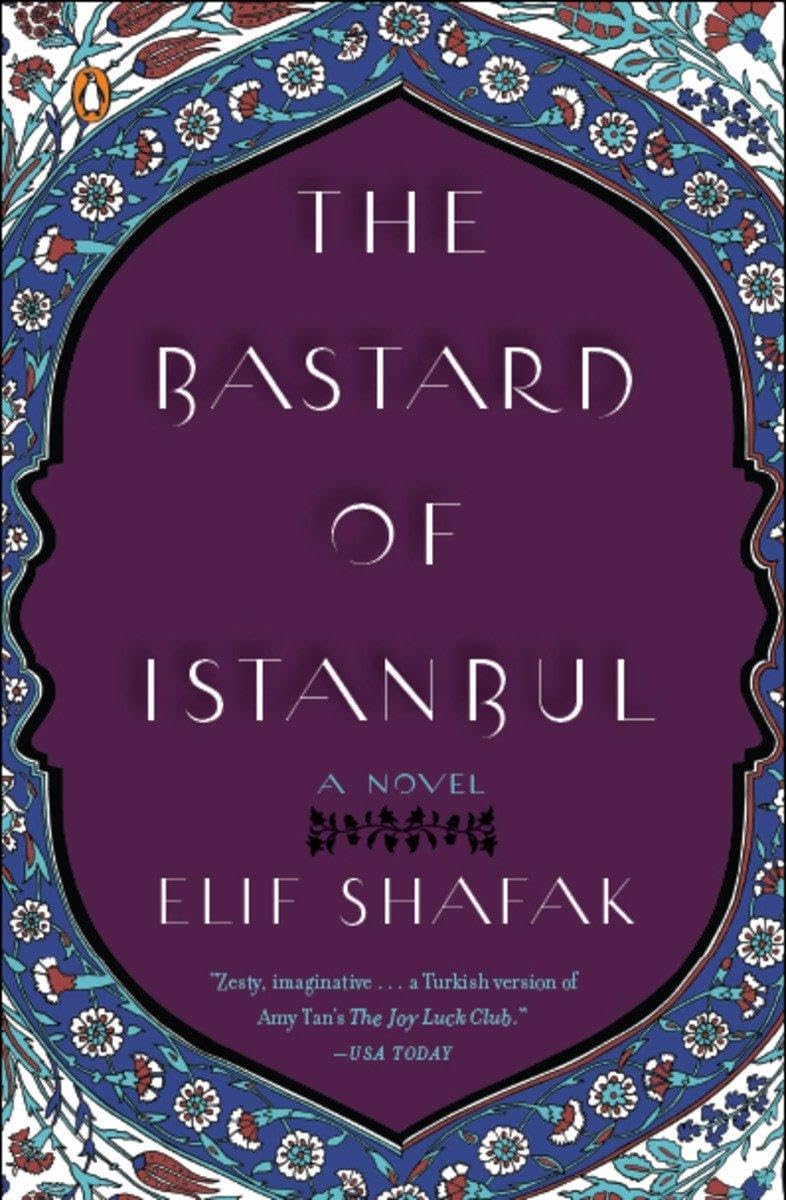
desertcart.com: The Bastard of Istanbul: 9780143112716: Shafak, Elif: Books Review: Bridges the gap between Turkish and Armenian-American points of view - Turkish writer Elif Shafak sure knows how to tell a great story. So great, in fact, that she nearly wound up in jail for "denigrating Turkishness" because some of her fictional characters in this 2007 novel dared to give their viewpoint of the 1915 Armenian deportation horror. And yet, this is a book that bridges the gap between the various points of views and winds up creating a bridge of understanding. This is all done with fine writing, nuanced perspectives, interesting characters and a complex plot that eventually ties up all the loose ends. Basically, it is the story of two large families. One is Turkish and consists four generations of females, the men having all died with the exception of one son who is living in America. The other is Armenian-American with a sad history of persecution. The "bastard" in this story Asya, a rebellious 19 year old Turkish girl whose mother is herself rebellious, dresses provocatively, is agnostic and runs a tattoo parlor. Her counterpart is an Armanoush, also 19, whose parents are divorced and whose American mother and Armenian extended family make her question her identity. She has discovered an Armenian-American internet chat room where she can share some of her thoughts about her heritage with other people and travels to Istanbul to try to understand her background. The book is like a puzzle and there's a new piece to put in place on practically every page. Each character is fully developed and then, just when you think you know where the story is going, there is a another twist to the plot. There is unhappiness of course, but there is also a lot of humor and I often found myself laughing out loud. I loved the portrayals of the places - Istanbul, Arizona, San Francisco. I felt I could hear the sounds, smell the various aromas. This was especially true of the food and the cooking and my taste buds came alive as I read these descriptions. I loved this book. Couldn't put it down. Don't miss it. It is a real treat. Review: Colourful and exotic ... Istanbul and one of it's families spring to life - This is a great read ... Full of colourful characters and wonderful descriptions of Istanbul itself ( which is so well described it's actually like another character itself ) ... Despite the fact that it is set in a traditional muslim city this family are not a run of the mill family .... For a start all the men are dead ( by 51 !!) Each sister , their mother and their grandmother are fantastic characters , full of interesting , and often hilarious ,quirks ... The story line is simple enough , the story of several generations of a family but the interest of the reader is sustained by the fabulously colourful descriptions of the people in this family and the interconnections between them , finally despite the exotic location it turns out teenagers are the same the world over ! ... Read this and you'll see what I mean ...
| Best Sellers Rank | #92,267 in Books ( See Top 100 in Books ) #160 in Cultural Heritage Fiction #640 in Contemporary Literature & Fiction #2,147 in Literary Fiction (Books) |
| Customer Reviews | 4.1 out of 5 stars 5,045 Reviews |
L**C
Bridges the gap between Turkish and Armenian-American points of view
Turkish writer Elif Shafak sure knows how to tell a great story. So great, in fact, that she nearly wound up in jail for "denigrating Turkishness" because some of her fictional characters in this 2007 novel dared to give their viewpoint of the 1915 Armenian deportation horror. And yet, this is a book that bridges the gap between the various points of views and winds up creating a bridge of understanding. This is all done with fine writing, nuanced perspectives, interesting characters and a complex plot that eventually ties up all the loose ends. Basically, it is the story of two large families. One is Turkish and consists four generations of females, the men having all died with the exception of one son who is living in America. The other is Armenian-American with a sad history of persecution. The "bastard" in this story Asya, a rebellious 19 year old Turkish girl whose mother is herself rebellious, dresses provocatively, is agnostic and runs a tattoo parlor. Her counterpart is an Armanoush, also 19, whose parents are divorced and whose American mother and Armenian extended family make her question her identity. She has discovered an Armenian-American internet chat room where she can share some of her thoughts about her heritage with other people and travels to Istanbul to try to understand her background. The book is like a puzzle and there's a new piece to put in place on practically every page. Each character is fully developed and then, just when you think you know where the story is going, there is a another twist to the plot. There is unhappiness of course, but there is also a lot of humor and I often found myself laughing out loud. I loved the portrayals of the places - Istanbul, Arizona, San Francisco. I felt I could hear the sounds, smell the various aromas. This was especially true of the food and the cooking and my taste buds came alive as I read these descriptions. I loved this book. Couldn't put it down. Don't miss it. It is a real treat.
O**B
Colourful and exotic ... Istanbul and one of it's families spring to life
This is a great read ... Full of colourful characters and wonderful descriptions of Istanbul itself ( which is so well described it's actually like another character itself ) ... Despite the fact that it is set in a traditional muslim city this family are not a run of the mill family .... For a start all the men are dead ( by 51 !!) Each sister , their mother and their grandmother are fantastic characters , full of interesting , and often hilarious ,quirks ... The story line is simple enough , the story of several generations of a family but the interest of the reader is sustained by the fabulously colourful descriptions of the people in this family and the interconnections between them , finally despite the exotic location it turns out teenagers are the same the world over ! ... Read this and you'll see what I mean ...
G**X
A dialogue of spirits of Turks and Armenians
A 19-year-old Turkish Istanbuli girl oblivious to the past and nearly suffocated by her overdevoted relatives, meets a 19-year-old Armenian-American girl obsessed by the past and nearly suffocated by her own overdevoted relatives; the first discovers a past that has been suppressed, and the second learns to partially free herself from the past and savor the present. This is an artfully constructed book with two contrary agendas, both essential, but not entirely comfortable with one another. First, the literary agenda: The quirks, foibles and virtues of a large number of complex characters, understandable even when not exactly lovable, are described in rich and vivid language, their personal dramas interwoven and mostly resolving in surprising and satisfying ways. The literary ambition is signaled in the opening chapter -- the sounds and sensations of rush hour in Istanbul in a rainstorm, and the furious and impious thoughts of young Zeliha as she hurries through the broken streets to a critical appointment, are delightful, frightening and hilarious, and will be unforgettable. And then we meet the other badly split family of the Armenian American girl, and then back to Zeliha and her three sisters, each eccentric in a different way, and her mother and grandmother living in sweet but comical confusion. But there is another agenda, political and didactic: Elif Shafak wants us to face a terrible tragedy -- the killings and deportations of Armenians in 1915 -- and to help all of us, but especially Armenians and Turks, to come to mutual comprehension and forgiveness today. The contemporary Turks of the novel (and, I think, in reality) have no problem whatever with their Armenian compatriots. None of Zeliha's friends thinks it remarkable that her lover, Arman, is Armenian; for them, "Armenian" is just another variety of Turk. But when Zeliha's now 19-year-old daughter Asya introduces her new friend Amy -- or Armanoush -- to her friends in the bar as an Armenian American, they are suddenly on the alert. "Now the word Armenian wouldn't surprise anyone at Café Kundera, but Armenian American was a different story. Armenian Armenian was no problem -- similar culture, similar problems -- but Armenian American meant someone who despised the Turks." As Asya begins to tell the tragedy of Armanoush's Istanbulite family, the execution of her great grandfather because he was an intellectual, one of the drinkers at the table blurts out, "That didn't happen." The problem is that Armenians in the diaspora cannot forget their terrible history, while Turks cannot remember it or, if they have even thought about it, accept a version where both sides did awful things and nobody now is to blame -- 1915 was a long before they were born, Turkey was a different country, and none of that has anything to do with them. But Shafak insists that it does have to do with them, because until Turks recognize and acknowledge the pain of the Armenians they are in effect accomplices of a massive cover-up. But on the other side, would Armenians in the diaspora ever accept any reasonable concessions or admissions by the Turks? When Armanoush gets Asya to take part in an on-line forum of Armenian Americans, one of them immediately demands that she as a Turk recognize the genocide. The young but well-read Asya writes back, "Genocide is a heavily loaded term... It implies a systematic, well-organized, and philosophized extermination. Honestly, I am not sure the Ottoman state at the time was of such a nature. But I do recognize the injustice that was done to the Armenians. I am not a historian. My knowledge is limited and tainted, but so is yours." And then she asks, "Tell me, what can I as an ordinary Turk in this day and age do to ease your pain?" And the Armenian Americans, never before confronted by such a question, have no plausible answer. Apologize, says one after a long pause. For something she had no part of? Get the Turkish state to apologize, demands another. But how could she get the Turkish state to do anything? But then another Armenian American forum member joins in, one who calls himself "Baron Baghdassarian" and whom we have been taught to expect to be wiser than the others, and surprises everyone by typing: "Well, the truth is... some among the Armenians in the diaspora would never want the Turks to recognize the genocide. If they do so, they'll pull the rug out from under our feet and take the strongest bond that unites us. Just like the Turks have been in the habit of denying their wrongdoing, the Armenians have been in the habit of savoring the cocoon of victimhood. Apparently, there are some old habits tht need to be changed on both sides." And whether or not you believe that a real Armenian American might write that in an on-line forum, it is clearly the opinion of Elif Shafak. The on-line forum allows Shafak to introduce political discourse by characters who have no existence beyond their cyber presence. And to describe events for which there is no human testimony, an ancient djinni who has been magically enslaved by Zeliha's eldest sister, the clairvoyant Banu, gives his eye-witness account. In this literary tale all the decisive actors (actresses) are women and the men, whether comical, sympathetic or pathetic, are necessary but secondary figures like Poins or Bardolph in Henry IV, useful for displaying some aspect of the more complex (and always female) protagonists. That for me was one of the pleasures of the book, allowing me to enter the consciousness of so many and such complex girls and women. The blatantly political segments interrupt the flow of the other, literary story, sometimes jarring the reader's willingness to believe. But they enable Shafak to describe that terrible history. The book is charming, sometimes stunningly beautiful, often outrageously funny, sometimes deeply sad. And because of its political content, it is also a very brave book. Elif Shafak knew she was taking a major risk when she published the original version in Turkish, that she would offend powerful members of the state and risk imprisonment. And I imagine that her version of events will also greatly offend members of the Armenian diaspora, for the very reason "Baron Baghdassarian" expounded. And for all these reasons, it's a book we need to read.
C**Y
Not as good as I thought it would be
I liked the writing style and descriptions but the story was disjunct and I had trouble following it sometimes. It seemed the writer was trying to be clever but wasn’t so good at it in my opinion. It wasn’t as good as I thought it would be. The story was just too tangled up in itself.
D**S
I am not sure just what to make of this
Two young women in two different households full of Aunties, one of (mostly) Turkish background living in the present (and detaching from the past in multiple ways) in Istanbul, the other of (mostly) Armenian background living in America but with the past always before them. Some interesting interactions between them, although they didn't feel entirely natural to me, for whatever that's worth. Generally fine writing, with a bit of telling rather than showing, some sudden passages of awkward exposition, a few odd solecisms (the author's or the translator's, hard to say). Both (all) of the families involved are full of odd and colorful characters, perhaps a few too many; I confused them with each other now and then, but it didn't really matter. A multi-generational secret connecting the two families was frankly too complicated for me; while it had tragedy and poignancy, I would have to go back through it and draw a diagram to figure out exactly who was involved and how. But I enjoyed it overall. Perhaps I just wasn't smart enough for it. :)
A**S
Engaging, wonderful book
This is the first Elif Shafak novel I've read. I can't wait to read others. Loved this book. Loved the characters and the plot. Loved all the details of the daily living of the characters. Loved the way she weaved the plot between the Armenian and Turkish families and made no one a hero, no one a villain--just real people caught up in the web of life and lives that many of us know or can imagine or know indirectly. She courageously took on a loaded political topic and brought it down to the basics of affected human lives. More importantly, as a novelist she brought history to reality in a creative way without writing a historical novel. A brilliant trick of novelistic wizardry that I really loved. I have lived in Turkey and am comfortable in the language in most ordinary conversational situations, so it was nostalgic but it was also a page turner. I have little time to read but found myself making time every day to read this book. I had to force myself to plod through the three books of Orhan Pamuk's that I have read, but this book was a joy. I rank this among the best books I have read by any author.
E**A
enjoyable and a bit convoluted
My Armenian friend recommended this book to me and I am very happy he did. Through the characters, I got an education about cuisine, the structure of an Armenian family, a glimpse into what it might be like to struggle with one's cultural identity, and information about the Armenian genocide. The book opened up a wonderful dialogue between us as I discovered both political events and actual events that happened in his family (he is a part of the diaspora - he grew up in Bulgaria). So, this was a wonderful novel for me. I can see how, if you are a person who already knows about the things I have described above, this novel would not suit you. The characters and scenes have a double purpose - to entertain and inform. Often, there is too much informing and not enough entertaining. Also, many of the descriptions are too long for a modern novel. However, if you are interested in learning about Turkish culture, Armenian culture, and historical events in a less didactic way (knowing that there are some flaws in the writing, but not enough to make me put the book down - I finished it in 2 days) I highly recommend it!
D**V
A family tree intertwined with common roots and a suspenseful truth!
Beautiful written, poignant family story spanning family histories narrated through the lens of two teenagers, one in America and the other in Turkey. Very underrated book with a suspenseful climax, which was hard to guess. Might find it slow in the beginning, but that’s the charm of a slow burn. I followed this book after Forty Rules of Love and Island of Missing trees and found it most provocative and endearing at the same time.
Trustpilot
1 day ago
2 days ago