
DOWNLOAD THE APP


Customer Services
Copyright © 2025 Desertcart Holdings Limited
DOWNLOAD THE APP

Full description not available
P**L
Kalevala's lasting power
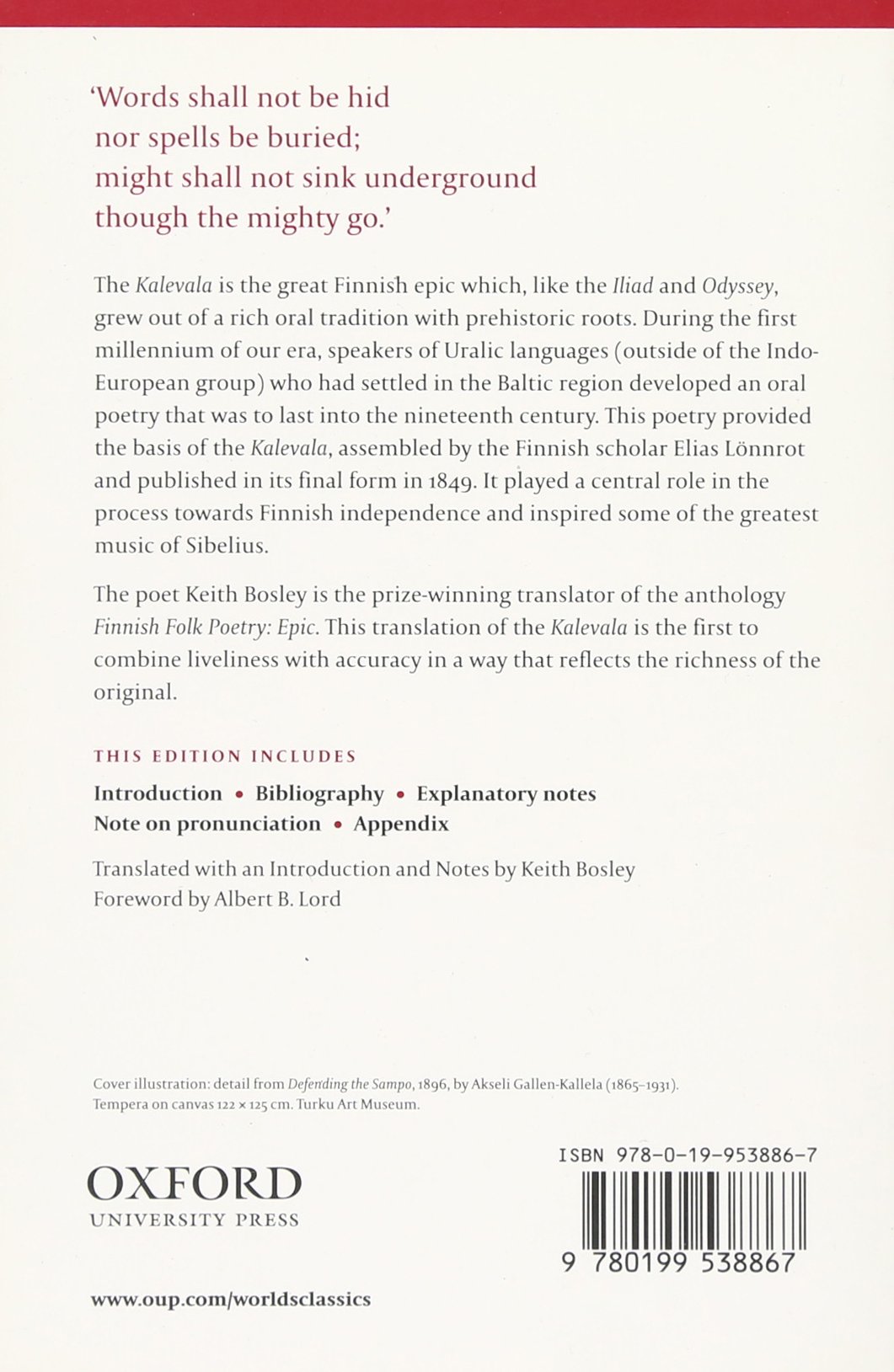
The Kalevala is a great body of mythology and folklore that is vital to understanding Finland, and Finnish national identity. In fact, it might not be going too far to say that the Kalevala cycle *is* Finland, in so much as a culture's founding stories can be said to "make" the culture. Aside from the Kalevala's importance in historical and cultural terms, however, this is a great collection of stories that will enchant and delight anyone who likes to meet interesting, larger-than-life characters and see them put in interesting situations.This Oxford World's Classics edition of The Kalevala benefits from a foreword by Albert B. Lord of Harvard University and an introduction by translator Keith Bosley. Both the foreword and the introduction do a very fine job of setting The Kalevala in its historical context, and particularly of explaining the Herculean labor that Finnish folklorist Elias Lönnrot performed in traveling throughout the Russo-Finnish border region of Karelia and recording the oral poetry he found among the Karelians.Yet one goes to The Kalevala not for forewords or introductions, but rather for the poetry itself, and the epic story it tells. The main characters of The Kalevala have that mythic, heroic quality, and it is interesting to wonder about the characters as we meet them in this poetic cycles. Were they originally gods of a polytheistic, pre-Christian religious cycle, and are the poem's references to one god, an Almighty Creator, a way by which the Karelians held on to the old stories under the pressure of adopting a new religion? Were the main characters of these stories originally eminent Karelians of ancient times, whose stories metamorphosed over time into tales of mythic heroes? Or do the stories come from some other source or cause, one that is too far removed in time from us for us to have a chance of discovering it?Whatever the case may be, the characters are vivid, and so are their stories. The elderly Väinämöinen is a great singer who can work magic through the power of his songs; but he is unlucky in love, and he laments that he should have married young (advice that might have been taken seriously by the rural residents of old Karelia, where early marriage might lead to the birth of more children who could help on the farm). The smith Ilmarinen is hard-working and preternaturally skilled at his craft; as the Norse thunder-god Thór was a hammer-wielder with whom working-class Vikings could identify, so Ilmarinen is a hero for the working-day. He is the man who forged the Sampo, a mystical device that is never described very clearly, but brings prosperity to its owner. You grind the Sampo, and it makes you wealthy. I suppose that is all we really need to know. The Sampo is a plot device, a catalyst - the MacGuffin of The Kalevala.Very different from Väinämöinen and Ilmarinen is the Kalevala cycle's third main character, the mischievous Lemminkäinen. On some levels, Lemminkäinen is a trickster-figure like Loki from Norse mythology; selfish and forever in search of gratification, "wanton Lemminkäinen" has a habit of seducing all the young women of a village, and then skipping out just a few steps ahead of a whole village-full of angry fathers and husbands and boyfriends and brothers. Yet his story takes a number of interesting and unexpected directions that the Vikings of pre-Christian times would never have expected to see from Loki. Rune 14, "Elk, Horse, Swan," shows Lemminkäinen journeying into the underworld in search of the swan of Tuonela (a story later adapted into a musical tone poem by Jan Sibelius); he is killed by a blind herdsman whom he had wronged (in a manner somewhat analogous to the way the compassionate god Baldr from Norse mythology is killed, albeit unintentionally, by the blind god Höðr) and torn to pieces. Rune 15, "Resurrection," shows Lemminkäinen's long-suffering mother journeying to the underworld, reconstructing her son's mangled body, and bringing him back to life - a story that invites parallels with the story of Isis and Osiris from Egyptian mythology.One of my favorite tales from the poem is Rune 17, "Inside the Giant," wherein Väinämöinen, seeking songs that he can use to wield magical power, goes inside the mouth of the giant Antero Vipunen, makes his way down to the giant's belly, and gives the giant no end of gastrointestinal discomfort until Antero Vipunen "opened his word-chest/and flung wide his box of tales" (p. 213), providing Väinämöinen with powerful spells that Väinämöinen will henceforth be able to sing when they are needed. In this story, one senses echoes of the various descents-into-the-abyss that one reads of in different mythological traditions - e.g., Odysseus and Aeneas making their respective descents to the Greco-Roman underworld, in order that they may bring back from the land of the dead the information that they need in order to fulfill their respective quests - as well as the story of Jonah's swallowing by the great fish in the Old Testament. Aside from the mythographic qualities and storytelling power of "Inside the Giant," I just find "Antero Vipunen" to be an incredibly awesome name.Another of the most important characters in the Kalevala is Kullervo. The child of one of two families involved in a feud, Kullervo is sent away from his family, made a serf of Ilmarinen, and treated cruelly by Ilmarinen's wife. Kullervo curses Ilmarinen's wife - "[Y]ou too will weep yet --/you'll weep your milch cows" (p. 462) - and transforms her herd of cows, which he had been sent to herd, into bears, instructing them, "Rip the mistress's/thigh, bite half her calf/when she comes to look/and crouches to milk!" (p. 463). Once his magic has brought about the death of Ilmarinen's wife, Kullervo returns home and finds his family, but then leaves them, determined to revenge himself on the family of Untamo, the family that has wronged him. He meets a girl on the road and has his way with her, but with tragic consequences (think Oedipus). And he does get his revenge; but as with those Shakespearean characters who dedicate themselves to revenge, Kullervo destroys himself even as he works the destruction of his enemies. These runes make for profoundly disheartening reading.A highlight of the Kalevala, for me, was the series of runes starting with Rune 39, "Sailing to Northland." In these runes, the three main characters - Väinämöinen, Ilmarinen, and Lemminkäinen - join forces and sail north in search of the Sampo, the mystical prosperity-bringing device forged by Ilmarinen but then taken away to the North by the witch Louhi. (I can't help wondering if such elements of the myth point back to old economic rivalries between the Finnish Karelians on the one hand and the Sami people of Sapmi, or Lapps of Lapland, on the other.) The three make their way successfully to Northland and retrieve the Sampo, but Louhi transforms herself into a bird-monster and pursues them: "[N]ow the North's dame is coming/the wondrous bird glides along --/as for shoulders, like a hawk/a wyvern as for body!" (p. 567). A great battle ensues, and the editors of this edition wisely made Finnish artist Akseli Gallen-Kallela's 1896 painting "Defending the Sampo" the book's front cover illustration (check out Kallela's other Kalevala paintings if you're an admirer of the stories). I won't tell you what happens to the Sampo - no spoiler alert needed here - but I will say that we'd all better plan to keep working for a living; none of us is likely to find the Sampo and grind his or her way to easy money.In modern Finland, the Kalevala is a living force, a benchmark of Finnish national identity and cultural pride. You never know when you'll turn a corner in Helsinki and find a statue of Väinämöinen singing, or Ilmarinen wielding his hammer. One of the best restaurants in the city, close to the waterfront, is named Aino, for the young maiden who threw herself into the sea in order to avoid marrying the elderly Väinämöinen, and in the process became the first mermaid. But you don't have to travel to Finland to appreciate the mythic power and beauty of The Kalevala. It is a great collection of stories, pure and simple, and this translation conveys well the power and beauty of the stories.
C**N
The National Epic of the Finnish People
We owe much to the efforts of the scholar Elias Lonnrot for preserving this great epic. The work was collected mostly in the mid 19th century, a time when much of the rural regions of Europe still remembered the ancient folk-beliefs, mythic lore, and superstitions of their ethnicities. Had Lonnrot not undertaken this project, these orally-transmitted tales may have been lost forever in the approaching modern age.Why is it important to read such lore? The very soul of a people is found within. What were their moral beliefs? How did they see the world? To simplify, the great deeds of the heros, the vile behavior of villains, define just what a culture believed to be good and bad. The hero serves as an ideal model of personal conduct, for the most part. Even when the hero fails to live up to his own standards, he teaches us a lesson about honorable behavior.The heros of The Kalevala are warrior-wizards. Vainamoinen is the primary character, an old shaman and bard of supernatural power. He is in quest of a wife, and deeper wisdom. Ilmarinen, a wizard and blacksmith, who uses his craft to forge many items of magical properties. He forged the Sampo, a mysterious mill which generates grain, salt, and gold. The Sampo is a central artifact in this narrative. There is my favorite, Lemminkainen, who, although he is a proficient wizard and warrior, gets himself into endless trouble with his hard-drinking, brawling, prolific womanizing, and outrageously brash behavior. Then there is Kullervo, who more than anything yearns to vent his vengeance on those who murdered his family...or anyone who insults him, personally. Their tales are all intertwined as they make a stand against Louhi, the evil sorceress of the North.
J**.
Epic Indeed - A tale for any one, any time
I have always felt proud of my Finnish roots - I appreciated the morals and values my mother taught us, and admired how her siblings remained close throughout their lives, They were all very proud to be Finns. Only recently I decided to learn more about Finland and it's history.I had read reviews about the different translations/authors of The Kalevala and wasn't sure which one to get. I first purchased the Eino Friberg version and soon after purchased the Magoun book. Little did I know that it would become interested in all things Kalevala. I went about reading with pen in hand, multiple books and laptop in front of me. It helped me to read a bit at a time, looking up characters and places and taking notes.I am no scholar, but I am definitely a hands on, multi-sensory learner.I didn't want to just read it. I waned to understand the importance, symbolism and humor in the runos before moving to the next.I was happy to get the book translated by Keith Bosley and the audio CD narrated by Keith Bosley ( Naxos Poetry) I have not had the chance to read this version of The Kalevala. After I do, I will look forward to sitting in my rocking chair, popping in the CD and having someone read the book to me. It has been fun getting to know the Finn in me :)
Trustpilot
5 days ago
1 month ago