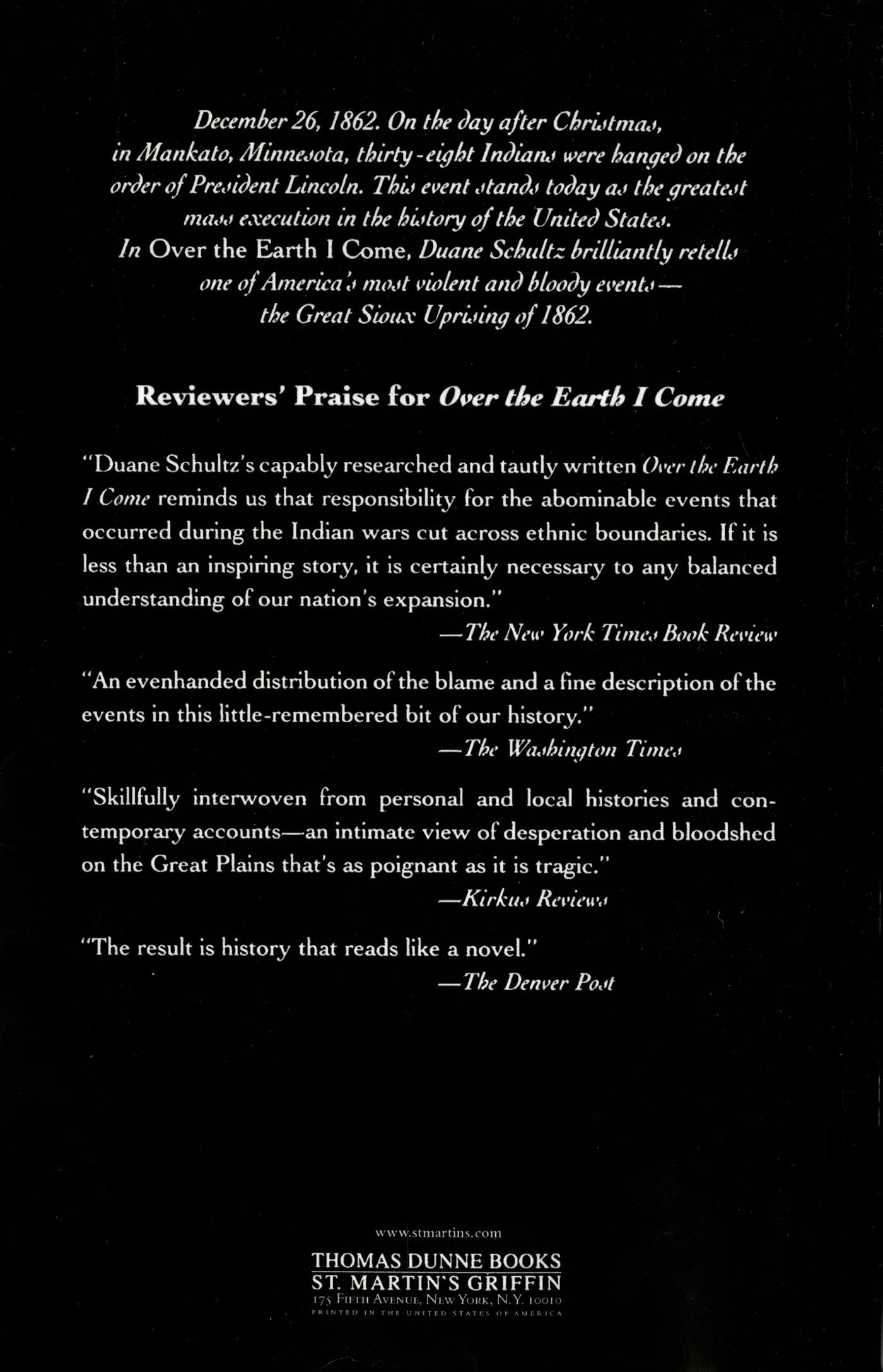
Over the Earth I Come: The Great Sioux Uprising of 1862
T**W
Excellent Book About a Largely Ignored But Very Important Event
This is an excellent, well-researched, well-written, and even-handed description of the Great Sioux Uprising of 1862, its genesis, and its aftermath. The Sioux Uprising of 1862 was responsible for the largest number of wartime civilian deaths in U.S. history until 9/11; reliable estimates of white civilian deaths during the Uprising range between 800 and 1,000 settlers. The Great Sioux Uprising was the forerunner of Louis Real the Metis' uprising on the plains of Manitoba only a few years later, as well as of Custer's Last Stand and other battles with the Sioux that occurred later and further west. The Great Sioux Uprising of 1962 was truly the beginning of the end for plains Native American and Canadian aboriginal culture. Despite its clear importance in the history of the American West, and even after the publication of "Over the Earth I Come," the Great Sioux Uprising of 1862 continues to receive scant notice from the American public, and its true importance remains largely (and mysteriously) ignored.
E**Y
Sad truths
This is a book everyone in the country should read to build awareness.
K**O
I had no idea. Sad.
I grew up in Minnesota, thinking that the Lakotas were supposed to be in, well, the Dakotas. I had no idea at all that they were in Minnesota, thank you very much, and were not treated very well. I had no idea that the largest government-ordered execution took place in Minnesota, nor that the beginning of Sioux (Lakota) uprisings started in Minnesota. I'm no scholar of history, so I can't speak personally to its veracity, but the reviews I've seen have supported it. I STRONGLY recommend it to Minnesotans and N/S Dakotans, as I'm not sure many who grew up there realize how big a role this uprising played (and, quite frankly, how shamefully those people were treated). Very sobering, and very important, I think, for us to appreciate.
R**P
More Historical Fiction Than History
One reviewer said this book was history that read like a novel. I think it is more like a novel that reads like history. As a native Minnesotan long interested in the Native Americans of that state, and especially the Dakota uprising of 1962, I read this book with great interest. And, eventually, with some doubts. The author made several mistakes about Minnesota geography that made me think he was not familiar with the area. With mistakes so basic, what else is poorly understood or researched in the book? He seems to uncritically accept personal reminiscences, frequently putting first person conversations into quotes that are often obvious creative embellishments on the author's part. I don't know how anyone who knows the subject at all could consider this a scholarly, well researched book. Consider it on the cusp between history and historical fiction. It, however, is a good read and touches on all the main events of the debacle that was the Dakota uprising. Four stars. .
W**G
I could not put it down
I have not read a book that I could not put down in years. An honest, unbiased review of the events of American history. Whites and Sioux both can see how and why the conflict grew from a few crimes into an all out war. The facts are revealed and left to be judged by the reader. The book caused me to pause and wonder how this could have been avoided. It pointed out some of the flaws in the government of the greatest country in the world. Many of the flaws persist today.
M**R
Very accurate, unbiased, highly readable account of the Uprising
This account of the Uprising of 1862 received many positive reviews when it was written and really "tells it like it was" with no politically correct spin. It is a very well written account that describes the events related to the Uprising in a way that makes the book difficult to put down. It is the best book describing the Uprising among several that I have read. Highly recommended.
W**T
After a brief read some basic inaccuracies.
I haven't read the book yet ... but did read pages 137 to 140 in the online "teaser" version.A couple of quick observations. I live about 3 miles from Guri Endresson's cabin. Mr. Schultz's account has some factual errors that could have been easily corrected if he had visited the site (which has been restored and is open for public tours), or Guri's gravesite. First her name is Guri Endresson, not Gure Anderson. Second the cabin is located on West Solomon Lake not Eagle Lake (which is about 4 miles east of the site).I will probably purchase the book ... but I my brief reading of events that are easily verifiable makes me question the veracity of Mr Schultz's accounting of other events
R**Y
Fascinating
A perspective not yet seen by me. I have heard that this book is controversial and some state parks in our area do not even carry it. But I was engrossed in the book - couldn't put it down and have shared it with my husband, a history teacher, and friends. All have appreciated it.
Trustpilot
3 weeks ago
2 weeks ago