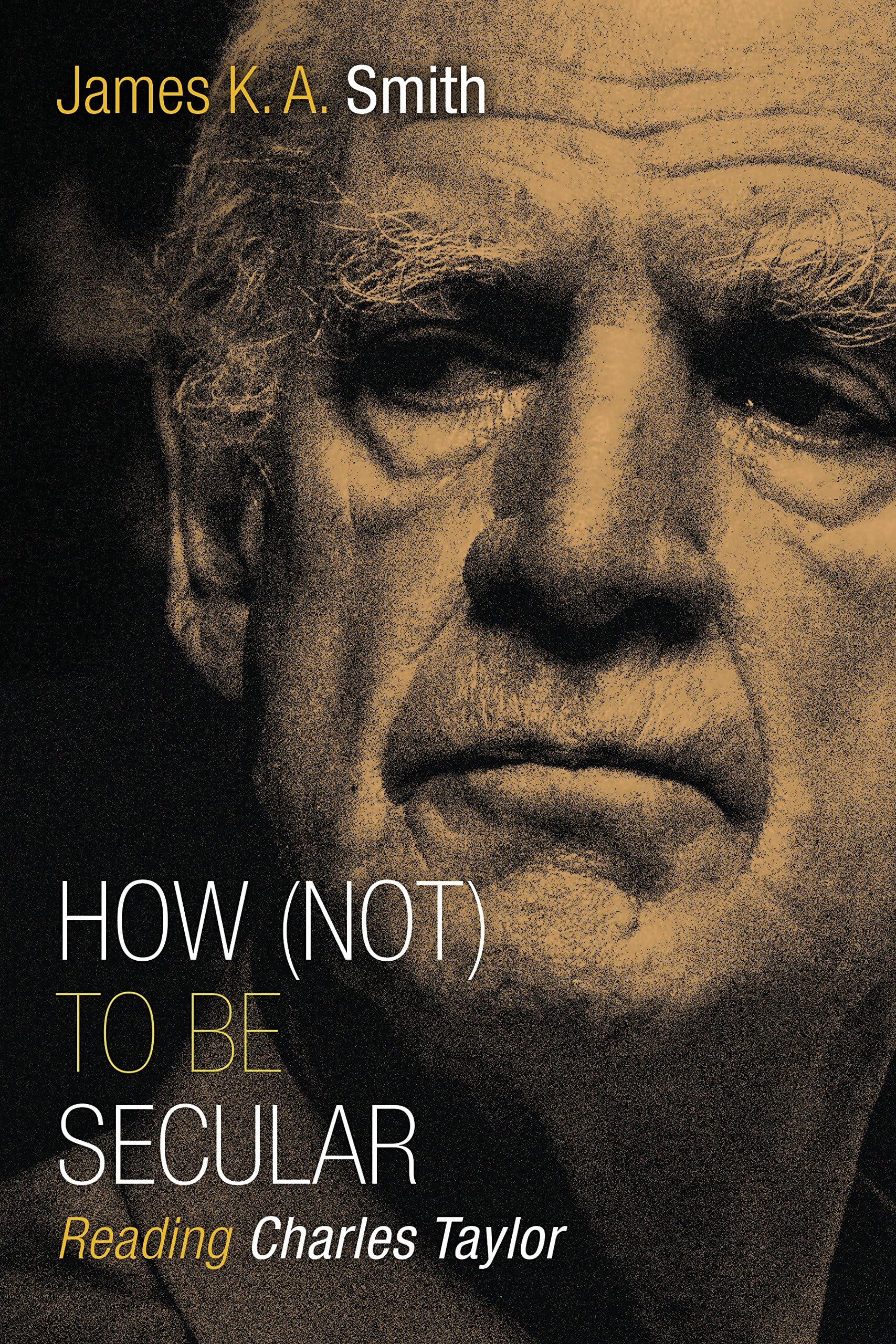
How (Not) to Be Secular: Reading Charles Taylor
Product ID: 1692869
Desertcart purchases this item on your behalf and handles shipping, customs, and support to Seychelles.
How (Not) to Be Secular is what Jamie Smith calls "your hitchhiker's guide to the present" -- it is both a reading guide to Charles Taylor's monumental work A Secular Age and philosophical guidance on how we might learn to live in our times. Taylor's landmark book A Secular Age (2007) provides a monumental, incisive analysis of what it means to live in the post-Christian present -- a pluralist world of competing beliefs and growing unbelief. Jamie Smith's book is a compact field guide to Taylor's insightful study of the secular, making that very significant but daunting work accessible to a wide array of readers. Even more, though, Smith's How (Not) to Be Secular is a practical philosophical guidebook, a kind of how-to manual on how to live in our secular age. It ultimately offers us an adventure in self-understanding and maps out a way to get our bearings in today's secular culture, no matter who "we" are -- whether believers or skeptics, devout or doubting, self-assured or puzzled and confused. This is a book for any thinking person to chew on. Review: An excellent conversational partner is James K - Bibliography James K. A. Smith. How (Not) To Be Secular: Reading Charles Taylor. Grand Rapids: Eerdmans, 2014. 161 pp. $16.00. Category Theology Summary Christians navigate a world dominated by secularism. Christendom has seen an end, but is that the final end? What do we mean by secularism? How did we get here? Do Christians embrace this environment? Combat it? How? Why? Why not? What are the implications of secularism in everyday life? How do Christians navigate a secular world? For a pastor to ignore these questions would be foolish. He can’t just sweep the Church under a sacred rug and hide it in the secular room it occupies. But how does a pastor address these questions? Where does he start? To whom does he turn for counsel? An excellent conversational partner is James K. A. Smith’s recent book, How (Not) To Be Secular: Reading Charles Taylor. This 150-pager is an accessible commentary of Charles Taylor’s seminal work on post-modernity. Smith, a philosophy professor at Calvin College, distills Charles Taylor’s, A Secular Age, to one-tenth its size, helping readers to interact with and process Taylor’s observations. Who is Charles Taylor? Taylor is a Catholic philosopher who has made significant contributions to interpreting post-modernity. Taylor’s 900 page tome, A Secular Age, explores the rise of secularism during the last 500 years. It studies the shift from a worldview of transcendence, humanity looking beyond to a supernatural realm, to a worldview of immanence, humanity locating itself in a natural realm devoid of supernaturalism. As focus shifts from one to the other, we see the decline of sacred and the rise of secular, the decline of superstition and the rise of science, the decline of corporate structures and the rise of individualism. It’s a story of reform, leading to deism, leading to secular humanism, leaving secularists with what Taylor calls lives under cross-pressure – “expressions of doubt and longing, faith and questioning” (14). Smith interacts with Taylor’s work, corresponding each chapter to each successive part of Taylor’s, A Secular Age. Smith does not just tell you what Taylor says, he explains the significance of it, commenting on what he agrees or disagrees with, and adding nuances or implications of Taylor’s reading of secularism. Smith’s work is not just Cliff Notes; it’s critical interaction with Taylor. Smith contextualizes Taylor’s observations with pictures we can relate to, such as examples from Fleet Foxes, Arcade Fire, Seinfeld, and a smattering of other pop-culture references. These references are punchy. He is not detailed in explaining them. Rather, they’re like solid one-liners that, if we know the context, end up being powerful connections for readers. If you’re going to read this book, do so with dictionary at side, and consult Smith’s glossary of Taylor’s verbiage. It follows the conclusion. I’m not saying How (Not) To Be Secular is a difficult read. You’ll simply want help along the way. Benefit for Pastoral Ministry Every pastor is a theologian who must engage rigorous reads. Though this one is not extremely heady, it will press you. Yet, it is practical. As you read, you’ll find yourself muttering, “So that’s what’s going on!” or “That’s why that person walked away from the Faith!” or “That’s why it is so difficult to defend Christianity against anti-theists!” For me, How (Not) To Be Secular, helped process my story from conversion to today. It caused reflection on why I am enamored by pietism (the historical period, people, and movement). I saw chinks in secular humanism’s armor. It trained me to point those flaws out and interact confidently with secular humanists. How (Not) To Be Secular, synthesized history, philosophy, sociology, and theology as if I were the blind man in the gospel seeing blurry trees and then blinking to take in humanity for the first time. Four critical contributions that I found in How (Not) To Be Secular include Taylor’s three definitions of secular, his sense of social imaginary, the significance that reform plays in the secular story, and his discussion on subtraction stories. Though you may not parade as an intellectual theorist, it does not mean you are not pondering meaning, purpose, and transcendence. It does not mean you are not seeking God or coping in light of the supposed “death of God”, which secularism presumably conceived. This is not just true of pastors; it’s true of congregations. Therefore, equip yourself to give an informed response by reading How (Not) To Be Secular by James K. A. Smith. Recommendation How (Not) To Be Secular negotiates the post-modern narrative, makes sense of the secular malaise, and gives a fresh take, which dispels the myth of secular spin. Review: Thought-provoking, well-reasoned, and challenging - I really enjoyed studying this book! It gave me a much clearer understanding of the secularists perspective and even helped me develop a deeper sympathy for the current state of secularism. The historical context provided was eye-opening, and learning about the three types of secularism helped me grasp the viewpoint more fully. I wouldn’t call it an offensive apologetics book, but rather a thoughtful Christian perspective on the secular worldview. My only challenge was that the author can be a bit wordy at times, but that might just be me!
| Best Sellers Rank | #56,827 in Books ( See Top 100 in Books ) #32 in Church & State Religious Studies #47 in Religion & Philosophy (Books) #73 in Religious Philosophy (Books) |
| Customer Reviews | 4.5 out of 5 stars 651 Reviews |
J**N
An excellent conversational partner is James K
Bibliography James K. A. Smith. How (Not) To Be Secular: Reading Charles Taylor. Grand Rapids: Eerdmans, 2014. 161 pp. $16.00. Category Theology Summary Christians navigate a world dominated by secularism. Christendom has seen an end, but is that the final end? What do we mean by secularism? How did we get here? Do Christians embrace this environment? Combat it? How? Why? Why not? What are the implications of secularism in everyday life? How do Christians navigate a secular world? For a pastor to ignore these questions would be foolish. He can’t just sweep the Church under a sacred rug and hide it in the secular room it occupies. But how does a pastor address these questions? Where does he start? To whom does he turn for counsel? An excellent conversational partner is James K. A. Smith’s recent book, How (Not) To Be Secular: Reading Charles Taylor. This 150-pager is an accessible commentary of Charles Taylor’s seminal work on post-modernity. Smith, a philosophy professor at Calvin College, distills Charles Taylor’s, A Secular Age, to one-tenth its size, helping readers to interact with and process Taylor’s observations. Who is Charles Taylor? Taylor is a Catholic philosopher who has made significant contributions to interpreting post-modernity. Taylor’s 900 page tome, A Secular Age, explores the rise of secularism during the last 500 years. It studies the shift from a worldview of transcendence, humanity looking beyond to a supernatural realm, to a worldview of immanence, humanity locating itself in a natural realm devoid of supernaturalism. As focus shifts from one to the other, we see the decline of sacred and the rise of secular, the decline of superstition and the rise of science, the decline of corporate structures and the rise of individualism. It’s a story of reform, leading to deism, leading to secular humanism, leaving secularists with what Taylor calls lives under cross-pressure – “expressions of doubt and longing, faith and questioning” (14). Smith interacts with Taylor’s work, corresponding each chapter to each successive part of Taylor’s, A Secular Age. Smith does not just tell you what Taylor says, he explains the significance of it, commenting on what he agrees or disagrees with, and adding nuances or implications of Taylor’s reading of secularism. Smith’s work is not just Cliff Notes; it’s critical interaction with Taylor. Smith contextualizes Taylor’s observations with pictures we can relate to, such as examples from Fleet Foxes, Arcade Fire, Seinfeld, and a smattering of other pop-culture references. These references are punchy. He is not detailed in explaining them. Rather, they’re like solid one-liners that, if we know the context, end up being powerful connections for readers. If you’re going to read this book, do so with dictionary at side, and consult Smith’s glossary of Taylor’s verbiage. It follows the conclusion. I’m not saying How (Not) To Be Secular is a difficult read. You’ll simply want help along the way. Benefit for Pastoral Ministry Every pastor is a theologian who must engage rigorous reads. Though this one is not extremely heady, it will press you. Yet, it is practical. As you read, you’ll find yourself muttering, “So that’s what’s going on!” or “That’s why that person walked away from the Faith!” or “That’s why it is so difficult to defend Christianity against anti-theists!” For me, How (Not) To Be Secular, helped process my story from conversion to today. It caused reflection on why I am enamored by pietism (the historical period, people, and movement). I saw chinks in secular humanism’s armor. It trained me to point those flaws out and interact confidently with secular humanists. How (Not) To Be Secular, synthesized history, philosophy, sociology, and theology as if I were the blind man in the gospel seeing blurry trees and then blinking to take in humanity for the first time. Four critical contributions that I found in How (Not) To Be Secular include Taylor’s three definitions of secular, his sense of social imaginary, the significance that reform plays in the secular story, and his discussion on subtraction stories. Though you may not parade as an intellectual theorist, it does not mean you are not pondering meaning, purpose, and transcendence. It does not mean you are not seeking God or coping in light of the supposed “death of God”, which secularism presumably conceived. This is not just true of pastors; it’s true of congregations. Therefore, equip yourself to give an informed response by reading How (Not) To Be Secular by James K. A. Smith. Recommendation How (Not) To Be Secular negotiates the post-modern narrative, makes sense of the secular malaise, and gives a fresh take, which dispels the myth of secular spin.
J**H
Thought-provoking, well-reasoned, and challenging
I really enjoyed studying this book! It gave me a much clearer understanding of the secularists perspective and even helped me develop a deeper sympathy for the current state of secularism. The historical context provided was eye-opening, and learning about the three types of secularism helped me grasp the viewpoint more fully. I wouldn’t call it an offensive apologetics book, but rather a thoughtful Christian perspective on the secular worldview. My only challenge was that the author can be a bit wordy at times, but that might just be me!
H**R
A succinct summary of how our society has become dangerously secular.
A highly readable, and reasonable length book describing the thinking of the highly respected Canadian, Roman Catholic philosopher and theologian, whose major work is 900 extremely dense pages. It is probably too difficult for most readers who are interested this subject matter. While Smith’s book is not easy sledding, it is comprehensible to the average person (i.e. those like me--I am a psychiatrist with a strong interest in philosophy and theology, but I have never had the opportunity to pursue the subjects in the depth I wish were possible). Happily, Smith covers most of the subject in 134 pages! Of course, it isn’t easy reading. The subject addressed is the serious problem that our secular society faces. Without a grounding in a intellectually sensible theology that remains consistent with ritual and scripture (whatever religion may be your preference), many people have abandoned religion entirely. The result can be the nightmare of the abuses of wall street and sexuality that are common today, in no small measure because so many of us are bereft of transcendent values with which to ground morality. In Taylor’s and Smith’s view, this often has been replaced by an attitude that individual flourishing, whatever its impact on others or society in general may be. All that is needed is my personal success and those who are constrained by traditional morality are often seen as suckers. There are, of course, numerous people who are agnostics or atheists who have moral values that are admirable and based on good thinking. This includes a number of my friends and both my grown sons. Some of these people are even in the process of building communities that serve many of the same functions for them that churches have provided. Never-the-less, we are all confronted by having to deal with those who see no point to moral grounding and personal restraint. For them, if it feels good or makes even more money, they live in such a way that there seems to be no reason not to engage in behavior that beats more money and immediate pleasure. Not the least of the problems of this view is that actually does not prove to be fulfilling. That being the case, their response is to seek more of the same--if you don’t need something, nothing is enough. Many of us consider it part of our morality to compassionately challenge that perspective. This book, along with others, provides some help with that task. Smith follows Taylor’s effort to explain historically how it came to be that before about 1500, very, very few were atheists of agnostics; but now it has come to pass that in much of the world the majority have no transcendent moral--let alone religious--convictions. The arguments are almost always interesting, although I personally did not agree with all of them, which is to be expected.
R**L
James Smith is an Excellent Sherpa
“A Secular Age” is a mountain of a book. With nearly 800 pages to read, this book either must be read slowly, or, if you are under a time constraint, like a semester, skimmed while leaving notes for future in-depth exploration. “How (Not) to be Secular” gave me a third way (pun intended). I let Smith lead me through the dense forests, along the rocky trails, until, guided by him, I could see the peak, and perhaps even get a peek at the other side. I look forward to that more leisurely stroll on the way back down the mountain at the end of the semester, and, thanks to this book, I might even get to enjoy the fragrance of the flowers.
A**S
The traditional story of how to the world came to be secular (a subtraction of belief) is not the real story.
Starting last year I have been paying a lot of attention to James KA Smith (Jamie). The first book of his that came across my radar screen was Desiring the Kingdom: Worship, Worldview and Cultural Formation. (I still haven’t actually read that one, it is on my list for this summer.) But I did read Imagining the Kingdom: How Worship Works. And it really did fundamentally change my perspective on liturgy and worship. Since then I regularly read Smith’s editorials (he is the editor of Comment magazine) and I have slowly been reading some of his other books. How (Not) to Be Secular is the type of book I wish were more popular. For important ideas to really take hold, we need good authors to popularize those important ideas into formats that a general public can understand. Charles Taylor’s A Secular age is a massive and important book, but at 900 pages it is too long (and too dense) for most readers. (And more than a few people have suggested Taylor is not the most readable author.) So Jamie Smith has put together a 148 page companion that covers the basics of the argument and includes relevant contemporary examples. The basic idea of A Secular Age is to explain what it means to live in a secular age and how we have come to this place in culture. "We are all skeptics now, believer and unbeliever alike. There is no one true faith, evident at all times and places. Every religion is one among many. The clear lines of any orthodoxy are made crooked by our experience, are complicated by our lives. Believer and unbeliever are in the same predicament, thrown back onto themselves in complex circumstances, looking for a sign. As ever, religious belief makes its claim somewhere between revelation and projection, between holiness and human frailty; but the burden of proof, indeed the burden of belief, for so long upheld by society, is now back on the believer, where it belongs." Taylor’s innovation is how he reframes discussion about secularization from what it has lost (belief in God) to how the very nature of belief claims have changed. “...these questions are not concerned with what people believe as much as with what is believable. The difference between our modern, “secular” age and past ages is not necessarily the catalogue of available beliefs but rather the default assumptions about what is believable. It is this way of framing the question that leads to Taylor’s unique definition of 'the secular.’" There is no good way to summarize this book. Smith already has condensed a 900 page book into 148 pages and I can’t condense that 148 pages into 700 words. But there are a couple points that really struck me as important. First, it is a good reminder that our world is not the only possible world. We have one 'take' on the world, that is not the same one that our pre-modern ancestors had, and it is not the only possible one that could have come about. Second, part of how secularization came about is that God moved from the being that controlled everything, to the being that put everything into place. So where pre-moderns saw God's hand in everything, we tend to see God as a step removed. The sun rises not because God told it to rise, but because God put into place a natural world that makes it appear that the sun is rising. It is probably more important for Christians to understand how our world has changed than non-Christians because our very belief systems now have to take into account not only the reality of God in the world, but the reality of God in a world that has moved God yet another step away. Third, as has been noted by a number of books I have been reading lately, the real incarnation of Jesus as human becomes even more important (and in some ways more unbelieveable) because of the way that modern culture understands God as other. And fourth, we cannot turn back. "So shouldn’t an “authentic” Christianity want to turn back the clock? “Isn’t the answer easy? Just undo the anthropocentric turn” (p. 651). Not so fast, cautions Taylor. First, even if we wanted to, there’s no simplistic going back. The anthropocentric turn is in the water; it’s increasingly the air we breathe.31 Not even orthodox Christians might realize the extent to which we’ve absorbed this by osmosis. Second, for Taylor, we shouldn’t want to." If you are interested in my take aways, Smith did do an interview with his publisher about the book that I think does a very good job introducing the book and giving you are good jumpstart on Taylor. [...] If you are frustrated with the way that apologetics are done in the church, or with how many seem to be missing the point (both inside and outside the church) of what it means to believe in something this might be a helpful book.
I**Y
Author Smith he's understand Taylor
Charles Taylor is a heavy read, but worthwhile. Smith provides excellent insights and guidance on understanding Taylor and Taylorisms. The secular age is upon us...how did we get here? Where are we going? This book helps!
A**R
Great for thinking through society's unspoken assumptions
It feels a bit strange to be so high on a book that appears to be adapted notes from undergraduate/graduate level class’ book discussion. Yes, I’d say that feels about right; reading this book is like sitting in on a few classroom sessions with James KA Smith, listening to him give you a pretty full walk-through of Taylor’s A Secular Age. As someone who loves that kind of learning environment, this book was right up my alley, but if that’s not really your style this book could be more of a challenge for you. Just a few highlights for me. Smith works through Taylor’s subversive intellectual history of Western Civilization as it attempts to undermine modern “subtraction theories” (that the modern world is just the old world after a God-ectomy). He maps the developments toward mature exclusive humanism as not inevitable, but resulting in many cases from developments within Christianity that are not faithful to the narrative of science displacing religion. The idea is that we can’t just subtract God from society without constructing an entirely new way of imagining life and significance and meaning. Exclusive humanism then, is not just society without all the God stuff, not just the neutral frame absent ancient or medieval mythology and superstition, it’s a whole new “take” on human life. Taylor’s somewhat apologetic tactic here is to paint exclusive humanism as a “take” in the same way that contemporary society considers Christianity a “take” to be criticized, evaluated, and accepted/rejected. He moves on to argue that this modern disenchanted world where exclusive humanism is the water we swim in can be at times less than satisfying, as many feel a kind of loss or doubt about meaning and significance absent transcendence. This creates a fundamental point for Taylor, the idea of “cross-pressure.” While everything around us focuses on the imminent, the here and now, there are still hints, hauntings, of transcendence that create this pressure on us. Somehow, many of our major strivings, goals, or achievements seem to lack something, to be more flat than they could be. Taylor is very big on this kind of gutsy, feeling type argument. Smith portrays him as dependent upon his readers’ sharing the vague feelings he describes as so essential to the modern world. Smith reinforces this by showing how this cross-pressures may be evidenced in literature and music that resonates with us. Living in a “cross-pressured” world is true for everyone, we feel pulled by the pressure to “grow up” and face the “reality” that transcendence is a myth and we must make meaning for ourselves, while still sometimes dealing with the internal call that there might be more “fullness” or “weight” to be had than just what can be humanly created and attained. Smith’s look at Taylor’s book can feel a bit apologetic to be sure, there are several points where it is clear that the aim is to “level the playing field” between exclusive humanism and Christianity by showing some of the primary criticisms lobbed at Christianity can also impinge upon exclusive humanism. One of the more significant sections deals with the question of whether Christianity/Exclusive Humanism better handles the “maximal demand": how to achieve our highest aspirations while not crushing the essentials of ordinary humanity. The ascetic and moral demands of religion easily fall upon this critique, but Smith/Taylor argue that humanism also may either underestimate capabilities of reform ("just victims" of environment) or may set the transformation bar too high allowing for a kinds of ends-justifying-means mode of achieving all that humanity could/should be. Smith/Taylor state that the playing field is level more than a few times, and I, even as a Christian, did not find myself fully convinced that it was actually level, though certainly more level than fundamentalist humanists would care to concede. In the end, this book provides a helpful window into the assumptions behind modern belief systems. If you can handle the sometimes apologetic tone, it provides some great questions of fundamentalisms (both Christian and humanist, though mostly of humanist). How do we as a society and as individuals deal with the big issues of shared morality, significance, and meaning in a world where religion is no longer anything like a default option? We need to examine our assumptions and this book is a good start for that. Highly recommend.
H**V
A Quack Pontificates
Smith's book presents Taylor's 900-page argument in about 200 pages. Right away, that incredible difference in length will alert the skeptical reader. Either Smith is condensing an argument that needed 900 pages, in which case the argument will suffer, or Smith is cutting the fat off Taylor's argument, in which case Taylor is obscenely verbose--a sign of intellectual insecurity. (When you don't have anything smart to say, gas out your critics with dense language and length.) In Smith's summary, Taylor comes across as a quack. Taylor's project is to explain the differences between the medieval Christian mind and the modern secular mind, and he attempts to trace how those differences came about. Very interesting. Unfortunately, Taylor (or Smith) does not present his ideas with much evidence. He gives a hypothesis about why Western people stopped believing this or started believing that, but rather than give convincing evidence for the hypothesis, he simply moves on. He reads a bit like Marx--just a well-read guy giving you his broad perspective on history. If that sort of historical scholarship appeals to you, then you will love this book. If you already agree with Taylor and require no evidence, then you will love this book. But if you prefer rigor, stay away. A small complaint: Smith is in love with Arcade Fire's Suburbs album, which rather dates the book. That album, like this book, was from five years ago--a century in pop culture time. Didn't Smith know that his cultural references would become irrelevant in the near future? The glorious, disposable future.
G**R
Every Christian should Read it
James k.a smith sums up Taylor's book very well. The language of the book is not so easy if English is not your first language, but even with that, the book is one of the most important for comprehending of a secular age
P**S
Thank goodness I read this book before tucking into 'A ...
Thank goodness I read this book before tucking into 'A Secular Age'. Smith gives an eminently readable overview of Taylor's magnum opus: a thought-provoking, insightful, and well-written introduction that is a solid and substantive work in its own right. 'A Secular Age' is, as Smith repeatedly affirms, a must-read for anyone trying to understand our zeitgeist, but it's a heavy slog. If you're pressed for time or not up on your Latin, go for Smith.
R**T
Not necessarily and easy read - useful to have the dictionary handy and ...
If you are interested in the way that our society feels about the eternal and present and how this has developed then this book is very interesting. Not necessarily and easy read - useful to have the dictionary handy and sometimes requiring a paragraph to be read several times to really absorb the meaning but I am sure that this reflects the way that James summarises what must be an even denser tome. Great at painting the picture and challenge and very thought provoking even though the so what do we do about it seems underdeveloped (by Charles Taylor) - but maybe this is for someone else to do.
P**N
Helpful
Smith provides a helpful unpacking of Taylor's opus. Smith opens up Taylor's ideas for an easier digestion, I found it to be a good commentary.
K**S
A readable, accessible and enjoyable introduction to Charles Taylor's thinking
I found this a delightful introduction to Charles Taylor's magnum opus, 'A Secular Age'. It was probably unlikely that I would have picked that 800-page tome up and read it without some sort of help and encouragement, which is what Jamie Smith so admirably supplies here. That doesn't mean that 'How Not To Be Secular' is a walk in the park: if nothing else, one has to get one's head around Taylor's own lexicon, in order to understand the complexities and power of secularism...in order then to go beyond that and perceive the case for transcendence. Smith's writing is pithy, toothsome. Perhaps because he is firing off Taylor's more ponderous narrative, what we get is something that is an extraordinarily effective introduction - it leaves one wanting to then grapple with the real deal, but actually in the short term it supplies a most helpful distillate of Taylor's reasoning. I, for one, am glad I encountered this modest little book first. It probably has some attractions for any secular thinker, beginning to come up against the boxing in of immanence, but it is peculiarly valuable for Christian pastors, teachers, leaders, seeking to understand the strengths and weaknesses of secularism, in order to engage effectively with this worldview which has, in such a short space of time, come to dominate almost every aspect of cultural life in the West. Jamie Smith does not provide us with an uncritical endorsement of all of Taylor's thinking in 'A Secular Age', but highlights questions for serious readers to explore further. He also usefully flags up some key points where Protestant and Catholic thinking will tend to diverge - but that's all to the good in seeing how our transcendent take on reality can pan out. Finally, I did find his discussion of modern (religious) responses to modernity as a kind of 'reconversion' to a premodern worldview, encumbered with the dangers of nostalgia - rather thought-provoking. This really is a great little book, and you won't regret reading it. Go on, buy it!
Trustpilot
1 month ago
2 weeks ago