
DOWNLOAD THE APP


Customer Services
Copyright © 2025 Desertcart Holdings Limited
DOWNLOAD THE APP
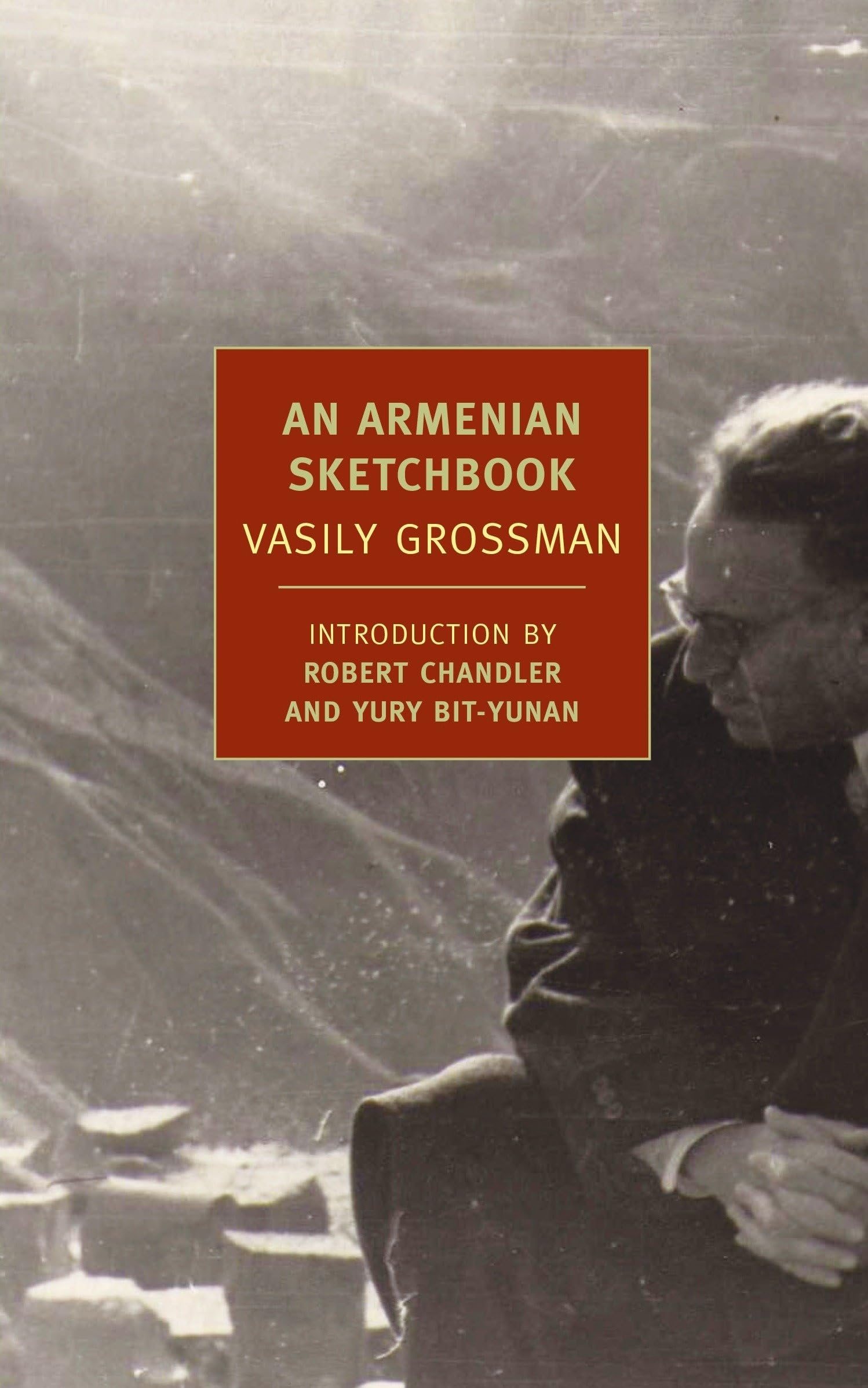
🎨 Sketch Your Story, One Page at a Time!
The Armenian Sketchbook is a beautifully crafted collection of over 200 pages, designed with high-quality paper and a vibrant cover, making it the ideal companion for artists and writers looking to capture their thoughts and creativity while celebrating Armenian culture.


| Best Sellers Rank | #1,290,693 in Books ( See Top 100 in Books ) #394 in Historical Russia Biographies #1,813 in Russian History (Books) #27,520 in Memoirs (Books) |
| Customer Reviews | 4.4 4.4 out of 5 stars (75) |
| Dimensions | 5 x 0.5 x 8 inches |
| ISBN-10 | 1590176189 |
| ISBN-13 | 978-1590176184 |
| Item Weight | 6.4 ounces |
| Language | English |
| Print length | 160 pages |
| Publication date | February 19, 2013 |
| Publisher | NYRB Classics |
A**S
A Rare Gem
Vasily Semenovich Grossman is best know for _Life and Fate_, a historical novel offering a profound philosophical critique of the Soviet Union. The novel was deemed dangerous and therefore "arrested" by the authorities. Not only was the work itself confiscated but even the typewriters and ribbons on which it was produced were destroyed. _An Armenian Sketchbook_ is an equally profound but sadly lesser-known work. Part travelogue, part memoir, and shot through with historical and philosophical insights, it is a joy to read. Grossman provides hauntingly beautiful descriptions of the Armenian landscape that rival the best work of nature-writers like Anne Dillard (_Pilgrim at Tinker Creek_) or Loren Eiseley (_The Night Country_) and muses on the incredibly tragic histories of peoples like the Jews and the Armenians. A must read. For those with a philosophical bent, it is worth noting that the Lithuanian-Jewish philosopher Emmanuel Levinas (1906-1995) was profoundly influenced by Grossman's work, in particular _Life and Fate_. It was through Levinas that I came to Grossman (cf. _Is It Righteous To Be?: Interviews with Emmanuel Levinas_, ed. Jill Robbins), and in my dissertation I devote an entire chapter to Grossman's impact on Levinas.
M**H
A Unique Travel Book - From the Heart of Soviet Russia
Vassily Grossman is relatively unknown in the West, but he's a major voice of Russian literature, continuing in his modernist fashion the humanistic ethos of Tolstoy and Chekov into the maelstrom of Stalinism and the Great Patriotic War (WWII). This sketchbook details a trip into the Southern USSR near the end of Grossman's life. The humor, observation, and powerful prose of this master come clear through the translation to give an insight into an intelligence worth knowing. Like the best travel books, Grossman's Armenian Sketchbook is a document of the human condition more than a tourist guide. The discovery here isn't just the Armenian people, landscape and culture, but of Grossman himself.
R**N
Armenia - the impressions and meditations, sometimes flights of fancy, of Vasily Grossman
Only recently did Vasily Grossman emerge on my literary radar, no doubt in part due to the publication of his works by New York Review Books. AN ARMENIAN SKETCHBOOK was Grossman's last book, and it is the most recent one from NYRB. I chose it as my introduction to Grossman, possibly as an almost unconscious tribute to Armenian friends and acquaintances from my youth. It may have been an unfortunate choice; I sense that AN ARMENIAN SKETCHBOOK does not reflect Grossman at his best. The genesis of the book stems from the Soviet authorities' decision to suppress Grossman's "Life and Fate". To help replace the money he would have earned from that book, the powers that be tossed him a bone - to translate into Russian a long Armenian war novel. Grossman, however, only knew two words of Armenian. So, someone else was commissioned to work up a literal translation, which Grossman then, using considerable literary license, transformed into a Russian novel. To facilitate the translation and meet the author, Grossman was sent to Armenia for two months in late 1961. He then used the expedition as the basis for a book of his own. NYRB has chosen to entitle it "An Armenian Sketchbook"; a literal translation, however, would be "Good to You", from the Armenian greeting "Barez dzez" that Grossman encountered nearly everywhere. The book does resemble a sketchbook in its loose organization of impressions and vignettes, as opposed to a linear account of Grossman's trip to Armenia. The subjects that catch Grossman's attention and spark his meditations include the capital city of Yerezan, Lake Sevan, an Armenian wedding, the pagan foundations of Armenia's Christianity, and - especially - stone: "The first thing I saw in Armenia was stone; and what I took away when I left was a memory of stone. * * * There is no beginning or end to this stone. There it lies--flat and thick on the ground. There is no escape from it. It is as if countless stonecutters have been at work--thousands, tens of thousands, millions of stonecutters, working day and night for years on end, for centuries, for millennia. * * * The stonecutter was time. This stone is ancient; it has turned black and green from age. What shattered the mighty body of the basalt were the blows struck by long millennia. The mountains disintegrated; time turned out to be stronger than basalt massifs. And now all this no longer seems to be a vast quarry; it is the site of a battle fought between a great stone mountain and the vastness of time. Two monsters clashed on these fields; time was the victor. The mountains are dead, fallen in battle. * * * Time has triumphed; time is invincible." AN ARMENIAN SKETCHBOOK contains passages of literary merit, often more like poetry than prose. There are several extended metaphors that are both striking and insightful. There are some astute observations and some entertaining anecdotes. But there also is a lot of maundering. It certainly appears to be the book of an aging man (Grossman died two years after it was written), whose attention tends to wander. There are stretches in which Grossman natters on about seemingly anything and everything that crosses his mind. Further, I don't particularly care for the tone of the work, which too often borders on being flippant or supercilious (perhaps that is the fault of the translators). There are harangues against nationalism and paeans to brotherhood that, understandable as they may be in the circumstances of the time, come across as overly preachy. While the book can be recommended to those who care deeply about Armenia, my feeling is that it does not make for a good introduction to the work of Vasily Grossman.
O**N
An honest read and an interesting moment in history
This was my first introduction to Grossman. I didn't totally know what to expect but it has left an impression on me and my family members. I expected more information on Armenia, which is still the significant majority of its content, but his monologues were so honest and revealed where he was at both psychologically and professionally. His insight to the literary class (Hrachya Kochar) he was introduced to in [far away] Armenia and the various socio-economic classes throughout the country allowed myself a snapshot of a country finding itself after Stalin's grand industrialization and WW2. I really feel he understood a significant portion of the Armenian people through his observations during a Sasuntsi Armenian wedding. This long and interesting scene left an impression on me, as he was both honest of himself and to Armenians. I realized it wasn't a masterpiece like other reviewers have indicated but it was a very pleasant read. You can tell through his voice and observations that his more well known books dodeserve the praise they receive. I plan to read them now thanks to this book.
C**N
A wonderful journey to Armenia by the words of this magnificent ...
A wonderful journey to Armenia by the words of this magnificent writer who will make us discover the beauty and the ugliness of human kind as a gender, while he makes a marvelous description to help us discover the uniqueness of an ancient culture. Life as a journey, human kindness as a major discovery.
T**R
Pure Poetry
This book will make you want to pack your bags. Reading it is like being there and viewing things through the eyes of one who brings vibrancy to interactions with a place, its people, and one's self.
T**N
Great read
I gave the book to an Armenian friend who very much enjoyed reading it. I have begun to read it my self and find it to be inso]piring.
Z**I
A very personal book, with Mr Grossman explaining his thoughts about the Armenians and their country. It is a fascinating read, and a must for anyone who likes the authors other books, or wants to know more about Armenia
P**3
lucky that this is available in English. A very humane story that is true, and autobiograhical, looking at the role and life of an author who went to Armenia at some point, and was able to empathize with the people there. Grossman has a profound understanding of the human condition in hard times.
N**N
A lovely gentle description of Grossmans trip to Armenia. If you have read any of his books you will love this as well. His description of the landscape is stunning.
L**N
The choice of title for this translation of Vasily Grossman's 1962 book, An Armenian Sketchbook, is admirably descriptive. It is a relatively short book and, chapter by chapter, sketches of the Armenian countryside, people, their homes and daily lives are exactly what we get. Grossman went there in late 1961, less than three years before his death from cancer. His great work, Life And Fate , had recently been "arrested" as he put it - confiscated by the KGB. In their joint introduction to this book, Robert Chandler and Grossman scholar Yuri Bit-Yunan surmise that he may have been given the task of serving as literary translator of an Armenian novel by way of compensation for the moral and financial loss of not being able to get Life and Fate into print. We begin in the train from Moscow, which takes so long to reach Armenia Grossman's clean-shaven fellow-traveller acquires a black beard by the time they arrive. Grossman is impressed by the barrenness of Armenia as seen from the railway, the stone, rocks and scree. The railway runs alongside the Turkish border, fortified with barbed wire, and Grossman reflects on Armenia's tragically unhappy historic relationship with Turkey. He glories in the sight of Mount Ararat - of great importance to the national consciousness of Armenians, despite being located in Turkey. No-one meets him on his arrival in Yerevan. Thus begins his rather detached relationship with the author of the book he is to translate. But contact is eventually made and time spent in the mountain village where the author has a dacha is the happiest part of Grossman's stay. He writes at length about the people he meets there, and of what he learns of their relationships and history. There have been some shockingly violent actions in the not at all distant past. In the background, animals are taken to the churchyard to be slaughtered, and always there is the barren rock and scree. Many peasant huts are formed of stone, and even kitchen utensils are fashioned from the rock. As he reflects on what her life will be like, Grossman feels pity for a shy young bride to whose wedding he is invited. Many who buy this book will, like me, be adding to their collection of Grossman's writing. However, besides being more from Grossman, the book has value as an observant outsider's view of Armenia, albeit rather more than 50 years ago. It also gives a well-informed but slightly distanced view of Russia and the Soviet Union. As ever, Robert Chandler, with his associates, provides us with an exemplary package; the introduction and notes add much, informed not just by the collaboration with Yuri Bit-Yunan but through contact with Grossman's daughter. A set of photographs taken during Grossman's Armenian stay is also included.
Trustpilot
2 months ago
3 days ago