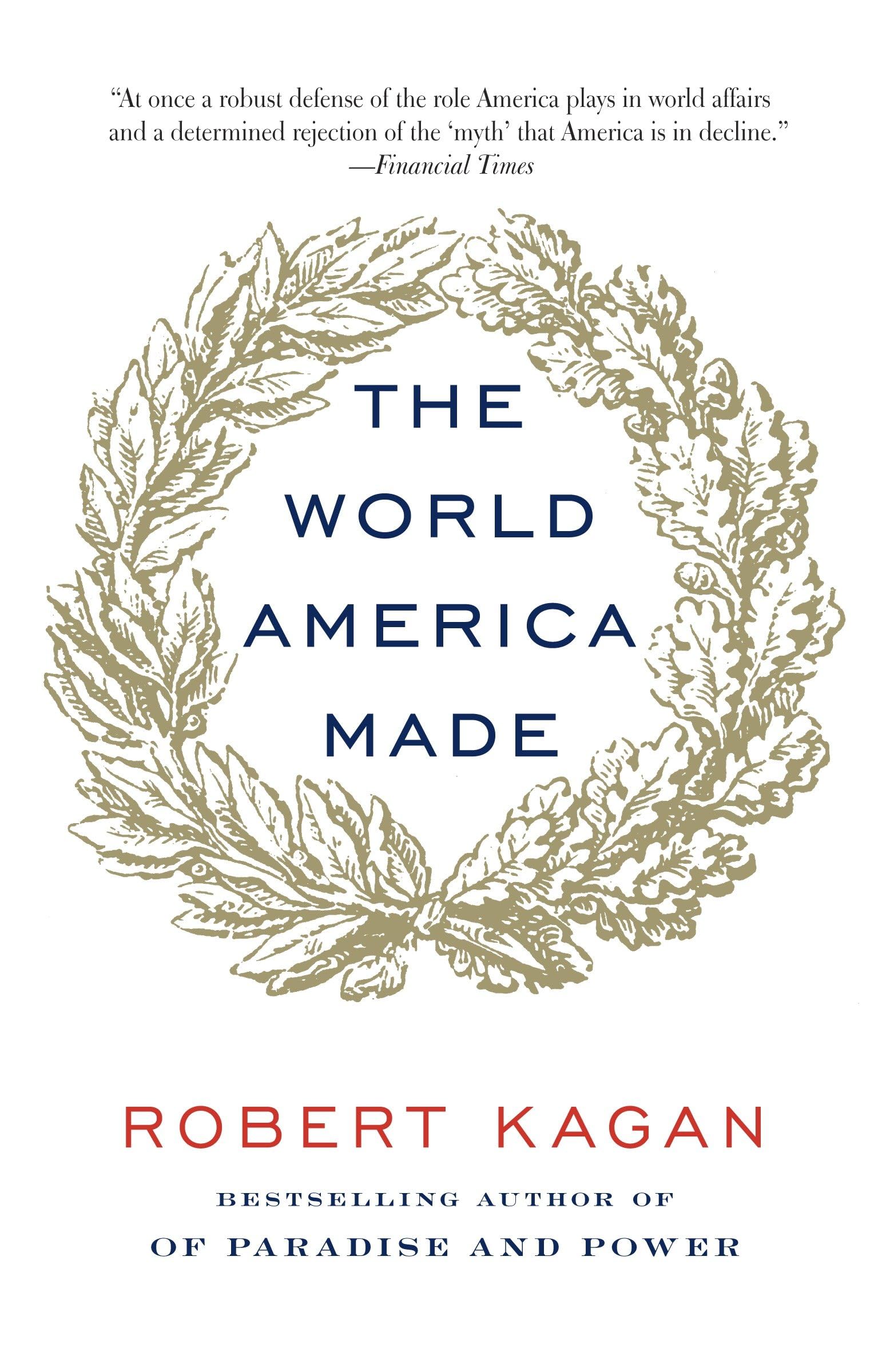
The World America Made [Kagan, Robert] on desertcart.com. *FREE* shipping on qualifying offers. The World America Made Review: excellent history of a topical subject - an excellent history from a learned historian who, specializes in this subject. Well written and enjoyable John M Review: A World Order Doesn't Just Happen - The core idea underlying Robert Kagan's short book is straightforward: Any world order is dependent, both for its formulation and for its maintenance, on the most powerful state or states of the day. The current world order is largely a creation of postwar American power. Kagan's main question, then, is two-fold. First, is America in decline, as much contemporary commentary suggests? And if it is, can it be supposed that the current economic, ideological, and security order--based on the primacy of liberal democracy and free-trade, free-market economies--would continue if American power or influence were eclipsed? Kagan's answer is no, not because of anything special about America, but simply because any world order is a reflection of its strongest powers. Kagan was a foreign policy adviser to John McCain during the 2008 presidential campaign, and apparently to Mitt Romney now, but it would be wrong to assume that he is narrowly partisan. Kagan sits on Secretary of State Clinton's Foreign Affairs Policy Board, and President Obama (we are told) has been an eager student of his work. In this book, he is both complimentary and critical of Republican as well as Democratic presidents. He is looking not at any specific policies as much as he is looking at structures. This is not to say that his views are not informed by ideology. Correctly or not, some have identified him with the neoconservative strain in American foreign policy thinking. Whether or not that is accurate (Kagan rejects it), there is certainly an ideology at work in his writings. It is conservative, but it is not constrained by the demands of narrow partisanship. Early in the book, Kagan nicely captures the ambiguities and ambivalences in the American character and national mythology. For much of the rest of the book, he lays out an expression of the Wilsonian liberal international ideal and its consequences. There is a tension--perhaps uniquely American--at the core of the situation Kagan describes, "the conundrum of power and interest that so bedevils" Americans, as he puts it (p. 94). The tension is between, on the one hand, the desire to maintain a world order that to a large degree suits American interests and reflects American ideals, and a reluctance, on the other hand, to exert American power in defense of that order. Any world order, Kagan maintains, is an "imposition," and will survive only as long as it reflects the interests and values of the most powerful nation and is backed up by that nation's political, economic, and military strength. In the end, Kagan doesn't buy the arguments about American decline, not because he doesn't recognize the same signs to which others have pointed, but because those signs are neither unprecedented nor necessarily fatal. His primary point, however, really is not about either decline or restoration. It is about a choice that he believes Americans must make: between robust and reliable defense of a world order that they largely created and have maintained to this point, or the hope that in the absence of American leadership, other nations of the world will somehow continue to give assent to a world order to which none of them has the same depth of allegiance. He sees the latter alternative as highly unlikely, and his prescription is therefore clear. Kagan is a fine writer and an astute observer of foreign policy and international affairs, with a particular talent for distilling complex issues into short, intelligent analyses. This book is certainly worth the time it takes to read it.
| Best Sellers Rank | #82,845 in Books ( See Top 100 in Books ) #84 in National & International Security (Books) #101 in Democracy (Books) #302 in History & Theory of Politics |
| Customer Reviews | 4.4 4.4 out of 5 stars (208) |
| Dimensions | 5.19 x 0.4 x 8 inches |
| ISBN-10 | 0345802713 |
| ISBN-13 | 978-0345802712 |
| Item Weight | 5.1 ounces |
| Language | English |
| Print length | 160 pages |
| Publication date | January 29, 2013 |
| Publisher | Knopf Doubleday Publishing Group |
J**Y
excellent history of a topical subject
an excellent history from a learned historian who, specializes in this subject. Well written and enjoyable John M
M**N
A World Order Doesn't Just Happen
The core idea underlying Robert Kagan's short book is straightforward: Any world order is dependent, both for its formulation and for its maintenance, on the most powerful state or states of the day. The current world order is largely a creation of postwar American power. Kagan's main question, then, is two-fold. First, is America in decline, as much contemporary commentary suggests? And if it is, can it be supposed that the current economic, ideological, and security order--based on the primacy of liberal democracy and free-trade, free-market economies--would continue if American power or influence were eclipsed? Kagan's answer is no, not because of anything special about America, but simply because any world order is a reflection of its strongest powers. Kagan was a foreign policy adviser to John McCain during the 2008 presidential campaign, and apparently to Mitt Romney now, but it would be wrong to assume that he is narrowly partisan. Kagan sits on Secretary of State Clinton's Foreign Affairs Policy Board, and President Obama (we are told) has been an eager student of his work. In this book, he is both complimentary and critical of Republican as well as Democratic presidents. He is looking not at any specific policies as much as he is looking at structures. This is not to say that his views are not informed by ideology. Correctly or not, some have identified him with the neoconservative strain in American foreign policy thinking. Whether or not that is accurate (Kagan rejects it), there is certainly an ideology at work in his writings. It is conservative, but it is not constrained by the demands of narrow partisanship. Early in the book, Kagan nicely captures the ambiguities and ambivalences in the American character and national mythology. For much of the rest of the book, he lays out an expression of the Wilsonian liberal international ideal and its consequences. There is a tension--perhaps uniquely American--at the core of the situation Kagan describes, "the conundrum of power and interest that so bedevils" Americans, as he puts it (p. 94). The tension is between, on the one hand, the desire to maintain a world order that to a large degree suits American interests and reflects American ideals, and a reluctance, on the other hand, to exert American power in defense of that order. Any world order, Kagan maintains, is an "imposition," and will survive only as long as it reflects the interests and values of the most powerful nation and is backed up by that nation's political, economic, and military strength. In the end, Kagan doesn't buy the arguments about American decline, not because he doesn't recognize the same signs to which others have pointed, but because those signs are neither unprecedented nor necessarily fatal. His primary point, however, really is not about either decline or restoration. It is about a choice that he believes Americans must make: between robust and reliable defense of a world order that they largely created and have maintained to this point, or the hope that in the absence of American leadership, other nations of the world will somehow continue to give assent to a world order to which none of them has the same depth of allegiance. He sees the latter alternative as highly unlikely, and his prescription is therefore clear. Kagan is a fine writer and an astute observer of foreign policy and international affairs, with a particular talent for distilling complex issues into short, intelligent analyses. This book is certainly worth the time it takes to read it.
T**N
Thereisa reason America is indispensable
Absolutely superb: every book by Kagan is fascinating, and this slim 140-page volume explaining why the U.S. is the indispensible society is likely the most intellectual book of this election year. Granted, anyone who knows history will find much to quibble about; by the same token, no quibbling quidnunc will counter his major theme: the world is more peaceful, prosperous and progressive because no nation dares challenge the U.S. It's no jingo tract; Kagan readily admits American blunders, bullying and bravado. But, his focus is on the larger picture which relates to the worldwide decline in military violence, well documented by others, since 1945. Why? No one wants to get into a serious shooting war with the nuclear-armed U.S. The greatest peacekeeping force since 1945 has been the U.S. military; not because of the absence of combat, but because of the absence of escalation of combat which led the plunge into World Wars I and II. It's a welcome antidote to doomsayers from Henry Kissinger to Samuel Huntington who, in 1999, declared the U.S. is the "lonely superpower" that is widely hated across the globe for its "intrusive, interventionist, exploitative, unilateralist, hegemonic, hypocritical" behaviour. Interesting, if true; and likely true if referring to the U.S. government. No one likes a smugly superior neighbour who bosses people around; but the U.S. has a long reputation of settling domestic abuse fights without seizing a neighbour's kitchen and moving into the bedroom. American government policies are hated in much of the world; but, the American people are greatly admired for their ability to say, do and believe anything and everything they want. The world treasures American libertym if not the U.S. government. Kagan has a delightful maturity that examines end results more than the messy processes of day-to-day politics and diplomacy. The most significant "end result" since 1945 is the absence of world-wide conflict using all available weapons. The question he raises: If not the U.S., who? The great national coalitions of history, up to and including the United Nations, are better at talking than deterring violence. The great "peacekeeping" machine is the dozen U.S. aircraft carriers, each one consisting of four and one-half acres of America that can be parked anywhere in the world. It's why Yan Xuetong said in 'The New York Times' of Nov. 20, 2011, "America has more than 50 formal military allies, while China has none." It's not because the U.S. seeks world domination; it is precisely the opposite, the American goal is always markets open to the U.S. dollar. Kagan is an original thinker, and thus provocative. But he's also likely to be right, which is especially annoying to querulous quibbling quidnuncs and pompous posturing politicians.
C**B
American Hegemony
This is an excellent book about the power, economic and security dynamics of the world. An update to include the lunacy of the current US administration and its total disregard for the liberal world order and for democracy would be fascinating.
C**G
Covers issues well. Brings balance to the topic. Only minor qu/thght/gripe: Not sure how much new thinking it brings to the subject. Well worth reading though.
C**I
Estuve buscando el libro en varias tiendas, pero nada. Por fin lo encontré en Amazon y vino genial, sin ninguna doblez ni arruga.
F**.
I had to make a presentation on the potential decline of the us and this book was very helpfull. It is a great read.
F**E
A very thoughts provoking essay by my favorite author simply because He's has a point I believe. Just try to compare for example with Zakaria, Mandelbaum or Vali Nasr. The author's comments about the Trump's foreign policy are also worth noting with respect to this book.
A**.
Chi conosce il punto di vista dell'autore apprezzerà questo sua opera che dipinge un quadro preciso e sicuramente in linea con le convinzioni neoconservatrici ma comunque rilevante per tracciare un bilancio del ruolo statunitense nel mondo. Consigliato
Trustpilot
3 weeks ago
2 weeks ago