🔆 Charge smarter, live brighter — never miss a watt!
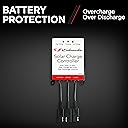
The Schumacher SPC-7A Solar Charge Controller offers dependable overcharge and discharge protection for 12V lead-acid batteries, supporting up to 7 amps and 100 watts of solar power. Featuring intuitive LED indicators and quick-connect ports, it ensures easy installation and real-time monitoring, optimized for use with Schumacher solar products.


| ASIN | B00752TRNW |
| Additional Features | Charging Indicator |
| Amperage | 7 Amps |
| Best Sellers Rank | #435,992 in Patio, Lawn & Garden ( See Top 100 in Patio, Lawn & Garden ) #489 in Renewable Energy Controllers |
| Brand | Schumacher Electric |
| Built-In Media | Unit^Instruction Guide |
| Color | Black |
| Compatible Devices | AC-DC Converters |
| Compatible Phone Models | Samsung, iPhone, Google, Motorola |
| Connectivity Technology | DC Port |
| Connector Type | Auxiliary |
| Current Rating | 7 Amps |
| Customer Package Type | Standard Packaging |
| Customer Reviews | 3.9 out of 5 stars 586 Reviews |
| Enclosure Material | Metal, Plastic |
| Global Trade Identification Number | 00026666810739 |
| Included Components | Unit^Instruction Guide |
| Input Voltage | 12 Volts |
| Item Type Name | Automotive Accessories |
| Item Weight | 0.2 Pounds |
| Main Power Connector Type | 2 Pin |
| Manufacturer | Schumacher Electric |
| Model Number | SPC-7A |
| Mounting Type | Tabletop Mount |
| Number of Items | 1 |
| Number of Power Levels | 1 |
| Output Current | 7 Amps |
| Output Voltage | 12 Volts |
| Portable | No |
| Power Plug | No Plug |
| Power Source | Solar Powered |
| Special Feature | Charging Indicator |
| UPC | 026666810739 |
| Unit Count | 1.0 Count |
| Warranty Description | 1 Year |
| Wattage | 100 watts |
T**R
Excellent Value and Performance, maybe?
Original Review - June 2014 I used the Schumacher charge controller after having a disappointing experience with a competing model from battery tender. The battery tender model gave me a fast flashing yellow light that indicated that the charge controller was defective. Amazon gave me a full refund. I purchased two of the Shumacher controllers. The first one went to use right away and is excellent. Notice that it includes the connectors on the charger, the connectors are clearly labeled, and the charge allows for a Battery connection, solar panel connection, and a load connection. It also provides LED status lights to aid you in your diagnostics and panel placement (it tells you when you have a low and high power orientation to the sun). I have also purchased solar chargers from sun force (that I like, but not as much as this one). The sun force 7a model lasted two years, and then needed to be replaced. Updated Review June 24, 2014 The second charge controller was used with a 50w panel (the charge controller is rated to 100W). I plugged it into the panel with full sun and none of the lights on the charge controller were lit. Keeping it plugged in, I checked the wiring. The charge controller started to smoke, the smoke was coming from the opening where the wires exit the unit. I picked up the controller and it burned my hand. I unplugged all wires and amazon agreed to exchange it. Because I like the design, I am going to give it another try.
S**R
The culprit is the cable polarity of solar panel. The solution is very simple and it works!
Many people complaint reverse polarity of the cables on the charge regulator but in fact it does NOT matter. The real culprit is the cable polarity of the solar panel. Cable is the combination of several wires. To explain, first we need to clarify: red wire does not mean that it must be positive, rather if it connects negative on the circuit it can be negative. On my unit all red wires connect to + on the charge regulator. Second same idea applies to the SAE connector, I call them black (black plastic) and silver (silver metal, the naked end) -- either one can be positive or negative depending on where it connects. That said, since the solar panel is energy giving, its cable polarity will determine the polarity of all the cables downstream. As many of us buying third party solar panels, we need to first use a multi meter to determine the cable polarity of the panel. Picture 1 shows positive voltage and picture 2 indicates negative voltage (minus sign under DC) when I reverse the leads. Picture 3 shows wires are properly labeled as positive vs negative. Second be sure when solar panel's SAE connects to the SAE of the charge regular, positive wire must attach to the positive in the regulator circuit. The SAE on my panel needs to flipflop so picture 3 also shows the new connections with blue wire connectors. To confirm if there is current going from the panel thru the regulator to the battery, a positive voltage should show on the multi meter when its leads are attached to "battery" SAE on the regulator. In this way the 12V battery will be properly charged.
S**T
It was junk for me...
Hooked this up to a small solar panel to keep the battery charged on a seldom used car that's parked on the street in front of my house. Connected to the car via the utility (cigarette lighter) port on the car. I get no lights on the charge controller indicating that it is doing anything, and indeed it does not appear to be passing power through to the battery as the battery was basically dead both times that I checked it. Had to jump start the car with a small jump starter box (which does work magically well). The solar panel tested functional, so it is definitely a problem with the charge controller. Unfortunately, I didn't discover this until just past the 30 return window, so I'm out the little bit of cash I spent on it.
R**D
You need something like this for those small, low amperage solar panels
I bicycle to and from work most days, but must have access to a vehicle should I need to go meet with customers across town, or to avoid the road dangers on my route from inclement weather. Accordingly, I park my 2000 Odyssey at work. Unfortunately, the battery will slowly discharge if the car is not driven, and on several occasions, I have needed a jump start. I thought I was so smart when I bought a small, Shumacher solar panel to trickle charge my battery (via the 12V power outlet. However, I failed to do enough research. It turns out that at night, this particular solar panel would allow current from the battery to run in reverse, thereby draining the battery. Your voltage off the solar panel varies significantly, depending on the intensity of light to which it exposed. Apparently, the voltage from the solar panel can run from around 3V to around 19V or 21V. At the low end, you get reverse current through the solar panel if the car battery is charged reasonably well; at the high end, your voltatge across the battery is not all that healthy for recharging/trickle-charging the battery. (You want your charging source to be running at 13-14 Vdc.) Bottom line - if your solar panel does not have a voltage regulator/charge controller, you need one. The Schumacher SPC-7A provides that capability at a reasonable price. It will handle up to 7 amperes coming off a solar array, and it will give you an indication of whether you are generating a charge, and it will warn you if you have a low voltage (below 12 V) coming off the solar panel. It has standard, 12V line plugs to connect to the solar panel output, to connect to your charging line for a 12V battery (either battery clamps or a 12Vdc power plug). there is a third ouput cable for an alternate load device. I have found that the low voltage indicator (an LED) is useful for ensuring that the solar panel is positioned properly. I just orient the solar panel so that the low voltage light goes off, and then I know that I am getting a useful trickle charge. My fault for chosing a trickle charger without a charge controller. But this modestly priced device got me back on track.
C**E
perfect companion for a 100 watt solar panel.
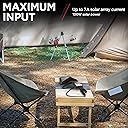
bought this to go with a 100 watt solar panel purchased off e-bay for $!05. mounted this on the back of the solar panel with Velcro. when installing, you will need to purchase several of the polarized power plugs used on this unit. pay attention to the color and orientation of the plugs/wires. the solar panel i purchase had a different style of plug (weather proof) that i had to remove. i created a 10 foot cord, with the plugs at both ends, along with a short leader attached to the deep cycle battery. the solar panel plugs into the charge regulator, and the 10 foot cord goes between the regulator, and the battery. the 3rd plug for lighting load is not used, since my load is connected directly to my battery. the 100 watt solar panel puts out about 5.5 amps maxim (should be about 8 amps, but the 100 watts the panel is rated at is "magic" watts, at 17 volts, and not real world watts at 12.5 volts). regulator works perfectly, not allowing battery to become over charged. only complaint is that L.E.D. indicators are impossible to see in bright daylight. wish it had a digital amp meter, showing charging rate.
R**Z
Buena compra
Excelente funciona muy bien
L**R
Not entirely satisfied.
I used it for several months and it worked well until it started overhearing. I'd give it 3 stars.
4**A
Great product! Works as expected.
Trustpilot
1 month ago
3 weeks ago