
DOWNLOAD THE APP


Customer Services
Copyright © 2025 Desertcart Holdings Limited
DOWNLOAD THE APP
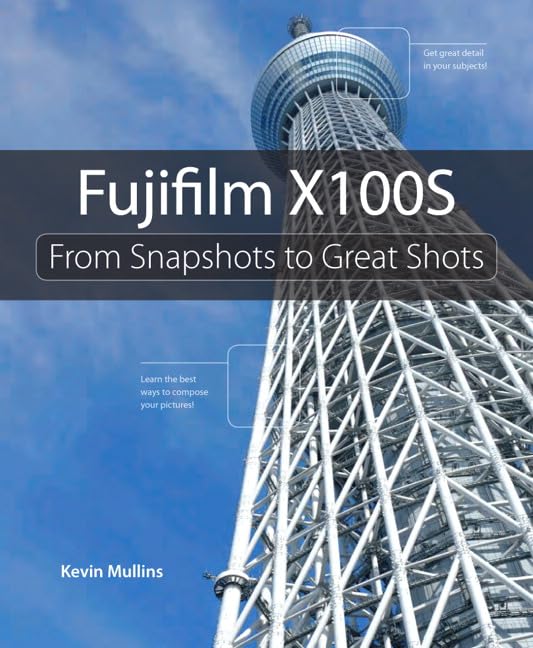
desertcart.com: Fujifilm X100S: From Snapshots to Great Shots: 9780321984395: Mullins, Kevin: Books Review: best of the x100s books! - I've owned the x-pro1 and xt1 and can't believe it took me so long to migrate to the d100s. But having done so, I love it? I bought and downloaded all the books on the x100 and x100s. I read the others first, and guess I saved the best for last. This book is both comprehensive, yet easy to understand. It is very organized, describing a function/feature, with illustrations, communicating the advantages or disadvantages of a setting, providing pictures that demonstrate the results of the setting, and finally, providing assignments to reinforce what was taught. And, everything was written without typos, or references to other cameras! Of course you say? But honestly, one of the books is read discussed locking the mirror up - obviously copied from a section on dslrs! Not this book. From start to finish, this book was conceived and written with one camera in mind - the x100s. If you own the camera, buy this one book! Review: A very good photography guide for X100s owners - "Fujifilm X100S: From Snapshots to Great Shots," by Kevin Mullins is a very good photography guide targeted towards owners of the Fuji X100S. It is not really a camera manual, as it doesn't exhaustively detail every feature, every setting, or every menu option, but it covers all the important aspects of this great camera in a manner that compliments the User Guide that comes in the box. It is hard to say that this book is better than the other two guides available for this camera (" The Complete Guide to Fujifilm's X100s Camera (B&w Edition) ," actually titled "Fujifilm's X100S Camera: Professional Insights for Experienced Shooters," by Tony Phillips and " Photographer's Guide to the Fujifilm X100S : Getting the Most from Fujifilm's Advanced Digital Camera," by Alexander S White), as its focus is different, but it is certainly much more successful at achieving its intended goal than those other two books, which are hobbled by significant flaws, which I detail in separate reviews (follow the links above). I would rate this guide at a 4-4.5 out of 5 stars. If you are an amateur photographer who just purchased a Fuji X100S with the intention of learning the fundamental concepts of photography (shutter speed, aperture, ISO, depth of field), understanding the various types of images (portrait, landscape, street/candid), and studying approaches to photographic composition, then this guide is for you. It is like a really good basic to early advanced photography course designed around the Fuji X100S camera. But if you a maturing photographer who is well past the beginner stage, who is adept at using a camera in manual mode, and for whom the rule of thirds is very old news, then you might find this book too basic to be useful. While it doesn't try to cover every aspect of the X100S, this guide does try to explain all the most important functions and settings. The descriptions of many of the camera's features are done in context, for example the use of the built-in neutral density (ND) filter is explained in the chapter on landscape photography, and the different metering modes are explained in the chapter on portrait photography. This is not really a problem, but it does mean that when you have questions about various aspects of the camera, you would better refer to the index than the table of contents. Fortunately, this book has a thorough index to help you find the answers you are looking for. The book is a comfortable read, and the text is well-edited with very few typographical errors. The writing style is relaxed without being too chummy, and technical without being overly complex or wordy. The text is organized well, with brief introductory chapters that get you going quickly and subsequent chapters on clearly defined subjects such as portrait photography, landscape photography, lighting techniques, advanced X100S features, etc. What really stands out about this book, especially compared to the other available guides for the X100S, is the size, quantity, quality and educational value of all the images. A few photographs are perhaps just fair to good, but the majority range from very good to excellent. They are laid out tastefully and in generous sizes. Every image is accompanied by a legend with the basic camera settings used (shutter speed, aperture, ISO, focal length); too many camera guides don't reveal such details. Even better, quite a few also have notes on the choices made by the author in technique and/or image composition. Rather than just a display of the quality of the camera or the cleverness of the author/photographer, it feels like this book's images are all a part of the learning process. There are a few minor problems with this guide. First, while it touches on a wide range of topics, at times the discussion feels a little thin. For examples, the description of the use of flash really doesn't go into much detail, and so this important concept doesn't feel well fleshed out; the critical question of white balance is barely touched on, which is surprising given the target audience; and while Film Simulations are mentioned and the author shows how to select them, there is almost no explanation of the individual Film Simulations (What is Velvia, and how does it differ from Astia? When would you use PRO Neg. Hi?) other than the demonstration of Sepia in the chapter on portrait photography, and Sepia is a simulation that many photographers would consider the most trite and least useful of all of them. Second, some of the frustrating quirks and oddities of the X100S are not well spelled out. This camera can sometimes inexplicably refuse to take a shot, and the other guides (notably the guide by White), do a better job of explaining these issues. Overall, this is a very good photography guide for users of the Fujifilm X100S camera, which perhaps was a bit overly long in coming out. The extra time taken was put to good use, as the quality of the text and imagery far outstrip the other two available guides. Note: this review is of the 2014 paperback edition, which covers firmware version 1.10.





| Best Sellers Rank | #3,780,069 in Books ( See Top 100 in Books ) #1,109 in Photography (Books) #1,498 in Photography Equipment (Books) #3,058 in Digital Photography (Books) |
| Customer Reviews | 4.5 4.5 out of 5 stars (207) |
| Dimensions | 7.6 x 0.6 x 9 inches |
| Edition | 1st |
| ISBN-10 | 0321984390 |
| ISBN-13 | 978-0321984395 |
| Item Weight | 1.26 pounds |
| Language | English |
| Part of series | From Snapshots to Great Shots |
| Print length | 288 pages |
| Publication date | June 15, 2014 |
| Publisher | Peachpit Press |
J**N
best of the x100s books!
I've owned the x-pro1 and xt1 and can't believe it took me so long to migrate to the d100s. But having done so, I love it? I bought and downloaded all the books on the x100 and x100s. I read the others first, and guess I saved the best for last. This book is both comprehensive, yet easy to understand. It is very organized, describing a function/feature, with illustrations, communicating the advantages or disadvantages of a setting, providing pictures that demonstrate the results of the setting, and finally, providing assignments to reinforce what was taught. And, everything was written without typos, or references to other cameras! Of course you say? But honestly, one of the books is read discussed locking the mirror up - obviously copied from a section on dslrs! Not this book. From start to finish, this book was conceived and written with one camera in mind - the x100s. If you own the camera, buy this one book!
A**N
A very good photography guide for X100s owners
"Fujifilm X100S: From Snapshots to Great Shots," by Kevin Mullins is a very good photography guide targeted towards owners of the Fuji X100S. It is not really a camera manual, as it doesn't exhaustively detail every feature, every setting, or every menu option, but it covers all the important aspects of this great camera in a manner that compliments the User Guide that comes in the box. It is hard to say that this book is better than the other two guides available for this camera (" The Complete Guide to Fujifilm's X100s Camera (B&w Edition) ," actually titled "Fujifilm's X100S Camera: Professional Insights for Experienced Shooters," by Tony Phillips and " Photographer's Guide to the Fujifilm X100S : Getting the Most from Fujifilm's Advanced Digital Camera," by Alexander S White), as its focus is different, but it is certainly much more successful at achieving its intended goal than those other two books, which are hobbled by significant flaws, which I detail in separate reviews (follow the links above). I would rate this guide at a 4-4.5 out of 5 stars. If you are an amateur photographer who just purchased a Fuji X100S with the intention of learning the fundamental concepts of photography (shutter speed, aperture, ISO, depth of field), understanding the various types of images (portrait, landscape, street/candid), and studying approaches to photographic composition, then this guide is for you. It is like a really good basic to early advanced photography course designed around the Fuji X100S camera. But if you a maturing photographer who is well past the beginner stage, who is adept at using a camera in manual mode, and for whom the rule of thirds is very old news, then you might find this book too basic to be useful. While it doesn't try to cover every aspect of the X100S, this guide does try to explain all the most important functions and settings. The descriptions of many of the camera's features are done in context, for example the use of the built-in neutral density (ND) filter is explained in the chapter on landscape photography, and the different metering modes are explained in the chapter on portrait photography. This is not really a problem, but it does mean that when you have questions about various aspects of the camera, you would better refer to the index than the table of contents. Fortunately, this book has a thorough index to help you find the answers you are looking for. The book is a comfortable read, and the text is well-edited with very few typographical errors. The writing style is relaxed without being too chummy, and technical without being overly complex or wordy. The text is organized well, with brief introductory chapters that get you going quickly and subsequent chapters on clearly defined subjects such as portrait photography, landscape photography, lighting techniques, advanced X100S features, etc. What really stands out about this book, especially compared to the other available guides for the X100S, is the size, quantity, quality and educational value of all the images. A few photographs are perhaps just fair to good, but the majority range from very good to excellent. They are laid out tastefully and in generous sizes. Every image is accompanied by a legend with the basic camera settings used (shutter speed, aperture, ISO, focal length); too many camera guides don't reveal such details. Even better, quite a few also have notes on the choices made by the author in technique and/or image composition. Rather than just a display of the quality of the camera or the cleverness of the author/photographer, it feels like this book's images are all a part of the learning process. There are a few minor problems with this guide. First, while it touches on a wide range of topics, at times the discussion feels a little thin. For examples, the description of the use of flash really doesn't go into much detail, and so this important concept doesn't feel well fleshed out; the critical question of white balance is barely touched on, which is surprising given the target audience; and while Film Simulations are mentioned and the author shows how to select them, there is almost no explanation of the individual Film Simulations (What is Velvia, and how does it differ from Astia? When would you use PRO Neg. Hi?) other than the demonstration of Sepia in the chapter on portrait photography, and Sepia is a simulation that many photographers would consider the most trite and least useful of all of them. Second, some of the frustrating quirks and oddities of the X100S are not well spelled out. This camera can sometimes inexplicably refuse to take a shot, and the other guides (notably the guide by White), do a better job of explaining these issues. Overall, this is a very good photography guide for users of the Fujifilm X100S camera, which perhaps was a bit overly long in coming out. The extra time taken was put to good use, as the quality of the text and imagery far outstrip the other two available guides. Note: this review is of the 2014 paperback edition, which covers firmware version 1.10.
M**N
Greats Shots
A really good book not only about the x100s camera operations but of photography in general. Mullins is a good explainer of terms in clearly written text. The book is very well laid out and has beautiful photos throughout. Great for enhancing your skill from a great photographer. You also may want to check out his Fuji lecture on YouTube to see how good this camera really is.
M**N
I really like this book
I really like this book. Wish I had found it before reading so many blogs and tips on the net. I would have become competent with my x100s a lot sooner if I had. The organization is so clear and helpful to the beginner/novice photographer. (Yeah, not sure what got into me to go from iPhone photos to expensive specialist camera. But I am really loving learning photography on this fun camera that reminds me of my dad's camera when I was a boy. I think it was a 35mm rangefinder Nikon @1959.) This book has been so incredibly helpful for people like me. I also think the writing is clear and fairly concise, which I really like. I am now ready for more advanced tutorials on setting customized settings, etc. This book has given me a solid foundation for using my x100s. Thank you.
V**O
Wonderful, clear and informative book for the Fuji X100S or even the X100T
I've been shooting for a long time, and recently got a Fuji X100T. Although this book is made for the X100S, the content is still 90% pertinent to the X100T. Kevin has a way of explaining things that makes it easy to understand and usable in real world situations. His example photos, end of chapter exersises (take the time to do these), help anyone get back to basics and get the most out of this of the Fuji X100S or X100T. Highly recommend it.
J**A
Unfocused
Surprised by how dull and lifeless the writing and the images are in this less than satisfactory book. It tries to be a basic guide to the specific camera and a general guide to photography in general with a digital rangefinder and in that dual quest the author ends up in a sort of middle road to nowhere. The more basic guide by White is better and at times even the manual that comes with the camera is more lively.
J**K
Good and Certainly Best of All the Alternatives
I bought this book hoping it might be as helpful as Mastering the Fujifilm XE1 and X-Pro1 (by Rico Pfirstinger), which is excellent. While not quite as comprehensive and detailed as "Mastering," it is quite good. My only complaint is that I have the subsequent model, the X100T, but this is still very useful and much better than any of the other guides for X100T I ran across. My experience has been that the camera manual is not particularly useful, and the other guides are very light once-overs. I strongly recommend this book for X100-? users until Pferstinger produces a book for the X100T.
J**Y
Amazingly Helpful for Your Fujifilm Camera X100S
If you have the camera and don't buy this book you will never realize the camera's potential. I have read it twice now, its that interesting if you wish to learn how to take "Great Shots". This book will easily show you how. I love tye camera. Everyone who sees it loves it too. Now I can learn how to use it to its fullest potential. Buy it if you want to learn photography
P**2
Les bouquins spécialisés par appareil m'ont toujours déçu car ils ne vont jamais bien plus loin que le mode d'emploi reformulé. Celui-ci sort vraiment du lot car il vise vraiment l'exploitation optimale de l'appareil pour se faire plaisir. Les conseils sont pleins de bon sens et sont vraiment orientés résultat. Bravo.
フ**ウ
X100Sの手引書のようなものを探していましたが、めぼしいものがなくて苦慮していたところ、X100やX100T、X100Fを含めて外国語で書かれた手引書がたくさん出版されていることに気づきました。いかに外国の写真家にフジのカメラが支持されているかがわかりました。そこで、読者の評価が高く値段も手ごろな英語で書かれたこの本を試しに買ってみることにしました。文は基本的には説明文ですので難しい文体もなく英検2級、TOEIC700点前後ぐらいのスキルがあれば十分読めると思います。写真に関する専門用語も予備知識がありますからあまり苦になりませんでした。面白かったのはいわゆる写真でいう「ぼけ」は立派にbokehという英語になっているんですね。手ブレや被写体ブレもblur(ブリットポップのグループ名にもありましたな)を使っていました。さて内容ですが、初めの数章はX100Sの導入、特徴と簡単な使い方。それからは、ポートレート撮影、風景撮影、暗所撮影、構図、ストリートスナップ撮影、動画、より進んだ使いこなし等内容盛りだくさん。各章共撮影の一般的な勘所、設定の仕方を説明し、それではX100Sをどう設定しどう使えばいいのかという内容になっています。 説明が非常に丁寧で、わかりやすく、撮影技術を学ぶのにもいい手引書だと思います。例えば、風景撮影ではISOは200ぐらいにできるだけ低く、絞りはf11などのパンフォーカス気味にして、日の出、日の入り当たりの時間帯がいい写真がとれる。必然的にシャッター速度は遅くなるので、三脚があるといいというよに解説しています。筆者が撮った写真も多数掲載されていて非常に参考になりた。X100Sは日本の製品なのにどうして日本でこのような素晴らしい手引書が出版されないのでしょう?この筆者はフジXシリーズの公式写真家らしいので、富士フィルムででも日本語版を出版してくれませんかねえ。
J**K
Books that run through specific camera models can feel like a bit of a mistake at times. I've bought ones before that have been cheaply produced and tell you the blindingly obvious, but this one from Kevin Mullins isn't one of them. Attractively set out, the book is both a useful reminder of some photography basics, and a very useful companion to the Fujifilm X100s manual. Better still, Mullins is a UK based working photographer, so the shots here give you some idea of what you can achieve within a familiar environment, rather than being peppered with some of those huge landscape shots etc from America that usually typify such books. The book is well-written, easy to understand but never patronising, and the photos and instructions are well-presented and clear. Having assignments to work through at the end of each chapter is a nice touch as well, giving the book a practical appeal. Far better than I was actually expecting, the practical, get out there and do it encouragement in this book adds to the pleasue of owning the camera and wanting to us it. Hard to see the version for Kindle having the same impact as the paper-version, which is a good size and an effective mix of text and colour photos. Recommended without hestitation for anyone wanting to get the best from picture making with this excellent camera from Fujifilm.
H**S
Great to know more about X100S but also photos basis knowledge. I only can advise for neophyte as I'm. Good description and pertinent exercices!
T**N
Goes further than just the nuts and bolts.
Trustpilot
2 weeks ago
2 weeks ago