
Rossini: Aureliano in Palmira
Product ID: 17980499
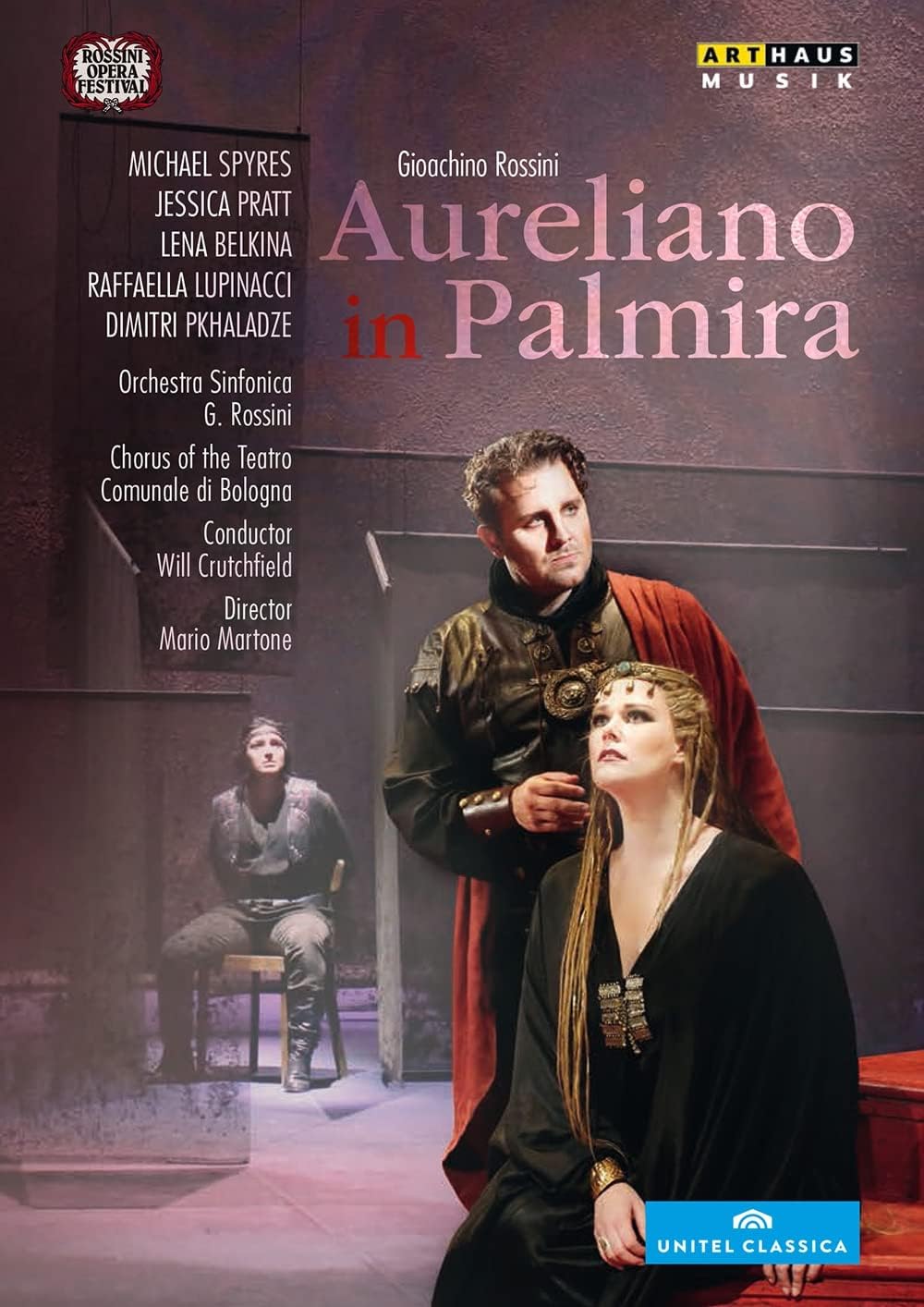
Aureliano in Palmira celebrated it's fi rst première on 26 December 1813 at the Scala In Milan. Soon afterwards the work was played in different theatres all over Europe. Nevertheless Rossini's piece fell into oblivion more and more compared to the great competitors like "Tancredi" or the "Barber of Seville" for which Rossini recycled musical parts of "Aureliano".But since a few years there are ambitions to play this work about love, war, jealousy, loyalty and magnanimity more frequently. The direction in Pesaro was in the proven hands of the famous fi lm director Mario Martone. Conductor Will Crutchfi eld contributes to the successful performance of the newly edited "Aureliano in Palmira" and masterfully directs the Orchestra Sinfonica G. Rossini. Michael Spyres as Aureliano "showed immediately that his tenor voice with marvelous top notes has not only fl exibility and agility, but also enough body, to provide the Roman emperor great vocal authority." Opernglas Review: Jessica does it again....................! - I love Jessica Pratt. She is a statuesque, quietly regal woman with an incredible Bel Canto technique. She has scored great notices in six other Rossini operas as well as such diverse roles as Verdi's Giovanna d' Arco and Cunegonde in Candide.Her true forte so far has been early Rossini for which she has a true knack. She has had three Pesero Rossini Festival headliners so far; Amira in Ciro in Babilonia with wonderful Ewa Podles and great tenor Michael Spyres and conducted by Will Crutchfield. The last two in this recording also. Ms. Pratt is priceless in Adelaide di Borgogna with Daniela Barcellona. And now she is radiant in Aureliano in Palmira. This opera is listed as no. 12 of about 40 known Rossini operas. He was 21 and this was going to open the 1813 season at La Scala. It is more of an old fashioned chamber opera of the Mozart type than the current vogue of Italian hard driving spellbinders with crashing cords and bodies everywhere. The retreat of the lover Prince Arsace to the peasant Idyll and wooded grove complete with goats on stage evokes some of the best music in the score. Rossini wrote the score for his mistress (later wife) Colbran (Zenobia) and the noted castrato, Velluti (Prince Arsace of Persia). Though it ran for 14 nights at La Scala it was not well received by the critics and was soon dropped and forgotten. A complete score does not exist. However the ever practical Rossini used sections of it in the later opera Barber of Seville where the overture and other sections are familiar to all. The conductor Will Crutchfield has reassembled the score from various sources as no authentic draft exists. The opera is quite fine ,certainly in Act 1 and the first part of Act 2 but the end seems to meander a bit too much. I think some judicious pruning would help. The cast in this recording is truly great. Besides Ms Pratt as Zenobia, Queen of Palmyra , the leading Rossinian Bari-tenor of the day, Michael Spyres does wonders as the ambivalent Roman leader Aureliano (3rd. century C.E. Emperor of Rome). He is a great foil for Ms. Pratt as he was as Baldassare in their recording of Ciro in Babilonia. Arsace, Prince of Persia and lover of Zenobia is mezzo Lena Belkina. She is a fine singer but as a mezzo she lacks the heft of a contralto (we don't have castrati anymore) and she is a petite person. So in some of the scenes with her beloved Queen Zenobia it looked more like mother and son (in drag) rather than noble lovers. But all in all it is an exceptionally beautiful performance. The orchestra is top notch with conductor Will Crutchfield who also assembled the score. The production is effective, useful and it works. Sadly the beautiful remains of historic Palmyra in Syria have recently fallen victim to destruction by religious fanatics of the Islamic Nation. Religion the destroyer! Review: Five Stars - Rare opportunity
| Customer Reviews | 4.2 out of 5 stars 32 Reviews |
D**N
Jessica does it again....................!
I love Jessica Pratt. She is a statuesque, quietly regal woman with an incredible Bel Canto technique. She has scored great notices in six other Rossini operas as well as such diverse roles as Verdi's Giovanna d' Arco and Cunegonde in Candide.Her true forte so far has been early Rossini for which she has a true knack. She has had three Pesero Rossini Festival headliners so far; Amira in Ciro in Babilonia with wonderful Ewa Podles and great tenor Michael Spyres and conducted by Will Crutchfield. The last two in this recording also. Ms. Pratt is priceless in Adelaide di Borgogna with Daniela Barcellona. And now she is radiant in Aureliano in Palmira. This opera is listed as no. 12 of about 40 known Rossini operas. He was 21 and this was going to open the 1813 season at La Scala. It is more of an old fashioned chamber opera of the Mozart type than the current vogue of Italian hard driving spellbinders with crashing cords and bodies everywhere. The retreat of the lover Prince Arsace to the peasant Idyll and wooded grove complete with goats on stage evokes some of the best music in the score. Rossini wrote the score for his mistress (later wife) Colbran (Zenobia) and the noted castrato, Velluti (Prince Arsace of Persia). Though it ran for 14 nights at La Scala it was not well received by the critics and was soon dropped and forgotten. A complete score does not exist. However the ever practical Rossini used sections of it in the later opera Barber of Seville where the overture and other sections are familiar to all. The conductor Will Crutchfield has reassembled the score from various sources as no authentic draft exists. The opera is quite fine ,certainly in Act 1 and the first part of Act 2 but the end seems to meander a bit too much. I think some judicious pruning would help. The cast in this recording is truly great. Besides Ms Pratt as Zenobia, Queen of Palmyra , the leading Rossinian Bari-tenor of the day, Michael Spyres does wonders as the ambivalent Roman leader Aureliano (3rd. century C.E. Emperor of Rome). He is a great foil for Ms. Pratt as he was as Baldassare in their recording of Ciro in Babilonia. Arsace, Prince of Persia and lover of Zenobia is mezzo Lena Belkina. She is a fine singer but as a mezzo she lacks the heft of a contralto (we don't have castrati anymore) and she is a petite person. So in some of the scenes with her beloved Queen Zenobia it looked more like mother and son (in drag) rather than noble lovers. But all in all it is an exceptionally beautiful performance. The orchestra is top notch with conductor Will Crutchfield who also assembled the score. The production is effective, useful and it works. Sadly the beautiful remains of historic Palmyra in Syria have recently fallen victim to destruction by religious fanatics of the Islamic Nation. Religion the destroyer!
C**B
Five Stars
Rare opportunity
L**O
Traditional opera production, but sets needed improvement.
This was an excellent performance. The singing and acting were very good. The costumes were traditional to fit the period, which made it superior to many other recent operas set out of period. I would assume that the budget was not sufficient for better sets. This was the only thing I did not like about the opera. There were veiled screens forming compartments. Some of the pieces in this opera, such as the overture were taken from some other works of Rossini. The overture to the Barber of Saville was played at a slower tempo. With better sets this opera could be improved.
A**S
Excellent Rossini, newly restored, great production!
While there can be rewards when an opera production is brought forward in time, there is a special satisfaction when creative forces focus on illuminating a story taken from history in its original setting, allowing us to relate to the beauty and dignity of historic figures, in this case from 1,750 years ago. Aureliano was a Roman General, sent to Syria in 267AD to bring the Palmyrene kingdom back into the Roman fold. Zenobia was the Palmyrene Queen who had also conquered Egypt for a short period of time. Rossini wrote this opera for the opening of Milan's La Scala in 1813. Alberto Zedda in an interview here makes the point that this is the premiere of the reconstructed score prepared by the conductor, Will Crutchfield, including passages and arias that were removed before and after the premiere. As often happened, after its premiere Aureliano was performed for a few seasons until Rossini started "borrowing" from the score, notably for "Barbiere" - the opening choral prayer became "Ecco ridente" and the overture was lifted whole. Velluti, the castrato for whom Arsace was written had also tired of the role. After starting the First Act I was reluctant to stop listening. The writing approached the quality of "Semiramide", with one number leading into the next, unlike some early works where Rossini hasn't quite gotten the flow working yet. There is much great music here that is unfamiliar yet attractive. Michael Spyres as Aureliano, the Roman General, is most convincing in the heroic high tenor role, with right amount of body in the voice, while negotiating difficult writing effortlessly. Lena Belkina sings the trouser role Arsace, the last operatic role written for a castrato and performed with the facile touch of a Horne. Both Spyres and Belkina sing over several octaves. Jessica Pratt is Zenobia, Queen of Palmyra (in Syria c. 269AD), Arsace's lover, and is in many of the florid arias, duets and trios. The characters are actual historical figures and the story is of interest (see Wikipedia). There are several versions of the story after Aureliano deposed her in 271AD. The opera libretto was written with a happy ending; this production shows in superscript the tragic version of the tale's end - which seems to be closer to the truth. The staging is first rate, with historically appropriate custumes with the colors and textures appropriate to a royal court. This production shows how carefully it was designed to create the atmosphere of a royal court in a desert land - subtle but evocative - designs with quiet integrity, that many regie productions lack. The visual components here put me the mindset of the period. The staging uses semi-transparent and opaque scrim panels with the maze-like appearance of the ruins of ancient cities. One scene in Act 2 is set in a shepherds' camp and there is a small group of goats onstage. There is a harpsichord present onstage that is used for recitatives together with a cello. The orchestra pit is compact. 201 minutes + bonus. The performance took place in a lovely smaller opera house with excellent acoustics. The voices were well recorded in the ambient space, as was the orchestra. Audio is LPCM stereo and dts-HD 5.1. The stereo mix has the voices a bit more prominent, as usual. No evidence of body mikes being used. Smaller house = no need to oversing, so natural sounding. After recently being offered a Semiramide set near a chicken coop with thrift store costumes and a Guillaume Tell with white walls and stuffed horses, this production is so welcome. All elements come together here to create realistic context for a first class production of a little known near masterpiece by Rossini. Following on Spyres' excellent Arnold in Guillaume Tell from Wildbad Festival and Baldassarre in Ciro on Babylonia (with Pratt) I'm looking forward to his future offerings. Strongly recommended. This is the fifth Rossini Opera Festival (Pesaro) blu-ray issued by ArtHaus. They have recently gone back and repackaged the first four in a reduced price box.
E**D
The singing is good. I found the staging very distracting
The singing is good. I found the staging very distracting; there was some kind of curtain (with material attached to look like dirt) in front of the actors for quite a bit of the time. overall a good production.
Q**R
Four Stars
A solid production.
V**T
Merci
Je salue la très belle initiative de l'éditeur cherchant à mettre à la disposition du public des opéras de Rossini fort peu donnés par les salles. La mise en scène ici semble améliorable!
H**N
Outstanding! Brilliant! Very Watchable! The Best!
Here we have an outstandingly brilliant performance of Rossini's Aureliano in Palmira, one of his earlier operas composed when he was in his early twenties. Both sound and picture quality are excellent on this Blu-Ray recording. Well sung and acted throughout, it is delightfully attention holding at every turn with sympathetic staging and period style costuming. The Rossini Opera Festival, Pesaro is to be congratulated for staging this rather less well known of Rossini's works in such inspiering fashion. Although, as is pointed out at the close of the performance, the plot is not entirely true to historical fact, everything is made to turn out just as those of us who prefer 'fairy tale' endings would have wanted it to. The 'age of Verdi' with all its tragic endings had not yet dawned, this work having been composed around the time of his birth. Bel canto is also evident here with unabated glorious singing and music from beginning to end. The work is mercifully entirely devoid of the 'musical shout' which seems to have developed in operas during the Twentieth Century. Everyone involved, including all the extras, give of their very best in this performance as if they are all overjoyed to be there working together in such a worthwhile piece of attention holding entertainment. This feeling includes the orchestra, stage hands and everyone involved. All told, this is a triumph for the director, Mario Martone, who believes that the link between stage and audience is important. Sergio Tramonti is to be congratulated on designing such realistic, yet unobtrusive staging, and Ursula Patzak gets it just right with her costume designs. Nothing is intrusive; it all fits in. Conductor Will Crutchfield and the orchestra are inspiring and the attractive overture sets the mode for the whole work. Michael Spyres is excellent in the lead male role of Roman general Aureliano, as is Jessica Pratt in the lead female role of Queen Zenobia. He impresses with his realistic 'here's me and who's like me' Roman ruling class style and she is just like one would expect a brave and beautiful Queen to be like and their singing is inspiring. Lena Belkina is equally good in the trouser role of the prince Arsace, who is Zenobia's love interest. She has the right voice, right figure and right acting ability for this role. enabling the viewer to believe she really is a man. Raffaella Lupinacci in the role of Publia, also in love with Arsace, sings and acts her role to perfection, as do all the rest of the cast. During Act 2 a rural idyll is depicted during which several real goats appear on the stage with their goat herd. It's always interesting when live animals appear in operas. I've now seen real live horses, ponies, donkeys, dogs, sheep, goats and pigs in various roles. I don't know of any composer who has yet managed to incorporate the noises they make into the singing. It would be difficult to get them to neigh, grunt, bark or squeal at the appropriate times. However, composers do quite often imitate animal sounds in their music. Following on from his belief in the importance of the link between stage and audience, Director Mario Martone has an attractive, long haired lady playing the harpsichord on stage during the latter parts of the performance. On one occasion she is accompanied by a man playing a double base. I liked the harpsichord on stage, especially when it fitted in well with the part when Zenobia and Arsace were contemplating suicide rather than having to be separated. It was tellingly done and I liked it. I'm overjoyed about this performance and I would be very surprised if many other opera lovers are not equally pleased by it.
T**S
Bien por Rossini
Muy recomendable para los amantes de Rossini. Una ópera temprana con unas arias, duos y concertantes llenos de ritmo, melodias bellas y muy ornamentadas que los cantantes resuelven de manera espléndida.
G**E
Una riscoperta
Ottima la registrazione (blueray) dal mitico Rof. Ho preso questo titolo con un poco di titubanza in quanto avevo in Lp l'unica registrazione possibile negli anni '80 dall'opera che Giacosa, musicalmente molto fragile per direzione e compagnia di canto. Qui al Rof, come spesso accade, hanno dato dignità e ragione di esistere a questo titolo decisamente desueto: allestimento semplice, buona la compagnia di canto con le "punte" di Spyres e Pratt e direzione non vivacissima ma di solido mestiere. Titolo che consiglio ai grandi amanti di quel Genio che fu Rossini perché per quanto riesumata e datole la sua dignità, si tratta indubbiamente di opera interessante madi passaggio nel catalogo rossiniano e capolavoro certamente non è.
D**E
The music is a wonder and a joy The singing
The music is a wonder and a joy The singing, of prolonged and challenging arias, is quite amazing. Why not five stars? I would have given it the absolute tops plus had it not been for the most potty staging I have seen from an Italian opera house ever. This is Rossini at his very best and stage sets at its worse. Innovation can be good but to do something just to be different is the curse visited on many opera houses to day. I think I would have opted for a good CD recording had I known just how dire this set is.
Trustpilot
2 months ago
1 day ago