

Desert Online General Trading LLC
Dubai, United Arab Emirates
Desert Online General Trading LLC
Dubai, United Arab Emirates
Full description not available
L**R
Excellent, thorough scholarship
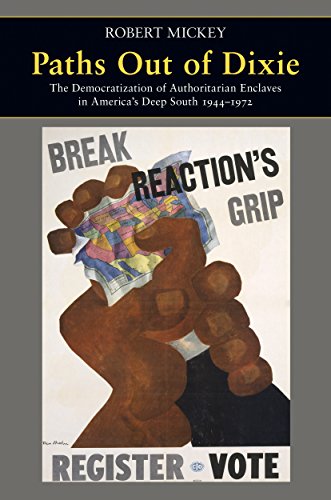
In _Paths out of Dixie_, Robert Mickey confronts the experience of the American South during the civil rights era from the underutilized perspective of comparative democratization. Conceptualizing southern states as authoritarian enclaves within a larger democratic polity, he traces the factors surrounding the often slow erosion of the enclave state until the state’s conversion into a biracial, fully participatory democracy. The structure of state executive power, especially including the county level and the division of authority between center and peripheral units, played a large role in how states were able to manage the various attacks on segregation. The state Democratic party’s relationship with the national party, in contrast, helped to explain the eventual timing and incorporation of Blacks into the state parties and the evolution of the state Republican parties, as well as explaining some of how the national government responded to developments in the states.The detailed archival work that went into this book makes the analysis solid and the conclusions credible. The book is detailed and extensively documented but still well-written, and that combination of features does not occur frequently. Mickey thoroughly addresses competing arguments and explains why the evidence is inconsistent with them – another feature which is frequently missing from even good qualitative scholarship. This is high-quality qualitative APD scholarship, and a valuable read for anyone interested in civil rights, democratization (even the non-comparative kind), or the history and evolution of the deep South.Mickey has a thoroughly researched book in which he deploys a range of concepts to explain what actors do and to categorize the context(s) and outcomes. I wish a little more time had been spent on the underlying conceptual apparatus. I recognize that the book is already exceptionally long, but the conceptual framework that shapes the book is too important to cut. Specifically, I’m talking about the concept of an enclave – which is not widely used in the comparative politics literature and was unfamiliar to me even though I read that literature regularly – and the various types of democratizations that he identifies as the outcomes. How one measures the DV – criteria for each category, what the alternative but unrealized categories might have been (or is this an exhaustive list?), etc. – is far too important to leave out or give short shrift.
L**M
Provocative food for thought
Haven't finished the book yet, but I can comment it is great. It is an outstandingly, to a large extent unexplored subject.One of my intellectual obsessions as a comparativist studying industrialized nations is that americanists seem to live in their own world in terms of subjects they study and approaches. This is not necessarilly bad, but sometimes a bit of fresh air is great. Personally, I feel that many topics that are studied in the framework of developping countries can be studied for industrialized nations and help us learn a lot about it. Among these are the issue of modernization, democratization, coups, etc.That is why I really liked this book. Most work on the american south, slavery, the civil rights revolution and so on, looks at it through a very american point of view. This book does not compare it with other nations, but it challenges the idea that the USA has been a democracy for its whole story. I guess most people's reaction here is that this is a higly controversial topic, but what makes Mickey's book great is that it looks at this subject through the lenses of the literature on democratic transitions. You can think of the american south as a non democracy, and then use the kind of instruments, ideas, and concepts that people have used to look at transitions and consolidation of democracy to analyze the evolution from the civil war to the civil right revolution. That feels like a lot of fresh air.
Trustpilot
2 months ago
5 days ago
5 days ago
1 week ago