
DOWNLOAD THE APP


Customer Services
Copyright © 2025 Desertcart Holdings Limited
DOWNLOAD THE APP

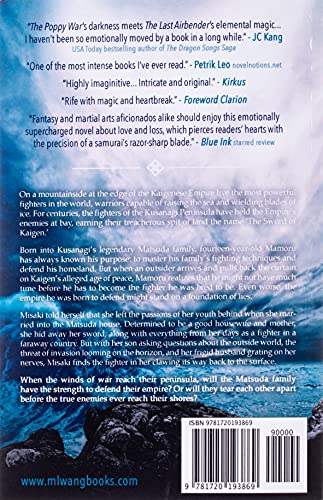


desertcart.com: The Sword of Kaigen: A Theonite War Story: 9781720193869: Wang, M. L.: Books Review: Simply stunning - This book had me in awe by the end of the pages I am sad this is a stand alone in this universe. You follow a handful of characters all belonging to the same family and the story is told from their points of view as. I have honestly enjoyed stories written this way. It adds another layer of depth and complexity to bring ideas into the story. You can get more then just one POV in situations and it also just gives you more opportunity to grow a relationship with the characters. People have elemental powers similar to Avatar the last Airbender where people of certain regions or families have control over one aspect. They don't delve too deep into the magic of it all but I have always loved a supernatural edge to a story. You start following Mamoru a young warrior in training from a famous clan Matsuda. You also follow the perspective of his mother Misaki as well they seem to dominate a majority of the major views you see this world from. Following Mamoru you get the sense of a young boy is confident but trying his best to meet the expectations of his powerful and traditional father. He meets a new classmate who has joined his school and this boy eventually shakes the entire foundation of Mamoru's world with truths that have been hidden away for a long time in the remote village his clan resides in. Mamoru struggling with truths he has been taught his whole life and the groundbreaking evidence this boy shows him to start in motion Mamoru's first experience with grappling that he has been lied to his whole life. That his life and the lives of the people in his village serve a darker purpose then what their glorious history shrouds. In these moments of uncertainty Mamoru confides in his mother the revelations he has discovered. Misaki born in another area is privy to the truths that have been hidden from these people for so long but in this world the roles are very traditional so it is not for a woman to voice truths that would tear down the culture of this village of warrior clans. When Mamoru comes to her with his new knowledge of the real reason they have lived and kept the wrong knowledge passed down generation to generation Misaki is struck with the struggle of whether to completely tear the veil from his eyes. Misaki is struggling much with herself. Who she is compared to her younger years and who she had become. She is unhappy but devout in her duty to be a good mother and wife even though it has destroyed any part of who she was. She is lost and while her son is also experiencing that sense of loss she feels a small connection and starts to realize not what she had lost but what she had gained from a cold and uncaring husband. The action in this story is intense. I lost myself everytime I picked the book up in the middle of the turmoil of the plot. There was no hesitating to make a great and heart wrenching scene no matter what characters it affected ( doing my best to avoid any spoilers I apologize about being so vague but you will see) I cried ALOT like just full on sobbing I ot so attached to characters ot the scene was just so emotionally intense I could help but feel my lip tremble and tears slipping down my cheeks. My face was so sore by the end of it all! And when it felt like I had to be close to the end I realized there was still about half of the book to go still.....oh how can this ever be a happy ending? My heart can't take it but I couldn't stop turning pages. After the major action finally calms and we come back to some semblance of normalcy we finally get a break through with Misaki and Takeru ( I will admit Takeru was not my favorite for a majority of the book but he was never so bad I hated his character he was so Stiff and Mean) this softened my heart to Takeru even the strongest have their hearts as well. You finally felt like in some way you could finally understand why he was the way he was and you could relate. The characters all struggle with inner strife finding who they are or accepting things for how they are. Accepting pain and facing it head on. Being true to yourself but also the ones you love and care for. All in all it's a beautiful story and I just wish it wasn't the END. It felt like there was a build up at the end that could have lead to another book maybe two but this is it and it makes me so sad to say goodbye to these characters so soon. What a great story and I just love the eastern theme of it That said I have read that the other books in this world do not match up and it makes me hesitant to read them. And I do not think they take place in this time so things would be different I am sure. This book is a great read you'll enjoy it!!!! Review: Great combat scenes, memorable characters - This is a good book and well worth the read, but it requires some patience to get through the first part (more on that later.) There are some memorable characters—some I liked, some I didn’t—and the worldbuilding was fascinating. There are two main characters featured in the story; Mamoru, a 14-year-old born to a powerful warrior house, and Misaki, his mother, who harbors a lot of secrets. Mamoru was inquisitive, and like many young teens, wanted nothing more than to live up to everyone else’s expectations—his father’s especially (I’ll discuss his father in a bit.) Of the two main characters, I liked him the best. He had a kind heart, looked after his brothers, and was generally a likeable character. Misaki was…interesting. I didn’t dislike her, but I didn’t love her either. She had an interesting back story filled with crime-fighting prior to her marriage, but she wasn’t a happy person. I didn’t relate to her well, but I did empathize with her situation. Her marriage was arranged, and her husband’s family was very traditional. Women did not do certain things, and she gave up so much of who she was that it was heartbreaking. Her personality was difficult for me to connect with for most of the book, but once she finally started to take control of her life, I liked her a lot more. There were some memorable side characters too. Some, like Mamoru’s friend Kwang Chul-hee, and his aunt Setsuko, were likeable. Others, like his father, Takeru were not. While Takeru wasn’t the ultimate evil in this story, he was one of the most frustrating characters I’ve read about in a long time. Between the way he treated his family (which was with cold indifference most of the time, or outright anger if they questioned him), his entire lack of empathy toward everyone, and his unquestioning loyalty to the Empire, I really wanted to see him gone. He was so aggravating… But he served his role within the story really well. Both Misaki and Takeru evolved throughout the story—though it took a massive tragedy before either of them were prompted to even attempt change. The last few chapters were probably some of my favorites, even though it was well after the action was finished. They were both so much better at the end of the book than they were for the first 70%. The worldbuilding had some interesting elements in it. The book is set in a small mountain town in the Kaigenese Empire. The town is governed by a mayor in conjunction with the leader of the local warrior house—in this case, the Matsuda family. The warrior houses of Kaigen all possess a force called jiya, and depending on the family involved, the jiya takes on a specific form. The Matsudas are wielders of water and ice, and the strongest of the line can summon a whispering blade—an ice construct akin to their steel katanas, but so sharp it can cleave through anything. Misaki’s family have powers over blood, an ability that can be used to heal, but is also feared. The elite fighters from the country of Yamma wield fire, and the dangerous Ranganese—ultimately the enemy of the Empire and its allies—wield wind. There is quite a lot of lore introduced about each type of ability, the gods/goddesses they’re associated with, and the history of the various countries. And through all of this, there is the hint of a massive conspiracy. Even at the 70% mark, I only had a vague notion of what exactly was going on. I loved that element of the unknown and the ominous quality it leant to the story. But back to the first part of the book that I mentioned earlier. It starts off incredibly slow, to the point I almost decided to give up. If you’ve followed me or my reviews for any length of time, you know I rarely DNF and it takes a lot for me to even consider it. But this one was a nearly, and not only due to its crawling pace at the start. I’m usually not too picky about “info dumping” in books, but I struggled with a few early parts in this one. There were some history lessons that not only included huge chunks of information about the world and its past, but dates as well. I am not a numbers person. I do not retain them well. The history lessons were not fun for a reader like me. (I’d much prefer this type of content in timeline format at the back of the book, especially since it wasn’t even relevant to the rest of the story.) What kept me going through the first section was that the world was interesting and the book is very well-written. It felt immersive, despite the initial slow pace, and I think my favorite parts of the book were the combat scenes. They meshed physical combat with jiya work so seamlessly, it was almost cinematic—and really cool. If you can get past the book’s slow start, to where the story really begins to take shape, it’s a fascinating read with some pretty memorable characters.
| Best Sellers Rank | #1,773 in Books ( See Top 100 in Books ) #3 in Asian Myth & Legend #65 in Sword & Sorcery Fantasy (Books) #136 in Epic Fantasy (Books) |
| Customer Reviews | 4.6 4.6 out of 5 stars (17,743) |
| Dimensions | 5.25 x 1.63 x 8 inches |
| ISBN-10 | 172019386X |
| ISBN-13 | 978-1720193869 |
| Item Weight | 1.61 pounds |
| Language | English |
| Print length | 649 pages |
| Publication date | February 13, 2019 |
| Publisher | Independently published |
M**I
Simply stunning
This book had me in awe by the end of the pages I am sad this is a stand alone in this universe. You follow a handful of characters all belonging to the same family and the story is told from their points of view as. I have honestly enjoyed stories written this way. It adds another layer of depth and complexity to bring ideas into the story. You can get more then just one POV in situations and it also just gives you more opportunity to grow a relationship with the characters. People have elemental powers similar to Avatar the last Airbender where people of certain regions or families have control over one aspect. They don't delve too deep into the magic of it all but I have always loved a supernatural edge to a story. You start following Mamoru a young warrior in training from a famous clan Matsuda. You also follow the perspective of his mother Misaki as well they seem to dominate a majority of the major views you see this world from. Following Mamoru you get the sense of a young boy is confident but trying his best to meet the expectations of his powerful and traditional father. He meets a new classmate who has joined his school and this boy eventually shakes the entire foundation of Mamoru's world with truths that have been hidden away for a long time in the remote village his clan resides in. Mamoru struggling with truths he has been taught his whole life and the groundbreaking evidence this boy shows him to start in motion Mamoru's first experience with grappling that he has been lied to his whole life. That his life and the lives of the people in his village serve a darker purpose then what their glorious history shrouds. In these moments of uncertainty Mamoru confides in his mother the revelations he has discovered. Misaki born in another area is privy to the truths that have been hidden from these people for so long but in this world the roles are very traditional so it is not for a woman to voice truths that would tear down the culture of this village of warrior clans. When Mamoru comes to her with his new knowledge of the real reason they have lived and kept the wrong knowledge passed down generation to generation Misaki is struck with the struggle of whether to completely tear the veil from his eyes. Misaki is struggling much with herself. Who she is compared to her younger years and who she had become. She is unhappy but devout in her duty to be a good mother and wife even though it has destroyed any part of who she was. She is lost and while her son is also experiencing that sense of loss she feels a small connection and starts to realize not what she had lost but what she had gained from a cold and uncaring husband. The action in this story is intense. I lost myself everytime I picked the book up in the middle of the turmoil of the plot. There was no hesitating to make a great and heart wrenching scene no matter what characters it affected ( doing my best to avoid any spoilers I apologize about being so vague but you will see) I cried ALOT like just full on sobbing I ot so attached to characters ot the scene was just so emotionally intense I could help but feel my lip tremble and tears slipping down my cheeks. My face was so sore by the end of it all! And when it felt like I had to be close to the end I realized there was still about half of the book to go still.....oh how can this ever be a happy ending? My heart can't take it but I couldn't stop turning pages. After the major action finally calms and we come back to some semblance of normalcy we finally get a break through with Misaki and Takeru ( I will admit Takeru was not my favorite for a majority of the book but he was never so bad I hated his character he was so Stiff and Mean) this softened my heart to Takeru even the strongest have their hearts as well. You finally felt like in some way you could finally understand why he was the way he was and you could relate. The characters all struggle with inner strife finding who they are or accepting things for how they are. Accepting pain and facing it head on. Being true to yourself but also the ones you love and care for. All in all it's a beautiful story and I just wish it wasn't the END. It felt like there was a build up at the end that could have lead to another book maybe two but this is it and it makes me so sad to say goodbye to these characters so soon. What a great story and I just love the eastern theme of it That said I have read that the other books in this world do not match up and it makes me hesitant to read them. And I do not think they take place in this time so things would be different I am sure. This book is a great read you'll enjoy it!!!!
A**.
Great combat scenes, memorable characters
This is a good book and well worth the read, but it requires some patience to get through the first part (more on that later.) There are some memorable characters—some I liked, some I didn’t—and the worldbuilding was fascinating. There are two main characters featured in the story; Mamoru, a 14-year-old born to a powerful warrior house, and Misaki, his mother, who harbors a lot of secrets. Mamoru was inquisitive, and like many young teens, wanted nothing more than to live up to everyone else’s expectations—his father’s especially (I’ll discuss his father in a bit.) Of the two main characters, I liked him the best. He had a kind heart, looked after his brothers, and was generally a likeable character. Misaki was…interesting. I didn’t dislike her, but I didn’t love her either. She had an interesting back story filled with crime-fighting prior to her marriage, but she wasn’t a happy person. I didn’t relate to her well, but I did empathize with her situation. Her marriage was arranged, and her husband’s family was very traditional. Women did not do certain things, and she gave up so much of who she was that it was heartbreaking. Her personality was difficult for me to connect with for most of the book, but once she finally started to take control of her life, I liked her a lot more. There were some memorable side characters too. Some, like Mamoru’s friend Kwang Chul-hee, and his aunt Setsuko, were likeable. Others, like his father, Takeru were not. While Takeru wasn’t the ultimate evil in this story, he was one of the most frustrating characters I’ve read about in a long time. Between the way he treated his family (which was with cold indifference most of the time, or outright anger if they questioned him), his entire lack of empathy toward everyone, and his unquestioning loyalty to the Empire, I really wanted to see him gone. He was so aggravating… But he served his role within the story really well. Both Misaki and Takeru evolved throughout the story—though it took a massive tragedy before either of them were prompted to even attempt change. The last few chapters were probably some of my favorites, even though it was well after the action was finished. They were both so much better at the end of the book than they were for the first 70%. The worldbuilding had some interesting elements in it. The book is set in a small mountain town in the Kaigenese Empire. The town is governed by a mayor in conjunction with the leader of the local warrior house—in this case, the Matsuda family. The warrior houses of Kaigen all possess a force called jiya, and depending on the family involved, the jiya takes on a specific form. The Matsudas are wielders of water and ice, and the strongest of the line can summon a whispering blade—an ice construct akin to their steel katanas, but so sharp it can cleave through anything. Misaki’s family have powers over blood, an ability that can be used to heal, but is also feared. The elite fighters from the country of Yamma wield fire, and the dangerous Ranganese—ultimately the enemy of the Empire and its allies—wield wind. There is quite a lot of lore introduced about each type of ability, the gods/goddesses they’re associated with, and the history of the various countries. And through all of this, there is the hint of a massive conspiracy. Even at the 70% mark, I only had a vague notion of what exactly was going on. I loved that element of the unknown and the ominous quality it leant to the story. But back to the first part of the book that I mentioned earlier. It starts off incredibly slow, to the point I almost decided to give up. If you’ve followed me or my reviews for any length of time, you know I rarely DNF and it takes a lot for me to even consider it. But this one was a nearly, and not only due to its crawling pace at the start. I’m usually not too picky about “info dumping” in books, but I struggled with a few early parts in this one. There were some history lessons that not only included huge chunks of information about the world and its past, but dates as well. I am not a numbers person. I do not retain them well. The history lessons were not fun for a reader like me. (I’d much prefer this type of content in timeline format at the back of the book, especially since it wasn’t even relevant to the rest of the story.) What kept me going through the first section was that the world was interesting and the book is very well-written. It felt immersive, despite the initial slow pace, and I think my favorite parts of the book were the combat scenes. They meshed physical combat with jiya work so seamlessly, it was almost cinematic—and really cool. If you can get past the book’s slow start, to where the story really begins to take shape, it’s a fascinating read with some pretty memorable characters.
M**O
On the Physical Book: Sturdy and easy to handle. The paper selection could have opted for a paper quality that would allow a more flexible spine. The cover treatment is average, as the outer plastic film shows signs of peeling after a few days at the beach (under shade, no sun exposure). On the Story: The Sword of Kaigen (@mlwangauthor ) is a gut wrenching epic with an amazing set of character arcs with really cool development that show depth and uniqueness . The world building is detailed and immersive with good socio-political nuances. The magic system is well developed and easy to grasp and complements well a martial arts background. The Sword of Kaigen is sadly only 600+ pages and seems to be a standalone. My wish is that the author may eventually bless us with more incursions into Duna and the Matsudas.
L**S
Es un increíble libro lo que más me gusta usa frases del japonés para referirse a cosas comunes para que tu vayas como aprendiendo y es muy listo me encanta el sistema muy bueno
L**N
The Sword of Kaigen is a deeply moving standalone fantasy. The slow beginning worked perfectly for me, building up the family and setting so that when tragedy struck, it hit incredibly hard. The battle scenes are cinematic, but what truly stands out is the subtle emotional writing — a single quiet line of grief often carried more weight than pages of description. Where the book lost me was in the final act. After such an unforgettable middle, the story seemed to lose focus. The Robin subplot felt forced, and several loose ends felt bolted on, as if the author was preparing for sequels that never came. The wider political threads also faded away, leaving an ending that didn’t provide the closure I had hoped for. Still, this remains one of the most emotional and impactful fantasies I’ve read in a while, and I’d strongly recommend it to anyone looking for a standalone with real depth.
J**R
Sometimes when I am about half-way through a book and I am reading something as powerful and impressive as this was, I have a fairly good idea what my review is going to be about. And at that half-way point, I did think I was going to write about the world building, and characterizations, magic and everything else that I found to be notable about this story. But, then I read the last half, and I can say that since reading Stephen King’s Wizard and Glass a few years back- I haven’t been so affected by a story as I was this one, or so emotionally invested in characters as these, that I cried through a good twenty percent of this book. See, I was expecting a regular epic-style fantasy, and when we had that amazing battle midway through, all I could think was holy crap, how is the author going to top this? And where can this possibly go from here with so many pages left? What I didn’t realize was, that the incredibly intense first half the book, was only part of the story and not even the best part. So, this stand-alone book works to set-up a little history of a country, and way of life of a people for a later series. While the front-half gives us this incredible world, people, and epic scale battle, the back-half deals with the aftermath, and is about a community finding strength to survive events that are just too horrifying to even imagine- surviving loss of everything from your loved ones to your home and livelihood. It’s about rebuilding and finding hope in each other, and coming together as people. But, at the core of all of that- was Misaki, and even though it was filled with a community of people that were just as full of life as her, this was really her story. Misaki was the heart of this book. She is a mother and wife, coming to terms with a life that maybe didn’t quite go the way she expected. Her story is about healing, regrets, grief, and feeling like you have no voice but also being scared to have one. And just as importantly, it’s about being responsible for your own happiness. Misaki’s journey is raw and painful but it’s also fulfilling and beautiful. As a mother, daughter and wife- her every fear, joy, and regret, resonated with me, and I applaud her characterisation. Without her this would have been a great book with some very cool fight scenes (I’m still in awe over the Matusda brother’s Ice Dragon) and a good solid base for a later series. With her though- it became an outstanding piece of storytelling that needs to be experienced, and one that is going to stick with me for a long time. Other Notes and small criticisms - Even with the huge amount of subtitled stuff I watch, which most of it is tv and film (where they sometimes tend to drop/change this sort of thing in favor of digestibility) and not print, it took me a while to keep the honorifics straight in my head. Particularly when there were a lot of different characters addressing one character. Misaki for instance, who is an elder, mother, and/or respected member of the community, has a different honor appropriate for each title depending on who is addressing her. There was a handy dandy glossary at the back of the book, which I did use once at the beginning, but kindle makes these things not the funnest things to flip back and forth between, so I rarely end up using them once I get going, and just rely on my bad memory for the rest of the book. Making this quibble more my problem than the authors’. Hey, I had to think of something to criticize. -The ending while I did like it giving Misaki a little closure, and setting up stuff for later books, I also felt it could have been trimmed a lot. At that point, I was happy with her present and didn’t want her past to interfere with the contentment she was beginning to find. c/p from my goodreads
A**A
O melhor livro que li esse ano. Uma fantasia que foca no desenvolvimento emocional das personagens, um alívio ler algo em que a protagonista feminina não é uma mulher de 20 anos ou uma donzela saindo da adolescência. Amei o universo da história, a magia, tudo.
Trustpilot
2 months ago
1 month ago