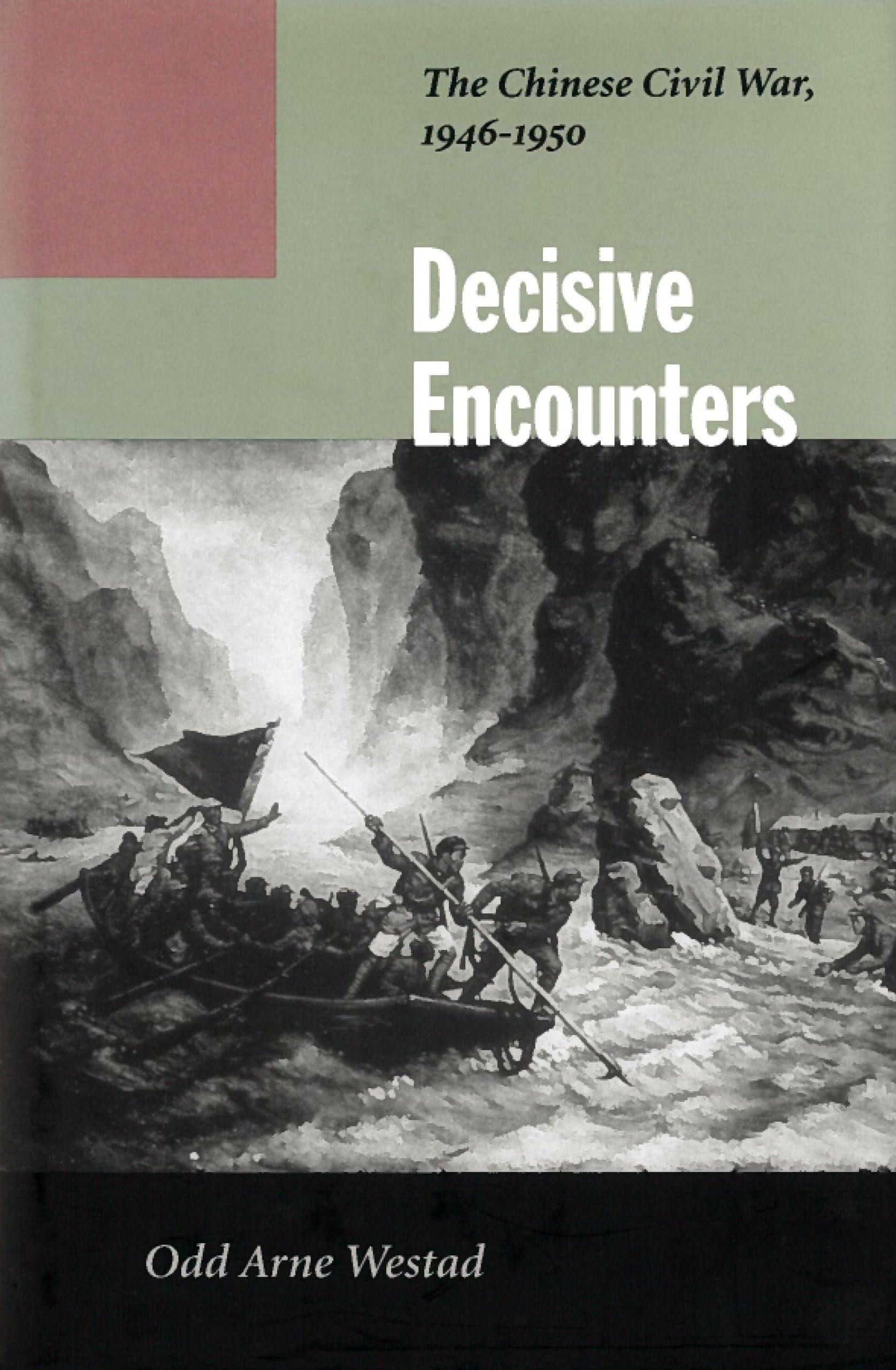

Decisive Encounters: The Chinese Civil War, 1946-1950 [Westad, Odd] on desertcart.com. *FREE* shipping on qualifying offers. Decisive Encounters: The Chinese Civil War, 1946-1950 Review: Nice book. - Nice book. Review: Love It - Best book I've ever read on the topic. Really helped me understand where Mao came from, and more, so much more.
| Best Sellers Rank | #940,801 in Books ( See Top 100 in Books ) #826 in Asian Politics #1,062 in Communism & Socialism (Books) #1,072 in Chinese History (Books) |
| Customer Reviews | 4.2 4.2 out of 5 stars (16) |
| Dimensions | 6 x 1.07 x 9 inches |
| Edition | 1st |
| ISBN-10 | 080474484X |
| ISBN-13 | 978-0804744843 |
| Item Weight | 1.35 pounds |
| Language | English |
| Print length | 428 pages |
| Publication date | March 21, 2003 |
| Publisher | Stanford University Press |
D**M
Nice book.
Nice book.
H**S
Love It
Best book I've ever read on the topic. Really helped me understand where Mao came from, and more, so much more.
E**U
Title is misleading
I was slightly disappointed after reading this book. The title gives an impression of military strategy on the battlefield level. This book offered very little of that. Most concepts, strategies, and thoughts were from the thirty thousand feet level. I was hoping for a book which outlined campaigns with battlefield maps, and greater descriptions of the eb and flow of the combat. Most battles were described in a paragraph or a two. That was very disappointing. The book did give good background information on why things happened, and the history of the conflict. But with a title of "Decisive Encounters" I was expecting more "decisive encounters".
O**N
No Organization
Every topic feels as though it started in the middle and rambles into other areas without conclusion. It is obviously the case of a professor more interested in impressing other professors instead of telling a story. I threw it away.
G**E
A Good Primary Source for The Non-Academic
For someone looking for a discussion of the civil war between the chinese communist party (CCP) and the nationalist gumingdong (GMD) this is a good primer. If you are looking for a detailed discussion of the military and social conflict that went on this is not the book for you. Westad does a good job of describing the situation in 1945 at the end of the Anti-Japanese War. Though most historians feel that the CCP came out of WW2 in worse shape than the GMD, they forget that Mao and company used the war years to solidify their hold on much of the North China countryside and the rural areas of Manchuria where they fought a guerilla war against the Japanese. Though it true that at times whole cadres of CCP adherents were caught and exterminated by the Japanese, the same was the fate of those who backed the GMD. The difference was that the GMD's strength was in the cities while the CCP's strength was in the countryside. You don't grow food in most cities and it's easier to hide out in the countryside where you can scrape together enough to eat and wait for a chance to hit back at your enemy. After the war, the CCP was much more successful in confiscating weapons from the Japanese and in 'enrolling' those who had fought on the Japanese side. They made perfect 'canon fodder' and didn't have any alternative than joining with the CCP since the GMD killed them as traitors as a matter of course. Though the CCP was at a numerical disadvantage at the end of the war they did have the a solid core of experienced fighters who were totally committed to a communist victory. The GMD on the other hand was made up of factions of competing warlords and private armies who sometimes had little or no concern for the needs of the Nationalist government. There were times when one army would not go to the aid of another that was fighting the CCP, or might even attack a colleague if they thought they could gain power in an area. For much of the war, the GMD was the major arms supplier to the CCP, either by ambush or more likely sale of American arms directly by GMD generals to the CCP. Money is seldom a replacement for ideology. Just like in the South Vietnamese Army, many of the GMD generals used barely trained conscripts (more like kidnapped) who were happy to surrender to the CCP with their weapons. These conscripts were then trained by the CCP and thrown back into battle against the GMD. The GMD usually did not take prisoners and killed most of their prisoners or sent them to prison camps where they were a drain on the GMD economy. Generals in the rural areas would lead 'ghost' armies made up of dead or non-existent soldiers for whom the Nationalist government paid salaries for and supplied weapons for. The generals would pocket the extra salaries and sell the weapons to the CCP. The CCP also had a phenomenal spy system, mostly turned GMD operatives that included the personal secretary of the general in charge of the campaigns in Northern China and Manchuria. I found the idea that the CCP had almost no idea on how to run a country since they had spent the last thirty years fighting a civil war, that in many cases they had to put one trusted communist at the head of a city or regional government to supervise the bureaucracy from the prior Nationalist government. They seemed to be as prepared as the Americans were after the overthrow of Saddam Hussein in Iraq. Of course these 'cadre' members could always call on the PLA (Peoples Liberation Army) should they have problems with their new subordinates. All in all a very satisfying study. Zeb Kantrowitz
R**N
Very Good Overview
This is a clear, well organized, and concise overview of the Chinese Civil War. This is not a detailed narrative or military history. Readers looking for that type of book can consult the excellent bibliography of this book. Westad's aims are to cover the basic narrative and provide analysis of the major features of the Civil War. Westad does this very well. Westad presents China emerging from WWII and the prolonged struggle against the Japanese as a profoundly damaged society. This was particularly true in those parts of Northern China that were the main battlegrounds in the fight against Japan. In this context, whoever could establish even moderately effective government would be able to dominate China. The Nationalist party (Guomindang - GMD)led by Jiang Jieshi (Chiang Kai-shek)had become the most powerful force in China in the interwar period but the success of the Japanese invaders greatly damaged the GMD. Nonetheless, in 1946, the GMD seemed likely to regain dominance of China. Jiang Jieshi was acknowledged internationally, including by the Soviets, as the leading figure in China, the GMD at least nominally controlled 80% of the country, and the GMD army had been well equipped by the Americans. In the initial battles of the Civil War, the GMD forces did well against the Red Army of the Chinese Communist Party (CCP). A major theme of this book is the failure of the GMD to capitalize on its advantages. The initial pre-eminence of the GMD was also a source of weakness as any failures to establish effective governance undermined the legitimacy of the GMD. Westad makes clear the high level of corruption, numerous errors in governing, high level of intra-party competition, economic ingnorance, poor leadership, and general incompetence that characterized the GMD efforts to establish effective government. GMD failures led to considerable unrest in the cities and the countryside, providing opportunities for the CCP. While the CCP started the war in an inferior position, it had certain advantages. It was a smaller and considerably cohesive movement, its leadership was clearly better, and despite problems due to inconsistencies in how vigorously to pursue radical reform in the countryside, CCP cadres generally proved more competent than their GMD counterparts. The CCP benefited also greatly from control of the most industrialized part of China, Manchuria, and significant assistance from the Soviets. Soviet support was clearly crucial, though its importance should not be overestimated as Stalin's China policy was rather cautious. Its clear from Westad's narrative, that the CCP leadership, specifically Mao were able to make the most of their advantages and exploit the huge shortcomings of the GMD. This is not the popular story of a peasant led guerilla uprising taking over China. Rather, this is the story of relatively conventional military success allowing establishment of reasonably competent government and leading to acceptance of CCP dominance of China. Military success in conventional warfare was crucial and the CCP appears to have had the outstanding commander of the war, Lin Biao. Westad stresses the importance of the Civil War experience for subsequent events in China. Mao dominated the CCP at the outset of the Civil War, but the rapid success of the CCP (much quicker than anyone, including Mao, expected), sealed Mao's domination of the CCP. The militarization of the CCP, the emphasis of rapid mass efforts, the importance of "will," and use of Soviet models of government and political organization, were all accelerated by the Civil War. Westad is very good as well on the nature of politics and change in the countryside adn the cities. The complicated relationships between the GMD, the CCP and the various national minorities is also covered well. While this book is very much a history of GMD failures, there is some irony when looking at the events of the Civil War and recent events. The GMD, notably Jiang, wanted a modernizing, nationalist state, in control of its own economy, restricting expression but still interacting with the greater world and markets. The state would be authoritarian but using democratic forms to boost legitimacy and a mass party to mobilize the party to support the regime. It appears that CCP domination of China was a painful way to achieve Jiang's goals.
A**0
Nice book thanks
Trustpilot
2 days ago
3 weeks ago