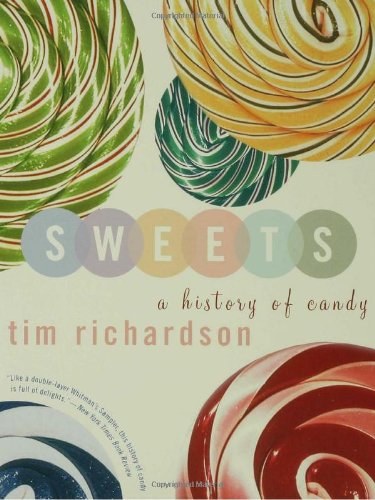
Full description not available
K**E
Fascinating book but the Kindle version is riddled with typos
This book is a fascinating history of "sweets" (or candy, as we would say in the U.S.). Written in a lively and entertaining style, it provides interesting facts about both the human love of sweets and specifics about particular types of candy. (It made me wish I had a bowl of candy at my side as I was reading it.) I would have given it five stars, but the Kindle version is riddled with annoying typos (e.g., swreets instead of sweets, Jake instead of fake, 1 instead of I, etc.). Still worth the read though!
C**O
Lots of history and sweet comments about growing up with candy and the love ...
Very well written book about the world of candy. Lots of history and sweet comments about growing up with candy and the love of it.I use this book to teach my candy class.
S**U
Five Stars
Great- thanks!
J**H
Candy History
It's a good book with full information.Each home need it.
B**9
Sweets: A History of Candy Reader Review
My first trip to Disney World in Florida was when I was six years old. At that age Disney did seem like a completely different world, one richer and more interesting that my own mundane life of school and play-dates. The rides were huge; you met all the Disney princesses and were allowed to eat all the candy you wanted. One of the clearest memories I have is looking up at a chocolate and sugar sculpture of a Pegasus in one of the many themed restaurants. Being the young horse lover I was, that sculpture held me enraptured much to the dismay of my exasperated parents who just wanted to eat, but all I could think was how did a person make that? That is the magic that candy has over all of us; the mystery of how it's made and how it could possibly taste so good and look so beautiful. The magicians who piece together these magnificent sculptures and craft everyday candy-bars are close-lipped about their magic and perhaps that's what makes candy so enticing. The art of candy making has been passed down through the generations starting at the beginning of human history. Our earliest ancestor's satisfied their sweet tooth by stealing the honey from bee's nest and letting it harden in the sun, and thus the world's first lollipop came into existence. The Sumerians took this a step further and added a type of dough sweetened with cornmeal before soaking it in honey and baking it. Hieroglyphics on Ramses III tomb show the making of jalebi an Indian pastry similar to the Mexican churros enjoyed at modern fairs and carnivals. Native North Americans would take sorghum grass, dry it and grind it into a sweet powder, the first powdered sugar! All over the world humans have found ways to create sweets using what natural resources were available to satisfy their sweet tooth. Self-titled International Confectionary Historian Tim Richardson takes us on a deliciously tempting journey in his book Sweets: a History of Candy. With a keen sense of taste and a bottomless pit for a stomach Richard travels around the world and makes countless visits to the library to uncover the truth behind the history of candy. What he discovers is a history more rich and influential on human history than you could possibly imagine as you peel back the wrapper on a small Hershey's Kiss. Eighty percent of the candy bought in the United States is bought on impulse. While standing in line at the grocery store or the sudden chocolate craving many experience is what the candy industry uses to market their products. Bright wrapping and catchy slogans drive their campaigns and try to sell you their products as you stand in line, debating over which confection to consume. Across the US and Britain the candy industry has grown exponentially over the past century. Candy companies use emotional ties, fancy boxes, annoying commercials and neon wrappings to make you see their product and buy their product. However there are countries in the world where candy is not so much of a business but an integral part of their culture and their history. Each country has its own confectionary preferences and their own sweets, but thanks to globalization Americans can eat sweets from Japan and India for just a few dollars. With those few dollars that American gets to taste a bit of that culture and perhaps develop a liking for that sweet and will continue to help spread that piece of culture around and move the world towards a more cohesive and globalized culture. Sweets have even been used as propaganda. A well-known instance was when Queen Victoria gave a royal order to Cadbury chocolate to make 100,000 tins of chocolate for the soldiers in the war for Christmas. Queen Victoria knew that sending chocolate to the troops gave them hope and that it made the government look charitable in a heartfelt way since chocolate was associated with love and comfort.Any major commodity can be exported and shipped to any country in the world quickly and relatively cheaply. Candy has come to represent a language all its own as Richardson points out on the first page of his novel, "The sweets of a country are, in fact, the one aspect of a cuisine that can almost always be enjoyed and understood by foreigners." Each brand has a specific taste, and perhaps a certain memory tied to that taste. Eating that sweet can send you back in time or trying a new sweet expands your horizons and can give you a sense of accomplishment. However the overlying truth is that people love sweets. It can be traced back to science that the sucrose in sugar is pleasing to the tongue. Through evolution it has been useful to eat sweet fruits since those fruits had more sugar in them and so more glucose and energy.In early Mesopotamia honey was used to make the first sun-hardened sweets. This tradition continued to the time of the Egyptians. While sweets were still being made honey was also used to sweeten medicines in countries such as Rome and Greece this practice was widespread. When sugar made its way from India through the Arabs and finally to Rome, Greece and Egypt it was hailed as the most powerful spice ever seen. "As a powder it is good for the eyes, as a smoke it is good for the common cold, as flour sprinkled on wounds, it heals them." Remarks a 16th century physician. Throughout the middle ages sugar was used in such quantities to sweeten medicine that it was hardly medicine anymore. Sweets such as Horehound had their beginnings in medicine but were soon found to hold no real medicinal value and so were sold as sweets.During the Middle Ages subtleties became popular. Subtleties are beautiful sculptures made of sugar, marzipan and frosting. In the middle ages subtleties were mainly made of other foodstuffs such as pork in the form of an apple and dusted with saffron to give it the "golden apple" appearance. Confectioners continued to experiment with sugar and by1429 the coronation of the eight-year-old Henry VI was filled with comfits and subtleties full of symbolism and used as propaganda. In fact, the only dish that Napoleon Bonaparte every complimented was the marzipan sculpture of himself sheathing his sword. At this point sugar was still a novelty and only the rich could afford to buy it, much less pay for a skilled confectioner to craft a sculpture out of it.On the island of Crete, in the 12 century the first sugar refinery was constructed by the Arabs and called Quandi. This is where the word candy, quandi meaning something made of sugar. By the 15th century the British and the Arabs were colonizing the West Indies and Canaries to build their sugar plantations and refineries. Sugar was a huge success in Britain. Nearly all the sugar from the plantation went to Britain where it was consumed, there was no extra to re-export out to the rest of Europe, the British were eating all of it! While countries such as France and Spain struggled to catch up Britain continued to colonize and constructed sugar refineries in the Americas, setting the stage for American sweets.At this point in time, there was a large gap between the sweets of the wealthy and the street sweets of the poor. The wealthy still commissioned subtleties and their sweets were small and delicate. Street sweets were wrapped in paper torn out of old books and made in the basements of sugar enthusiasts. When the sugar economy crashed in the 1800's there were still mass shipments of sugar being imported but the price was much lower. The gap between the two classes lessened and sugar was used in nearly every food made. Large sweet companies such as Cadbury began to make an appearance and when the Industrial Revolution rolled around and the production of sweets took a new route. Machine made mass production of sweets possible and sweets were sold on a worldwide scale never seen before.Over the past 150 years candy has become a force of globalization. It is sold in nearly every country and the marketing of candy has made it more appealing than ever. With its rich history and even richer taste, what's not to love about this delicious commodity?Tim Richardson, International Confectionary Historian, writes in his book, "I like sweets... and that is why I set about writing this book, the first ever world history of sweets." In this book Richardson sets about on a twisty path through history that has no apparent destination at points and at others seems so disorganized that you wonder if there is a path. Richardson's enthusiasm cannot be undermined though; this is one very dedicated and tenacious historian. Richardson seeks to prove that sweets are a fundamental base of human culture, that we eat sweets not only because they taste good but because they help establish relations, are a business and give the consumer a pleasure that is more than just physical but deeply psychological.Over the course of the book Richardson uses quotes from previous books written on the history of sweets and sugar, giving the readers a detailed view of how the world may have looked at that time, at least if you were viewing only the confectionary side of the culture. Even with a detailed bibliography full of primary sources Richardson makes leaps to connect dots that are miles apart such as suggesting that sweetmeats are called such in reference to the Medieval tradition of coating meat with sugar, often to cover the fact that the meat was rotting. In her book Sugarplums and Sherbets: A Prehistory to Sweets Laura Mason contradicts this saying, "The anamolies in our own language are due to the origin of sweets or sweeties...as diminutives of sweetmeat. This word, still not entirely obsolete, was in common use for over 400 years to the end of the nineteenth century. The suffix-meat has an archaic meaning of food in the widest sense (surviving in the phrase 'meat and drink'), so sweetmeat simply means a sweet food." (p.22)Richardson is also very biased, basing most of the book off British confectionary history. While Britain has a very rich history as far as sweets go countries such as France, Spain and even India have a much richer and more fascinating history as well as contributing more to the development of modern sweets. Most of the book is based in Britain however and France is mentioned only at brief intervals and not given the credit it duly deserves in making confections what they are today. As author of Candy: The Sweet History Beth Kimmle points out that the French are the most skilled and have the most delicately flavored candy today. Richardson also fails to mention what his credits are to be appointed as the International Confectionery Historian. Besides his unparalled love of sweets the only qualifications he gives are the careers of his father and grandfather; his father being a dentist and his grandfather being a toffee maker. It is apparent in his book that his writing is very lacking organizationally and is wanting in a more complete world history of sweets. Sweets: A History of Candy is overflowing with facts about candy, whether it is how they are made, where they came from or any other aspect of their history. With his personal opinions and jokes in parentheses he keeps the book entertaining and adds his own supposed signature to the writing. When reading it is difficult not to be craving the sweets he describes in such detail or wishing to see the marvelous candy sculptures Richardson raves about. The reader is sure to be brimming with facts about every type of candy by the time they are finished with Richardson's history of candy. Sweets, it is a tempting subject, but one that is also filled with more than a bit of mystery. A sweet can bring us back to a moment in our life where that sweet was present, perhaps our childhood or a fond memory of a friend or relation. A book filled with fascinating facts about candy and mouthwatering descriptions of foreign confections and delicacies is enough to drive one mad but Sweets: A History of Candy is interesting enough to keep you entertained. Though at points confusing and seeming to have lost his outline, Richardson is a plethora of sweet related facts that keeps you coming back for more.
P**N
A must for anyone interested in confectionary arts.
A really good overview of candy worldwide. I took this out of the library, but once I move I plan to purchase this book. I especially loved the chapter on "Bad Candy" with such discussions as dead baby candy.If you want to know if this book is for you, go to your local library. If they don't have a copy there is always the option of the Inter-Library Loan procedure (books usually take about 3 weeks to arrive). I almost always preview books from the library before purchasing ... it has saved a lot of disappointment
R**Y
A Delicious International History
American candy names have their own sweet, maybe cloying, attractiveness: divinity, Tootsie Roll, Slo Pokes, or Goo Goo Clusters. In _Sweets: A History of Candy_ (Bloomsbury) by Tim Richardson, you will find these, but you can also find Scottish curlie murlies, gundy, and soor plooms (sour plums); Australian Fizzoes, pollywaffles, and Freddo Frog Chocolate Bars; and candy with a more-or-less international appeal, such as Cowpats which are shaped like you-know-what. Tim Richardson has, in researching and writing this book, transformed himself into the world's first international confectionary historian, a designation he frequently, with self-deprecating humor, bestows on himself as he tells us about his efforts on our behalf. It's a wonderful post for him. He begins his book, "My grandfather worked for a toffee company. My father was a dentist. So I have always had strong feelings about sweets. But I have never been confused. I like sweets. I like them a lot." The enthusiasm shows on every page.This is not a recipe book. Though many of the candies might be made at home, Richardson concentrates on manufactured sweets, and the recipes for them are deeply guarded secrets. Candy is so complicated that it is virtually impossible to copy a sweet exactly without inside information. Not only the recipes are closely guarded, but the machines and processes, too, and often Richardson didn't get a peep. But when he did get admitted to a factory, he was delighted: "...every time I entered one I was delirious with joy, ecstatic that the machines were exactly as I hoped they would be." Comparisons with Willy Wonka's factory are unavoidable. Richardson covers the long association of sweets and medicines; often in the past apothecaries and confectioners had bitter rivalries. It was not simply that "a spoonful of sugar helps the medicine go down;" sugar preserved medicines and helped bind pills together. Shaping sweets into fanciful statues has a long tradition. The Duke of Albemarle a couple of centuries ago commissioned a tower of sugar eighteen feet high, inhabited by gods and goddesses; it was too tall to get into his banqueting room. These days we have more modest gingerbread houses adorned with candy for the holidays, but marzipan, sugar, and spun sugar used to be carved into ornate sculptures of windmills, temples, and ruins to make table decorations.There are countless sweet plums pulled out here, amusing details about a universal human interest produced with the sort of good humor that the subject deserves. Richardson's puns are actually worth savoring; in a section on the eighteenth century's low price of sugar and high price for handmade sweets, he tells us "A good confectioner could make a mint." Richardson has informed us of his own favorites here, in a happily personal book of international history, and the boiled sweet known as Rhubarb and Custard is his top choice. "It is said that on his deathbed, the novelist Aldous Huxley called for a dose of mescalin, the hallucinogenic drug. If ever I find myself in a similar situation I will not call for mescalin. No, a quarter of rhubarb and custards will suffice."
P**A
Photos needed
This is an excellent, highly entertaining and informative book on the history of sweet-making and well worth reading. The few grammatical errors do not detract in the least - these exist in practically all books.What IS very disappointing, however,is that there are no photographs at all - even a few line drawings or some copyright-free engravings of sweet-making entrepreneurs would have added to the pleasure of reading. And a book predicated on nostalgia cries out for photos. I bought this book for my partner who refused to read it once he realised there were none whatsoever - he wanted to be reminded of what Black Jacks, Sherbert Dabs etc used to look like. And, in principle, I think any book on the history of its subject needs the inclusion of photographs. Shame on the publishers for that.
J**.
Five Stars
Very interesting
B**1
A good book
Very entertaining and interesting.
D**L
Five Stars
No problems.
Trustpilot
2 months ago
3 days ago
5 days ago
2 days ago