
DOWNLOAD THE APP


Customer Services
Copyright © 2025 Desertcart Holdings Limited
DOWNLOAD THE APP
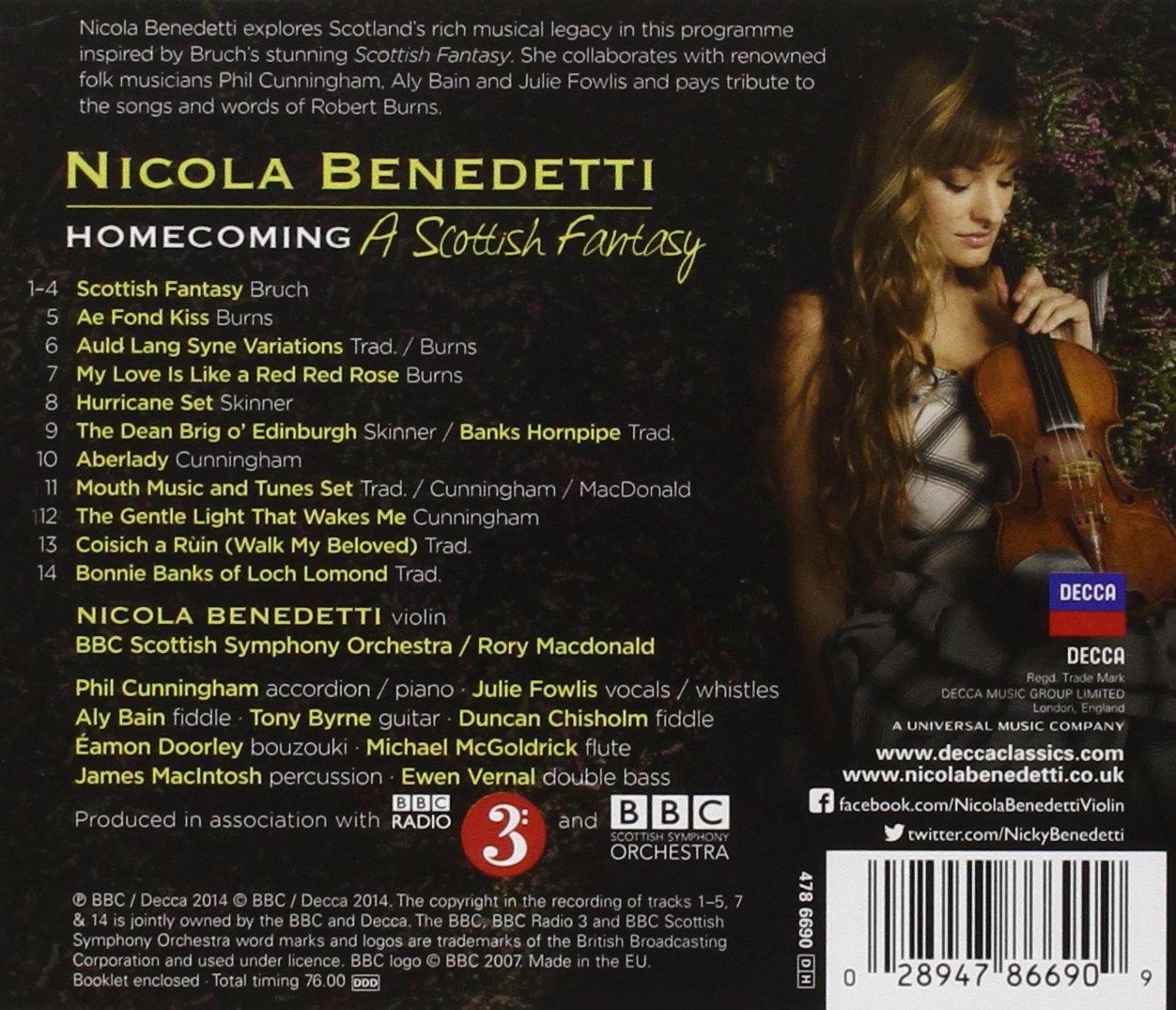
Violinist Benedetti plays Scottish folk and classical favorites in lush, expressive arrangements inspired by her heritage. Review: Hmmmm. How did this one avoid becoming a smash hit of the top rank? - Given the undiminished popularity of Scottish/Celtic/Irish music, you would have thought that something this splendidly executed - and recorded - would make it a sensation. First of all, for many violin lovers, Benedetti's tone quality and shaping of the line is especially appealing. To my taste, it is virtually ideal. I prefer her to just about all the other European soloists who strive for a more lyrical sound these days, as opposed to the slash-and-burn, take-no-prisoners crowd. . . . Here she is beyond perfection in Bruch's Scottish Fantasy. Sentimental? Sure, and brilliantly so. Quite frankly, this is now my favorite rendition of the Bruch; it is profoundly satisfying. The first movement has never evinced either a pathos or an allusion to the tragedy of its subject this moving - nor, for that matter, a nostalgic sweep this impressive. Just the right amount of surging drama is applied, and in all the right places, without ever descending into melodrama. Nicola Benedetti's performance brings both affection and profound understanding to the work, and the orchestral accompaniment is ideally realized. In a work such as this, the orchestra's contribution is, of course, at least as important as the soloist, if not more so. Rory MacDonald's conducting is more than just a model of sympathetic collaboration; it's clear that he GETS it. Alas, such is very often not the case in either Brahms or Bruch these days, whether in the studio or the concert hall. This may be a 19th Century warhorse, but it should wear that title proudly because it is a masterwork in the grand style and of the highest order. The autocratic taste ogres who used to prevail have fortunately been supplanted in recent years by audiences who have awakened to Bruch's visionary Romanticism and by modern critics who have joined the ranks of the admirers, restoring Bruch to that perch of respectability he enjoyed 100 years ago. (The Dvorak is another masterpiece whose stock has soared recently.) . . . The great beauty of the semi-classical arrangements of things such as 'Ae Fond Kiss' are not to be missed. As for the folk offerings, they fit in wonderfully, seeming to inform rather than to contrast. The Julie Fowlis vocals are just right. Aly Bain and Duncan Chisholm are fiddling delights. The compilation is first-rate, both in selection and sequencing. And there is surprising depth in the folk offerings. Everywhere and always Benedetti supplies pitch-perfect sincerity or tasteful exuberance as required. . . . And the audio? You don't often hear 19th-Century, Central European violin concertos (and the Bruch is just as much the creature of German Romanticism as of enthusiasm for things Scottish) recorded with such an apt balance between soloist and orchestra and such clarity of textures. Much of the praise must go to Benedetti herself or to conductor Rory MacDonald, but also to other crucial factors such as superb microphone placement and to choice of venue - Glasgow City Hall. Only occasionally do even high-profile Brahms recordings feature sonics this successful. Of course, the thick Brahmsian textures are notoriously difficult to capture, even in studio settings, but Bruch is no walk in the park either. In the Scottish Fantasy, the engineering - no, make that the engineering decisions - dazzles. It's impossible to determine who deserves more credit - Mike Clements for the recording or Andrew Walton for the mixing. The results speak for themselves. Altogether, this is not just one of the finest semi-crossover albums, but, thanks to a sublime Scottish Fantasy, one of the best issues by a major label for classical violin and orchestra of recent years. Viva Benedetti! Review: 'Homecoming' shares love of Scotland's best - This CD was a a joy to listen to, and the selection of tunes is a must for all those who love Scotland and its beloved music. The performance is a sampling of classic tunes with a pop slant. Indeed, some of the tunes have been slightly altered to suit fans of both. And while the artists don't have the star quality of Joshua Bell or The London Symphony Orchestra, they certainly shine. What they lack in technicality they more than make up for it with heart and enthusiasm. If you want technical perfection buy something else. If you want a a performance with soul and joy, this is it!

















| ASIN | B00JLZVJSM |
| Best Sellers Rank | #84,267 in CDs & Vinyl ( See Top 100 in CDs & Vinyl ) #80 in Classical Fantasies |
| Customer Reviews | 4.6 4.6 out of 5 stars (340) |
| Date First Available | May 10, 2014 |
| Is Discontinued By Manufacturer | No |
| Item model number | 028947866909 |
| Label | Decca |
| Language | English |
| Manufacturer | Decca |
| Number of discs | 1 |
| Original Release Date | 2014 |
| Product Dimensions | 5.59 x 5.16 x 0.39 inches; 3.88 ounces |
T**N
Hmmmm. How did this one avoid becoming a smash hit of the top rank?
Given the undiminished popularity of Scottish/Celtic/Irish music, you would have thought that something this splendidly executed - and recorded - would make it a sensation. First of all, for many violin lovers, Benedetti's tone quality and shaping of the line is especially appealing. To my taste, it is virtually ideal. I prefer her to just about all the other European soloists who strive for a more lyrical sound these days, as opposed to the slash-and-burn, take-no-prisoners crowd. . . . Here she is beyond perfection in Bruch's Scottish Fantasy. Sentimental? Sure, and brilliantly so. Quite frankly, this is now my favorite rendition of the Bruch; it is profoundly satisfying. The first movement has never evinced either a pathos or an allusion to the tragedy of its subject this moving - nor, for that matter, a nostalgic sweep this impressive. Just the right amount of surging drama is applied, and in all the right places, without ever descending into melodrama. Nicola Benedetti's performance brings both affection and profound understanding to the work, and the orchestral accompaniment is ideally realized. In a work such as this, the orchestra's contribution is, of course, at least as important as the soloist, if not more so. Rory MacDonald's conducting is more than just a model of sympathetic collaboration; it's clear that he GETS it. Alas, such is very often not the case in either Brahms or Bruch these days, whether in the studio or the concert hall. This may be a 19th Century warhorse, but it should wear that title proudly because it is a masterwork in the grand style and of the highest order. The autocratic taste ogres who used to prevail have fortunately been supplanted in recent years by audiences who have awakened to Bruch's visionary Romanticism and by modern critics who have joined the ranks of the admirers, restoring Bruch to that perch of respectability he enjoyed 100 years ago. (The Dvorak is another masterpiece whose stock has soared recently.) . . . The great beauty of the semi-classical arrangements of things such as 'Ae Fond Kiss' are not to be missed. As for the folk offerings, they fit in wonderfully, seeming to inform rather than to contrast. The Julie Fowlis vocals are just right. Aly Bain and Duncan Chisholm are fiddling delights. The compilation is first-rate, both in selection and sequencing. And there is surprising depth in the folk offerings. Everywhere and always Benedetti supplies pitch-perfect sincerity or tasteful exuberance as required. . . . And the audio? You don't often hear 19th-Century, Central European violin concertos (and the Bruch is just as much the creature of German Romanticism as of enthusiasm for things Scottish) recorded with such an apt balance between soloist and orchestra and such clarity of textures. Much of the praise must go to Benedetti herself or to conductor Rory MacDonald, but also to other crucial factors such as superb microphone placement and to choice of venue - Glasgow City Hall. Only occasionally do even high-profile Brahms recordings feature sonics this successful. Of course, the thick Brahmsian textures are notoriously difficult to capture, even in studio settings, but Bruch is no walk in the park either. In the Scottish Fantasy, the engineering - no, make that the engineering decisions - dazzles. It's impossible to determine who deserves more credit - Mike Clements for the recording or Andrew Walton for the mixing. The results speak for themselves. Altogether, this is not just one of the finest semi-crossover albums, but, thanks to a sublime Scottish Fantasy, one of the best issues by a major label for classical violin and orchestra of recent years. Viva Benedetti!
C**S
'Homecoming' shares love of Scotland's best
This CD was a a joy to listen to, and the selection of tunes is a must for all those who love Scotland and its beloved music. The performance is a sampling of classic tunes with a pop slant. Indeed, some of the tunes have been slightly altered to suit fans of both. And while the artists don't have the star quality of Joshua Bell or The London Symphony Orchestra, they certainly shine. What they lack in technicality they more than make up for it with heart and enthusiasm. If you want technical perfection buy something else. If you want a a performance with soul and joy, this is it!
C**G
A Wonderful Performing Performing Beautiful Music
I purchased this CD because I had heard Nicola's rendition of Loch Lomond, but I had no idea how many great pieces of music she performs on this CD. Truly a taste of Scotland with both familiar and new tunes/
S**A
the first half is complete rubbish, second half is wonderful
My CD arrived with a case smashed to pieces. Fortunately it was only the case. As for the music, the first half is complete rubbish (Scottish Fantasy). I have a hard time understanding what was trying to be accomplished. The composition isn't all that bad, but the arrangement, production and mixing is very hard to listen to. The second half is absolutely wonderful.
P**B
Clarity, passion and Love!
An exquisitely beautiful CD! The compositions are treasures and Benedetti plays them with sensitivity, clarity and passion! We love this CD!
G**L
A wonderful musical salut to Scotland!
Brilliantly played by Ms. Benedetti with love for Scotland! You can hear and feel her emotion in this tribute to her native home.
D**E
Fantastic CD. Phenomenal performances
Fantastic CD. Phenomenal performances. I listen all the time. Never gets old. As s matter of fact, I find I discover something each and every time I listen to a track. Simply beautiful. Fills my soul.
G**A
Pleasant music, somewhat repetative, and disc was defective
A little of this goes a long way.....I liked the music generally, but the themes were repetitive and the disc was defective and wouldn't load in my player....had to listen through my laptop.....
S**Y
..... or at least, you almost did. Chatting with Ms Benedetti a while back - as you do when you've queued up for a brief blether and an autograph, along with a couple of hundred other fans, at a signing session in a Glasgow music store - I said something like: "Nicola, is there any chance you might do a recording of Bruch's Scottish Fantasy sometime?" "Yes", she replied, flashing that dazzling smile, "actually it's the next thing I'm doing!" Well, as it turned out, it wasn't quite the next thing she did; but the point is that ever since then I've been eagerly awaiting this recording - along, I've no doubt, with many of her other admirers, especially those who've heard her play the Max Bruch piece in concerts such as the one I heard at Edinburgh's Usher Hall where, accompanied by the Royal Scottish National Orchestra under Stéphane Denève, she brought the house down with a stunning rendition alternating rollicking bravura with exquisite lyricism. Well, she repeats that tour de force here - and, if anything, to even greater effect. What's more, she has made it the centrepiece of a superbly imaginative programme of Scottish moods and melodies in a variety of styles, with something bound to please even the most cloth-eared of listeners. Starting with the Bruch piece, the introductory Grave and Adagio cantabile are played with warm lyricism by Ms Benedetti, accompanied by the excellent BBC Scottish Symphony Orchestra under the stylish direction of Rory Macdonald. The Scherzo second movement is an absolute stunner, with fabulously vivid playing from Nicola. The beautifully lyrical Andante, based on the glorious folksong "I'm A-Doun for Lack of Johnnie", overflows with tenderness and longing, and Bruch's forceful Finale brings us magically spirited bravura with wonderful double-stopping passages. This is all a fabulous treat for lovers of the Bruch piece; my favourite versions until now have been from Rachel Barton Pine and Tasmin Little, but it's hard to imagine a player better equipped to give it the full works than Nicola Benedetti, and that's before you even hear the rest of her programme. The next three pieces, all based on Robert Burns poems, continue in classical style and spirit, two of them - "Ae Fond Kiss" and "My Love is Like a Red Red Rose" - in arrangements by Paul Campbell. The last of these (track 7) is especially fine - already a gorgeous melody, and Nicola's playing of it quite magical. The following items take us more into a mixture of styles, with a lively and tasteful Scottish folk band taking over the accompanying role from the classical orchestra for some of the time, and yet the sequence still retains a remarkable unity and consistency. I especially enjoyed composer James Scott Skinner's rollicking Strathspey (track 8) which can't fail to set your feet tapping. Phil Cunningham's "Aberlady" (10) gives us another great tune, and the following sequence of short pieces brings us some stylish singing in Gaelic from the fine voice of Julie Fowlis. Track 11 forms a lovely sequence and once again, hearing the verve and spirit of the violinist and her band, you just won't be able to keep still. For Phil Cunningham's extremely graceful melody "The Gentle Light That Wakes Me" (12), fiddler Aly Bain proves a worthy partner for Nicola - by no means the first time they've played together. The disc closes with another absolute treat - a set of variations, arranged by Paul Campbell for violin and orchestra, on "Bonnie Banks of Loch Lomond". They're in a variety of styles which fit together beautifully - and in any case, how can you go wrong with a tune like this? It makes a beautifully fitting close to this very Scottish programme. The violinist writes her own booklet essay, showing both passion and thoughtfulness, and everything is impeccably documented, with Gaelic texts and English translations where appropriate. The session photos aren't bad either. A word of caution, though: just in case you're wondering, I'm reliably informed that this present issue, in spite of its obvious potential for arousing patriotic and nostalgic feelings among natives or lovers of Scotland, is in no way intended to influence - or to represent a comment of any kind upon - the Scottish independence debate. Nicola's unashamedly Scottish programme clearly constitutes a passionate advocacy of Scots culture and tradition - but certainly not of Alex Salmond! So, Scots music-lovers - of which I am one - if you read any reviews by the First Minister, whether in his own name or under one of his many pseudonyms, attempting to make political capital out of the very Scottish delights of this recording, don't be fooled! And remember, in the most unlikely event of the Scots nationalists prevailing in the forthcoming independence vote, you'll soon be paying a lot more for your CDs because of the taxes Salmond and co. will need to raise in order to pay for all their promises. But let's return to musical matters. This recording is simply a gorgeous programme of music which, once again, demonstrates Nicola Benedetti's imagination, versatility and communicative instinct. For, in addition to being the most beautiful musician in the history of the universe, and just in case anyone doesn't know already, she's also an absolute magician on the violin, and here she plays all of this marvellous music with spirit, panache and soul. So, best get it while you can!
M**M
A simply beautiful CD filled with joy. Utterly uplifting in every sense of the word. Buy it for someone special. He/she is worth it!
M**O
very good I love this.
K**0
Great Album folk & classical
E**Z
Bajo este significativo rótulo se esconden la Fantasía Escocesa del compositor alemán Max Bruch (especie de concierto para violín, que suele acompañar al propiamente denominado como primero, pues hay otro segundo raramente interpretado), más una serie de piezas menores escocesas que van desde algunas tradicionales a otras adaptadas de autores como Robert Burns y otros varios, a diversos instrumentos en los que se erige el violín como centro. Son melodías muy agradables tomadas de canciones cuyos textos se incorporan al libreto del disco. Ni que decir tiene que la interpretación de la Benedetti es más que solvente. Echamos de menos que al concierto no se le haya añadido otra obra de más fuste que estas preciosas piezas, pero la elección no es nuestra. Respecto al plato fuerte, la interpretación de la obra de Bruch, la competencia es feroz, recordemos la versión de Heifetz (que la hay además en versión remasterizada de SACD de suntuoso sonido y de profundos planos sonoros), y ya desde el primer compás oiremos la diferencia, en Heifetz hay una fuerza y vigor internos de los que carece Benedetti, pero incluso en la grabación del lituano el sonido del arpa (en Heifetz acompañaba el maravilloso Ossian Ellis) se destacaba de manera esencial, mientras que aquí el arpa está prácticamente ausente (como ha recordado Petróvich en su acertada reseña para Amazon). Precisamente cuando he leído la de este documentado crítico, iba a abandonar la mía por innecesaria; no obstante, no lo hago para insistir en lo que es bastante obvio: el conjunto interesará a los escoceses o amantes del folklore escocés, también a los fanáticos de Nicola Benedetti, pero los que piensen en hacerse con una versión de la Fantasía de Bruch vean otras opciones (el mencionado Heifetz, Kyung Wa Chung, la antigua de Oistrakh), si no, es preferible abstenerse. Y, si no se es demasiado exigente con Bruch, el disco de la Benedetti es un bonito regalo, que a nadie disgustará.
Trustpilot
2 months ago
2 weeks ago