
Buy Prisoners of Geography: Ten Maps That Explain Everything About the World (Politics of Place) on desertcart.com ✓ FREE SHIPPING on qualified orders Review: Eye opener of geography and politics - Absolutely enjoying this book. As one who does not have a very good understanding of how things work politically in the world, this has helped me to understand more thoroughly the dynamics involved in geography and the political games that are played. I have also gained knowledge about our world as a whole. Now that I have started, I cannot put this book down. I am almost done. Everyone should read this book. It will open your eyes and understanding of geography and politics involved. Review: The power of geography! - The book Prisoners of Geography: Ten Maps That Explain Everything About the World (Politics of Place Book 1) by journalist Tim Marshall explores the impact that geography has on international relations. Marshall uses ten maps of key regions of the world to explain how the physical aspects of a country, such as its location, its climate, its natural resources, and its borders, can influence its foreign policy. The book begins with a discussion of the importance of geography in politics. Marshall argues that the leaders of countries are not completely free to make their own decisions, since their options are limited by geographical conditions. For example, Russia needs to have a navy in order to project its power to the world, but its ports are frozen for six months of the year, limiting its ability to operate at sea. Marshall then examines ten key regions of the world, using maps to illustrate his points. In the chapter on Russia, for example, Marshall explains how Russia's location between Europe and Asia, its extreme climate, and its long borders have made it vulnerable to foreign invasions. In the chapter on China, Marshall explains how geography has helped China become an economic powerhouse, but has also limited its ability to project its military power. The book concludes with a discussion of the future of geography in politics. Marshall argues that geography will continue to be an important factor in international relations, but that the impact of geography may be tempered by technological development. For example, the development of aircraft and ballistic missiles has allowed countries to extend their military power further, reducing the importance of land borders. Prisoners of Geography is a fascinating and well written book that offers a new perspective on international politics. The book is a must-read for anyone who wants to better understand how geography affects the world around us. Here are some of the book's highlights: The book uses maps effectively to illustrate its points. The book is accessible to the general reader, but it is also informative for readers who are more knowledgeable about geography. The book is relevant to current events as it discusses the implications of geography for the politics of the major world powers. The book is a good starting point to learn more about the importance of geography in international politics. If you are interested in learning more about international politics, I recommend reading Prisoners of Geography. It is a book that will help you better understand the world around you.


| Best Sellers Rank | #8,884 in Books ( See Top 100 in Books ) #2 in Human Geography (Books) #2 in Historical Geography #6 in Middle Eastern Politics |
| Customer Reviews | 4.5 out of 5 stars 6,278 Reviews |
D**A
Eye opener of geography and politics
Absolutely enjoying this book. As one who does not have a very good understanding of how things work politically in the world, this has helped me to understand more thoroughly the dynamics involved in geography and the political games that are played. I have also gained knowledge about our world as a whole. Now that I have started, I cannot put this book down. I am almost done. Everyone should read this book. It will open your eyes and understanding of geography and politics involved.
M**S
The power of geography!
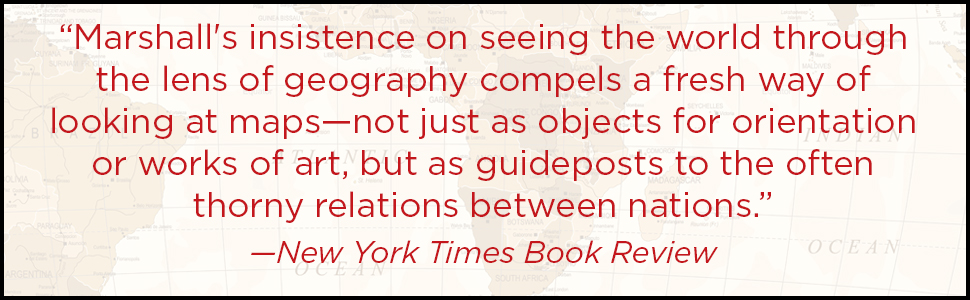
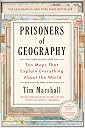
The book Prisoners of Geography: Ten Maps That Explain Everything About the World (Politics of Place Book 1) by journalist Tim Marshall explores the impact that geography has on international relations. Marshall uses ten maps of key regions of the world to explain how the physical aspects of a country, such as its location, its climate, its natural resources, and its borders, can influence its foreign policy. The book begins with a discussion of the importance of geography in politics. Marshall argues that the leaders of countries are not completely free to make their own decisions, since their options are limited by geographical conditions. For example, Russia needs to have a navy in order to project its power to the world, but its ports are frozen for six months of the year, limiting its ability to operate at sea. Marshall then examines ten key regions of the world, using maps to illustrate his points. In the chapter on Russia, for example, Marshall explains how Russia's location between Europe and Asia, its extreme climate, and its long borders have made it vulnerable to foreign invasions. In the chapter on China, Marshall explains how geography has helped China become an economic powerhouse, but has also limited its ability to project its military power. The book concludes with a discussion of the future of geography in politics. Marshall argues that geography will continue to be an important factor in international relations, but that the impact of geography may be tempered by technological development. For example, the development of aircraft and ballistic missiles has allowed countries to extend their military power further, reducing the importance of land borders. Prisoners of Geography is a fascinating and well written book that offers a new perspective on international politics. The book is a must-read for anyone who wants to better understand how geography affects the world around us. Here are some of the book's highlights: The book uses maps effectively to illustrate its points. The book is accessible to the general reader, but it is also informative for readers who are more knowledgeable about geography. The book is relevant to current events as it discusses the implications of geography for the politics of the major world powers. The book is a good starting point to learn more about the importance of geography in international politics. If you are interested in learning more about international politics, I recommend reading Prisoners of Geography. It is a book that will help you better understand the world around you.
J**H
Unique perspective, well written
I've seen World power struggles refined by energy, water and other things, but overall geography is a fascinating and clearly relevant look. The author is convincing but doesn't need to be. What is laid out makes itself very clearly obvious, out just isn't often looked at that way. Whether you like geography, World politics, history, military affairs or just want to learn something new and interesting, this is a worthwhile and interesting read
A**N
Readable account of how geography is at the core of geopolitics
Prisoners of Geography gives an overview of modern geopolitics through the lens of geography. It provides a brief history of the worlds major geographic regions and powers and how geography has both shaped events as well as define current relationships. The author sets out chapters for China, Russia, the US, Western Europe, Africa, the Middle East, the Indian subcontinent, Korea and Japan, Latam as well as the Arctic. The book in short space gives a easily readable overview of how to think about the geography of the world and its impact on historic and contemporary events. Given the breath of books on politics this book is a refreshing read which brings fresh insight with how to view geopolitical conflicts. We often forget about the role of geography in the modern age with integrated supply chains in an age of global trade but access to resources and stability of borders have often defined economics and in particular politics. The author discusses how the geography of Russia has defined recent events in the Ukraine and how China's energy trade make the South and East China Seas of critical national importance. The author discusses the remarkably beneficial geography and resources of the US and how the territory's natural defenses make it largely impossible to defend, unlike Russia and Europe. The author discusses how colonial powers divided and put up fictitious borders in Africa and the Middle East and how the ethnic divisions plague the regions today. The author gives an account of India and Pakistan and how the Himalayas provide both a boundary but also have forced the conflicts for those inside the boundaries. The author spends some time on South America but discusses how despite resource wealth the trade distance has been prohibitive. The role of geography in politics is of course of utmost importance. It is usually subordinated these days to the narratives of the time but in Prisoners of Geography the author spells out how it is geography that defines national interest and creates the conditions for conflict. It is definitely a quick read and there is far more comprehensive books out there on how geography has defined development and historic conflicts but this is a highly readable overview for interpreting today's politics.
B**T
Must Read- Well Informed Work, Factual- All Perspectives: Military, Political, Technological Etc..
This is a must read book. US Veterans whom have read it and either "trained" for and or "fought" in regions discussed claim it to be a "highly" militarily factual representation of the "challenges" faced in various Global "theaters" of operation not only geographically but also "politically" with very few errors.... in authors "assessments"!!!! Furthermore, "technologically" and "demographically" it points out numerous "interesting" points, such as on page number 242 were the author asserts "America is an Arctic nation without an Arctic strategy in a region that is heating up." Furthermore, the author points out on page 251 of hard copy, that in 2014 Russia conducted "military exercises" in the Arctic Region with 155,00 troops and the exercise opponents were in fact named "Missouri" and "an unnamed Asian power [Japan] which had already clashed with Russia" in the past (Sino-Russian Conflict; WWIII etc..)! (Do not recall these simple facts making it into main-stream American Media reporting-interestingly enough!) Furthermore, IAW author in the case of the former Tsarist Russian Empire-Soviet Union, its leaders purposely left "pockets" of pro-Soviet/Russian populations in place as the Empire expanded and/or contracted to utilize various "political" reasons....if it so chose!!!! Interesting point! As far as Latin America or South America, the author really hits home the fact most of the "continents" population resides along the coasts and the numerous difficulties in establishing development in the vast interior, and issues arising from this such as "deforestation" of the rain forest, as well as numerous difficulties these nations face in bringing "goods" from the interior to port, etc....! On this note, in the "conclusion" on page 260- the author states "To take an extreme and unlikely scenario: imagine a majority Hispanic Florida has seceded from the United States and allied itself with Cuba or Mexico. This would alter only the dynamics of whom controlled the Gulf, not the importance of the location!" Clearly, a very poignant point about the total and absolute "importance" of geography and too some extent "demographics" and its role in shaping national strategic policies.....not only in the US but around the Globe! The author, also has a very interesting take on "Africa" and the countless issues facing nations there and those other nations involved there for various reasons. The author makes a point of "hammering" home the massive Chinese involvement in nations in Africa and why other nations must also follow suit to some degree, not only in Africa but around the Globe as well. Finally, the author touches on points of "global" warming and the impacts it may play Globally as well as "outer-space" and numerous global national issues there as well. In a nut shell this is must read- well informed, factual work- from most all perspectives (Military, Political, Technological Etc..) for those interested in Global Politics and Current Affairs!
M**R
Good book, but questionable quality
I love the book, well explained and fascinating, but the quality is questionable. Came in good condition.
C**T
How does the world function?
It is a great book, well written in a pleasant style. There are not that many intelligent books in any library, including mine! Here is the author's theory: "the land on which we live has always shaped us. It has shaped the wars, the power, politics, and social development of the peoples that now inhabit nearly every part of the earth." Behind this aim, the author displays a vast knowledge and understanding of history and politics, even for the smallest players. I checked for instance the author profound understanding of a small country like Belgium.
T**H
Poorly supported conclusions, propaganda
This seems as much propaganda as anything else. Conclusions are drawn by the author with nothing to back them up but the simplest of reasoning and opinion. For instance, Russia had no choice but to invade Crimea due to need for a warm water port, or had to take Tibet due to needing to protect itself from India, which in other places in the book was stated to be protected by the Himalayas! Don’t look here for any deep meaning for geopolitical action but rather justifications of past bad acts. The author seems a fan of Putin.
Trustpilot
1 month ago
4 days ago