

Desert Online General Trading LLC
Dubai, United Arab Emirates
Desert Online General Trading LLC
Dubai, United Arab Emirates
Full description not available
O**H
THE Core Reference on Business Strategy!
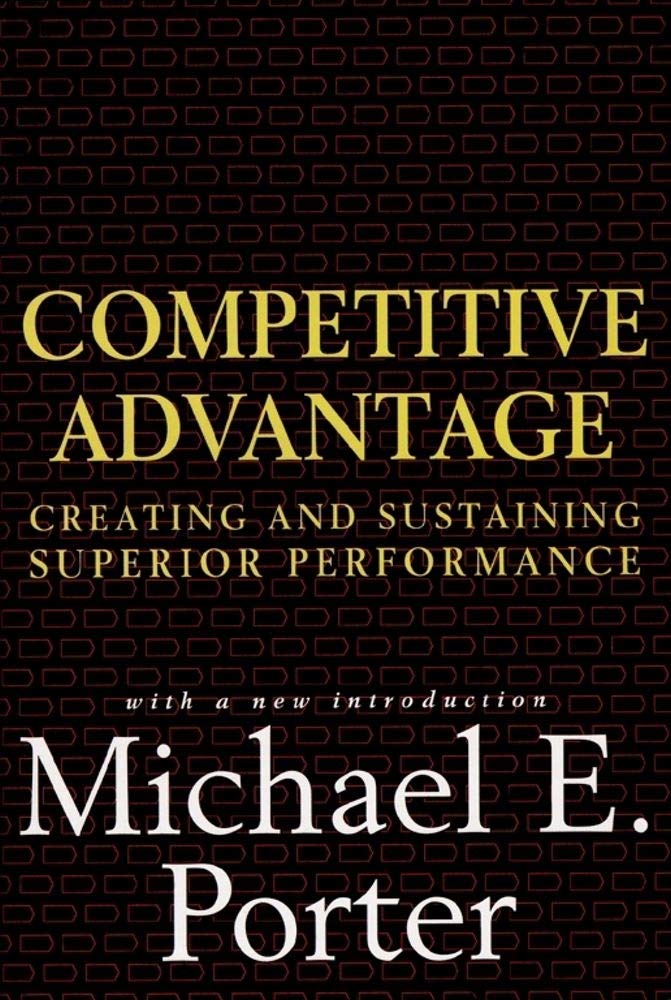
Below are key excerpts from the book that I found particularly insightful:1- "Both industry attractiveness and competitive position can be shaped by a firm, and this is what makes the choice of competitive strategy both challenging and exciting. While industry attractiveness is partly a reflection of factors over which a firm has little influence, competitive strategy has considerable power to make an industry more competitive strategy has considerable power to make an industry m( or less attractive. At the same time, a firm can clearly improve or erode its position within an industry through its choice of strategy. Competitive strategy, then, not only responds to the environment but also attempts to shape that environment in a firm's favor. These two central questions in competitive strategy have been at the core of my research."2- "The ability of firms to shape industry structure places a particular burden on industry leaders. Leaders' actions can have a disproportionate impact on structure, because of their size and influence over buyers, suppliers, and other competitors. At the same time, leaders' large market shares guarantee that anything that changes overall industry structure will affect them as well. A leader, then, must constantly balance its own competitive position against the health of the industry as a whole. Often leaders are better off" taking actions to improve or protect industry structure rather than seeking greater competitive advantage for themselves."3- "The second central question in competitive strategy is a firm's relative position within its industry. Positioning determines whether a firm's profitabihty is above or below the industry average. A firm that can position itself well may earn high rates of return even though industry structure is unfavorable and the average profitability of the industry is therefore modest. The fundamental basis of above-average performance in the long run is sustainable competitive advantage. ^ Though a firm can have a myriad of strengths and weaknesses vis-a-vis its competitors, there are two basic types of competitive advantage a firm can possess: low cost or diff'erentiation. The significance of any strength or weakness a firm possesses is ultimately a function of its impact on relative cost or diff'erentiation. Cost advantage and differentiation in turn stem from industry structure. They result from a firm's ability to cope with the five forces better than its rivals. The two basic types of competitive advantage combined with the scope of activities for which a firm seeks to achieve them lead to three generic strategies for achieving above-average performance in an industry: cost leadership, diff'erentiation, and focus. The focus strategy has two variants, cost focus and differentiation focus."4- "The ability to be both low cost and differentiated is a function of being the only firm with the new innovation, however. Once competitors also introduce the innovation, the firm is again in the position of having to make a tradeoff."5- "Linkages among value activities arise from a number of generic causes, among them the following: The same function can be performed in different ways...The cost or performance of direct activities is improved by greater efforts in indirect activities...Activities performed inside a firm reduce the need to demonstrate, explain, or service a product in the field...Quality assurance functions can be performed in different ways."6- "Exploiting linkages usually requires information or information flows that allow optimization or coordination to take place. Thus, information systems are often vital to gaining competitive advantages from linkages."7- "Cost dynamics occur because of the interplay of cost drivers over time, as a firm grows or as industry conditions change. The most common sources of cost dynamics include: Industry Real Growth...Differential Scale Sensitivity...Different Learning Rates...Differential Technological Change...Relative Inflation of Costs...Aging...Market Adjustment."8- "Steps in Strategic Cost Analysis...1. Identify the appropriate value chain and assign costs and assets to it. 2. Diagnose the cost drivers of each value activity and how they interact. 3 Identify competitor value chains, and determine the relative cost of competitors and the sources of cost differences. 4. Develop a strategy to lower relative cost position through controlling cost drivers or re-configuring the value chain and/ or downstream value. 5. Ensure that cost reduction efforts do not erode differentiation, or make a conscious choice to do so. 6. Test the cost reduction strategy for sustainability."9- "Steps in Differentiation...I. Determine who the real buyer is...2. Identify the buyer's value chain and the firm's impact on it...3. Determine ranked buyer purchasing criteria...4. Assess the existing and potential sources of uniqueness in a firm's value chain...5.Identify the cost of existing and potential sources of differentiation...6.Choose the configuration of value activities that creates the most valuable differentiation for the buyer relative to cost of differentiating...7.Test the chosen differentiation strategy for sustainability...8.Reduce cost in activities that do not affect the chosen forms of differentiation."10- "Technological change is not important for its own sake, but is important if it affects competitive advantage and industry structure. Not all technological change is strategically beneficial; it may worsen a firm's competitive position and industry attractiveness. High technology does not guarantee profitability. Indeed, many high-technology industries are much less profitable than some "low-technology" industries due to their unfavorable structures."11- "Formulating Technological Strategy...1. Identify all the distinct technologies and subtechnologies in the value chain... 2.Identify potentially relevant technologies in other industries or under scientific development...3.Determine the likely path of change of key technologies...4.Determine which technologies and potential technological changes are most significant for competitive advantage and industry structure...5.Assess a firm's relative capabilities in important technologies and the cost of making improvements.6.Select a technology strategy, encompassing all important technologies, that reinforces the firm's overall competitive strategy."12- "Competitors are not all equally attractive or unattractive. A good competitor is one that can perform the beneficial functions described above without representing too severe a long-term threat. A good competitor is one that challenges the firm not to be complacent but is a competitor with which the firm can achieve a stable and profitable industry equilibrium without protracted warfare. Bad competitors, by and large, have the opposite characteristics. No competitor ever meets all of the tests of a good competitor. Competitors usually have some characteristics of a good competitor and some characteristics of a bad competitor. Some managers, as result, will assert that there is no such thing as a good competitor. This view ignores the essential point that some competitors are a lot better than others, and can have very different effects on a firm's competitive position. In practice, a firm must understand where each of its competitors falls on the spectrum from good to bad and behave accordingly."13- "To segment an industry, then, four observable classes of segmentation variables are used either individually or in combination to capture differences among producers and buyers. In any given industry, a, any or all of these variables can define strategically relevant segments: Product variety. The discrete product varieties that are, or could be, produced. Buyer type. The types of end buyers that purchase, or could purchase, the industry's products. Channel (immediate buyer). The alternative distribution channels employed or potentially employed to reach end buyers. Geographic buyer location. The geographic location of buyers defined by locality, region, country, or group of countries."14- "Industry Segmentation: 1) Identify the discrete product varieties, buyer types, channels, and geographic areas in the industry that have implications for structure or competitive advantage 2) Reduce the number of segmentation variables by applying the significance test 3) Identify the most meaningful discrete categories for each variable 4) Reduce the number of segmentation variables further collapsing correlated variables together 5) Plot two-dimensional segmentation matrices for pairs of variables and eliminate correlated variables and null segments 6) Combine these segmentation matrices into one or two industry segmentation matrices."15- "Sharing activities among business units is, then, a potential substitute for market share in any one business unit. A firm that can i share scale- or learning-sensitive activities among a number of business units may neutralize the cost advantage of a high market share firm competing with one business unit. Sharing is not exactly equivalent to increasing market share in one business unit, however, because a shared activity often involves greater complexity than an equivalent scale activity serving one business unit. The complexity of a shared logistical system involving ten product varieties may increase geometrically cc compared to one that must handle only five. The added complexity becomes a cost of sharing."16- "Formulating Horizontal Strategy: 1. Identify all tangible interrelationships...2. Trace tangible interrelationships outside the boundaries of the firm... 3. Identify possible intangible interrelationships...4. Identify competitor interrelationships...5. Assess the importance of interrelationships to competitive advantage...6. Develop a coordinated horizontal strategy to achieve and enhance the most important interrelationships...7.Create horizontal organizational mechanisms to assure implementation."17- "While there are many non-Japanese firms that have achieved interrelationships, a number of characteristics of many, though not all, Japanese firms make them well positioned for exploiting interrelationships: -strong belief in overarching corporate themes -internal development of new businesses -a less rigid tradition of autonomy -more flexible incentives, less based on business unit results -willingness to centralize activities -greater tradition of committees and frequent personal contact among executives -intensive and continuing in-house training -corporatewide hiring and training"18- "Complements are pervasive in industries. A firm must know what complementary products it depends on, and how they affect its competitive advantage and the structure of the industry as a whole. A firm must decide which complements it should produce itself, and how to package and price them. Bundling and unbundling of complements to package and price them. bundling and unbundling of complements is one of the ways in which fundamental industry restructuring takes place. The challenge is to make strategy towards complements an opportunity rather than a source of competitive advantage for competitors."19- "An industry scenario is an internally consistent view of an industry's future structure. It is based on a set of plausible assumptions about the important uncertainties that might influence industry structure, carried through to the implications for creating and sustaining competitive advantage. An industry scenario is not a forecast but one possible future structure. A set of industry scenarios is carefully chosen to reflect the range of possible (and credible) future industry structures with important implications for competition. The entire set of scenarios, rather than the most likely one, is then used to design a competitive Strategy. The time period used in industry scenarios should reflect the time horizon of the most important investment decisions."20- "The best way to deal with uncertainty is to make a conscious choice to follow one or more approaches, rather than a choice based on inertia or an implicit scenario. Weighing the factors involved in choosing 5 an approach described above requires a logic for each scenario that portrays the interdependencies between various aspects of industry structure. The most challenging part of dealing with uncertainty is to find creative ways to minimize the cost of preserving flexibility or hedging, and to maximize the advantages of betting correctly. Understanding the way in which each activity in the value chain can contribute to competitive advantage under the various scenarios may allow the firm to do so."21- "Conditions for Attacking a Leader: Successfully attacking a leader requires that a challenger meet threes basic conditions: 1. A sustainable competitive advantage...2. Proximity in other activities...3. Some impediment to leader retaliation."22- "Some important industry signals of leader vulnerability include: -discontinuous technological change -buyer changes -changing channels -shifting input costs or quality -gentlemen's game...The following traits of industry leaders are signs of possible vulnerability: -struck in the middle -unhappy buyer -pioneer of current industry technology -very high profitability -history of regulatory problems -weak performer in the parent company portfolio."
W**J
The most comprehensive, concrete, and logical business strategy book I have read to-date
According to Porter, a firm's profitability is a function of (i) the industry it competes in and (ii) its competitive position within its industry. His first book, "Competitive Strategy", teaches the first profit driver (industry analysis). His second book, "Competitive Advantage", teaches the second profit driver (competitive positioning).Reading both of Porter's seminal books are (in my opinion) essential to understanding business strategy. I have read several other strategy books, and none are as well researched, data-backed, concise, and logical as Porter's. I believe these are the best books on business strategy out there.Reading these books will improve your perspective on business and competition. For instance, I have used what I learned from Porter's books to provide several strategic insights to the CEO, CFO, and board of directors of the company I work for (a Fortune 500 company). Put simply, these books have provided a tremendous return on investment for my career, and I recommend them to anyone working in business that is also looking to propel their career forward.
D**N
Skip the MBA, get this book instead
The media could not be loaded. This book has been mentioned in every MBA class I’ve taken so far, so skip the expensive degree and just get this book! All your favorite Porter theories about business are here for your use in business and he got famous for these ideas. Go get it and enjoy!!
G**N
You'll learn, but you need to make the effort
Michael Port's classic text is a classic for a very good reason - it tells you much you didn't know and explains much that you understood intuitively without being able to rationalise or explain. It's a text book, so it's not designed to be easy to read, but it's well worth the effort
D**E
Hard work as a book but worth the effort.
Many managers have a copy of this book on their book shelf - most have read the first 40-50 pages but no more. This is a shame (there is great value in the second half) but understandable as there are few examples and the text build on itself so working through the copy requires continual focus.There are almost zero recorded applications of the entire value chain approach in the literature - either the results are too valuable or it is too difficult - I am not sure which one is the case.My PhD is on the use of value chains which are realigned to how the customer values the results (in FMCG supermarkets) then how each precursive step can be then optimised to suit the customer value equation. It is almost a line of best fit as optimising one step always impacts on the other steps - just as Heisenberg said for managing both location and velocity of things.Great book - read it from end to end or you will not get the true benefits. What it needs is a second book that brings the cases to life with real world examples - you will have to wait for my book for that bonus.
S**O
The best methode to understand industry
The classic teori by mr porter clearly and comprehensifly explain how can we deeper our understanding toward industry. It start with porter generic strategies that show in which battle map we should play with and continued with value chain analysis, this methode is the best way to crafting distictive advantage of company in industry, by well planed examination of the chain of value in company we not just discover value chain of one company but also the linkage of other entities valu chain in same industry more further across industy
T**O
Great book.
I read Understanding Porter by Joan Magretta as a primer first...that helped tremendously. Great book...I read portions of this book weekly. I recently bought the kindle version because the book was covered in highlights and carrying around that large book was a pain.Great book...not the type of book to read cover to cover but to stop often and contemplate...and write lots of notes.
Trustpilot
1 week ago
1 month ago