We remain fully operational. Our teams are working around the clock to ensure your deliveries continue safely.

DOWNLOAD THE APP


Copyright © 2025 Desertcart Holdings Limited
DOWNLOAD THE APP
Buy anything from 5,000+ international stores. One checkout price. No surprise fees. Join 2M+ shoppers on Desertcart.
Desertcart purchases this item on your behalf and handles shipping, customs, and support to Seychelles.
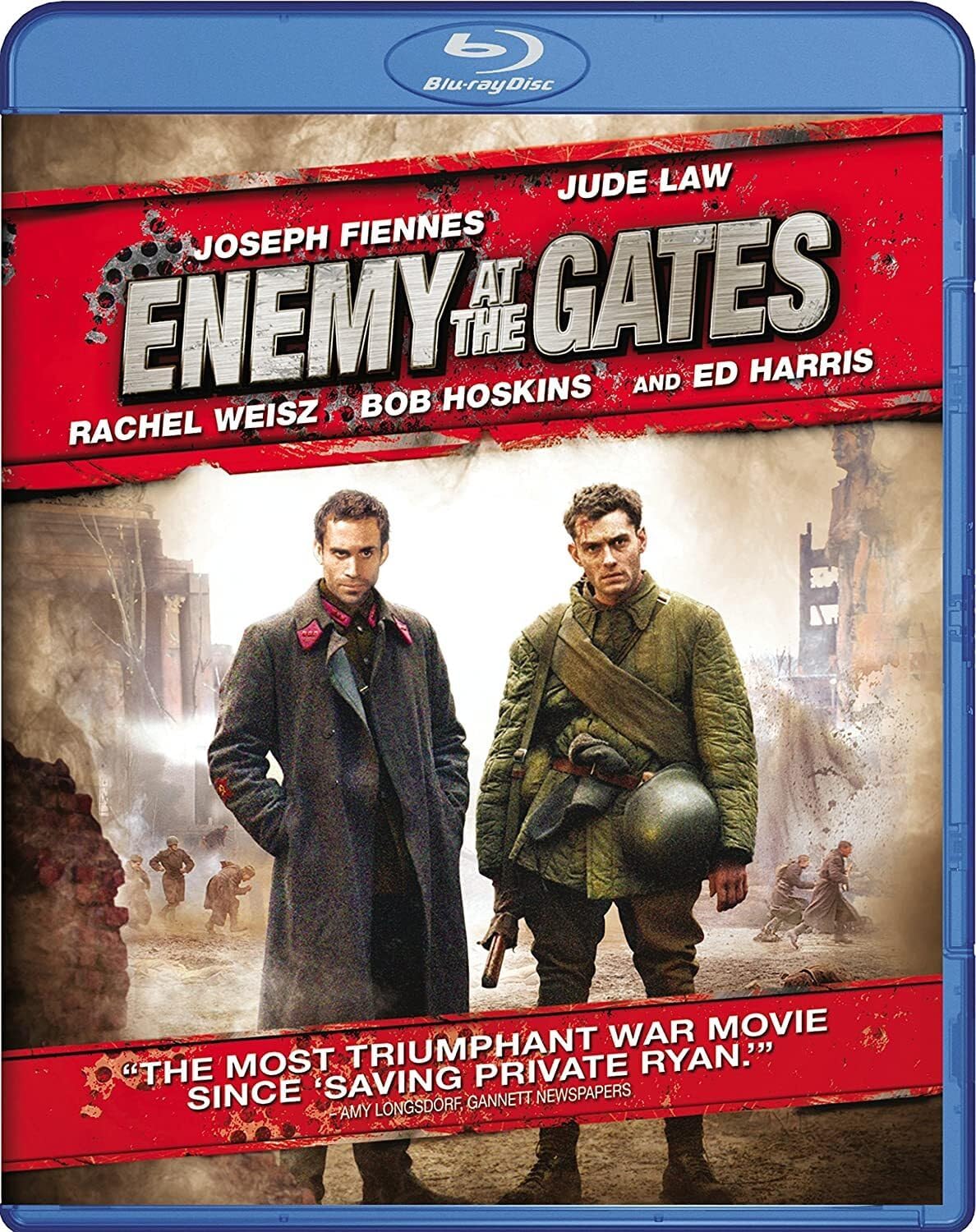
Enemy At The Gates - September 1942. The German Army has advanced to the gates of Stalingrad. The Russian Army holds on desperately. It is so poorly equipped that every pair of soldiers is given a single rifle-the second man only gets the weapon when the first is cut down. Trapped in no man's land between the opposing armies, Russian recruit Vassili Zaitsev (Jude Law) finally acquires a rifle from Political Officer Danilov (Joseph Fiennes). Danilov is astonished when Zaitsev picks off several German officers. On their return to the Russian lines, Danilov writes about Zaitsev's exploits in the army newspaper. Zaitsev is assigned to a sniper unit. He kills more German officers and, thanks to Danilov, becomes a hero. In retaliation, the Germans bring in sharpshooter Major König (Ed Harris) from Berlin-to hunt Zaitsev. The two snipers engage in a desperate duel, as the appalling Battle of Stalingrad rages. In ENEMY AT THE GATES, director Jean-Jacques Annaud uses a palate of dull greens, blues, and greys to tell the powerful, true story of Russian sniper Vassili Zaitsev. The film is distinguished by fine performances from Law, Fiennes, Rachel Weisz as a female soldier, and Bob Hoskins as Nikita Khrushchev-with Harris particularly notable as the chilly, aristocratic König. Review: Great - Excellent movie. I highly recommend it Review: Great movie, a must have for any movie collection! - I can't believe how long I've gone without owning this movie. I've seen it at least 5 times and it still holds up great! Blu-ray looks amazing, Jude Law and Ed Helms pack a mean punch in this war-torn sniper-battle story! I love it!


| Contributor | Bob Hoskins, Ed Harris, Eva Mattes, Gabriel Marshall-Thompson, Jean-Jacques Annaud, Joseph Fiennes, Jude Law, Matthais Habich, Mikhail Matveev, Rachel Weisz, Ron Perlman, Sophie Rois Contributor Bob Hoskins, Ed Harris, Eva Mattes, Gabriel Marshall-Thompson, Jean-Jacques Annaud, Joseph Fiennes, Jude Law, Matthais Habich, Mikhail Matveev, Rachel Weisz, Ron Perlman, Sophie Rois See more |
| Customer Reviews | 4.7 out of 5 stars 2,806 Reviews |
| Format | Subtitled |
| Genre | Military & War/World War II |
| Language | English |
| Runtime | 2 hours and 10 minutes |
J**E
Great
Excellent movie. I highly recommend it
N**N
Great movie, a must have for any movie collection!
I can't believe how long I've gone without owning this movie. I've seen it at least 5 times and it still holds up great! Blu-ray looks amazing, Jude Law and Ed Helms pack a mean punch in this war-torn sniper-battle story! I love it!
J**R
Dvd
I thought this was another good movie
A**O
Unconvincing Romance Substract from an Otherwise Good Movie
I rate this movie overall as a four star (out of five). I will divide it in terms of: Historical Accuracy: Yes Vasily Zaitzev fought in Stalingrad and earned the tittle of Hero of the Soviet Union. Its true he was extensively used in propaganda efforts by the Red Army in trying to keep the moral of its troops high while still being on the loosing side of the war. The careless disregard for human lifes and the lack of war materiel was true on part of the Red Army, the use of terror and the fratricidal killing by the political troops of the NKVD and the political commissars was also true. The importance attached to Zaitzev by the German High Command was grossly overated, the sharpshooters as a whole were seen as a grave danger but bringing a full Prussian Colonel to deal with just a Russian soldier will not be in line with the usual behavior of the Wehrmacht. The film gives too much importance to Nikita Khruschev and any credit at all to General Chuikov, who kept the defenses of Stalingrad going against all odds. Although the premise of the story is basically true some details are way off so I will give 3 stars in terms of accuracy. Entertainment.- Very entertaining, very good scenes specially the crossing of the Volga while being attacked by Stukas and the Red Square battle. Sniping is mostly a game of stealth and patiente and certainly is not a matter of great spectacle but the movie kept this very light and did not make it boring. In this category the movie certainly rates a high 4 stars. The Romance.- I didn't see the point of Rachel Weisz's character, too untrue, too volatile. Very convenient that she was listening to the radio when news of the assasination of her parents by a german death squad came, this is the sole premise for her getting in harms way to try to acheive vengeance by becoming a sniper and landing in the process in the arms of Jude Law (sorry Zaitzev). The romantic triangle was also unnecesary and Danillof (Joseph Fiennes) should have been played as a manipulating Commissar rather than a basically good man lead astray by jealousy. As I undestand one of the requisites to be a Political Commisar was devoting your actions to the cause while leaving personal feelings or symphaties out of the way. Since the romance and the amorous triangle was hokey and unnecessary I will give this part a One-star. The Scope.- Stalingrad was basically the bloodiest and greatest battle fought until that moment, one can even argue it is the biggest battle ever fought, I believe the scope of the movie was not appropriate to showcase the battle, in fact you never learn something about the battle in itself, why the Russians in the end win, the treatment of the battle is mostly referential and tangential. the snipers were one of the causes for the german defeat but not the main reason. The encircling operation of Stalingrad is much more important as the city was left isolated when the Rumanian, Italian and Hungarian armies that were left in the left and right flank of the city defenses collapsed against the Soviet attack allowing the German Sixth Army to be encircled and the starved it to submission in the bleakest part of the winter 42-43. There is never a reference to this, about the starvation of the german army, and we don't have a feeling for the battle with its artillery duels and the house to house fighting. In this respect the movie does not pay justice to the subject and I will leave this as three stars. The sets.- very well done, the sets look real, I have seen pictures of red square and the red October factory and the sets used are very accurate. The Volga I believe is a much more impressive river than what is shown to us (I believe the movie was shot in Germany and maybe the river portrayed is the Rhine. The ambientation, the uniforms, the equipment shown is very realistic (mark III panzer tanks, spandau machine guns, SKDf half tracks, etc.) in this respect I will give the production a five star. The Music.- repetitive, needs more grandeur to accomodate the subject, I was not impressed by the soundtrack. Why not use Soviet and German patriotic music that has the grandeur and probably give the movie more realism. Three star. Overall a good movie, not the best on the subject and the Stalingrad Battle still has not been portrayed as justly deserved
K**N
Bob Nikitavitch
If anyone ever does a picture about Khruschev, Bob Hoskins must play the lead role. And it wouldn't be typecasting either, because he only shows up for a total of, say, ten minutes in this film as Khruschev in his Stalingrad position as the senior Political Comissar. (What, you ask, is a Political Commissar? Read on.)This was a much sweeter assignment,apparently, for Nikita Sergeievich than his previous one, which was to surrender Kiev. But back to Mr. Hoskins. This, my friends, is acting. Never mind the make up job that turns the star of Who Framed Roger Rabbit, Mona Lisa, and the Cotton Club into the star of the Cuban Missile Crisis and The Secret Meeting About Stalin. Never mind the set-up by excited crowds whispering about "Stalin's envoy" (didn't they know he'd surrendered Kiev?). In one sweeping scene, Hoskins manages to convey Khruschevian brutality (throwing a pistol at his predecessor with a gruff, "You might want to avoid the red tape"), fearmongering contempuousness as he slowly inspects the political officers, and his propensity for odd witticisms: "I want our boys to stop [expletive connotating defecation] their pants." "This isn't Leningrad. It isn't Moscow. This is Stalingrad. This city bears the name of [leans into trembling officers face ominously] the boss." Does he raise his voice? No, he doesn't have to. Then we see him shift, chameleon like, in response to a suggestion an officer Danilov gives when Khruschev demands one. "Hope. They need hope." When Danilov tells Khruschev that yes, he knows a hero who can provide such hope, a sharpshooter who was able to kill five Germans one right after the other in order to save the officer and himself, a smile literally creeps across the senior officer's face. It's clear he's decided this is information he can use. Brilliant performance. Five minutes to show emotions and characteristics that run the gamut with a character who's been diagnosed posthumously as being something less than mentally balanced. Mr. Hoskins, I salute you! Jude Law does well too, although he's a young'n here with room to grow. "Enemy At the Gates" tells us,on one level, about one of the most brutal battles of The Great Patriotic War. But the main character in this story isn't the people of Stalingrad or the Soviet army, it's a rifleman named Vassili Zaitzev (a real guy, apparently, who has his own monument someplace) who is touted as an expert marksman after killing the five Germans Danilev mentioned above. The information about this, as a result of the Commissar's little machine, gets out all over the USSR, and before you can say "Nastrovye!", Vassili is like a Soviet Frank Sinatra, getting fan male from Minsk to Pinsk. No dummy, Vassili realizes quickly he's being used, and protests. To no avail, however. Khruschev and Danilov are not above putting the child of a friend in mortal danger to continue the sniper exploits and the positive press they bring. So, apparently, this is what Political Comissars do: they run around creating and putting out propoganda about the great work other people are doing while these other people actually do the work, perhaps even risking their lives.(The scary thing is, given Stalingrad's remarkable victory, its Comissars' propoganda may have actually done some good.) Danilov et al, in the film, continue to use Vassili as agitprop to spruce up morale among soldiers and citizens alike. In an art-meets-reality spin, Annaud himself creats a final duel between Zaitzev and his German counterpart in the film that never occurred. Annaud's theme of someone just trying to do their job, only to have someone else exploit it for the good of "the collective", with sometimes tragic results, could be reflective of a minor scale of a certain seventy year experiment with a nation full of workers. Or, arguably, of the perceived need in any conflict for the folks on the home front to believe their boys are doing well. And historically inaccurate though it may be, the sniper duel scene pretty much rocks the free world. Or the Communist world. Whatever.
R**N
Great film
Gritty and realistic, Ed Harris is fantastic as Major Konig. Movie should have been bigger, probably to realistic for some.
C**E
Enemy At The Gates
A must see movie about to snipers on the hunt for one another.
K**N
NOT JUST ANOTHER WORLD WAR II FILM
I really thought the cast and crew did a wonderful job in making this film. The opening scenes are enough to make you aware of how really bad the situation was in the Soviet Union shortly after the German invasion. did the film makers exaggerate? I think not as much as the traditional writeup would lead us to believe. I thought Bob Hoskins playing Khruchov conveyed a harshness in dealing with army officers and the situation as a whole that seemed very Russian (and Ukrainian) to me. In writing the characters of Zaitsev, the university trained local girl and the political worker the film makers cought much of what I would consider legitimate character types of that era. Ron Pearlman is great and what he has to say about Soviet-German relations before the outbreak of war is worth listening to.Stalin virtually destroyed the Soviet military during the 30s. Some viewers did not like the romance as part of tthe movie. Conducting a major battle in an urban area means interaction between military and civilian personnel. So the local little boy played a very dangerous game going between Soviet and German units, so young men and women will snatch bits of time for love and sex. You will find romance in the best of Soviet war related fiction. This whole film reminds me so much of Konstantine Siminov's Dni i Nochi or though it deals with the Civil War, M. Sholokhov's Tixii Don. I spent years of my academic career reading Soviet literature, many trips there including Volgagrad. I spent hours in the historical museum, probably saw Zaitsev's gun. For a 67 year old lady I really thought they cought many of the key points on the event.
Trustpilot
3 weeks ago
3 weeks ago