Desert Online General Trading LLC
Dubai, United Arab Emirates
Desert Online General Trading LLC
Dubai, United Arab Emirates

Full description not available


B**H
Great read. Full of stories!
Great book! I have read the Patton book by Liddell Hart and this one is wonderful.
E**E
Brilliant book
Work well as advertised
D**D
a must read for military strategists and politicans
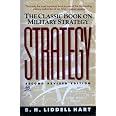
Never give a sucker an even break. Why attack the enemy head-on and try and force your way towards an objective that will become so obvious that it will draw across all the enemies reserves to further block your way? Why not confuse, demoralise and set the enemy up for easy defeat by taking unpredictable indirect approaches?This timeless classic is in two parts.The first part is analysis of over 200 military battles across all ages of history to show that head on military attacks rarely succeed. I found that to cover all these battles, the analysis was so limited and brief, and maps often lacking detail, that much of it didnt mean anything. Luckily I had read about many of these battles previously and could follow on, but I reckon this section could bore and lose many people.The second part is the great bit that makes this book a classic that should be read all high level military and defence politicians - luckily for them its also the shorter bit! It looks at the definitions of peace and strategy and concludes that the aim of war is 'to provide a better peace'. How many times has a winning side suffered so badly that it was worse off also in absolute terms than before the war? Often there are better ways to build a constructive long term peace (for everyone) if war was not simply seen as a race to crush your opponent in a climatic battle. Taking the 'indirect approach' can not only allow that better peace but by avoiding the bloody battles it saves lives on both sides - a surprisingly humane touch for such the cold subject of military strategy. His analysis of the overbearing effect of Clausewitz on modern strategy in seeking the climatic battle was thought provoking.A good read for strategic thinkers and wargammers - if you get stuck on the first part of the book, then read the second bit on theory of strategy. You can then use the index to chase up the pages of the various battles he uses in support of his arguments, if you want that extra historical detailregards and happy readingdavid
C**L
Excellent book
Interesting point of view on military theory
R**N
Very good book on the history of war
I want to start by saying that I recommend this book to people that like to read about military history and strategy; however, I am not that high on this book as other reviewers."Strategy" was written with the purpose to prove one thing: battles and wars are normally won by unbalancing the enemy at all the levels, a strategy the author coins as the "Indirect Approach", not by attacking him directly. The book has two sections, one which narrates the history of warfare from the Persian Wars all the way to the Arab-Israeli War of 1948. The second section postulates the principles of Indirect Approach and "revisions" on Von Clausewitz's postulates.That said, unlike other reviewers, I believe that there are two landmark books on War better than this one, Sun Tzu's "The Art of War" and Von Clausewitz's "On War". While Liddell Hart had the benefit of living on the time when Von Clausewitz's war "premises" were revised after the massacres of WWI, and Liddell Hart is one of the grandfathers of modern tank warfare, I think his concept of "Indirect Approach" is a modernization of Sun Tzu's principles on deception in warfare. That is why I think this book does not have the theoretical value other reviewers want to give.As for his historical evidence about the application of the "Indirect Approach", I think many accounts are based on biased reports that don't truly tell us the complete picture (for more on this, I recommend Hans Delbruck's History of Warfare series, which is the best I've read). If this is correct it would undermine the supposedly "overwhelming" evidence of his theory. I would add, however, that his description of WWII is extraordinary and I consider it the best analysis on the overall conflict I've ever read.Overall, I think two thing makes the book worthy. First, the Indirect Approach has the spirit of Sun Tzu in it. The way this concept clarify's some of the old precepts on the chinese manual about war is extraordinary. Besides, it completely modernizes the spirit of the "Art of War" and proves there are many ways to outclass an enemy and force him to make a mistake in modern times. It also presents a great principle on winning the Grand Strategy, in the realm of politics, before even considering victory at the Strategic and Tactical levels. I would recommend the book because of this and because of the great description on WWII.
S**A
You must absolutely master the lessons of this book
Colonel Hart does a Great Job of weaving history into the three levels of warfare strategy.He also points out how unwise it is to always directly attack an adversary.He reviews the History and Tactics of the Greek and Roman Wars.The strategies of WW1, WW2 and later wars.He peels the Strategy of the rise and fall of the Germany Army using the Blitzkrieg.This book should be slowly read with Pen and highlighter.He shows you that Strategy, Grand Strategy, and revolutionary tactics ,are an ART and not a how-to instruction bookletOne of the best books on Warfare and Strategy I have ever read.I am a USAF Lt Col Ret
R**G
Forget Lao Tse; this guy has the straight skinny
Full of practical advice, and far more useful that Lao Tse, who is so commonly cited.Liddel Hart gives practical illustrations and examples of his theories in action, and I found them far more applicable in the real world.
G**K
Three Stars
Important for those interested in the theory of strategy
Trustpilot
2 weeks ago
2 weeks ago
2 weeks ago
1 week ago