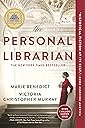

📖 Get lost in a story that’s more than just a book!
The Personal Librarian is a captivating novel selected by GMA Book Club, featuring over 300 pages of rich storytelling and unforgettable characters that resonate with the millennial experience.


| Best Sellers Rank | #2,161 in Books ( See Top 100 in Books ) #3 in Biographical Historical Fiction #5 in Biographical & Autofiction #7 in Black & African American Women's Fiction (Books) |
| Customer Reviews | 4.5 4.5 out of 5 stars (49,794) |
| Dimensions | 5.42 x 0.81 x 8.2 inches |
| Edition | Reprint |
| ISBN-10 | 0593101545 |
| ISBN-13 | 978-0593101544 |
| Item Weight | 10 ounces |
| Language | English |
| Print length | 368 pages |
| Publication date | June 7, 2022 |
| Publisher | Berkley |
B**L
A Captivating & Superb Read!
The Personal Librarian is one of my most favorite books of 2025! I had no idea what was awaiting me in the pages of this book about Belle da Costa Greene and her amazing life. The Personal Librarian is a rich, multi-layered treat filled with history, love, tension, family relationships and so much more. Not only did I read it, but I listened to it as well. And the voice actress, Robin Miles, who voiced Belle was simply stunning. I highly, highly recommend The Personal Librarian. I hope you love it as much as I did! 🙂
R**S
Remarkable Woman!
I thoroughly enjoyed reading and learning about Belle da Costa Greene! I never heard of this strong, remarkable and accomplished woman until reading "The Personal Librarian" and for that I really appreciate the efforts made creating this book. I am also inspired to go visit “The Morgan Library & Museum” in New York City. Ms. Greene's confidence, conviction and determination are truly inspiring, and in a time period where women's right were just taking shape and white supremacy was taking over Reconstruction. I rated 4 stars because I thought the most intimate fictional details in the story were not necessary to capture the full essence of a woman who was determined to keep her personal identity and life private.
C**K
An unexpected level of historical accuracy for a novel.
The Personal Librarian is a fictional account of the life of Belle da Costa Greene, who managed the acquisition and collection of books and art for J. P. Morgan - his personal librarian, as it were, continuing with his son until her death in 1950, of cancer. During her life, she was most notable for aggressive style in the acquisition of books and art for Morgan, at a time when doing this as a woman was considered highly unusual. But there was another aspect of her life that only came out 49 years later, when a photographer noted that she had spent her entire life passing for white, while in fact, her father was the first black Harvard graduate, and a leader in the civil rights movement, which had regressed profoundly after the civil war, thanks to The Great Compromise of 1877, which led to Jim Crow. Marie Benedict, upon realizing the implications of this, enlisted a co author for the book, Victoria Christopher Murray, to try and concoct a fictional account of Belle da Costa Greene life, with some level of plausibility. I would say they succeeded admirably, even though of course we will never really know what her thoughts were at the time. I will say, much to my surprise, all the basic plot lines are tied nicely to historical facts. In fact, as historical fiction goes, Greene's thoughts notwithstanding, this book seems to have a historical accuracy that I have not experienced in many decades. What an amazing individual.
Z**T
Who Built J.P. Morgan’s Wealth?
And at what price did she build it? By choosing to heed her mother’s advice, Belle chose to risk identifying as being a white woman in public, during post the Reconstruction era. To any non-black person, Belle’s light skin, anglicized name, and her love of art history played into the elite white psyche. They blindly decided that she is one of their own. During the time capture in this novel (1905 to 1924), and after the Dyer Bill was filibustered in 1877, blacks who tried to have agency were deemed disrespectful, out of their place and only worthy of being lynched. In particular, the filibuster argument was that they needed to be able to lynch the freed blacks to protect their white women from being raped. So, when Belle’s mother insisted that they all change their name, and identify in every way to the public as having a Portuguese heritage, Belle’s fate was chosen for her. And because a daughter’s first mirror is her mother, Belle studied who she needed to be, how she needed to maintain decorum, and how to talk in a way that black women weren’t and aren’t free to talk amongst wealthy businessmen. She studied how to be coquettish, how to think on her feet, and to deflect whenever necessary. Each successful business transaction and interaction became a cause set in motion towards her simultaneously being more visible to society and more at risk for getting caught. The price of which would impact not only her livelihood, but also that of her mother and siblings. It was interesting to “watch” the struggles that she went through over her question of whether she should have followed her mother’s path, or that of her father, which was the antithesis of her mother’s focus. Her father fought for civil rights, because he believed that some day black folks would be judge by their character. Yet, her mom, based upon witnessing every day blacks being lynched to death for their desire to be integrated socially, politically and economically, in her mind, it was only possible to be successful and free if their entire family takes advantage of looking white by choosing to be white. While reading this book, at first, I wanted to side with Belle’s dad, because to me, owning your voice, being your authentic self gives you peace of mind. Identifying as someone who you are not has always meant to me as lying to myself and destroying the chance of align your personality with your soul. I also saw the pressure Belle lived with when her father left the family because he could no longer live in the dichotomy of “Choose to be white to be successful”, or “Choose to be black to own our right to matter” that existed. Of course, my mindset was based upon living in a freeing society that 1877 to 1924 did not know. Also, we have the benefit born out of the Belle’s in our history, to speak up and be heard. Yet, one hundred years later, June 2024, black women, or any person of color, much modulate their approach to success according to societal unspoken rules. Yes. Belle built the J.P. Morgan wealth by choosing to be white, at the price of her own peace of mind. As a white woman, she could name a price of art, negotiate with old cronies, and close the deal as if she just bent her arm. That wouldn’t have happened had she identified as a black woman, back then. The wealth that she amassed for the Piermont Librarian counted upon her ability to not only study art, network with the best in the business, but also study what it meant to be an influential white woman. If she was going to have to abandon her ethnicity for the sake of her immediate family, she was going have to perpetually study being who she needed to be, and who, as a white woman, she would have licensed to be. She wasn’t free to look a black servant in the eye, for fear that they would report her to the public as being one of them. The only way she saw her biological family was through carefully planned trips that were out of the view of the socially elite. Ultimately, she mastered the public persona, though she struggled with the lie she had to continually nourish and preserve. Like “The First Ladies”, this was an excellently written book that truly helped me to be part of U.S. History. One hilarious moment that reading this book in public was: after waiting a bit for my banker to be available, seeing me reading this book in my hand, she asked, “What are you reading?” My enthusiastic response was, “Oh this is a great historical novel about how a black woman 100 years ago made J.P. Morgan’s wealth.” The look on her face was priceless.
R**N
Loved this book, inspirational and full of interesting facts! In some ways we have come so far but some of the same issues are still present today.
M**S
Great story. Made better as it's true.
E**Y
Excellently written book revealing the racial tension in the early 19th century in the USA and life of talented, ambitious, and smart librarian and art collector. An easy read that allows you to learn about history and art.
B**R
Muy bien escrito. Muy interesante, mantiene tu interés. No sabía la importancia que tuvo esta mujer.
C**N
Excellent historical fiction here highlights so many important issues… It explores the art world, women's rights and racism all in elegantly packaged novel that is difficult to put down. Telling the story of Belle da Costa Green's career as JP Morgan's personal librarian, it really brings you back to NYC in the early 20th century. Robert my eyes not only to this impressive historical figure but of the challenges of being a black woman in the early 1900s.
Trustpilot
2 weeks ago
1 week ago