
DOWNLOAD THE APP


Customer Services
Copyright © 2025 Desertcart Holdings Limited
DOWNLOAD THE APP
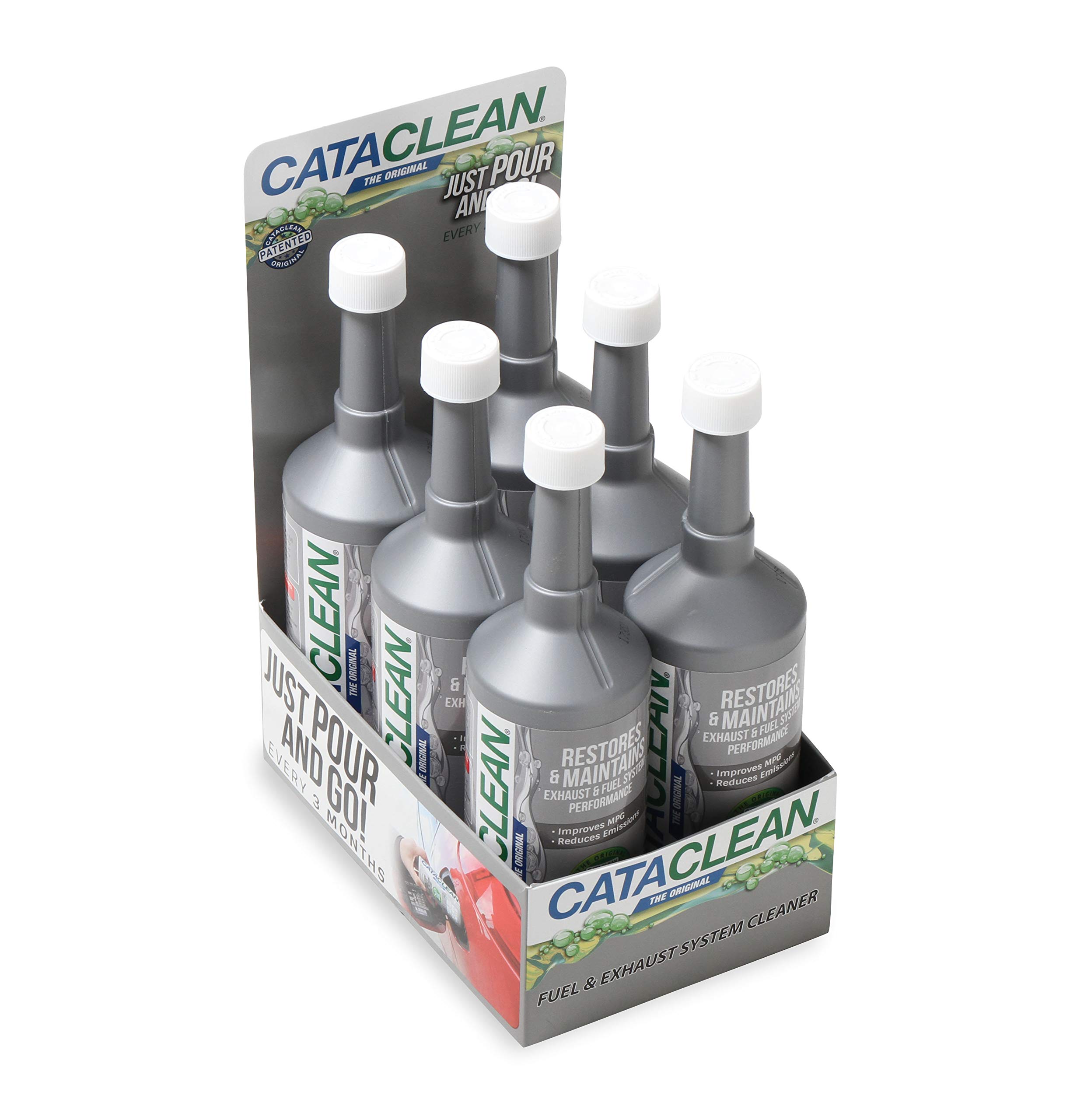


🚗 Clean fuel, clear lights, and greener drives—don’t get left behind!
Cataclean Fuel & Exhaust System Cleaner is a powerful 16oz additive designed to reduce carbon buildup, improve fuel economy, and clear common check engine codes. Proven to cut hydrocarbon emissions by up to 50%, it restores catalytic converters, DPF filters, and oxygen sensors, helping vehicles pass emissions tests across all 50 states. Easy to use and compatible with gasoline, diesel, and hybrid engines, Cataclean is a must-have for proactive vehicle maintenance and long-term engine health.


| ASIN | B07B2X34WM |
| Best Sellers Rank | #315 in Automotive ( See Top 100 in Automotive ) #3 in Fuel System Cleaners |
| Brand | Cataclean |
| Brand Name | Cataclean |
| Contains Liquid Contents | Yes |
| Contains Liquid Contents? | Yes |
| Customer Reviews | 4.2 out of 5 stars 14,999 Reviews |
| Global Trade Identification Number | 00090127028094 |
| Included Components | Cataclean - 16Oz. Fuel/Exhaust Sys Clnr (120007-6) |
| Item Type Name | Cataclean - 16Oz. Fuel/Exhaust Sys Clnr (120007-6) |
| Item Weight | 6.1 Pounds |
| Manufacturer | Cataclean |
| Number of Items | 1 |
| UPC | 090127028094 |
| Unit Count | 1.0 Count |
| Warranty Description | Manufacturer Warranty |
K**H
This WORKS! Car ran sooo good after!
This WORKS! Car ran sooo good after! I used this product during a fill-up and it was simple to add no mess and no fuss. After a tank or two, I noticed smoother idling and emissions seemed cleaner. Cleanliness: Helped clear some buildup and soot over a few uses with speed. Leakage: No leaks during application pours cleanly. Durability: N/A (single-use additive) but bottle held up well. Product quality: Feels like a solid formula nothing spilled or stained. Longevity: Results seem to last a couple of tanks after use.
E**H
Worked as advertised, took two bottles.
I used this on a Porsche Boxster with 55,000 miles. Got a “check engine” light, and the code was for the catalytic converter. Figured I had nothing to lose. Followed the directions to add to 1/4 tank of fuel, and the the code did not clear. Figured I would try another bottle. The code then cleared in about 10 miles. This was all over 1000 miles ago, the check engine light has come back on and there are no pending codes. I am sure this stuff won’t fix every catalytic unit. In Given the cost of a new catalytic unit, this is a bet worth taking.
L**S
Worked, but has issues.
Here's the quick summary: Yes I used this and yes my car passed smog test.... but I would try lots of other things before using Cataclean again. My vehicle is a 2004 Toyota Sienna with 137,000 miles. Check engine light (CEL) has been on for two years now. The CEL is on due to the following codes P0420 - Cat Bank 1, P0430 - Cat Bank 2 , P2238 - AF Sensor Circuit. This year we got the registration renewal and were required to get a smog certificate. Since you can't pass smog test with CEL on, we took the van to the dealer to see about getting it the CEL fixed. The dealer recommended replacing both catalytic converters the A/F sensor and calibrate ECM. All for a cost of over $2,800. So instead of spending the $2,800 I figured it was worth it to give Cataclean a try. I followed the directions and added the entire contents to about 1/4 tank of gas. Then immediately drove the van until it was empty. The van was not completely empty, but the yellow fuel warning light did come on and the gauge was on E. At this point I filled up the tank with premium gasoline. After filling it I immediately drove the van for about 40 miles. I was expecting the CEL to turn off but it did not. At this point my story gets less normal than most I suppose. My wife drives this van most times and I have another car. It just so happened that my wife was sick with a bad case of the flu and she did not drive the Sienna for more than 1 week. So the Sienna sat with nearly a full tank of fuel and whatever was left of the Cataclean for 1 week. After 1 week of sitting in the garage, I decided it was time to try to drive the van and see if the CEL would turn off. This is where it gets very weird and discouraging and expensive. I pulled out of the garage and the van barely ran at all. It felt like only half of the engine was running. The engine had very little power and to make matters worse the CEL was now flashing ON and OFF. I pulled over and did some quick research on my phone and found out that a flashing CEL is bad news. I spent the next 4 hours "babying" my car. I would drive it for a little bit and the CEL would flash. So I would pull over and let it idle next to the curb. When the engine was simply idling the CEL would not flash. I did this for hours and hours and the CEL flashing got less and less prevalent. Finally the CEL stopped flashing after about 4 hours of driving and idling. If this does happen to you, you need to be very careful. Driving with a flashing CEL could lead to really expensive damage and even your car catching on fire. After that long evening of babying my car, the CEL never flashed again. But the car did not run correctly after that either. The car was rough at idle and vibrated a lot while it ran. And now, my car had a new code P0354. I took it to a mechanic and he replaced the #6 ignition coil and spark plug and cleaned the fuel injection system. This made the car run smooth and cleared the P0354 code. Replacing the ignition coil spark plug and cleaning the fuel injection system cost $510. I had a lot of expensive problems after I put in the Cataclean (see above). These problems could have been a coincidence and I could have had those problems without the Cataclean. After all, it's an old vehicle with lots of problems. Anything is possible. But I don't think I will be using Cataclean again. I cleared all codes and tried to run the monitors. For those of you not familiar, there are "monitors" which run in software on your vehicle. These monitors must be run and passed with no codes before you can have your car smogged. If the monitors generate codes, then the CEL turns ON. If you clear the codes, your CEL does go off, but your monitors are now "imcomplete" in your cars OBD memory. You cannot pass smog with incomplete monitors (actually the number of incomplete monitors allowed to pass smog varies from state to state so check with your motor vehicle department). You can find the rules for California here: [...] So now my car runs smoothly, the Cataclean has run through the emission system and the CEL is off. I have two incomplete monitors. One of the incomplete monitors is the Catalytic Converter monitor. So I then drive the van around town running some errands. Mostly stop and go, but some highway driving. After about 50 miles the CEL turns ON and generates code P0420... very discouraging. But I did not give up. I cleared the P0420 code and decided to try nothing but highway driving at moderate speed. Just a hunch I guess. So I got on the freeway and drove. Entirely freeway driving at very moderate speed. I got in the slow lane with the trucks and probably averaged 55 MPH and for it's worth I turned my Air Conditioning off. I did this for about 75 miles. I kept checking the scanner to see if the monitor for the Catalytic Converter had run, but it said incomplete. I must have checked the scanner 30 times to see if the monitor had run. Then it happened, the Catalytic Converter monitor ran and the status went to OK with no code. As soon as the monitor ran with no code I found the first smog station I could find and got a smog certificate. YEAH!!!! In order to do all of this I needed an OBDII scanner with me in the car to check monitors, read codes and clear codes. I used a very inexpensive OBDII scanner that I bought at Wal-Mart for $21. I think some of the inexpensive models offered on Amazon would work as well. You don't need an expensive scanner to do this. The main thing for checking monitors is a feature called "I/M Readiness Status"-- make sure your scanner can do this function. So did the Cataclean help pass smog? Did Cataclean cause the damage to the ignition coil? Did not driving it for a week in the middle of this process cause a problem? .... I don't know. If I were to ever need to use Cataclean again, I would drive the vehicle... a lot and try to get it through the system as quickly as I could. Hopefully, I won't need to use it again.
M**T
Wow, it worked
So I had a P0430 check engine light code trigger on a G63 AMG Mercedes. The P0430 code means that the catalytic converter on Bank 2 of your engine is not operating efficiently, which leads to an increase in harmful emissions. This code is triggered when the vehicle's computer detects that the catalytic converter is below the required efficiency threshold, often indicated by a check engine light. Common causes include a faulty catalytic converter, but issues with oxygen sensors, exhaust leaks, or engine problems like misfires can also cause this code. I used this product exactly as directed in combination with Rayhong boost up catalytic cleaner also on Amazon with super unleaded refill and after about 50 or so miles. Chrck engine light went away. Hopefully will last, I will update if not. So far, very happy!
S**O
Effective Solution for Enhancing Vehicle Performance and Emissions Compliance
I recently utilized the Cataclean Fuel & Exhaust System Cleaner, and it has demonstrated exceptional efficacy in addressing several automotive maintenance concerns. This 16-ounce liquid formulation, produced by Mr. Gasket Co., is designed to reduce carbon accumulation in critical components such as catalytic converters, oxygen sensors, fuel injectors, and cylinder heads. Following a single application, I observed a noticeable improvement in engine drivability, including smoother idling, reduced hesitation, and enhanced fuel efficiency, which aligns with the product's claims of potential hydrocarbon emission reductions by up to 50 percent. The product's compatibility with gasoline, diesel, hybrid, and flex-fuel vehicles, without altering fuel composition, ensures broad applicability across various engine types. Its patented, EPA-approved composition is non-toxic and unscented, facilitating straightforward usage—simply pour into the fuel tank every three months for optimal results. Notably, it assisted in clearing a persistent check engine light and supported successful emissions testing, thereby extending the operational lifespan of exhaust system elements like DPF filters. In terms of construction, the durable COEX-HDPE bottle with a long-nose design accommodates capless gas tanks efficiently, enhancing user convenience. Overall, this cleaner represents a reliable, cost-effective investment for maintaining vehicle performance and regulatory compliance. I recommend it to automotive professionals and enthusiasts seeking a proven method to restore and preserve engine integrity.
M**.
PLEASE Do Not Risk It! Read My Story!
I'll try to make this brief. I used Cataclean once about a year ago on recommendation from a mechanic and various online sources as a stop-gap measure to keep the engine light off for enough miles to pass inspection with a P420 catalytic converter code. This also required turning off the light with an OBD scanner first, adding the Cataclean, then driving over 100 miles and resetting the I/Ms. It was successful, but I can't say if the product helped keep the CEL off or if it just happened to work out. After inspection, the CEL returned at 280 miles, which it always will, this is not a permanent fix, please understand that. Now comes the very, very bad part. This year, each time I turned off the CEL to see how long it would remain off before inspection, it came back on well before 50 miles. So I know my catalytic converter is getting worse, no way to make it one more year, it would have to be replaced. But I thought I'll give Cataclean one more try and maybe it will help keep the CEL off a bit longer before I commit to $2,000+. Cleared the code last night. Added the Cataclean, precisely as directed, 1/4 tank, etc. Started driving. Within ONE mile, massive misfires, chugging, struggling, no pickup, CEL FLASHING. I had entered a highway on ramp when it hit, managed to get up to speed at least, then exited immediately. Vehicle shaking and sputtering at stops, I put it into neutral and gave it some gas so it wouldn't stall. Drove to the nearest gas station and filled the tank to at least dilute this garbage, the best option at the time. I ran my OBD scan at the gas station, P0300 random misfires code, all cylinders reporting misfires. Cleared the code so I could see how fast it would return. I drove only around my neighborhood so I wouldn't be far from home if catastrophe struck. The CEL of course came on again in a few miles but the jerking, stuttering, shaking and struggling were greatly diminished now because I diluted the additive with premium. The problem remains, however. When the CEL came on again, at the very least it was steady and not flashing, certainly because of my quick thinking to dilute it. Now I'm in the unenviable position of HOPING it's JUST the catalytic converter that got badly clogged from the release of filth or whatever the product released into the system in the single mile I drove it after adding it to the tank. Did the research online. It could be a lot of system components affected in addition to the already weak cat. Look it up yourselves, PLEASE! This can foul your spark plugs, fuel injectors, O2 sensors. It can severely damage your cat when you have misfires, causing it to overheat and break apart. There are tons of articles about all the possible side effects of using this. I never came across them when I researched it the first time because I didn't specifically search for these side effects. All I saw were opinions that maybe it will work out, maybe it won't, but that it was safe. THIS IS NOT A SAFE PRODUCT! Look, maybe it's OK for some people - it doesn't work at all for others. A very mildly dirty cat might be cleaned enough to get through an inspection and turn off the CEL for a while longer than normal but - wow. Did I ever make a huge error using this again. Yes, nothing happened the first time I tried it. You might get lucky. You also might release so much gunk into your engine and exhaust that you destroy your vehicle to the tune of THOUSANDS. Do the research. Be smart. I poured this junk into my tank without a care in the world, thinking it would either help keep the CEL off or not and that would be it, never suspecting massive misfires and a flashing CEL. It's a holiday weekend now and I can't get to a garage until Monday. I will update this review when I learn the extent of the damage and I'm hoping it's only 2K for cat replacement. Imagine that. Think long and hard about trying this. I hope I can save some of you from the scary situation of being on the highway and misfiring and struggling to get up to cruising speed and a nerve-wracking drive back home or having to call for a tow. Consider this a public service. Get online, find out everything about this and other additives before using them!
B**N
Hit and miss
Have used a bunch of this stuff. Sometimes it works great, others doesn't do anything.
Z**.
Spending $16-20 on the Cataclean before you touch the expensive oxygen sensors or catalytic convertors could be a good investmen
This is my story. My Honda Odyssey EX-L 2005 (85K miles, first owner, bought new, all regular maintenance) all of sudden had a CEL light on 11/22/2016. It threw a code of P0420 pointing at catalyst system efficiency below threshold (bank 1). Based on my research, there are too many things that can cause this code. However, if it comes to the catalytic convertor or oxygen sensor replacement, the expense could be too high. So, I decided to take care of it myself before I go to Honda dealer or other mechanics. I first changed the engine oil at Walmart, just regular Quake 5w20 oil. Besides, I asked the technician at Walmart to add a bottle of Lucas (heavy duty Oil stabilizer, white bottle) as well because the engine seems to burn a bit oil over time. I also filled the gas tank up (regular 87 gas) and added a bottle of Heet (red bottle, Heet Fuel Line Antifreeze, Water Remover and Fuel Injector Cleaner) into the gas tank to remove water and hopefully to clean the fuel injector. Then I cleared the code myself and started driving the vehicle locally. After driving about 135 miles, the engine light was on again and had the same single P0420 code. At the time, the Cataclean I ordered from Amazon arrived so I want to give it a shot. At this weekend (12/03/2016), I already drove the car for about 190 miles since I filled the gas full. I poured the whole Cataclean into the gas tank, which had a bit less than a quarter tank of gas. Then I drove on to highway. As some reviewers suggested, when there were no cars close to me, I stepped on the gas pedal hard (almost 'floored' it) to get RPM to 5K. When the RPM reached 5k, the speed of the car was about 85 miles on highway and then RPM immediately fell back below 4k and 3k itself. I released the gas pedal to slower the car. (If you do that as well, do be careful. Nobody wants to get a speed ticket on high way, right?). I did the same cycle for about 5 times on highway: slowing down to about 60 miles/hr -- flooring gas pedal to reach 5k RPM (speed over 80 mile/hr) -- releasing gas pedal to let the car slow down. After driving about 30 miles, I stopped in front of a mall to shop a while. About 15 minutes later I came back to the car and started it. You know what, the engine light was off, on its own! I drove another 40 plus miles after that and stopped at a gas station to add some fuel. I just added 6 gallons of regular 87 gas. As I do not plan to add premium gas in the future, I did not want to do it now as some reviewers suggested. With 6 gallons of fuel, I drove more than 120 miles before I filled the gas tank again. That 6 gallons of gas gave me about 21-22 miles/gallon gas mileage, which was about right for Honda Odyssey. The engine light is still off (after driving 170 miles). I felt the car was getting more power after adding the cataclean. The acceleration was smooth and more powerful. I did not observe any black smoke (or any kind of smoke) from the tailpipe when I floored the gas pedal. The car did not have any driving issue or noise or anything. I did not expect it worked so well when I did not see any smoke or anything coming out of the tailpipe. But obviously it helped clean the catalytic convertors or oxygen sensors or whatever that threw the P0420 code. I am not sure how long the code will be off and I will post a follow-up comment in the future. Again, the car has been maintained regularly for oil change, transmission flush, and I added sea foam to gas, oil gasket, and even brake air intake lines once every other year. However, the car was driven mostly local in the past 4-5 years. I can tell you, its RPM never reached 5K in the past 5 years. What causes the P0420 code? I do not know. But obviously the Cataclean did help at this time. Spending $16-20 on the Cataclean before you touch the expensive oxygen sensors or catalytic convertors could be a good investment. I plan to buy another bottle in case the code comes back again. Good luck to you DIY maintenance.
Trustpilot
2 months ago
2 weeks ago